The last 14 days of your production cycle represent approximately 50% of your total feed cost and carry 90% of your total mortality risk. No other two-week window in the 42-day cycle concentrates financial exposure so densely — and no other period is managed with less precision by the average commercial producer.
The reason is a genuine biological tension with no easy resolution. Push growth too hard in the finisher phase, and your birds die from sudden death syndrome or ascites before they reach the processing plant. Pull back too conservatively, and your breast meat yield drops below the threshold at which your processing partner pays the premium price. Both outcomes cost you money. The difference between an elite finisher programme and an average one is not the willingness to push hard — it is the precision to push exactly as hard as the bird’s cardiovascular system can support, and no harder.
This article gives you the nutritional specifications, management protocols, and monitoring systems to navigate that tension successfully on every batch.
The Biology of the Finisher: Muscle vs. Organs
The Genetic Lag — A 50-Year Imbalance
Modern Cobb 500 and Ross 308 genetics have achieved something biologically extraordinary: breast muscle mass has increased by approximately 400% over the last 50 years of selective breeding. The heart and lungs of the same bird have increased in capacity by approximately 25% over the same period. The cardiovascular system, responsible for delivering oxygen to that massively enlarged muscle mass, has been left behind by the genetics that created the muscle in the first place.
This structural imbalance is manageable throughout most of the production cycle. In weeks 1–4, muscle mass is modest relative to cardiovascular capacity, and the oxygen delivery system is adequate. In weeks 5–6, as the bird’s total muscle mass approaches its genetic maximum and the rate of protein synthesis peaks, the oxygen demand from rapidly developing breast muscle regularly exceeds what the heart and lungs can reliably supply. The consequence is the cluster of metabolic failures that define finisher-phase risk: ascites, sudden death syndrome, and the emerging myopathy problem known as woody breast.
Woody Breast — The Processing Plant Rejection
Woody breast is the most commercially significant quality defect in modern broiler production and the one most directly connected to finisher phase management decisions. It is a degenerative myopathy — a muscle fibre breakdown condition — triggered by localised hypoxia in the breast muscle during periods of extremely rapid growth. When muscle fibres are synthesized faster than the capillary blood supply can adequately oxygenate them, fibre necrosis occurs. The affected tissue is replaced by fibrotic connective tissue and fat infiltration, producing the hard, rubbery texture that gives the condition its name.
Retailers and processing plants reject or downgrade woody breast portions because they are visually and texturally unacceptable to consumers and because they affect cook yield and product consistency. In contract growing arrangements, woody breast incidence above a threshold — typically 3–5% of carcasses — triggers financial penalties that can eliminate the margin advantage of running heavier, faster-growing birds. The finisher programme that maximizes breast weight while minimizing woody breast incidence is not a theoretical ideal — it is a commercial necessity.
Ascites and Sudden Death Syndrome
Ascites — colloquially known as water belly — is the accumulation of fluid in the abdominal cavity resulting from right-sided heart failure under chronic oxygen deficit. The right ventricle, unable to pump blood through constricted pulmonary vessels fast enough to meet the oxygen demand of peak-growth muscle mass, enlarges, fails, and allows fluid to back up into the abdominal cavity. Affected birds are visibly distended, reluctant to move, and die within days of symptom onset. There is no treatment once ascites is established — the bird is a production loss.
Sudden death syndrome (SDS) is the acute form of the same underlying cardiovascular failure. The bird appears healthy, is often one of the heaviest in the flock, and dies suddenly — typically found on its back, indicating a fatal cardiac arrhythmia. SDS mortality peaks in the final week because that is when muscle mass, oxygen demand, and cardiovascular strain are simultaneously at their highest.
Both conditions are partially genetic — some bloodlines are more susceptible than others — but both are substantially modifiable by finisher nutrition and environmental management. The protocols in this article directly address the nutritional and environmental drivers of ascites and SDS mortality.

Precision Nutrition: The Finisher Formula
Energy Over Protein — The Phase Shift
The nutritional strategy that governs the finisher phase is a deliberate shift in the energy-to-protein balance of the diet. In the starter and grower phases, crude protein and amino acid density are the primary growth drivers — the bird is building the structural template of muscle fibres that will be filled in later weeks. In the finisher phase from Day 25 onward, that template is largely established. The bird’s primary nutritional requirement shifts to metabolizable energy for muscle protein synthesis, fat deposition, and the maintenance of a growing body mass.
Target metabolizable energy of 3,100–3,200 kcal/kg in the finisher ration, with crude protein reduced from the grower-phase level of 20–21% to 18–19%. Reducing crude protein while maintaining energy density does not compromise breast yield when the amino acid profile is correctly specified — it reduces the metabolic heat generated by excess protein catabolism, which is a direct driver of heat stress mortality in tropical finisher houses.
The Amino Acid Profile — Lysine and Methionine
Reducing crude protein in the finisher ration is only safe when the reduction is in non-essential nitrogen — the crude protein fraction that contributes heat of catabolism without contributing to productive muscle synthesis. The essential amino acids that directly limit breast muscle deposition must be maintained or increased.
Digestible lysine is the first limiting amino acid for breast meat yield in Cobb 500 and Ross 308 finisher birds. Target digestible lysine at 1.05–1.15% of the finisher ration on a dry matter basis. Methionine plus cystine — the sulphur amino acid pair governing protein metabolism efficiency — should be maintained at 0.72–0.78% digestible in the finisher phase. These figures represent the minimum for full expression of breast yield genetics. Falling below them produces measurable yield reduction at processing — a deficiency that no increase in energy density or feed intake can compensate.
The practical tool for verifying amino acid adequacy without reformulating from scratch is the digestible lysine-to-energy ratio. A finisher ration delivering 3,150 kcal ME/kg and 1.10% digestible lysine has a lysine-to-energy ratio of 0.349g lysine per 1,000 kcal. This ratio, rather than either figure in isolation, governs the balance between muscle protein deposition and fat deposition — keep it within 0.33–0.36 and the bird deposits muscle. Drop it below 0.30, and the bird increasingly deposits fat at the expense of breast yield.
Vegetable Oil as an Energy Source — The Dual Benefit
Replacing a proportion of the cereal-based energy in the finisher ration with added vegetable oil — palm, soybean, or sunflower at 3–5% inclusion — delivers two simultaneous benefits that are particularly valuable in tropical finisher management.
The first is FCR improvement. Fat has a metabolizable energy value of approximately 8,500 kcal/kg compared to 3,300–3,500 kcal/kg for maize. Including fat allows the same energy density to be achieved at lower total feed volume — the bird consumes less physical weight of feed to meet its energy requirement, improving FCR.
The second is reduced heat increment. Fat has the lowest heat increment of feeding of any macronutrient — approximately 5–10% of ingested energy is lost as metabolic heat during fat digestion and metabolism, compared to 25–30% for protein and 15–20% for starch. In a finisher house where ambient temperature and bird-generated metabolic heat are already creating cardiovascular stress, reducing the heat increment of the diet by substituting fat for cereal starch meaningfully lowers the internal heat load on each bird — directly reducing ascites and SDS risk.
Managing the Withdrawal Period
The Regulatory and Commercial Reality
In markets where coccidiostats, antibiotic growth promoters, or other regulated in-feed compounds are used during the starter and grower phases, the finisher phase introduces the mandatory withdrawal period — the minimum number of days the bird must be off these compounds before slaughter to meet regulatory residue limits and buyer specifications.
Manage the transition to withdrawal feed precisely. A missed withdrawal calculation — placing birds on standard non-withdrawal feed when the processing date requires withdrawal compliance — is a food safety incident, not a management error. Build withdrawal start dates into your batch management calendar at placement, not retrospectively. Know the specific withdrawal periods for every compound in your programme. In markets where BCC-compliant or antibiotic-free labels command a retail premium, this compliance is also a revenue-protecting commercial requirement.
Feed Form — The 3.5–4mm Finisher Pellet
The standard grower pellet diameter of 2.0–2.5mm is appropriate for birds in weeks 2–4. In the finisher phase, the bird’s beak size, feed intake capacity, and digestive throughput have increased substantially. Maintaining a small-diameter pellet in the finisher phase creates unnecessary energy expenditure — the bird must consume more individual pellets to meet its energy target, increasing eating time and beak activity energy cost.
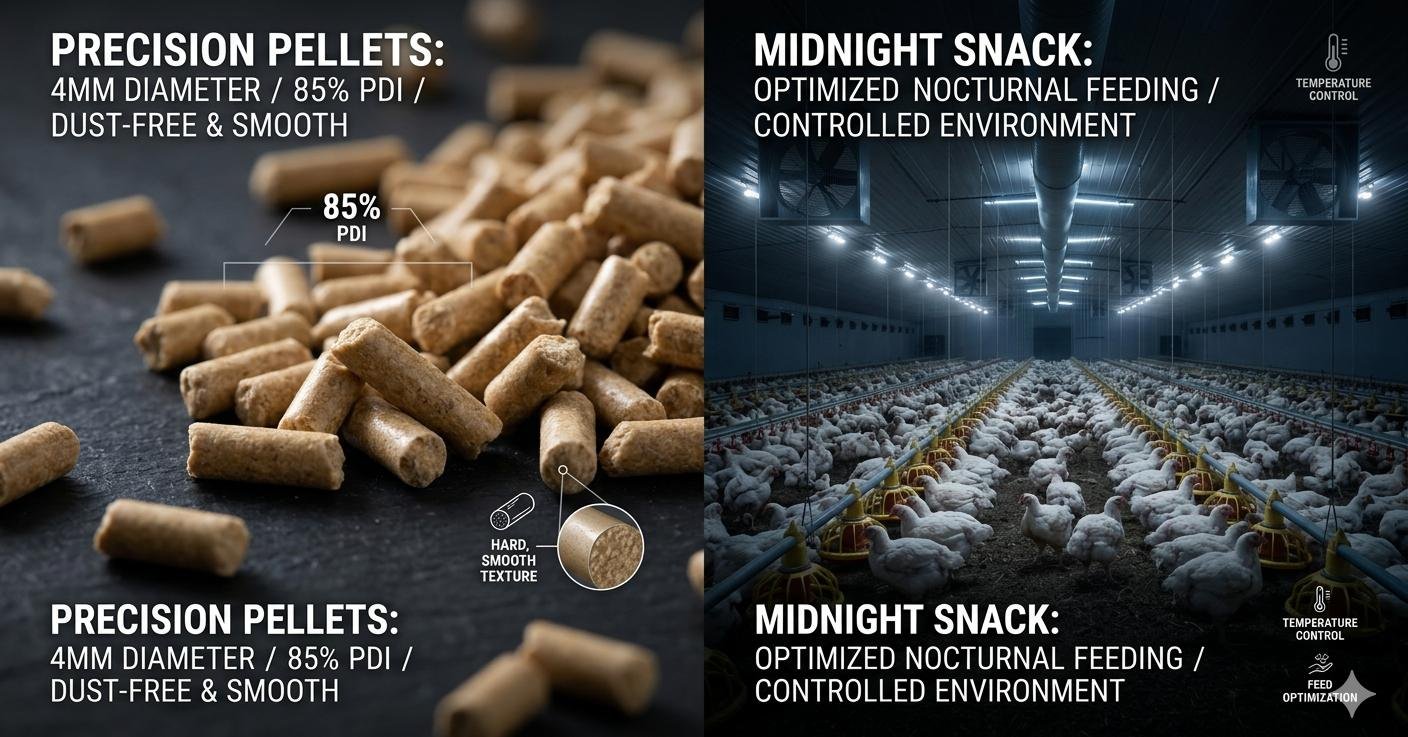
Transition to a 3.5–4.0mm diameter pellet for the finisher phase. The larger format reduces the number of individual pellets consumed per kilogram of feed intake, reduces eating energy expenditure, and — critically — reduces the fines fraction generated by pellet-to-pellet abrasion during handling. A 3.5mm finisher pellet at standard hardness (PDI above 85%) generates significantly fewer fines than an equivalent 2mm pellet under the same handling conditions, because each pellet has greater structural integrity.
Pellet hardness matters independently of diameter. A soft or poorly conditioned finisher pellet crumbles during transport, bin transfer, and auger movement, generating the dust fraction that birds reject and that ends up on the litter floor as a direct feed cost loss. Specify a minimum pellet durability index (PDI) of 85% in your feed supply agreement and test incoming deliveries. A hard pellet is not a specification preference — it is a feed efficiency variable with a direct FCR consequence.
The Oxygen First Rule — Ventilation for Yield
Why Breast Meat Requires Ventilation
Breast muscle protein synthesis is an aerobic process — it requires a continuous supply of oxygen delivered via the bloodstream to support the biochemical reactions of myofibril assembly. A bird in an understocked, well-ventilated house with 20 air changes per hour synthesises breast muscle at a rate limited only by its nutrition and genetics. A bird in a stuffy, oxygen-depleted, ammonia-contaminated house in week 6 synthesises breast muscle at a rate limited by cardiovascular oxygen delivery — and that rate is meaningfully lower than genetic potential.
The interaction between ventilation and breast yield is not theoretical. Processing plant data from farms that increased air exchange rates in the final 10 days of production consistently show improvements in breast meat percentage at processing of 0.3–0.8 percentage points — a figure that translates directly to premium payment in yield-based contracts. The ventilation investment that generates this improvement is a fan speed increase or run-time extension that adds minimal electricity cost relative to the yield revenue recovered.
The 20% Air Exchange Increase Protocol
In the final 10 days of production, increase your target air exchange rate by 20% above your standard week 5 setting. This accounts for the substantially increased metabolic heat output and CO₂ production of birds approaching slaughter weight — a flock of 10,000 birds at 2.5 kg average weight generates dramatically more heat and respiratory gas than the same flock at 1.0 kg average weight, and ventilation programmes set at placement and not adjusted through the cycle are chronically under-ventilating the finisher house.
Monitor CO₂ concentration at the bird level as a proxy for ventilation adequacy. Target below 3,000 ppm CO₂ in the finisher house. Above 3,500 ppm, oxygen partial pressure is meaningfully reduced and cardiovascular strain increases. Above 5,000 ppm, SDS and ascites risk escalate sharply. A calibrated CO₂ meter at bird level is a more reliable guide to finisher ventilation adequacy than fan settings alone, because it measures the actual atmospheric outcome rather than the theoretical airflow.
The Midnight Snack Lighting Protocol
The cardiovascular event most directly associated with SDS in the finisher phase is post-feeding cardiac stress — the period immediately following a large feed intake when gut blood flow increases sharply, cardiac output must increase to compensate, and the heart of a bird already operating near its capacity limit experiences its highest acute stress.
Birds on a standard 20-hour light programme in week 6 engage in two major feeding bouts: a large morning feeding response when lights come on, and a second large feeding bout in the afternoon. Both represent concentrated periods of high feed intake and high cardiovascular stress.
Introducing a 1-hour lighting period between 01:00 and 02:00 — the “midnight snack” — distributes daily feed intake across a third feeding bout, reducing the volume consumed in each individual bout and flattening the cardiovascular stress peaks associated with gorging. Farms implementing this protocol report SDS mortality reductions of 15–25% in the final week without any reduction in total daily feed intake or final body weight. The modification costs nothing beyond a timer adjustment.
The Yield vs. Mortality Matrix
| Finisher Energy Density | ME (kcal/kg) | Digestible Lysine | Projected Breast Yield | SDS/Ascites Risk | FCR | Otto’sFarms Assessment |
|---|---|---|---|---|---|---|
| Low density | 2,900 – 3,000 | Below 1.00% | 18% – 20% of live weight | Low | 1.75 – 1.90 | Unacceptable — yield loss exceeds mortality saving |
| Standard industry | 3,000 – 3,050 | 1.00% – 1.05% | 20% – 22% of live weight | Moderate | 1.60 – 1.70 | Average — acceptable performance, significant upside remaining |
| Balanced optimum | 3,100 – 3,150 | 1.05% – 1.15% | 22% – 24% of live weight | Low-moderate | 1.48 – 1.58 | Otto’sFarms Recommendation — maximum yield with managed cardiovascular risk |
| High-density aggressive | 3,200 – 3,300 | 1.15% – 1.25% | 24% – 26% of live weight | High | 1.42 – 1.50 | High risk — suitable only with tunnel ventilation, cool climate, and elite genetics |
The balanced optimum specification — 3,100–3,150 kcal ME with 1.05–1.15% digestible lysine, 3.5–4.0mm pellet, 85%+ PDI — is the formulation that delivers the highest net return per bird when both yield premium and mortality cost are accounted for simultaneously. The high-density aggressive specification produces better yield on paper but generates mortality losses and woody breast incidence that eliminate the theoretical margin advantage in most real-world production environments, particularly in open-sided tropical houses without supplementary cooling.
Don’t Kill Your Birds at the Finish Line
Every bird that dies in week 6 represents the accumulated feed cost, housing cost, and labor cost of six weeks of production — recovered at zero revenue. A bird that dies on Day 40 has consumed approximately $1.80–$2.20 in feed and generated nothing. At 2% SDS and ascites mortality in a 10,000-bird flock, that is 200 birds — $360–$440 in pure feed cost written off, plus the lost revenue of 200 dressed carcasses at market price.
The finisher phase is where genetics, nutrition, and management intersect at maximum intensity. The bird is at peak metabolic demand, peak cardiovascular strain, and peak feed cost simultaneously. Managing it correctly — with the right energy-to-protein balance, the right pellet specification, the right ventilation protocol, and the right lighting programme — is not a refinement available only to large integrated operations. It is a set of precise, implementable decisions available to any producer willing to manage the final 14 days with the same discipline applied to Day 1 brooding.
The race is not won in the last week. But it is very frequently lost there. Manage the finish line accordingly.