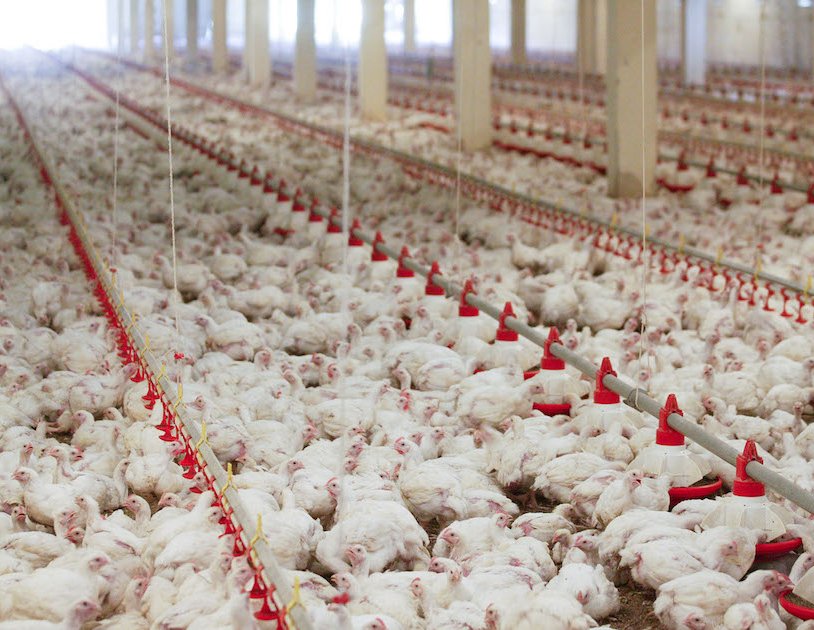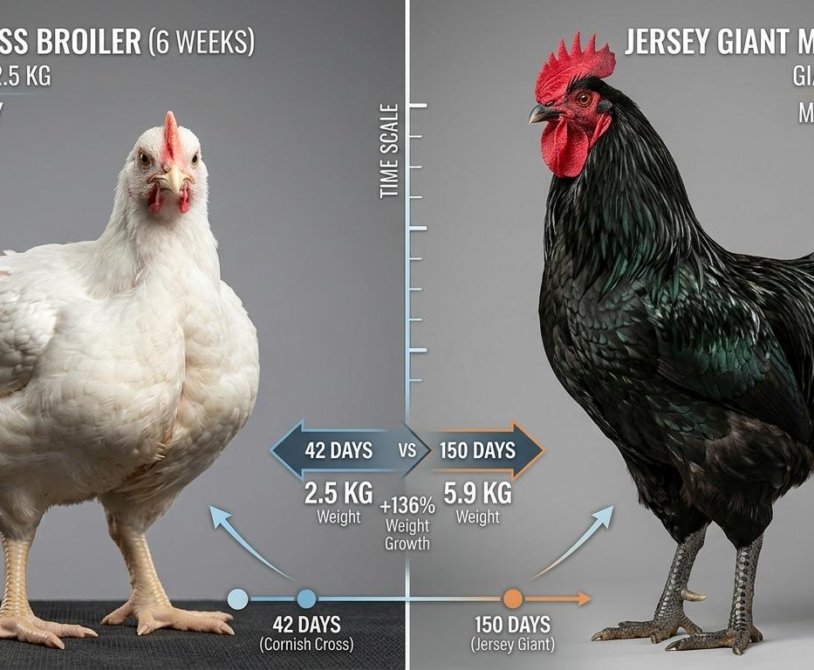
Here is why industrial birds fail on pasture. The Cobb 500 and Ross 308 were engineered for one environment: a climate-controlled, biosecure, high-density house where every variable is managed. Put those genetics on range, and you encounter a cascade of welfare failures that modern consumers — and their procurement officers — are increasingly unwilling to accept. Leg disorders emerge because the bird’s skeletal system cannot keep pace with its muscle development rate. Cardiac events increase because a heart engineered for sedentary indoor life cannot support the demands of walking, foraging, and environmental variation. Foraging drive is essentially absent — the bird sits by the feeder rather than ranging across the pasture.
The Better Chicken Commitment (BCC), now adopted by hundreds of major food service and retail brands globally, exists precisely to address these failures. It mandates slower-growing genetics, meaningful outdoor access, and verifiable welfare outcomes. The two breeds at the center of this transition are the Hubbard JA757 — the European high-welfare standard — and the Freedom Ranger — the American pasture-raised favorite.
The thesis of this article: Success on pasture is not achieved by simply opening a door and giving birds “outside access.” It is achieved by selecting genetics whose biology allows the bird to walk, forage, thermoregulate outdoors, and grow slowly enough to develop a skeletal system capable of supporting its own body weight for the full duration of a 56–81 day production cycle. Understanding the difference between these two breeds — and which fits your specific market — is the difference between a premium product and an expensive welfare failure.
Genetic Origins and Foraging Behavior
Hubbard JA757 — The Scientific Welfare Specialist
The Hubbard JA757 was developed by Hubbard Breeders in France specifically to meet the technical requirements of high-welfare and organic production systems. It is one of several slow-growth strains that appear on approved breed lists for BCC compliance, RSPCA Assured certification in the UK, and EU organic poultry standards.
Genetically, the JA757 is a deliberate balance between welfare performance and commercial viability. It achieves market weight at 56–63 days — significantly slower than the 35–42 days of industrial strains — which allows the skeletal system, cardiovascular system, and immune competence to develop at a rate the bird’s body can support. The result is a bird with very low leg disorder incidence, low ascites (water-belly) mortality, and consistent carcass conformation that meets the quality expectations of premium retail buyers.
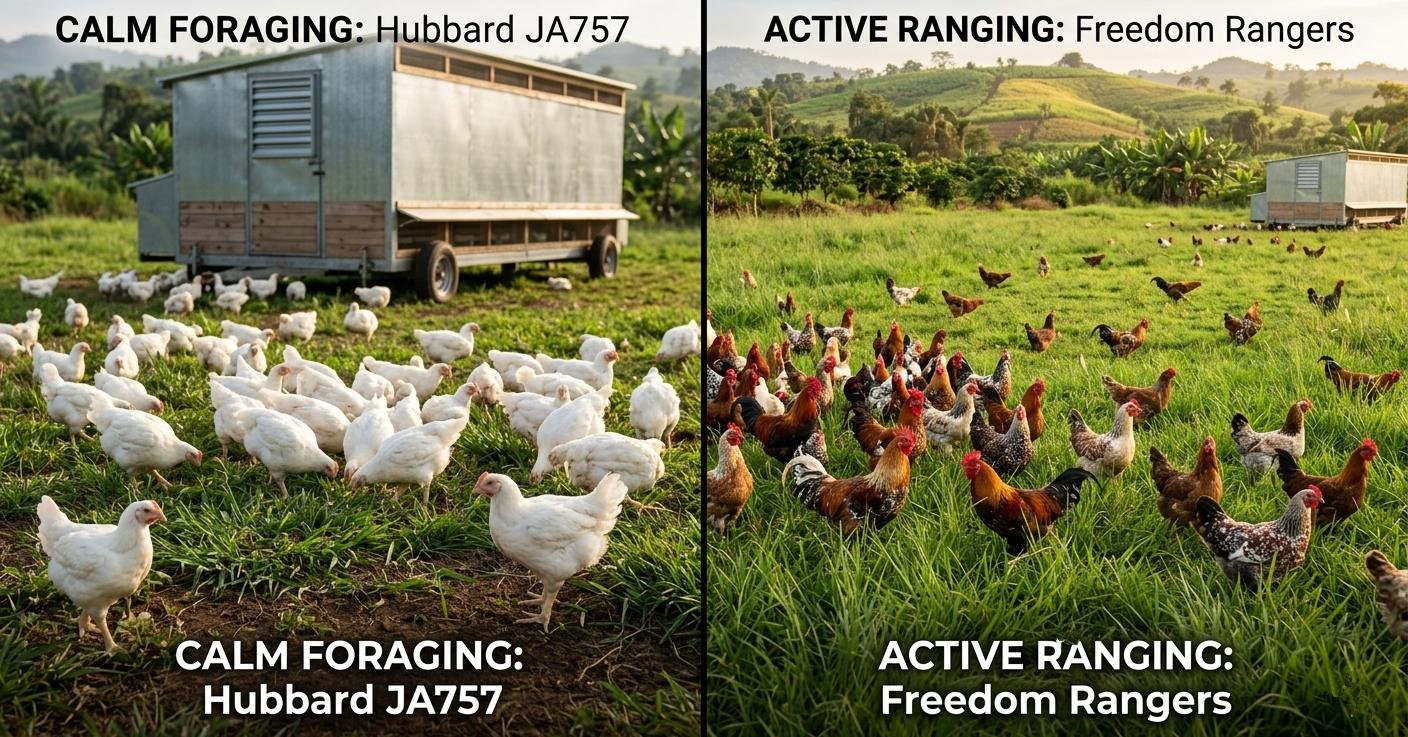
The JA757’s temperament is notably calmer than heritage or ranger-type breeds. It forages — meaningfully and measurably more than industrial strains — but it is not an aggressive or high-anxiety bird. For farmers supplying welfare-certified retail or food service contracts where consistency and certification documentation are the primary deliverables, this temperament is an asset, not a weakness.
Freedom Rangers — The Active Heritage Forager
The Freedom Ranger was introduced to the United States market in the mid-2000s, bred from French Label Rouge and heritage genetics developed under France’s rigorous Label Rouge quality certification program — a system that has been producing premium slow-growth chicken for over 60 years. The breed carries red-brown and multi-colored plumage derived from its heritage ancestry, and this is not merely aesthetic. The coloration provides meaningful camouflage against aerial predators in outdoor environments, a trait with real production implications that will be examined in the management section.
Freedom Rangers are genuinely active birds. Their foraging drive is substantially higher than the JA757 — they cover significantly more ground per day, actively seek insects, grass, and plant material, and exhibit strong flock cohesion behaviors that contribute to predator awareness. They reach market weight at 63–81 days, slightly slower than the JA757 in most production systems, though the range overlaps depending on management and feed quality.
For direct-to-consumer farmers — those selling at farmers markets, through farm stores, or via CSA meat boxes — the Freedom Ranger’s visual presentation, active behavior, and heritage story are marketing assets that the JA757’s more uniform, corporate-bred appearance cannot easily match. Customers watching chickens on pasture respond to colorful, active, visibly healthy birds. That emotional response converts directly into premium pricing and repeat sales.
Activity Levels — How Much Do They Actually Range?
Published welfare research consistently demonstrates that slow-growth breeds use outdoor range space at higher rates than fast-growth breeds. Between the JA757 and the Freedom Ranger, the Freedom Ranger typically shows higher range utilization — measured by the percentage of the flock observed outdoors at any given time during daylight hours and by the average distance traveled from the house entrance.
Studies from the UK and the Netherlands report that Freedom Ranger-type birds will regularly range 40–60 meters from the pop-hole entrance, while JA757-type birds range 20–40 meters on average. Both figures are dramatically better than fast-growth birds on range, which typically cluster within 5–10 meters of the house. In practical terms, this means Freedom Rangers graze a larger proportion of the available pasture, deposit manure more evenly across the range area, and consume a meaningfully higher proportion of their nutrition from forage — reducing purchased feed cost per bird when pasture quality is well managed.
Growth Performance and Feed Efficiency
The Slow-Growth Curve — Why 56–81 Days Is the Point, Not the Problem
The industrial poultry industry has spent 60 years reducing days-to-market as the primary efficiency metric. The pasture-raised premium market has inverted this logic entirely. The extra weeks on pasture are not inefficient — they are the product. They are what creates the intramuscular fat distribution, the skeletal integrity, the skin quality, and the flavor depth that justifies a $5–$10 per bird premium at the point of sale.
Understanding the growth curve also clarifies the feed economics. Slow-growth birds consume more total feed per bird because they are alive longer. But their daily feed intake is lower, their metabolic heat generation per unit of body weight is lower, and their mortality from cardiovascular and musculoskeletal causes is substantially lower. When you account for mortality savings and premium pricing, the economics of slow-growth production are more favorable than the raw feed cost figures suggest.
Pasture Performance Data — Side-by-Side
| Performance Metric | Hubbard JA757 | Freedom Ranger | Advantage |
|---|---|---|---|
| Days to 2.2 kg live weight | 56 – 63 days | 63 – 81 days | JA757 |
| Pasture FCR (including foraging energy) | 2.8 – 3.2 | 3.0 – 3.6 | JA757 |
| Livability on range | 96% – 98% | 94% – 97% | JA757 (marginal) |
| Range utilization (% flock outdoors) | 45% – 65% | 60% – 80% | Freedom Ranger |
| Foraging contribution to diet | 10% – 15% | 15% – 25% | Freedom Ranger |
| Predator awareness behavior | Moderate | High | Freedom Ranger |
| Carcass uniformity | Very high | Moderate | JA757 |
| BCC/welfare certification eligibility | Confirmed | Confirmed | Equal |
| Direct-to-consumer visual appeal | Standard | High | Freedom Ranger |
The JA757 wins on the metrics that matter for certified retail supply chains: faster turnover, better FCR, higher livability, and more uniform carcasses. The Freedom Ranger wins on the metrics that matter for direct sales: range behavior, foraging performance, predator intelligence, and visual storytelling. Neither is objectively superior. They are optimized for different markets.
Culinary and Market Quality: Flavor, Texture, and Skin
Intramuscular Fat and the Flavor Dividend
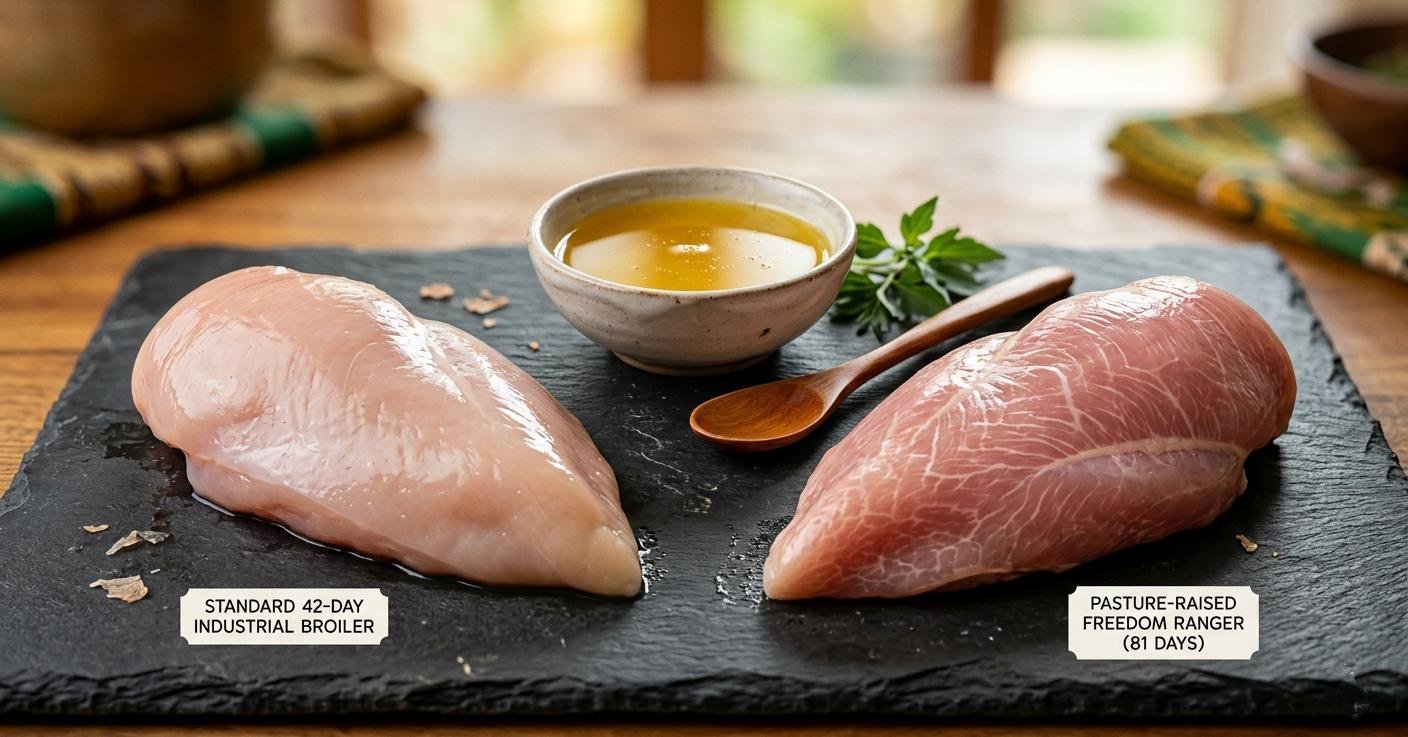
The most important quality difference between a slow-growth pasture bird and a 42-day industrial bird is invisible to the eye but immediately apparent on the palate: intramuscular fat distribution. In fast-growth birds, the muscle fibers develop so rapidly that fat deposition within the muscle tissue is minimal. The result is lean, uniform, mild-flavored meat that requires significant seasoning and preparation to deliver flavor.
In slow-growth birds, the extended production period allows fat to infiltrate the muscle tissue progressively. This intramuscular fat — similar in principle to the marbling sought in premium beef — is the primary driver of what chefs and consumers describe as “real chicken flavor.” It also improves moisture retention during cooking, meaning the bird is significantly more forgiving of roasting and grilling than an industrial bird of identical weight.
Freedom Rangers, with their higher activity level and longer production cycle, typically show slightly higher intramuscular fat than JA757s under equivalent management. For direct-to-consumer sales where a chef or home cook is the end buyer, this is a meaningful quality differentiator worth communicating explicitly in your marketing.
Skin Integrity and the Beta-Carotene Effect
Pasture-raised birds on well-managed grass and legume pastures develop visibly different skin compared to confinement-raised birds. The skin is thicker, more intact, and — critically — yellow to deep gold in color rather than the pale white of grain-fed indoor birds.
This yellow pigmentation is not a cosmetic trick or feed additive. It is the direct result of beta-carotene and xanthophylls accumulated from fresh green forage, deposited in the skin and fat tissue. It is a visible, honest signal of genuine outdoor access and is recognized by knowledgeable consumers as a quality marker. Freedom Rangers, with higher range utilization and greater forage consumption, typically develop deeper skin pigmentation than JA757s — another direct-to-consumer marketing advantage.
Managing the “Chew” Factor
A pasture-raised bird that has genuinely exercised its muscles for 63–81 days will have firmer, more textured meat than a 42-day industrial bird. This is not a defect. It is the product. However, it requires managing customer expectations — particularly for first-time buyers of slow-growth birds.
The key message to communicate at the point of sale is simple: this bird needs slightly longer cooking at slightly lower temperature than the industrial chicken your customer is accustomed to. A Freedom Ranger roasted at 170°C for 90 minutes will deliver significantly better results than the same bird treated like a supermarket chicken at 200°C for 60 minutes. Provide this guidance on your packaging, your market table, and your farm website. Customers who understand how to cook the bird become loyal repeat buyers. Customers who don’t and have a dry result do not return.
Management for Success
Mobile Housing — Match the Design to the Breed
The Freedom Ranger’s high activity level and wider ranging behavior have a direct implication for mobile house (chicken tractor) design. A house sized for 200 industrial broilers will feel cramped and restrictive to 200 Freedom Rangers, which spend a significantly larger proportion of their time moving and foraging rather than resting near the feeder.
For Freedom Rangers, size your mobile house for a minimum of 0.2 m² of indoor floor space per bird, with pop-hole access providing at minimum one opening per 30–40 birds. Move the house every 3–5 days d, depending on pasture recovery rate in your climate. A house that stays in one position too long creates bare, compacted, parasite-loaded ground — the primary welfare and health risk in outdoor poultry production.
The JA757’s calmer temperament and slightly lower range drive allow a slightly smaller indoor footprint — 0.15–0.18 m² per bird is workable — but the same pasture rotation discipline applies. In both cases, healthy pasture is not background scenery. It is a production input as important as your feed.
Predator Protection — Which Bird Is Smarter?
This is an area where the Freedom Ranger’s heritage genetics provide a measurable production advantage. Freedom Rangers exhibit significantly stronger predator awareness behaviors: they vocalize alarm calls, respond to aerial predator shapes, and seek cover more rapidly and consistently than JA757s. Their colored plumage provides genuine camouflage in grassland and light woodland environments against hawks and falcons.
This does not mean Freedom Rangers are invulnerable to predation — no unprotected outdoor bird is. Perimeter electric netting, overhead netting where aerial predation is severe, and secure overnight housing remain non-negotiable regardless of breed. But in a comparison of two breeds under equivalent protection infrastructure, Freedom Rangers will consistently show lower predation losses than JA757s, particularly from aerial predators during midday hours when birds are widely dispersed across the range.
Supplementary Feeding — You Cannot Raise These on Grass Alone
A common and costly mistake among first-time pasture poultry producers is under-feeding on the assumption that “the grass covers it.” Forage — even excellent, high-quality pasture — contributes 10–25% of a slow-growth bird’s dietary nutrition under good range conditions. The remaining 75–90% must come from a balanced, age-appropriate crumble or pellet.
Slow-growth birds at the finisher stage (from day 42 onward) require a ration with 18–20% crude protein, adequate methionine and lysine levels for muscle development, and sufficient energy density to support both growth and the thermoregulatory demands of outdoor life. Do not drop to a low-protein finisher on the assumption that grass protein bridges the gap. It does not, and the result will be poor feed conversion, extended days-to-market, and inconsistent carcass weights that create pricing problems at the point of sale.
Economics: Pricing the Pasture Premium
Real Cost of Production
Slow-growth pasture birds cost more to produce than commodity broilers across every input category. Days on feed are longer — 56–81 days versus 35–42 days for industrial birds. Feed conversion is higher — 2.8–3.6 versus 1.55–1.72 — in part because the bird expends energy walking, foraging, and thermoregulating. Labor per bird is higher because mobile house management, daily water and feed checks, and pasture rotation require significantly more human time than a static confinement house.
A realistic cost-of-production estimate for a well-managed slow-growth pasture bird in 2026, accounting for day-old chick cost, feed, labor, mortality, and housing depreciation, falls in the range of $8–$14 per bird,d depending on your scale, land costs, and local feed prices. This is the floor below which you cannot price without losing money.
Building the Retail Premium
The good news is that the retail premium available for verified pasture-raised slow-growth chicken in 2026 is real, growing, and defensible. Farmers selling BCC-compliant or welfare-certified birds through premium retail, food service, or direct-to-consumer channels routinely achieve $18–$28 per bird for a 1.8–2.5 kg dressed weight. The margin at that price point, while not effortless, is substantially better than commodity production at any scale accessible to a small or mid-size operation.
The labels and claims that drive this premium — in order of consumer recognition and price justification power in 2026 markets — are: Pasture-Raised (the highest premium), BCC-Compliant / Better Chicken Commitment, Welfare Certified (third-party verified), Slow-Growth Genetics, and Heritage Breed (particularly for Freedom Rangers with their French Label Rouge lineage).
Use these claims precisely and honestly. Do not use “free range” if your birds are genuinely pasture-raised — the distinction matters to your target buyer and the premium reflects it. Invest in third-party certification early; the cost is recovered within two or three production cycles at premium pricing.
Targeting the 2026 Premium Consumer
The consumer willing to pay $5–$10 more per bird in 2026 is not simply someone who “cares about animals,” though they do. They are a consumer who has been educated by a decade of food media, welfare journalism, and procurement transparency campaigns to understand what distinguishes a genuine pasture-raised product from welfare-washed marketing. They ask specific questions. They read labels carefully. They respond to farm stories, production photography, and honest explanations of why the bird costs what it costs.
Freedom Rangers, with their visually compelling plumage, heritage story, and observable foraging behavior, give direct-to-consumer farmers an enormous amount of authentic content to sell the story. JA757s, with their certification documentation, carcass consistency, and BCC compliance credentials, give retail and food service suppliers the paperwork and performance data that procurement teams require. Match your breed to your buyer, and the premium becomes defensible and repeatable.
The Winner Depends on Your Brand
There is no single correct answer to the Hubbard JA757 versus Freedom Ranger question. There is only the correct answer for your specific operation, your specific buyer, and your specific brand positioning.
Choose the Hubbard JA757 if your market is welfare-certified retail or food service supply chains where BCC compliance documentation, carcass uniformity, and production consistency are the primary deliverables. The JA757 will grow faster, convert feed more efficiently, and deliver the standardized product that institutional buyers require. Its welfare credentials are unimpeachable. Its story, however, is a corporate one — and that matters in direct sales environments.
Choose the Freedom Ranger if your market is direct-to-consumer: farmers’ markets, farm stores, CSA boxes, and premium local restaurants where the bird’s appearance, its visible behavior on pasture, and its heritage lineage are central to the product narrative. The Freedom Ranger’s colored plumage, active ranging, and French heritage genetics give you a story that sells itself. Its slightly higher feed cost and longer production cycle are offset by the premium pricing that story commands and the customer loyalty it builds.
The pasture-raised market is large enough, and growing fast enough, for both breeds to be profitable. The farmers who struggle are not those who chose the wrong breed — they are those who chose a breed without a market to match it, or raised a premium bird at commodity prices. Know your buyer, match your genetics, price honestly, and manage the pasture. The margins follow.