When managing a commercial poultry operation, your choice of breed is the single most important lever for profitability. In 2026, the landscape has shifted. We are no longer just looking at how fast a bird can grow; we are looking at Feed Conversion Ratios (FCR), market-specific meat yields, and the rising global demand for welfare-certified genetics.
At Otto’sFarms, we’ve analyzed the performance data of the world’s leading strains. Whether you are looking for the lightning-fast turnover of industrial giants or the premium margins of slow-growing heritage birds, this guide breaks down the numbers you need to know.
📊 The 2026 Broiler Performance Comparison Matrix
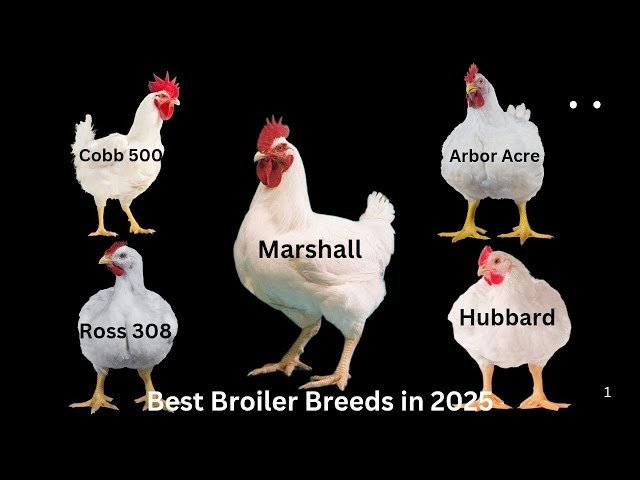
| Breed Category | Top Strain | Days to 2.5kg | Avg. FCR | Best For |
| Industrial Fast | Cobb 500 | 38–42 | 1.45 – 1.50 | Efficiency & Profit |
| Balanced Performer | Ross 308 | 40–44 | 1.55 – 1.60 | Adaptability/Health |
| Welfare Certified | Hubbard JA757 | 54–56 | 1.75 – 1.85 | Premium Retail |
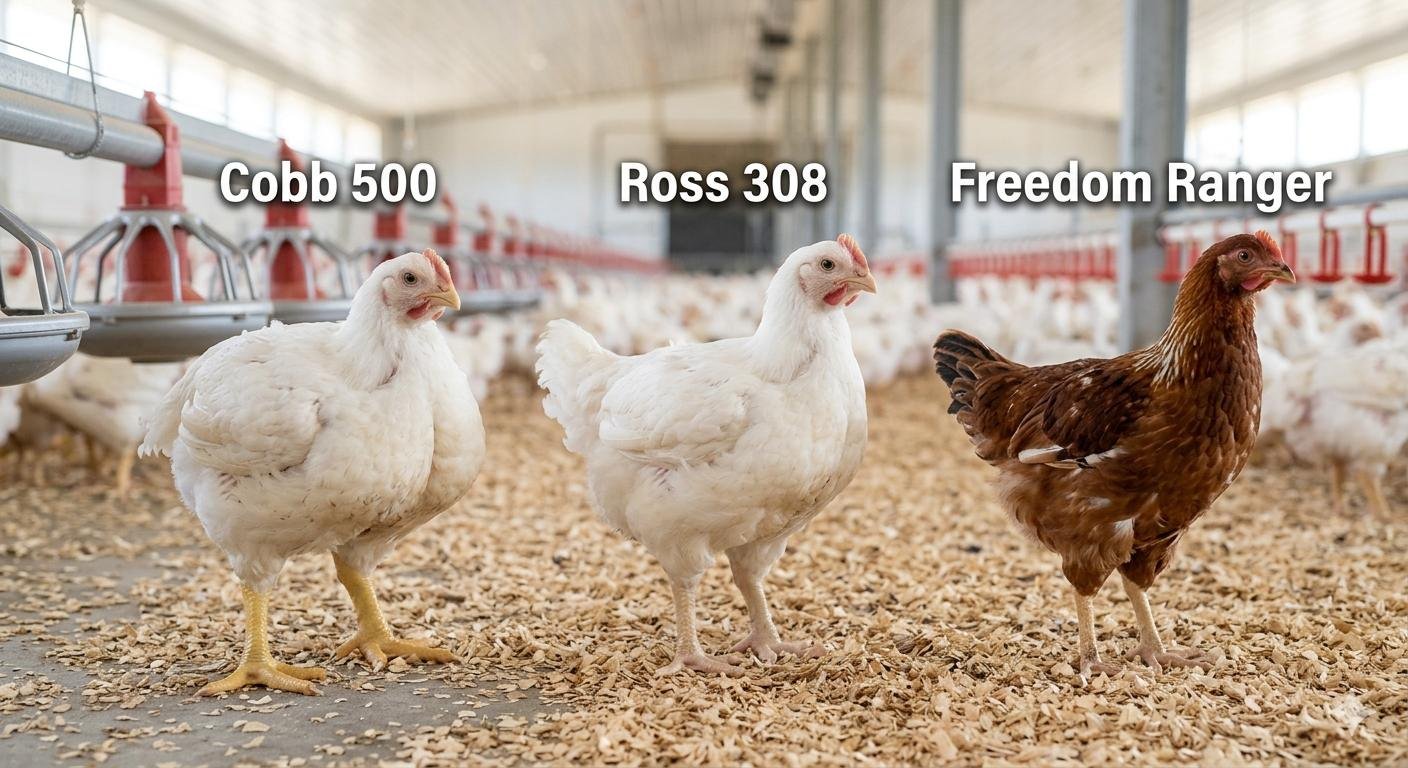
| Pasture Specialist | Freedom Ranger | 60–70 | 2.10 – 2.40 | Organic/Range |
| Heritage Giant | Jersey Giant | 160+ | 3.50+ | Niche Roasters |
1. The Industrial Titans: Cobb 500 vs. Ross 308
For the majority of commercial farmers, the choice comes down to these two. In 2026, the data shows a narrowing but distinct gap.
Cobb 500: The Efficiency King
The Cobb 500 remains the world’s most effective broiler for one reason: it converts feed into breast meat faster than any other bird.
-
The 2026 Edge: Recent trials show Cobb 500 maintains superior FCR even on lower-density, cost-saving diets.
-
CEO Insight: If your market demands white meat (fillets/nuggets), this is your breed. However, be prepared for strict environmental management; their rapid growth requires precision ventilation.
Ross 308: The Robust Workhorse
If your farm faces temperature fluctuations or you want higher “livability,” the Ross 308 is your best bet.
-
The 2026 Edge: Ross 308 has shown better late-stage compensatory growth and stronger leg health compared to extreme fast-growers.
-
Why choose it? It is more “forgiving.” If your house automation isn’t 100% perfect, the Ross will likely weather the storm better.
📊 Cobb 500 vs. Ross 308: A Technical Performance Showdown (2026 Data)
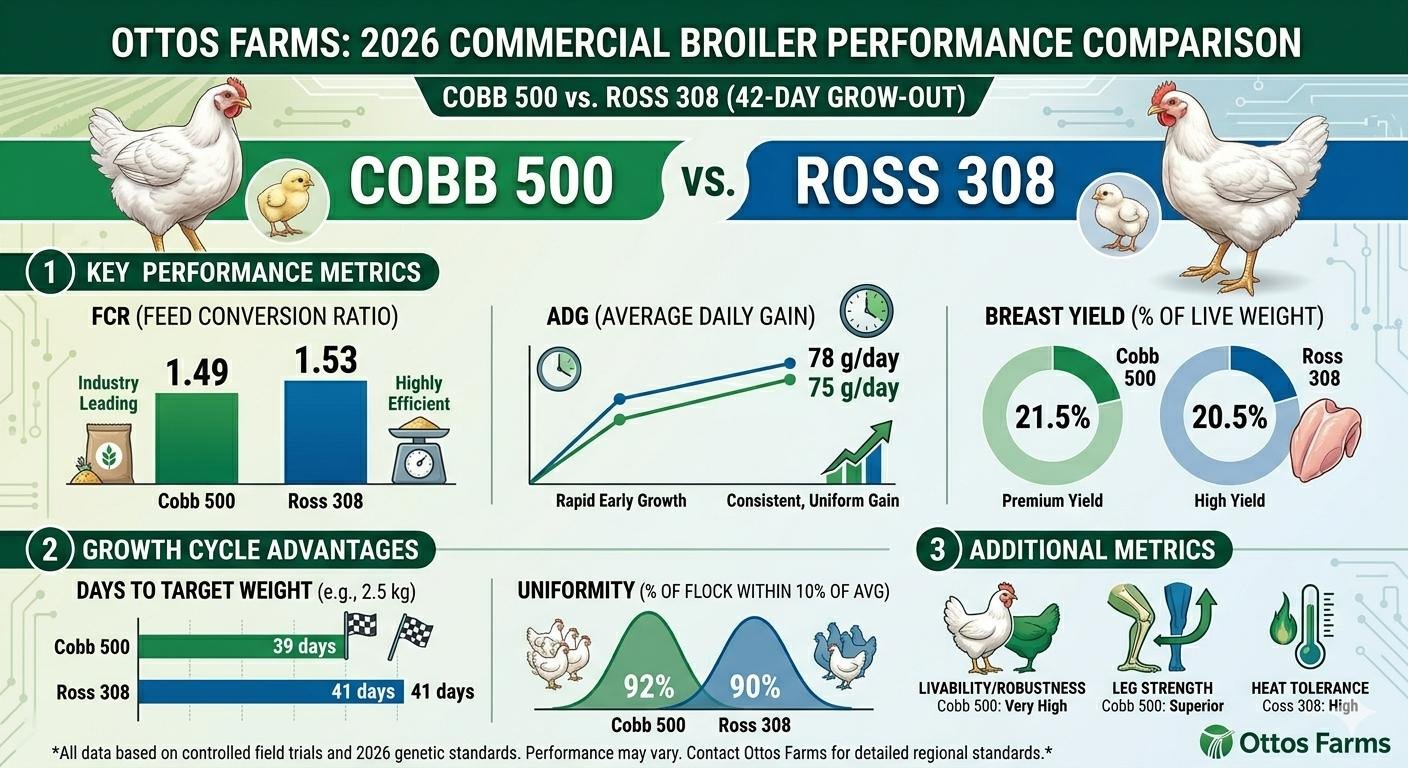
As a poultry CEO, you need more than just names. You need the metrics that determine your cost of production. This chart provides a direct, head-to-head comparison of key performance indicators (KPIs) for the two most dominant commercial broiler strains, optimized for a standard 42-day cycle.
| Key Performance Indicator (KPI) | Cobb 500 (Industrial Benchmark) | Ross 308 (Robust Performer) | The CEO’s Strategic Edge |
| Days to Market (2.5kg) | 38–42 Days | 40–44 Days | Cobb 500 is typically 2–4 days faster, saving on late-stage feed costs. |
| Feed Conversion Ratio (FCR) | 1.45–1.50 (Very High) | 1.55–1.60 (High) | A lower FCR means the Cobb 500 converts feed into body mass more efficiently. |
| Average Daily Gain (ADG) | 58–62 g/day | 56–60 g/day | Cobb has a slightly faster metabolism, accelerating daily weight gains. |
| Breast Meat Yield | 21–22% (Dominant) | 19–21% | Cobb is the clear leader for processing plants focused on breast fillets. |
| Total Meat Yield | 71–73% | 70–72% | Both birds have an incredibly high dressing percentage (carcass weight/live weight). |
| Chick Livability (0-42 Days) | 96.5–97.5% | 97.0–98.0% | Ross 308 consistently shows slightly higher robustness, meaning fewer losses from metabolic or leg issues. |
| Environmental Adaptability | Low to Moderate | Moderate to High | Ross 308 has better resilience to heat stress and ventilation fluctuations. |
| Skeletal & Leg Health | Good | Very Good | Aviagen (makers of Ross) has a long-term genetic focus on leg strength. |
| Feed Complexity Requirement | High (Needs high-density, precise nutrition) | Moderate (More forgiving to varied feed quality) | The Cobb’s rapid growth can be derailed by poor quality or inconsistent feed formulas. |
2. The “Slow-Growth” Revolution: Hubbard & Ranger Gold
As of 2026, major retailers following the Better Chicken Commitment have mandated a shift to slower-growing breeds.
-
Hubbard JA757 & Ranger Gold: These are the new standards for “high-welfare” poultry. They grow at roughly 30–45g per day, compared to the 55g+ of industrial birds.
-
Profit Strategy: While the FCR is higher, the market price for these birds is significantly higher. At Otto’sFarms, we see these as the “premium tier” for health-conscious urban markets.
3. Heritage & Dual-Purpose Breeds: The Gourmet Market
For farmers focusing on pasture-based systems, breed longevity, or historical flavor profiles, these heritage options are the gold standard.
Jersey Giant
Developed in New Jersey, this is the largest purebred chicken. While they take up to 6 months to reach full size, their sheer frame makes them an impressive roasting bird for niche “Slow Food” markets.
Bresse (La Bresse Gauloise)
Often called the “King of Chickens,” this French breed is famous for its blue legs and intense, marbled meat. It is the only chicken with its own AOC status. Marketing these can yield a 3x premium over standard broilers.
Delaware
A classic American breed and the “original” broiler before the Cornish Cross. They are excellent foragers and maintain high meat quality on a natural diet, making them perfect for organic labels.
4. CEO Strategy: How to Choose for Your Farm
Choosing a breed isn’t about which bird is “best” on paper—it’s about which bird is best for your setup.
-
Check Your Climate: If you are in a high-heat region without evaporative cooling, favor the Ross 308 or Hubbard Efficient Plus.
-
Analyze Your Feed Cost: If soybean prices are peaking, the FCR of the Cobb 500 will save your margins.
-
Know Your Buyer: Do they want cheap protein (Cobb/Ross) or “Ethical Meat” (Hubbard JA757/Ranger Gold)?
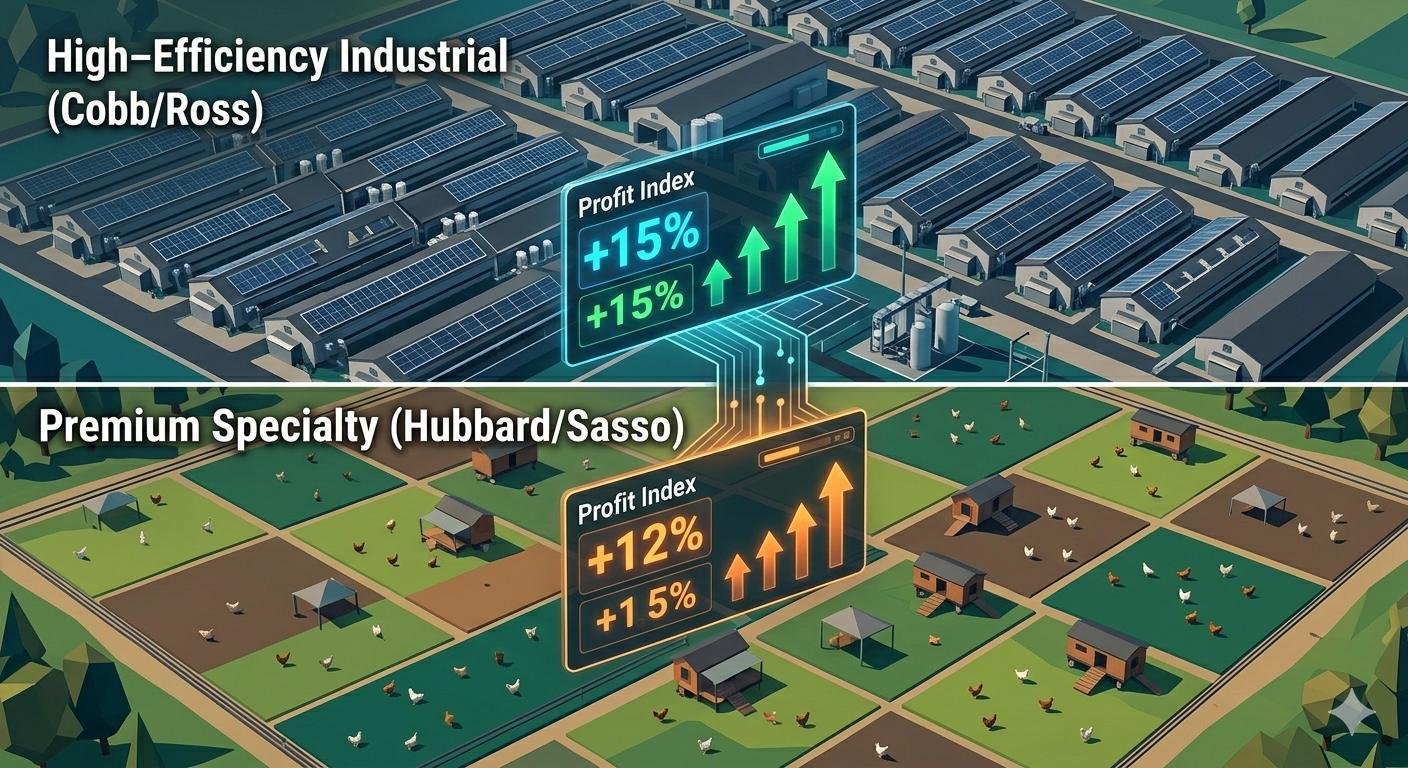
CEO Pro-Tip: Don’t put all your eggs in one basket. Many successful farms run a 70/30 split—70% high-efficiency fast-growers for stable income and 30% premium slow-growers to capture higher-margin niche sales.
5. The Science of Selection: Metabolism vs. Skeletal Strength
As a Digital Farmer, it’s not enough to know the names; you must understand the genetic trade-offs.
Fast-Growth Metabolism (Cobb 500 Strategy): The Cobb 500 is genetically selected for an incredibly aggressive appetite. Its metabolic rate is tuned to prioritize muscle deposition (specifically the pectoralis major) over almost everything else.
-
The Risk: This high metabolic heat means they are prone to “Ascites” (water belly) in poorly ventilated houses.
-
The Reward: You save significantly on “Maintenance Energy.” Because the bird reaches market weight 4 days faster than a Ross 308, you spend 4 fewer days burning feed just to keep the bird’s heart beating and body warm.
Skeletal Integrity (Ross 308 Strategy): Aviagen (the makers of Ross) has historically focused more on “Leg Strength and Livability.”
-
The Advantage: If you are in a tropical environment or have a high-density floor system, the Ross 308’s skeletal structure often holds up better under the rapid weight gain.
-
The Outcome: Lower mortality rates in the final week (Week 6), which is when death losses are most expensive because you’ve already invested 4kg of feed into that bird.
6. Phase Feeding: Tailoring Nutrition to the Breed
At Otto’sFarms, we have found that a “one-size-fits-all” feed program is the fastest way to lose money.
The Starter Phase (Days 1–10)
Regardless of breed, your Crude Protein (CP) should be at least 22–23%. However, for the Cobb 500, we recommend a “Pre-Starter” with higher digestibility to kickstart that aggressive metabolism immediately.
The Grower Phase (Days 11–25)
This is where the breeds diverge.
-
For Ross 308: Maintain a slightly lower energy density to allow the frame to catch up with the muscle.
-
For Cobb 500: Push the Metabolizable Energy (ME) to 3,100 kcal/kg to sustain the rapid growth.
The Finisher Phase (Day 26–Slaughter)
In 2026, feed costs are the highest they’ve ever been. We recommend using a “Withdrawal Feed” that reduces protein but maintains energy. This satisfies the bird’s appetite while protecting your margin.
Final Verdict: The CEO’s Selection
If you are building a new farm today in 2026:
-
Start with Ross 308 to stabilize your operations (it’s more resilient).
-
Once your automation is tuned, switch to Cobb 500 to squeeze out that extra 2% FCR.
-
Keep a small “Pilot House” for Freedom Rangers to capture the local premium market.
Frequently Asked Questions (FAQ)
Which broiler grows the fastest in 2026? The Cobb 500 remains the fastest-reaching market weight, often hitting 2.5kg in under 40 days in optimized conditions.
What is the best feed-to-meat ratio? Currently, a well-managed Cobb 500 flock can achieve an FCR as low as 1.42, meaning 1.42kg of feed produces 1kg of live weight.
Are slow-growing chickens more profitable? Yes, but only if you have a guaranteed buyer. The higher feed costs must be offset by a premium retail price.