There is a precise moment in pullet production when the nutritional program must change — not gradually, not eventually, but on a defined timeline tied to the bird’s reproductive biology. That moment is the grower-to-layer feed transition, and it is one of the most consequential and most frequently mishandled nutritional events in commercial layer production.
The grower ration that served the pullet well through weeks 7–16 contains 0.9–1.0% calcium. The laying ration she needs from week 19 onward contains 3.8–4.2% calcium. The difference is not a minor adjustment. It is a fourfold increase in the most metabolically active mineral in poultry nutrition — delivered to a digestive system that has never processed it at that concentration and a renal system that must suddenly regulate blood calcium at levels it has never encountered.
Done correctly, the transition is invisible in the production data. The flock moves into lay with stable shell quality, strong peak production, and no measurable feed intake disruption.
Done incorrectly — too fast, too slow, or at the wrong body weight — it produces a production dip that looks like a housing problem, a lighting failure, or a disease event. It is often all three of those things investigated and cleared before anyone looks at the feed program.
This article explains exactly how to execute the transition correctly: the timing, the calcium step-up protocol, the gut adaptation strategy, the common errors, and the production signals that tell you whether the transition is going as planned.
Why the Transition Is Biologically Difficult
The grower-to-layer transition is not simply a feed change. It is a simultaneous shift in three biological systems that must be coordinated to avoid production loss.
The Renal System
A pullet’s kidneys have been regulating blood calcium at grower-ration levels — approximately 10–11 mg/dL serum calcium in a non-laying bird — for 16 weeks. When dietary calcium quadruples at the transition to laying ration, blood calcium concentration rises as shell gland demand activates and medullary bone deposition accelerates. The kidneys must recalibrate rapidly to manage urinary calcium excretion without either losing excessive calcium (reducing shell quality) or retaining it in soft tissues (urolithiasis, visceral gout).
This recalibration takes time. A renal system exposed to the full calcium load of a laying ration before it has co-developed with the reproductive tract — specifically, before estrogen-stimulated calcium transport proteins are fully expressed — cannot manage the transition without physiological stress.
The Digestive System
The intestinal calcium absorption mechanism in a pre-lay pullet is calibrated for approximately 800–900 mg of dietary calcium per day. A full laying ration delivers 3,500–4,000 mg per bird per day. The absorptive machinery — calcium transport proteins in the duodenum and jejunum, calbindin-D28k expression, vitamin D₃ receptor density — must scale up to match the increased demand.
This upregulation is driven by calcitriol (active vitamin D₃) and estrogen signaling and takes 10–14 days to reach full capacity from a baseline calibrated for grower-level calcium. During that window, absorption efficiency is lower than it will be at full laying capacity. Dietary calcium provided during this period is partially wasted — excreted rather than absorbed — unless the transition is paced to match the biological upregulation rate.
The Feed Intake Adjustment
Calcium carbonate (limestone) — the primary calcium source in layer rations — is not neutral in terms of palatability. At concentrations above 3.0%, it affects feed texture, particle size distribution, and buffering capacity in the proventriculus in ways that measurably reduce voluntary feed intake in birds transitioning from a grower ration for the first time.
A pullet moving directly from grower ration to full laying ration on the day of house transfer typically shows a feed intake depression of 5–10% for the first 7–14 days. This depression is not a problem with the laying house, the lighting program, or the flock health status. It is the digestive system adjusting to a ration it has never encountered. The depression resolves, but the energy deficit during that resolution period suppresses early laying rate and peak production if it coincides with the onset of lay.
The Correct Transition Protocol: Three Stages
The solution to all three of these biological challenges is the same: pace the nutritional transition to match the bird’s capacity to absorb and regulate the new calcium level, rather than delivering the full change in a single step.
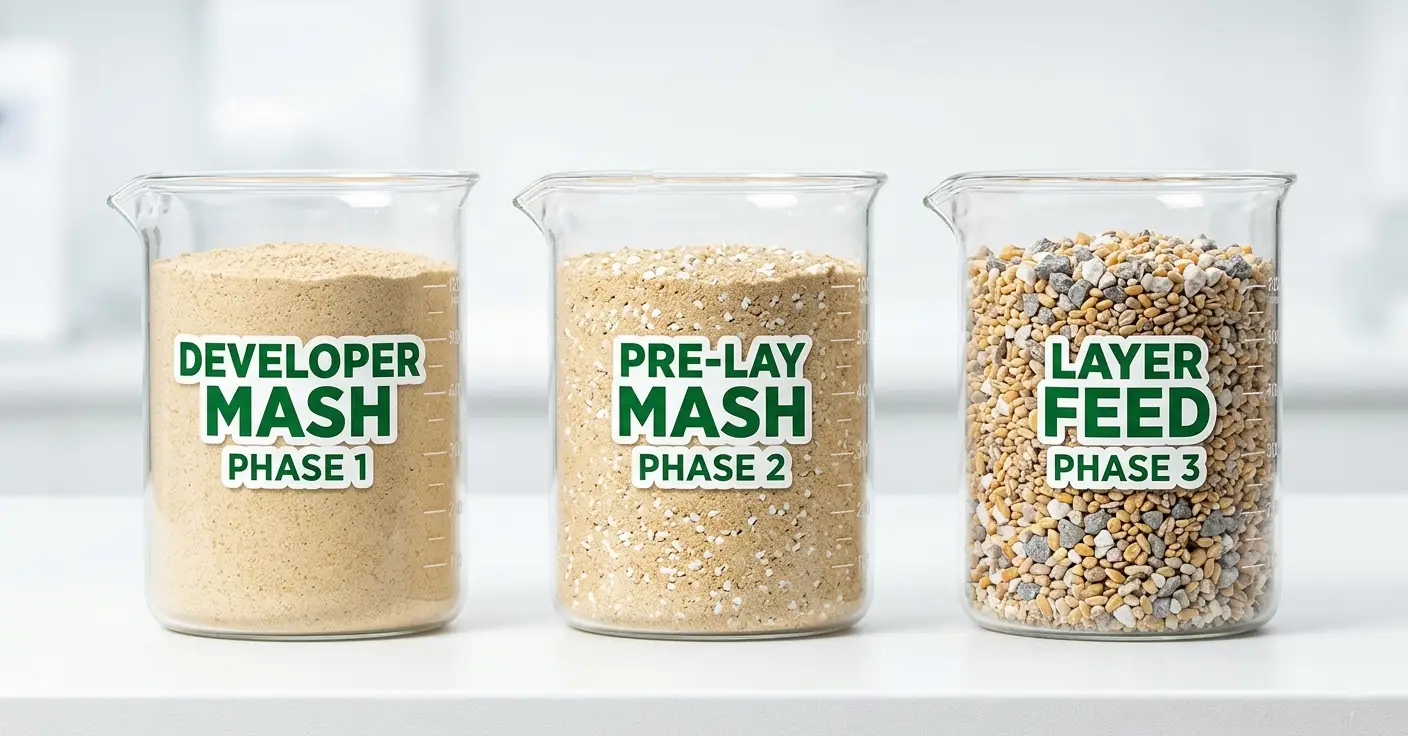
Stage 1 — Developer Ration (Week 13–16): Maintain Low Calcium
The developer ration holds dietary calcium at 0.9–1.0% — identical to the grower ration — while reducing protein to 14–15% to prevent premature stimulation of the reproductive axis. This is not the transition. This is the period of correct restraint before the transition begins.
The error made most frequently during this phase is premature calcium elevation. Farmers who believe that starting calcium supplementation at week 14 or 15 will “build up” the bird before lay are providing high calcium before medullary bone development has been triggered by estrogen. The result is renal calcium overload without productive benefit. The calcium is either excreted or deposited in non-productive soft tissue calcifications.
Hold 0.9–1.0% calcium through week 16. Do not increase it early.
Stage 2 — Pre-Lay Ration (Week 17–18): The Bridge
The pre-lay ration is the transition mechanism. It introduces dietary calcium at 2.0–2.5% — a doubling from developer levels but half the full laying ration concentration — during the precise biological window when medullary bone development is being triggered by rising estrogen.
This is the stage most frequently missing from commercial pullet programs in West and Central Africa, where feed procurement practices and feed supplier product ranges often reduce the feeding program to two rations (grower and layer) rather than the four that optimal production requires (starter, grower, developer, pre-lay, layer).
Why the pre-lay ratio is non-negotiable:
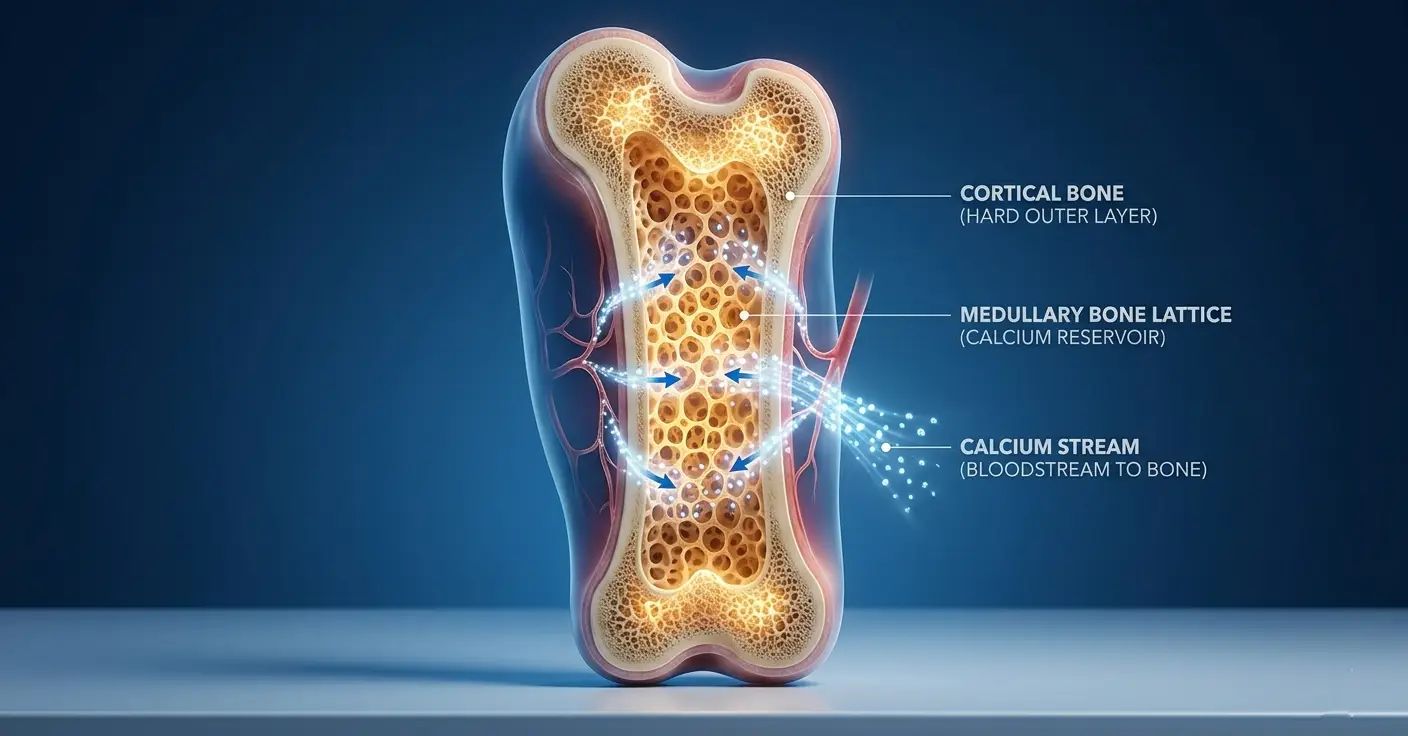
Medullary bone development begins 10–14 days before the first egg. The medullary cavity — the hollow interior of long bones — begins filling with rapidly mobilizable calcium reserve under estrogen stimulation. If dietary calcium is still at 0.9–1.0% when this process begins, the bird draws the calcium for initial medullary bone construction from cortical bone. She enters her laying cycle already in cortical calcium deficit. Her first shells are thin. Her early peak production is compressed. The production curve never fully recovers because the cortical deficit created in the pre-lay window cannot be rebuilt while the bird is simultaneously producing 5–6 eggs per week.
The pre-lay ration at 2.0–2.5% calcium provides dietary calcium at the moment medullary bone development begins, preserving cortical bone integrity while building the medullary reserve. This single intervention — adding an appropriately formulated pre-lay ration for two weeks before transfer — measurably improves shell quality in the first four weeks of lay and first-cycle persistency.
Pre-lay ration specification:
| Nutrient | Target |
|---|---|
| Calcium | 2.0–2.5% |
| Available Phosphorus | 0.40–0.42% |
| Crude Protein | 17–18% |
| Metabolizable Energy | 2,800–2,900 kcal/kg |
| Vitamin D₃ | 3,000–3,500 IU/kg |
| Lysine | 0.85–0.90% |
| Methionine + Cystine | 0.70–0.75% |
Introduce the pre-lay ration when the flock reaches 5% production — or at week 17, whichever comes first. Do not wait for 50% production to switch. By 50% production, half the flock has already been laying on developer-level calcium.
Stage 3 — Layer Ration Introduction (Week 19 Onward): The Full Transition
By the time the layer ration is introduced — at or just after housing transfer, when 5–10% of the flock has begun laying — the digestive and renal systems have had two weeks of exposure to elevated calcium and have begun the biological upregulation process. The jump from 2.0–2.5% calcium (pre-lay) to 3.8–4.2% calcium (layer) is proportionally smaller than the jump from 0.9% to 3.8% would have been, and the biological machinery to handle it is partly in place.
The layer ratio transition should still be executed progressively if possible:
Days 1–3 of layer ration: Mix 50% pre-lay ration with 50% layer ration. This maintains continuity in ration texture, energy density, and feed palatability while stepping calcium to approximately 3.0%.
Days 4–7: Move to 25% pre-lay ration and 75% layer ration. Calcium at approximately 3.4%.
Day 8 onward: Full layer ration at 3.8–4.2% calcium.
In operations where feed mixing is impractical — single-bin systems, small-scale operations, or situations where pre-lay ration is not available — the transition can be made in a single step from pre-lay to layer if the pre-lay ration has been correctly fed for the two weeks prior. The abrupt single-step transition that causes production disruption is the transition from grower ration (0.9%) directly to layer ration (3.8–4.2%) — which bypasses the pre-lay bridge entirely.
Housing Transfer and Feed Transition: Coordinating Two Stressors
Feed transition and housing transfer — moving the flock from the rearing house to the laying house — frequently coincide. This is a problem when both events happen simultaneously, because the bird is asked to adapt to a new environment and a new ration at the same moment. The cumulative stress response suppresses feed intake more severely than either stressor alone.
The practical recommendation: Feed the new layer ration in the rearing house for 5–7 days before transfer, if possible. Birds are already adapted to the ration when they enter the new house, arrive with one stressor already resolved. Feed intake returns to normal faster. Lay onset is more uniform. The production curve during the first four weeks of lay is stronger.
Where this is not operationally possible — because rearing and laying houses are managed on separate sites or because rearing house turnover does not allow a 5–7 day overlap — prioritize minimizing transfer stress: move birds during the coolest part of the day, avoid overcrowding transport crates, ensure the laying house is pre-warmed to 22–24°C, and have feed and water immediately accessible in every cage or pen before the first bird enters.
The Stress Response and Its Nutritional Consequences
Transport and housing transfer activities activate the hypothalamic-pituitary-adrenal (HPA) axis, elevating corticosterone — the primary glucocorticoid in poultry — within minutes of handling. Sustained corticosterone elevation suppresses luteinizing hormone (LH) secretion, which directly inhibits the ovulatory cycle.
A flock that is severely stressed during transfer may show a 3–5 day delay in lay onset or a production dip of 10–15% in the first week, which has nothing to do with the lighting program or the ration. The HPA activation resolves on its own within 24–72 hours if no further stressors are added, but adding a simultaneous ration change to that stress load extends the recovery period significantly.
Managing transfer stress is part of managing the feed transition. They are the same production problem viewed from two angles.
Electrolytes and Vitamin C: Supplementation During Transition
Two short-term supplementation strategies support the flock during the transition period and measurably reduce the production dip associated with combined transfer and feed change stress.
Oral Electrolytes
Adding oral electrolytes (sodium, potassium, chloride, bicarbonate) to drinking water for 3–5 days around transfer supports blood osmolarity regulation during the period when feed intake is suppressed, and water intake is the primary nutrient delivery route. Electrolyte supplementation does not eliminate transition stress but reduces its metabolic duration.
Standard protocol: 1–2 g electrolyte powder per liter of drinking water for 3 days before transfer, day of transfer, and 2 days after.
Remove electrolyte supplementation before any vaccine is administered through water — electrolyte solutions alter water pH in ways that can reduce vaccine stability.
Vitamin C (Ascorbic Acid)
Poultry synthesize their own vitamin C under normal conditions. Under stress — heat, transport, social disruption, ration change — endogenous vitamin C synthesis is insufficient to meet demand. Supplemental ascorbic acid at 100–200 mg per liter of drinking water during the transition period reduces corticosterone-mediated immune suppression and maintains feed intake at higher levels than in unsupplemented flocks during equivalent stress events.
Vitamin C is heat-labile. Add it to cool or room-temperature water — not warm water or water mixed with minerals that accelerate degradation. Prepare fresh solutions daily.
Reading the Production Data: Signs the Transition Is or Is Not Working
The grower-to-layer transition is invisible when it goes correctly. The flock enters lay on schedule, peak production climbs steadily, and shell quality is consistent from the first eggs. When the transition is mismanaged, the production data signals it — but only if you know what to look for.
Signs of a Successful Transition
- Lay onset within the breed-standard window (typically first eggs appearing at week 17–18, 50% production reached by week 20–21)
- Shell quality acceptable from first eggs — no excessive thin-shelled or soft-shelled eggs in the first two weeks
- Feed intake recovering to the breed standard within 7–10 days of housing transfer.
- Flock uniformity at first egg above 75% — birds entering lay within a 2–3 week window rather than trickling in over 6–8 weeks.
Signs of Transition Failure
Production dip in weeks 1–4 of lay: If the flock reaches 70% production and then drops to 55–60% before recovering, the transition or the pre-lay period was mismanaged. A true production peak followed by a dip in the first four weeks of lay is almost always nutritional — specifically, a calcium supply failure during medullary bone development or early shell calcification.
High proportion of soft-shelled or thin-shelled eggs in the first two weeks: The shell gland is working, but the calcium supply is inadequate. Either the pre-lay ration was not provided, the transition was too abrupt, or vitamin D₃ levels were insufficient to support absorption at early lay rates.
Prolonged lay onset spread: If 20% of the flock lays its first egg at week 17 and the final 20% does not lay until week 24, the problem is poor uniformity at transfer compounded by a ration transition that did not support the late-maturing birds through their pre-lay calcium window. Both the uniformity program and the feed transition protocol need review.
Persistent feed intake below breed standard in the first 3 weeks: If feed intake is more than 10% below breed standard for more than two weeks after housing transfer, the ration palatability or the combined stress load is suppressing intake beyond the normal adaptation period. Review ration composition (limestone particle size, salt inclusion, energy density), water quality, and transfer management.
Layer Ration Specifications: What the Full Ration Must Deliver
Once the transition is complete and the flock is on full layer ration, the ration must be formulated to support simultaneous maintenance, egg production, and medullary bone replenishment.
Full layer ration targets:
| Nutrient | Target Range |
|---|---|
| Calcium | 3.8–4.2% |
| Available Phosphorus | 0.35–0.40% |
| Crude Protein | 16–17% |
| Metabolizable Energy | 2,750–2,850 kcal/kg |
| Lysine | 0.85–0.90% |
| Methionine + Cystine | 0.72–0.78% |
| Sodium | 0.16–0.18% |
| Vitamin D₃ | 3,000–4,000 IU/kg |
| Vitamin E | 10–20 IU/kg |
| Linoleic Acid | 1.0–1.2% (minimum) |
Calcium source in the layer ratio: A 50:50 blend of fine limestone (particle size < 0.5 mm) and coarse limestone (particle size 2–4 mm) improves shell quality by releasing calcium over the full 16-hour shell calcification period. Fine limestone provides rapid peak-time calcium. Coarse limestone releases slowly through the gizzard overnight, sustaining blood calcium during the 8-hour dark period when the shell gland is most active, and no feed is being consumed.
Operations formulating their own rations from local ingredients — maize, soybean meal, fishmeal, limestone, DCP — should have the ration laboratory-analyzed for crude protein, calcium, and phosphorus at a minimum before feeding. Maize calcium content varies significantly by source and season. Assuming standard book values without verification is a common source of undiagnosed calcium deficiency in small and medium commercial operations.
Adjusting the Ration for Tropical Heat
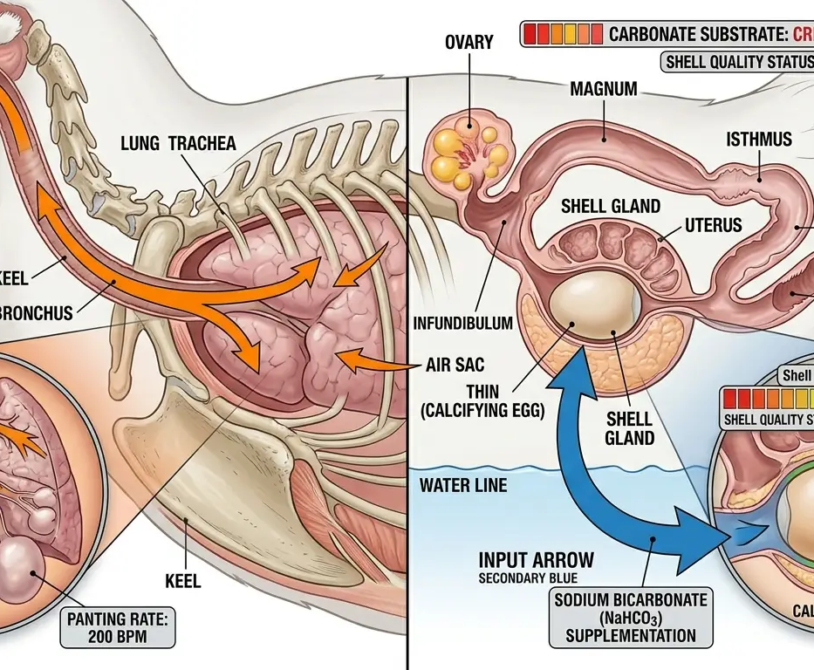
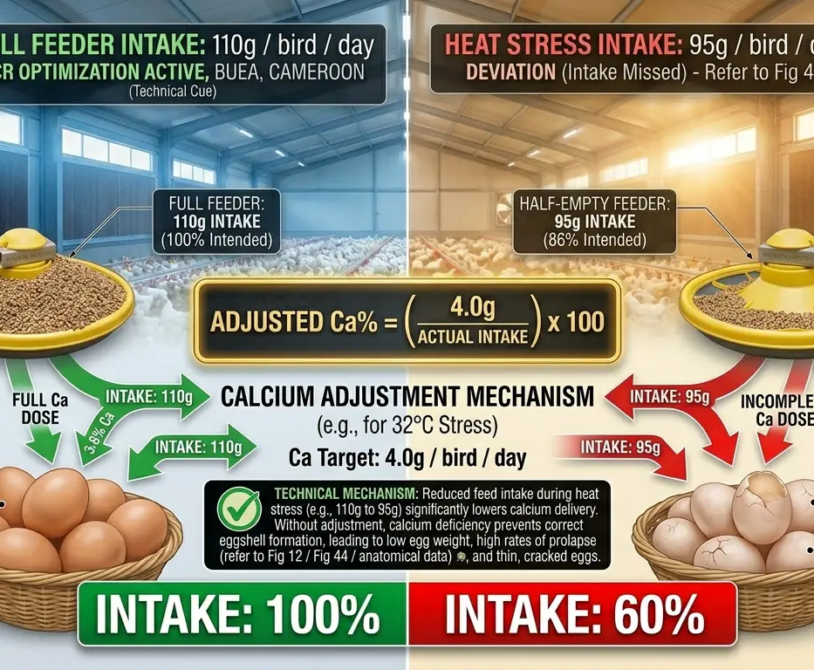
In tropical West Africa, feed intake declines as ambient temperature rises — approximately 1.5% per degree Celsius above 22°C. A flock at 30°C ambient temperature may eat 8–12% less feed than breed standards specify. At reduced feed intake, calcium and energy intake both fall below requirements even when the ration is correctly formulated.
Compensating for heat-reduced feed intake:
- Increase calcium concentration in the ration by 0.2–0.3 percentage points above the standard target for every 5°C above 22°C sustained ambient temperature. This maintains calcium intake per bird even as total feed volume consumed falls.
- Increase energy density by adding 1–2% fat or rice bran oil to the ration rather than increasing feed volume — heat-stressed birds will not eat more volume but will consume energy-dense rations.
- Feed during the coolest part of the day (early morning before 08:00 and late afternoon after 16:00) to capitalize on the natural feeding behavior increase that occurs when temperatures fall.
- Ensure water availability is unrestricted — dehydrated birds eat less regardless of feed quality or palatability.
Common Errors That Cause Feed Transition Failures
Skipping the pre-lay ration entirely. The most damaging single error. Moving directly from the developer/grower ratio to the full layer ratio at transfer produces the maximum calcium shock to the renal and digestive systems simultaneously with maximum housing transfer stress.
Starting the pre-lay ration too late. Beginning pre-lay calcium at the first observed egg instead of at week 17 means the pre-lay ration was absent during the entire medullary bone construction window. First-cycle shell quality and persistency will reflect this.
Providing the pre-lay ration for only a few days. Two weeks of pre-lay ration is the minimum for meaningful medullary bone development. Five days is not two weeks.
Using the same ratio for all production phases to reduce procurement complexity. A single all-purpose ration fed from week 7 through the end of lay does not meet the bird’s changing nutritional requirements at any phase. The calcium level that is safe for a 10-week pullet is inadequate for a laying hen. The calcium level adequate for a laying hen is nephrotoxic for a 10-week pullet.
Changing ration and changing houses on the same day. Two independent stressors that double each other’s impact on feed intake depression and lay onset disruption. If only one can be staged, stage the feed transition first.
Not testing water quality when feed intake depression is diagnosed. A ration that is correctly formulated and correctly introduced still fails to deliver its nutrients if water intake is suppressed by bacterial contamination, high mineral content, or incorrect drinker pressure. Investigate the water supply alongside the feed program whenever unexplained intake depression occurs.
Summary
The grower-to-layer feed transition is a four-phase nutritional event, not a single feed change. The developer ration holds correct calcium through week 16. Pre-lay ration bridges the medullary bone development window at weeks 17–18. Progressive layer ratio introduction paces the gut and renal adaptation to full calcium load. Full layer ration sustains shell quality and production rate from week 19 through the end of the cycle.
The pre-lay ration is the single most impactful intervention in this sequence. It costs two additional weeks of a separate feed formulation and prevents the cortical calcium deficit, shell quality failure, and compressed early peak that define the production dip every farmer who has skipped it has seen — and most have attributed to something else.
A flock that transitions correctly enters its laying cycle with intact structural bone, a built medullary calcium reserve, a digestive system calibrated for the calcium load it will carry for the next 52 weeks, and a production curve positioned to reach its genetic ceiling.
That is the outcome a correctly executed feed transition produces. Every time.