In the world of high-density egg production, we often focus exclusively on the “inputs” (feed) and “outputs” (eggs). However, as a software engineer, I know that the “environment” in which a process runs determines its long-term stability. For a layer hen, providing Perches is not a luxury—it is a critical piece of behavioral infrastructure that upgrades the bird’s physical “hardware.”
By understanding the biological drive of chickens to seek high ground, we can engineer a house that improves bird welfare, reduces stress-related aggression, and significantly increases bone strength.
The Biological Logic of Perching
Chickens are descendants of jungle fowl that roosted in trees to escape ground predators. This “legacy code” remains in modern layers. When a hen is forced to stay on the floor 24/7, her stress levels remain high, and her physical development is stunted.
Developing Skeletal Integrity
Layers are “calcium-processing machines.” To produce 300+ eggs a year, they draw massive amounts of calcium from their bones.
-
The Benefit: Jumping up to and down from perches acts as resistance training. It increases the mineral density of the keel bone and legs.
-
The ROI: Stronger bones mean fewer “spent hen” fractures and a longer productive life for the flock.
Social Hierarchy and Stress Reduction
In a deep litter system, a flat floor creates a “high-latency” social environment where dominant birds constantly bully subordinates.
-
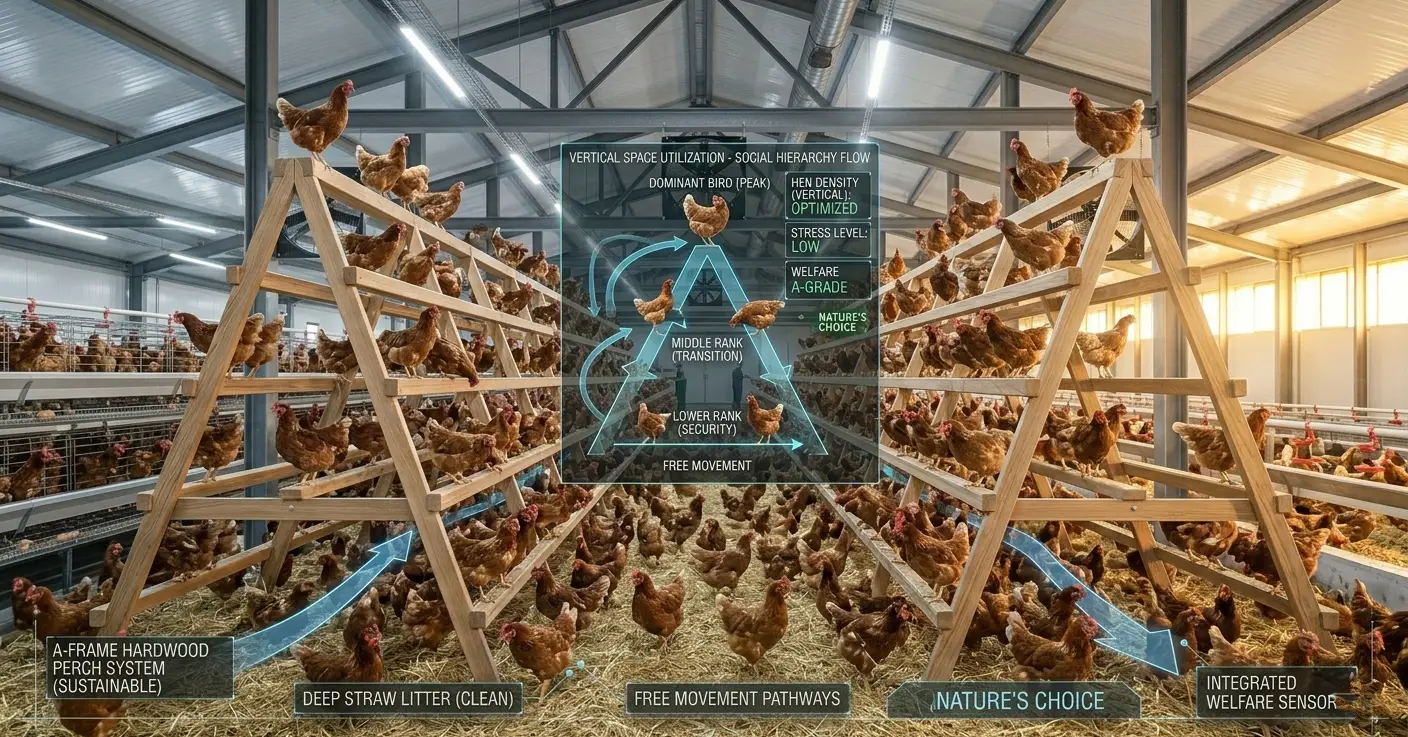
Vertical Space: Perches allow less dominant birds to move vertically to escape aggression.
-
System Stability: By utilizing the vertical volume of the house, you effectively increase the “bandwidth” of the space, leading to a calmer, more uniform flock.
Engineering the Ideal Perch: Dimensions and Spacing
A poorly designed perch can cause more harm than good, leading to footpad dermatitis or keel bone deformities. Precision in the “build” is essential.
Material Selection
-
Wood vs. Plastic: Hardwood is the superior material. It provides a natural grip and is less slippery than plastic or metal.
-
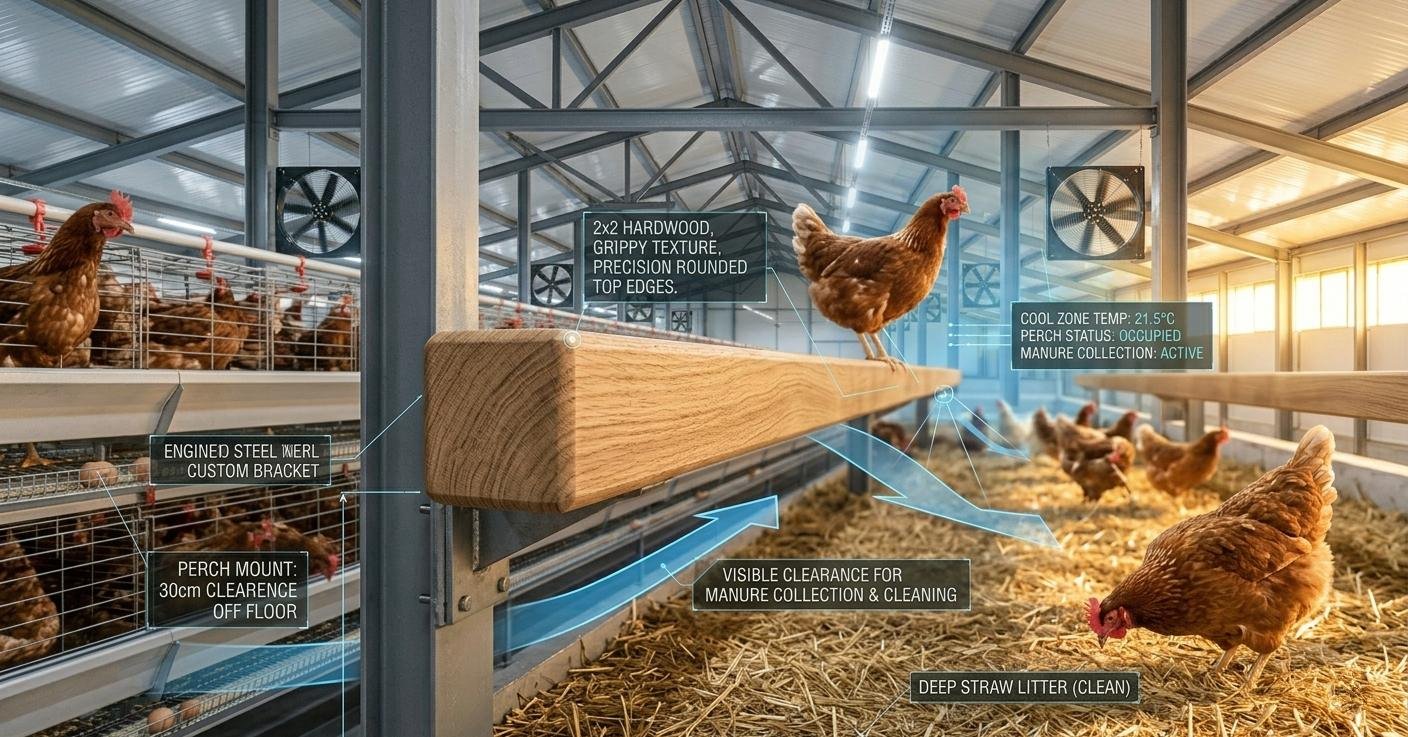
Shape: Never use round pipes. A bird’s foot is designed to grip a flat or slightly rounded rectangular surface. Use 2×2 inch (5×5 cm) timber with the top edges rounded off. This ensures the bird’s weight is distributed across the ball of the foot, not just the toes.
Height and Tier Logic
-
The Starting Height: The lowest perch should be at least 30 cm (12 inches) off the floor to allow birds to walk underneath without getting “pooped on” by those above.
-
The Multi-Tier Approach: In high-ceiling houses, use an A-frame or “stepped” design. This allows birds of different social ranks to find their own level.
-
Clearance: Ensure there is at least 25 cm of head clearance between the perch and the roof or the next tier to prevent head injuries.
Spacing Requirements
-
Perch Length: Budget 15 cm to 20 cm (6–8 inches) of linear perch space per hen.
-
Horizontal Gap: If placing perches parallel to each other, leave 30 cm to 35 cm between the bars. This prevents birds on the lower bars from being soiled by those above and allows enough “take-off” and “landing” room.
Placement and Integration with House Layout
The placement of your perches must not interfere with the primary “data pipelines” of the farm—feeding and egg collection.
Strategic Positioning
-
Away from Feeders: Do not place perches directly over feed troughs or water lines. Droppings will contaminate the inputs, leading to disease outbreaks.
-
The “Cool Zone”: Place perches in the best-ventilated areas of the house. Since birds huddle together while roosting, they generate significant heat.
-
Night-Time Logic: Perches are primarily used for sleeping. Ensure they are not blocking the path to the nest boxes, as hens need a clear “route” to lay their eggs early in the morning.
Welfare is Efficiency
From a business perspective, perches are a low-cost infrastructure upgrade with a high biological payout. While they require a small initial investment in timber and labor, the reduction in flock mortality and the improvement in bird health directly impact your bottom line.
At Otto’s Farms, we view bird welfare not just as an ethical choice, but as a technical requirement for a high-performing agribusiness. A hen that can fly, perch, and rest securely is a hen that will reward you with consistent, high-quality egg production.