In a large-scale poultry operation, labor and feed represent the two highest operating expenses. As a CEO, I view feeding and watering systems as the “data pipelines” of the farm. If these pipelines are inefficient, you lose “packets” (feed wastage) and experience “latency” (uneven bird growth).
For a software engineer-turned-farmer, the choice between manual and automated systems is a balance between Initial Capital Investment (CAPEX) and Long-term Operational Efficiency (OPEX).
Watering Systems: The Lifeblood of the Flock
Water is the most critical nutrient for a layer; a 10% reduction in water intake can lead to a 50% drop in egg production.
Bell Drinkers (Manual/Semi-Automated)
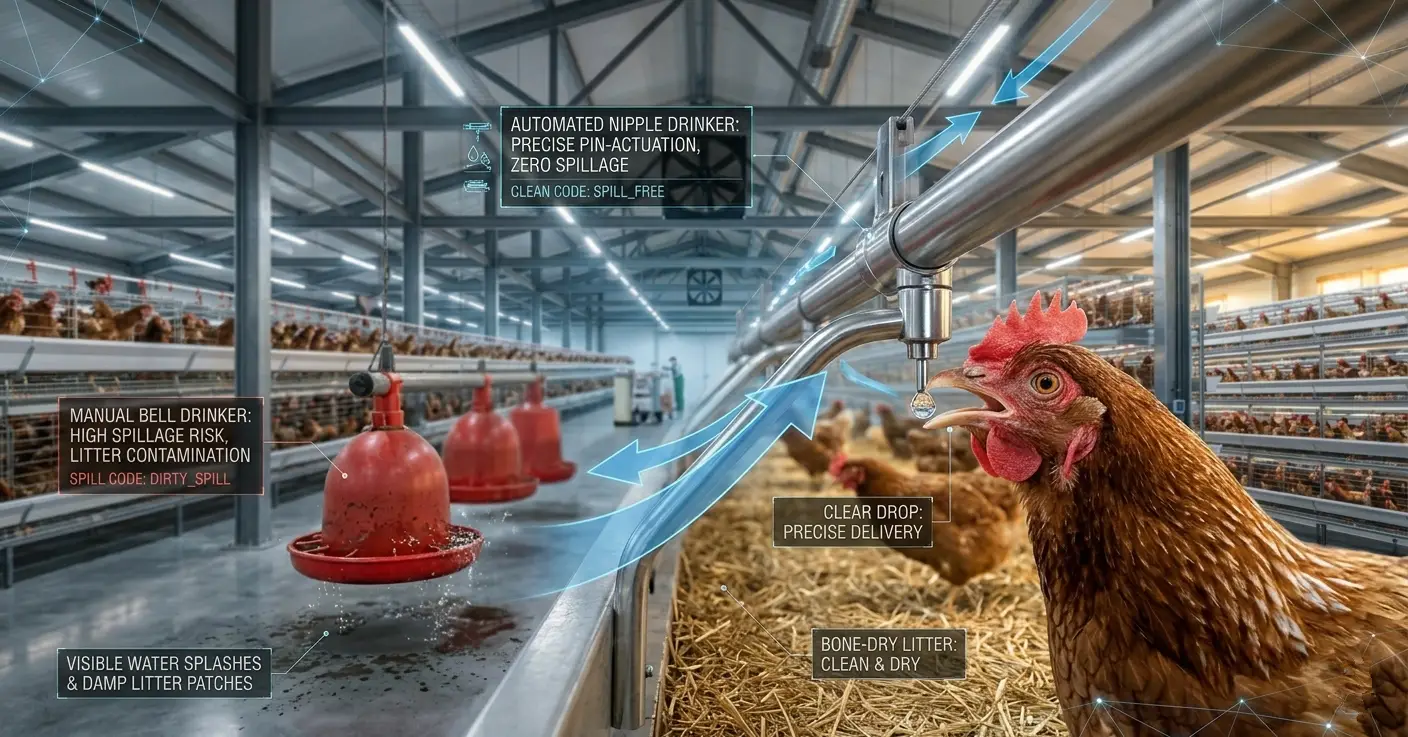
Bell drinkers are suspended circular troughs that refill via a gravity-fed valve.
-
The Pros: They are inexpensive to purchase and easy for birds to find.
-
The Cons: They are prone to spilling, which leads to wet litter—the primary cause of Coccidiosis and ammonia spikes in the Southwest Region. They also require daily manual scrubbing to prevent biofilm and algae buildup.
-
Cost-Benefit: Best for small-to-medium startups where labor is cheap and capital is limited.
Nipple Drinkers (Fully Automated)
Nipple drinkers are closed-pipe systems where birds peck at a stainless steel pin to release a drop of water.
-
The Pros: This is the “Clean Code” of watering. Because it is a closed system, the water stays sterile. There is zero spillage, keeping the litter bone-dry. It significantly reduces labor as there are no troughs to wash.
-
The Cons: High initial installation cost and the requirement for a high-quality water filtration system. If your water has high mineral content (common in some parts of Cameroon), the nipples can clog.
-
Cost-Benefit: High ROI for large-scale farms (2,000+ birds) due to improved flock health and massive labor savings.
Feeding Systems: Managing the “Input” Costs
Feed accounts for nearly 70% of egg production costs. Even a 5% wastage can be the difference between profit and loss.
Manual Tube Feeders
These are the standard hanging plastic or galvanized feeders filled by hand.
-
The Logic: They are simple and don’t break down.
-
The Problem: They are prone to “selective feeding” (where birds pick out the big grains and leave the nutrients) and significant wastage from birds scratching feed onto the floor.
-
Labor Tax: For 5,000 birds, manual feeding takes hours of heavy lifting every single day.
Chain Feeders (Automated)
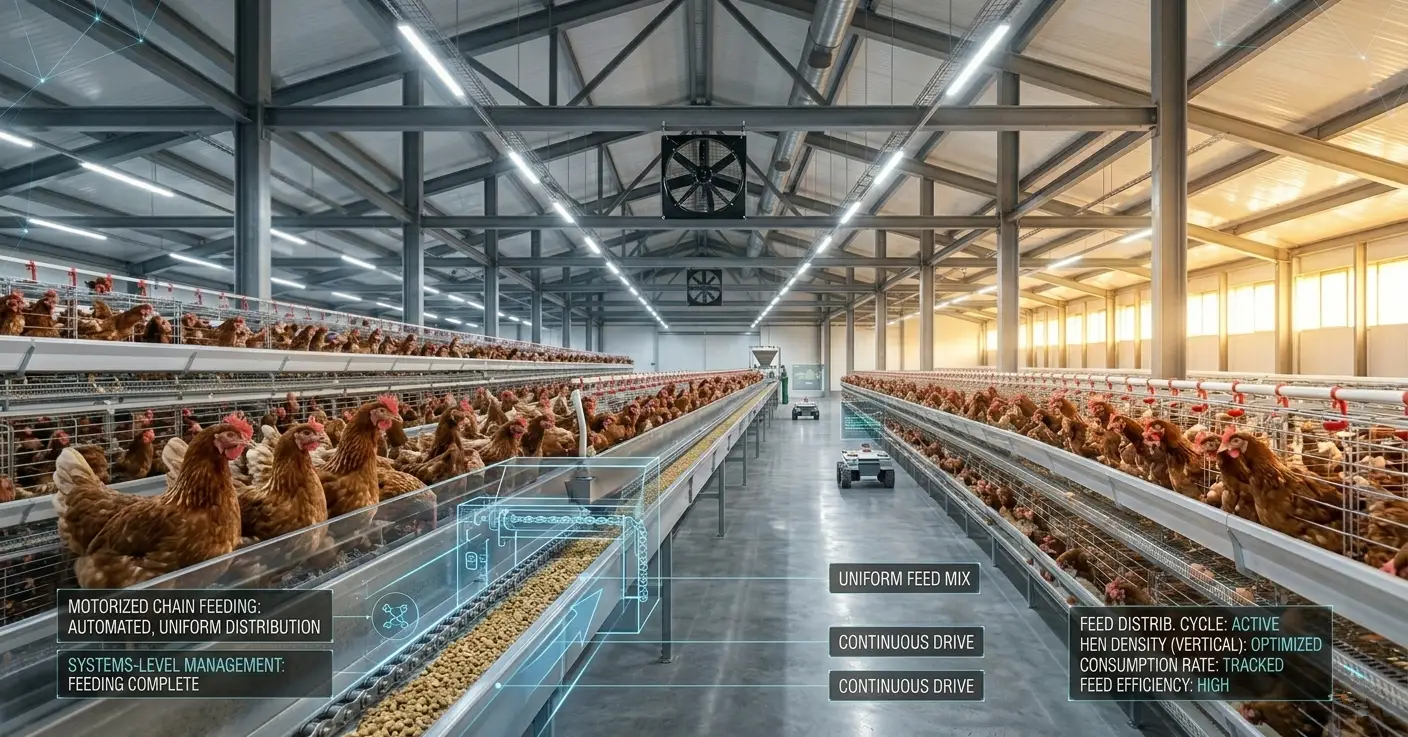
A motorized chain pulls feed from a central hopper through a trough circuit that runs the length of the house.
-
The Pros: Rapid, uniform distribution of feed. It ensures that the “boss birds” at the front of the house don’t eat all the nutrients before the feed reaches the back. It can be linked to a timer to deliver precise “meals,” which is essential for weight management in layers.
-
The Cons: High mechanical complexity. If the motor fails, your entire “input pipeline” stops.
-
Cost-Benefit: Essential for commercial scale. The reduction in feed wastage alone usually pays for the system within 2 to 3 years.
Technical Cost-Benefit Matrix
| System Component | Manual (Tube/Bell) | Automated (Chain/Nipple) |
| Initial Investment | Low | High |
| Labor Requirement | High (Daily manual tasks) | Low (Periodic maintenance) |
| Feed/Water Wastage | High (10–15%) | Low (<2%) |
| Biosecurity Risk | Medium (Open troughs) | Low (Closed systems) |
| Scalability | Poor (Linear labor growth) | Excellent (Systems-based) |
Automation as a Scaling Strategy
If you are running a farm of 500 birds, manual systems are manageable. However, if your vision is to scale to 5,000 or 10,000 layers—like the client case study featured on our YouTube channel—automation is not an option; it is a necessity.
At Otto’s Farms, we recommend a phased approach. Start with automated Nipple Drinkers first, as they provide the immediate benefit of drier litter and better health. As your cash flow stabilizes, move to Chain Feeders to optimize your FCR.
Investing in automated systems is essentially “hardcoding” efficiency into your farm. It frees you from the drudgery of manual labor, allowing you to focus on the “CEO-level” tasks: data analysis, market expansion, and strategic growth.