Scaling a poultry farm is not as simple as multiplying your bird count by 100. In the world of software engineering, we call this “Horizontal Scaling.” If your initial architecture is flawed, scaling up only magnifies the bugs. For a poultry CEO, scaling from a backyard 100-bird setup to a commercial 10,000-bird enterprise requires a transition from Individual Bird Management to System-Level Management.
To scale successfully in Cameroon’s competitive market, you must adopt a Modular Approach—building your farm in “blocks” that can be replicated, managed, and audited independently.
The Modular Architecture: Building in Clusters
When you have 100 birds, you can manage them in a single room. When you have 10,000, you cannot put them in one giant house without catastrophic risk. A single disease outbreak or ventilation failure would result in total system failure.
The “Unit” Strategy
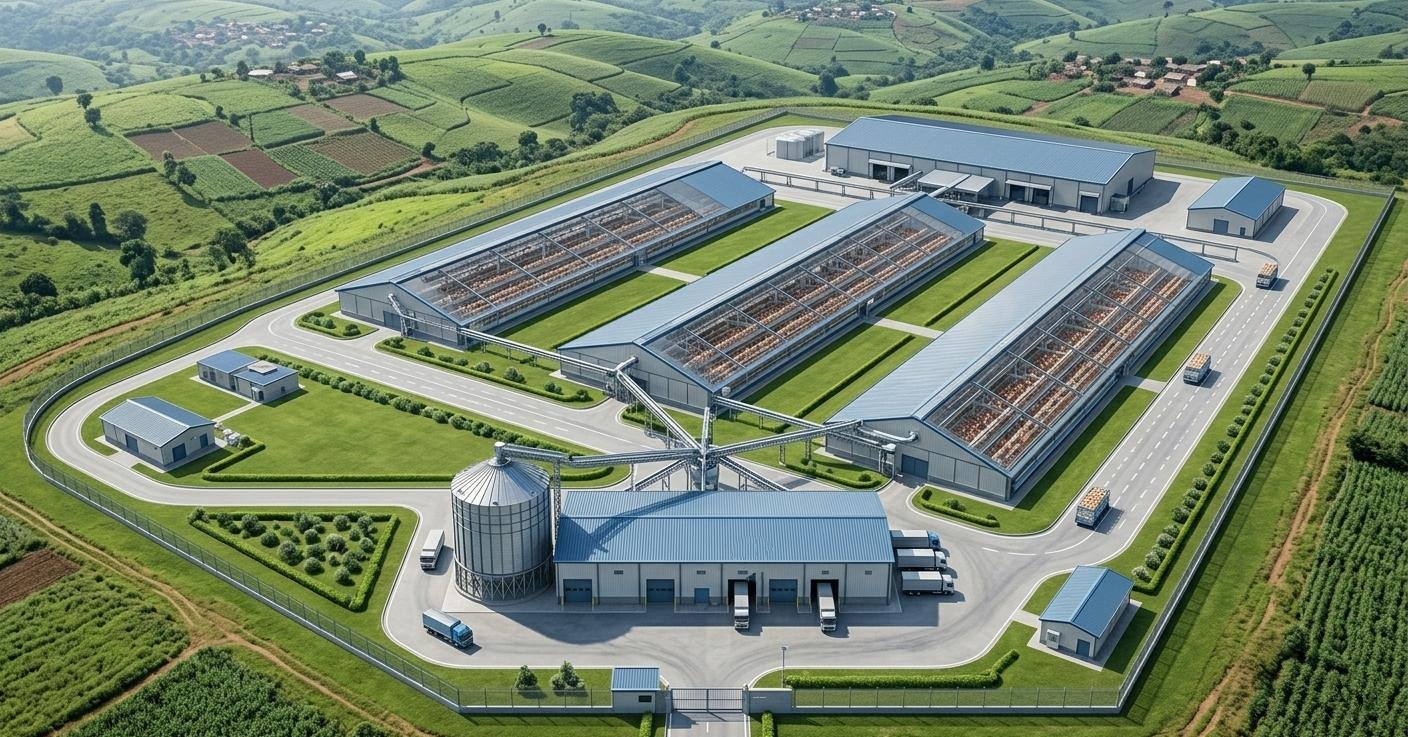
Divide your 10,000-bird goal into manageable “Units” or “Modules.” For example, 10 houses of 1,000 birds each, or 5 houses of 2,000 birds.
-
Biosecurity Isolation: If House 3 has a health issue, you can “quarantine” that module without affecting the other 9,000 birds.
-
All-In/All-Out Flow: Modular housing allows you to stagger your flocks. While House 1 is at peak production, House 5 can be in the brooding phase, ensuring a consistent daily egg supply for your B2B clients.
Land Utilization and Site Master Planning
As you scale, land becomes your most constrained resource. Efficient “Spatial Logic” is required to maximize bird density while maintaining biosecurity.
Minimum Distance Requirements
To prevent cross-contamination, houses should be spaced at least 15 to 20 meters apart. This “Air Gap” ensures that exhausted air from one house (potentially carrying dust and pathogens) is diluted before it reaches the intake of the next.
Logistics and Workflow Optimization
-
Centralized Feed Hub: Position your feed warehouse at the “Entry Zone” of the farm. This prevents feed delivery trucks (high-risk vectors) from driving deep into the production area.
-
The Egg Collection Route: Design a dedicated “Clean Path” for egg trolleys that moves from the houses to a centralized grading and packaging room.
Infrastructure Upgrades: From Manual to Automated
What works for 100 birds will break your back at 10,000. Scaling requires a shift in your “Hardware Specifications.”
Water and Feed Delivery
-
At 100 Birds: Manual bell drinkers and tube feeders are fine.
-
At 1,000 Birds: Transition to semi-automated nipple drinkers to save hours of cleaning.
-
At 10,000 Birds: Fully automated chain feeding systems and silo-fed water lines become a mechanical necessity. The labor cost of manually feeding 10,000 layers is higher than the monthly installment on an automated system.
Data Monitoring and Sensors
Scaling to 10,000 birds means you can no longer “sense” the environment manually. You need Digital Telemetry:
-
Temperature/Humidity Sensors: Linked to an alarm system to alert you if a house is overheating.
-
Water Meters: A sudden drop in water consumption across a 2,000-bird module is your “Early Warning System” for disease, often appearing 24 hours before physical symptoms.
The Economics of Scaling: CAPEX vs. OPEX
Scaling requires significant Capital Expenditure (CAPEX), but it significantly reduces your Operating Expenditure (OPEX) per egg through Economies of Scale.”
| Expense Category | 100 Birds (Small Scale) | 10,000 Birds (Commercial) |
| Feed Purchase | Retail Price (Expensive) | Bulk/Wholesale (15–20% Cheaper) |
| Labor Cost | High per bird (Manual) | Low per bird (Automated) |
| Market Access | Local neighbors/stalls | Supermarkets/Hotels/Contract Supply |
| Risk Level | Low (Low investment) | High (Requires strict biosecurity) |
Scale with Logic, Not Emotion
Scaling from 100 to 10,000 birds is an engineering feat. You are moving from being a “Farmer” to being a “Systems Operator.”
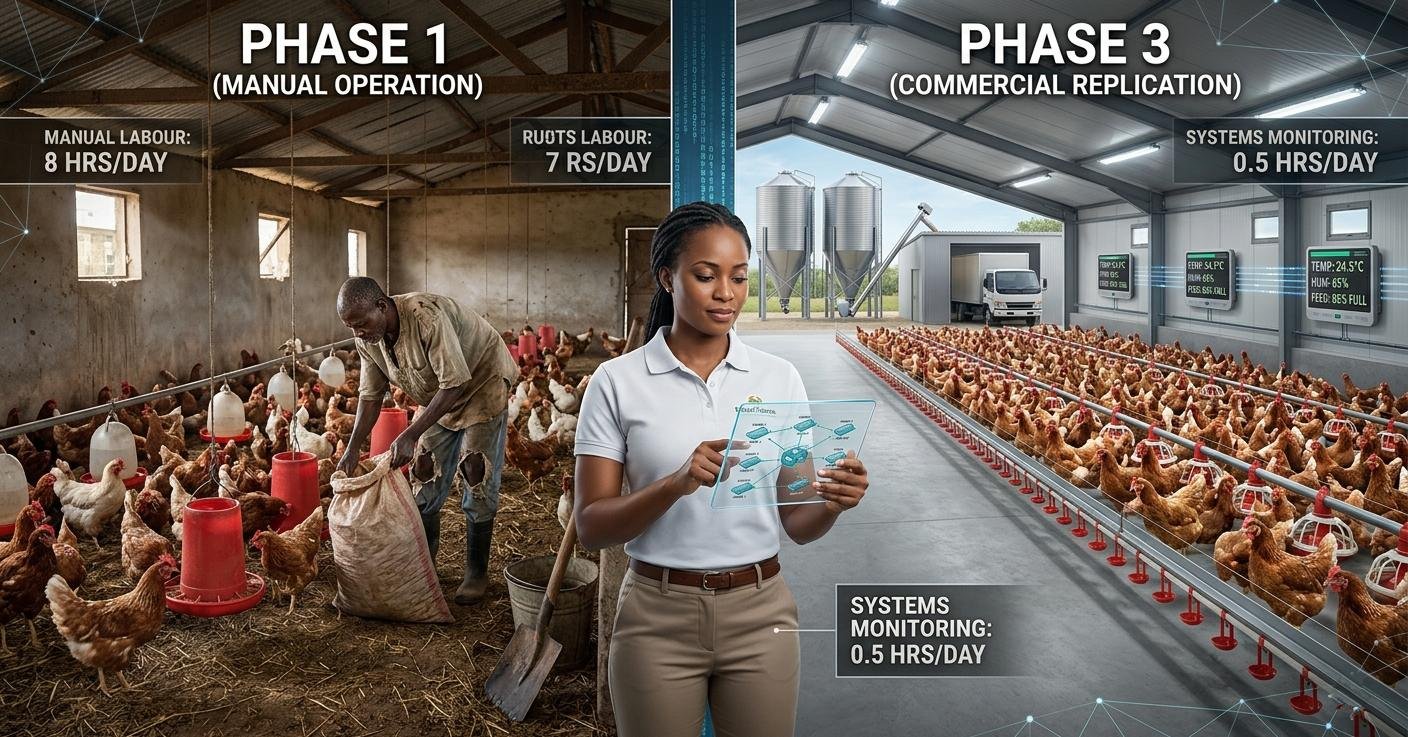
At Otto’s Farms, we recommend the 3-Phase Expansion Model:
-
Phase 1 (The Pilot): Master 500–1,000 birds to stabilize your management protocols.
-
Phase 2 (The Replication): Build 2-3 additional identical modules using the profits from Phase 1.
-
Phase 3 (The Commercial Hub): Full automation and centralized logistics once you hit the 5,000-bird mark.
By treating each poultry house as a repeatable “code module,” you can scale your infrastructure with confidence, ensuring that your growth is both profitable and sustainable.