In tropical regions like West Africa, the environment is your biggest challenge and your greatest asset. A poultry house in Cameroon doesn’t just need to hold birds; it needs to function as a thermal regulator. High humidity and soaring temperatures can lead to heat stress, which is the “silent killer” of egg production.
As a software engineer, I view a poultry house as a passive cooling system. By utilizing specific materials and geometric orientations, we can “program” the building to stay cool without consuming a single kilowatt of electricity.
The Logic of Orientation: The East-West Axis
The most critical rule in tropical poultry engineering is the orientation of the building. In regions near the equator, the sun passes directly overhead from East to West.
Minimizing Solar Gain
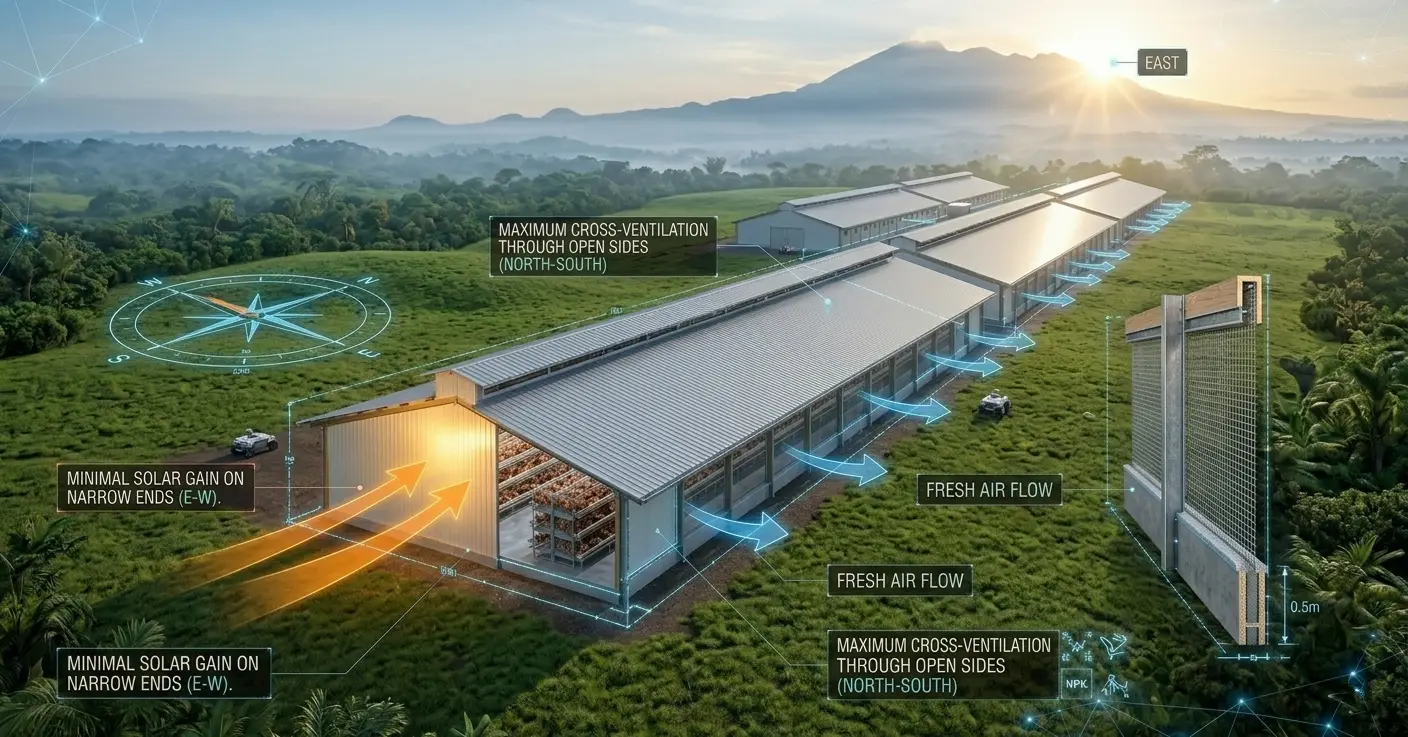
Your poultry house must be built with its longest sides facing North and South, and its narrow ends facing East and West. This ensures that the intense morning and afternoon sun hits only the smallest surface area of the building.
Preventing Direct Sunlight
By keeping the open sides facing North and South, you prevent direct sunlight from reaching the birds. Direct sun on a layer of chicken in a tropical climate can raise its body temperature to lethal levels within minutes. Proper orientation ensures the interior remains in a “permanent shade,” allowing for natural cooling.
Roof Height and the Stack Effect
In a humid climate, hot air must be allowed to escape rapidly. Standard house heights used in temperate climates will fail here because they trap heat right at the level of the birds.
Leveraging the Stack Effect
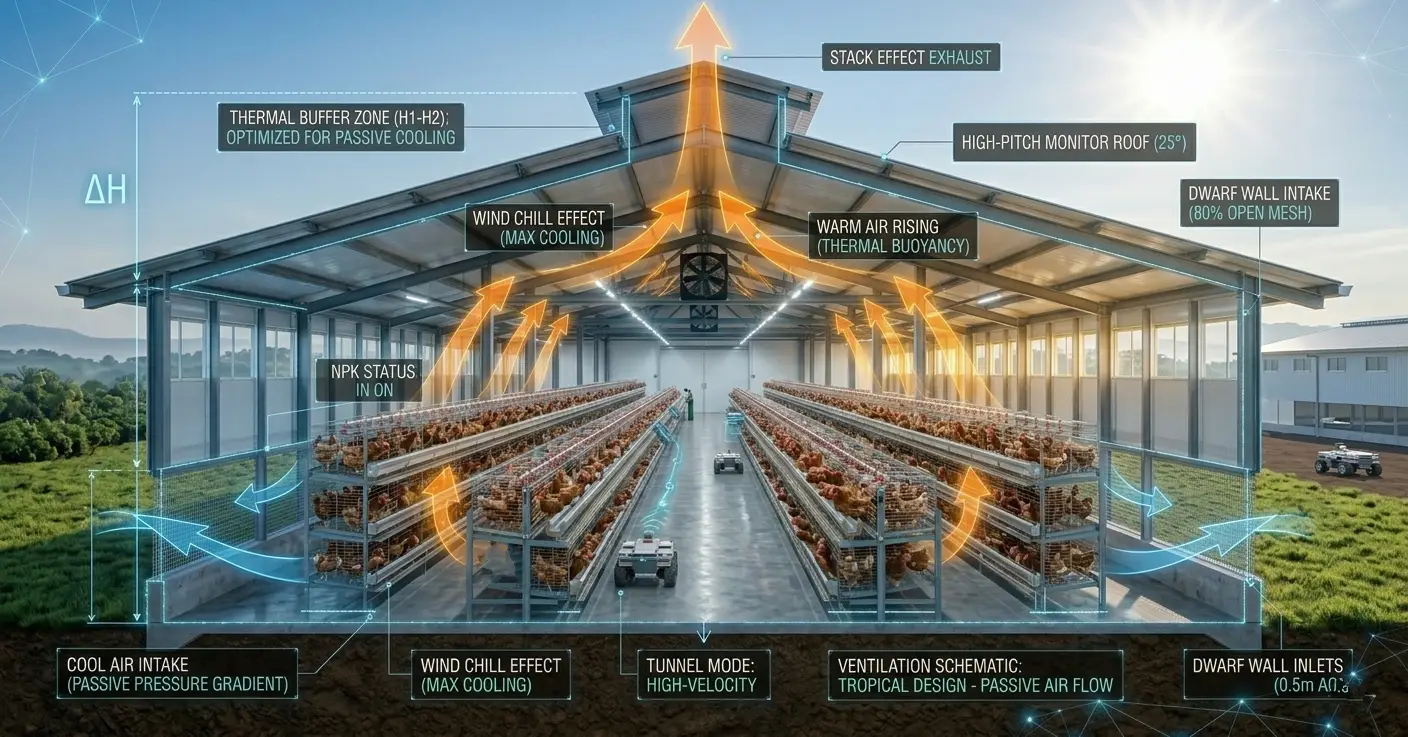
We design our houses with high ceilings—ideally 3 to 4 meters at the eaves and even higher at the ridge. Because hot air is less dense than cool air, it rises. By creating a high “buffer zone” above the birds, the heat naturally moves upward.
The Monitor Roof Design
A “Monitor Roof” or a ridge vent (an opening at the very top of the roof) is essential. This creates a vacuum effect: as hot air escapes through the top, it pulls cooler, fresh air in through the side mesh. This constant air exchange is vital for removing ammonia and moisture, which are always higher in tropical humidity.
Material Science: Combatting Humidity and Heat
The materials you choose act as the “insulation layer” for your agricultural system. In the South West Region, where rainfall is heavy and humidity is high, durability is just as important as thermal properties.
Reflective and Insulative Roofing
-
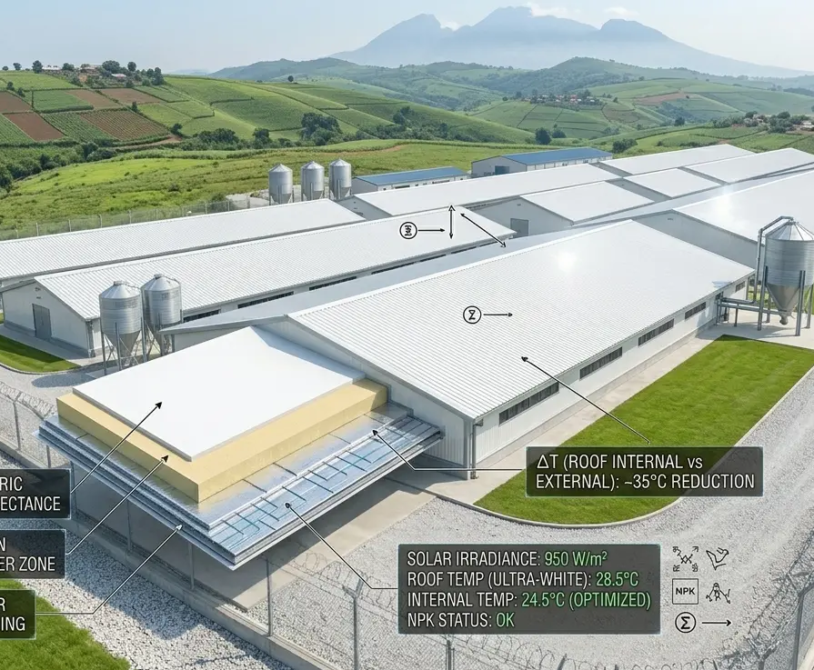
Aluminum vs. Zinc: While zinc is common, aluminum or light-colored prepainted sheets are superior because they reflect a higher percentage of solar radiation.
-
Thatch and Shingles: In some eco-friendly setups, thatched roofs provide incredible insulation, but they require high maintenance and can harbor pests.
-
Heat Paint: For existing structures, applying a reflective white “heat-shield” paint can reduce internal temperatures by as much as 3°C to 5°C.
Wall Construction and Mesh
-
Dwarf Walls: Construct “dwarf walls” of about 2 to 3 feet (60-90 cm) using concrete blocks. This protects the birds from ground-level drafts and predators while keeping the rest of the side open for maximum airflow.
-
Wire Mesh: Use high-quality, galvanized wire mesh for the upper sections. This provides 100% ventilation while keeping out wild birds and rodents that carry diseases like Avian Influenza.
Floor Engineering and Moisture Management
In the tropics, the floor isn’t just for standing; it’s for moisture control.
The Concrete Advantage
A concrete floor with a slight slope is ideal. It allows for easy “wash-downs” between flocks and prevents the “rising damp” that is common during the rainy season in Cameroon. Damp floors lead to wet litter, which spikes ammonia levels and triggers respiratory issues in layers.
The Otto’sFarms’s Technical Summary
Building a poultry house in a tropical climate is about Passive Climate Control. If you get the orientation and roof height right, you reduce the “biological load” on your hens. A cool hen eats less for maintenance and spends more energy on egg production, which directly improves your Feed Conversion Ratio (FCR).
Before you lay the first block, remember: you aren’t just building a shed; you are building a machine that converts feed into eggs. The more comfortable the machine stays, the better it performs.