Feather pecking and cannibalism kill more layer hens in commercial production than most diagnosed diseases. In high-density housing — cage-free barns, aviaries, and deep-litter floor systems — a single cannibalism event that draws blood can escalate to flock-wide injury within hours. The economic damage — mortality, downgraded birds, reduced production from injured hens, and management disruption — makes it one of the most costly welfare and production problems in the layer industry.
Beak trimming — the controlled removal of the sharp distal tip of the upper and lower beak — is the primary structural intervention for preventing injurious pecking behavior in commercial layer flocks. When performed at the correct age, with precision equipment, by trained operators, and followed by appropriate post-procedure care, it reduces injurious pecking behavior without measurable long-term production impact.
When performed incorrectly — wrong age, wrong technique, wrong equipment, no post-procedure support — it causes chronic pain, feed intake depression, permanent growth suppression, and flock uniformity breakdown that follows the bird through the entire laying cycle.
The difference between an outcome and the other is not the procedure itself. It is the understanding of what the procedure is actually doing to the bird, and the management response that follows.
The Anatomy of the Chicken Beak: What Is Being Trimmed
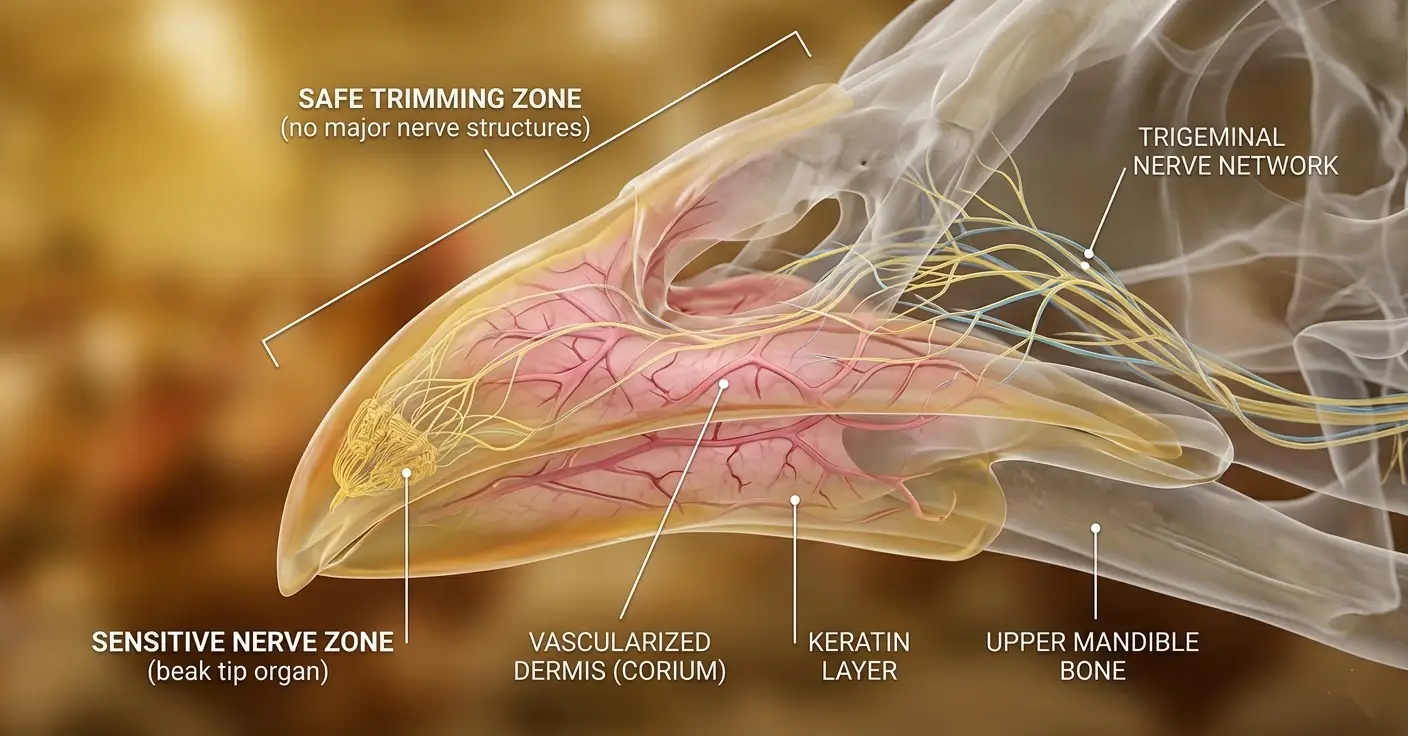
The chicken beak is not a simple keratin sheath. It is a living, innervated sensory organ with a neurological architecture that determines how painful the trimming procedure is, how long recovery takes, and what long-term functional impairment results from different trimming depths.
Beak Structure
The beak consists of three principal layers:
The keratinized epidermis (ramphotheca): The hard outer layer — what appears as the beak surface — is composed of cornified keratin. This layer has no direct nerve supply and can be removed without immediate pain. However, it regenerates continuously and will regrow after trimming, particularly in younger birds.
The dermis (corium): The living tissue layer beneath the keratin, richly supplied with blood vessels and nerve endings. This is the layer that bleeds when trimming is too deep. Cutting into the corium causes acute pain and triggers the primary inflammatory response that, if not managed, produces chronic pain and feed intake depression.
The bone (premaxilla and dentary): The structural core. Cutting into bone during trimming is a severe trimming error that causes lasting structural deformity, persistent pain, and in some cases, complete inability to eat without assistance.
The Beak Tip Organ: The Neurological Reality
The distal tip of the upper beak contains a specialized sensory structure called the beak tip organ — a dense concentration of mechanoreceptors (Herbst corpuscles and Grandry corpuscles) that detect texture, pressure, and vibration. It functions as the hen’s primary tactile interface with her environment: for finding and evaluating feed particles, for nest material assessment, and for social interaction.
Research published in veterinary and avian neuroscience literature confirms that the beak tip organ is innervated by the infraorbital branch of the trigeminal nerve — the same nerve complex involved in phantom limb pain in mammals. Damage to this neural architecture during trimming produces a neuropathic pain condition — the avian equivalent of trigeminal neuralgia — characterized by hypersensitivity at the trimmed site, avoidance of hard feed particles, and a persistent reluctance to probe feeders.
This neurological reality is the reason that trimming age and precision matter so fundamentally. In a day-old chick, the beak tip organ is not yet fully developed and the trigeminal nerve branches are less differentiated — trimming at this stage produces less neurological damage and shorter recovery. In a mature bird, the beak tip organ is fully innervated; trimming produces more severe pain and longer-lasting behavioral effects.
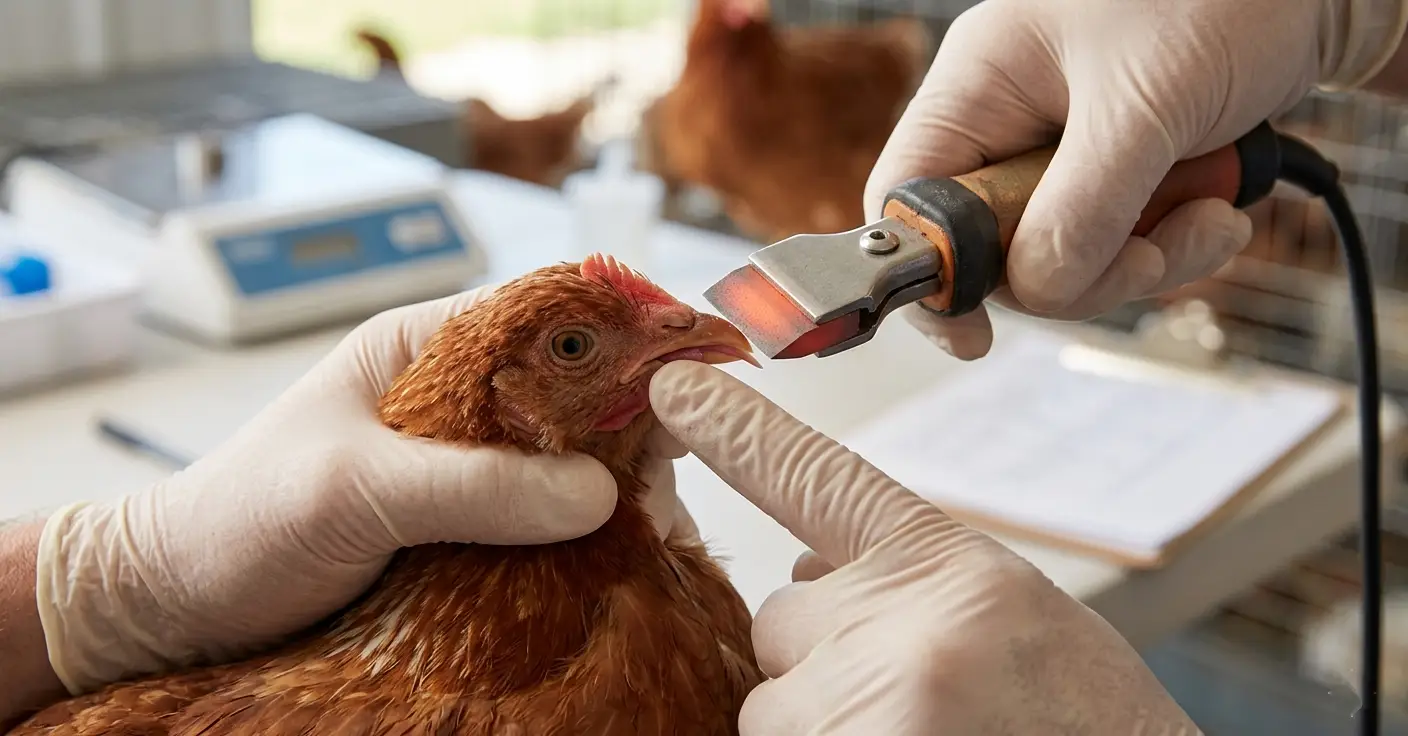
It is also the reason that infrared beak treatment — now the industry standard in high-welfare commercial operations — is preferred over hot blade trimming: the infrared energy precisely ablates the keratinized tip and superficial corium without cutting into the deeper nerve supply, avoiding the acute neuropathic pain associated with blade trimming.
Why Beak Trimming Is Necessary in Commercial Layer Production
Injurious pecking behavior — feather pecking, vent pecking, and toe pecking — is not a pathological behavior in the clinical sense. It is a displacement behavior that emerges when high-density housing prevents expression of natural foraging and dust-bathing behavior, when lighting is too intense and uniform, when stocking density exceeds the flock’s social management capacity, or when nutritional deficiencies (particularly sodium, crude fiber, and methionine) create behavioral restlessness.
The structural solution — reducing stocking density, introducing enrichment, managing lighting — is correct in principle and is the direction the global layer industry is moving. It is also expensive, operationally complex, and not currently accessible to most commercial layer producers in West and Central Africa operating in high-density cage or barn systems with limited enrichment infrastructure.
In that production context, beak trimming is the practical intervention that prevents injurious pecking from becoming a mortality and production event. It does not address the behavioral drivers — it limits the physical damage those drivers can cause.
Understanding this distinction is important: a correctly beak-trimmed flock in a badly managed environment will still experience feather pecking. The beak trimming reduces the wound severity; the environment drives the behavior. Both must be managed.
Timing: When Trimming Produces the Best Outcome
Trimming age is the single most important determinant of procedure outcome. It determines the maturity of the beak tip organ at the time of trimming, the bird’s capacity for recovery, the growth trajectory during the recovery period, and the permanence of the trim.
Day-Old Trimming (Hatchery, Day 1)
Day-old trimming — using infrared beak treatment at the hatchery — is now the standard for commercial pullet production in high-welfare markets and is the recommended approach for new commercial layer operations in West and Central Africa, where hatchery-level treatment is available.
At day one, the beak is small and soft. The keratinized layer is thin. The beak tip organ is not fully differentiated. Infrared treatment at this age produces a controlled zone of tissue damage in the distal beak tip that:
- Takes 7–10 days to slough off completely
- Leaves a blunted tip that regrows slowly, and without the sharp point
- Causes minimal neurological disruption at the beak tip organ
- Does not interfere with early feed and water intake if treatment depth is correctly calibrated
The primary limitation of day-old treatment is re-trimming. Day-old infrared treatment does not always produce permanent results in all breeds — in some cases the beak regrows a functional point by week 10–12, requiring a second treatment at 6–8 weeks. Whether re-trimming is needed should be assessed at first weighing.
Week 6–10 Trimming (Primary Field Trimming Window)
Where day-old hatchery treatment is not available — the common situation in most smallholder and growing commercial operations in West and Central Africa — the primary field trimming is performed at 6–10 weeks of age.
This is the optimal field trimming window for three reasons: the bird is large enough to handle precisely, the beak tip organ is still developing and less fully innervated than in mature birds, there is sufficient rearing time (8–12 weeks) for behavioral and nutritional recovery before transfer to the laying house, and the trimmed beak tip regrows slowly enough that re-trimming before transfer is rarely required.
Trimming after week 12 is progressively more damaging because the beak tip organ is increasingly mature and innervated. Trimming an adult or near-adult bird — particularly with a hot blade — produces severe acute pain, prolonged recovery, and feed intake depression that measurably affects pre-transfer body weight and uniformity.
Re-Trimming (If Required)
If re-trimming is needed — because day-old treatment has regrown or a previous trim was inadequate — perform it before week 12. Never re-trim within four weeks of a previous trimming event; the trimmed tissue is still recovering, and a second procedure on partially healed tissue causes disproportionately more damage.
Equipment: Infrared Treatment vs. Hot Blade Trimming
Infrared Beak Treatment
Infrared beak treatment uses a focused beam of infrared radiation delivered through a small aperture in the treatment device. The beak tip is inserted into the aperture; the infrared energy penetrates the keratin and superficial corium to a calibrated depth, denaturing the proteins in the distal beak without cutting or burning the surface.
The treated tissue dies and sloughs off over 7–10 days, leaving a rounded, blunted tip. The infrared penetration depth is controlled by the device settings — typically expressed as a percentage or numeric level — and must be calibrated to the bird’s age and beak size. Incorrect settings produce either under-treatment (insufficient beak shortening, behavior unchanged) or over-treatment (excessive tissue death, beak deformity, pain).
Advantages of infrared treatment:
- No open wound — the outer keratin surface remains intact during the healing period, reducing infection risk
- More precise tissue targeting — does not cut into the deep nerve supply if correctly calibrated
- Lower acute pain response than blade trimming in clinical assessments
- Does not require sharpening or blade maintenance
Limitations:
- The equipment cost is higher than that of blade trimmers
- Requires trained operators for correct depth calibration
- Result is not immediately visible — the trim takes 7–10 days to complete as the treated tissue sloughs
Hot Blade Trimming
Hot blade trimming uses a heated blade (typically 700–900°C) to cut through the beak and cauterize the cut surface simultaneously. The heat from the blade coagulates blood vessels at the cut edge, reducing immediate hemorrhage, and partially cauterizes nerve endings at the cut surface.
Where infrared equipment is not available, hot blade trimming at weeks 6–10 remains a practical and widely used technique. Its outcomes are acceptable when performed correctly at the right age by trained operators. Its outcomes are significantly worse than infrared treatment when performed at the wrong age, with an incorrectly calibrated blade temperature, or by operators without consistent technique.
Critical hot blade trimming parameters:
- Blade temperature: 700–900°C (orange-red color in dim light). A blade that is too cool does not cauterize adequately and produces post-trim bleeding. A blade too hot causes excessive tissue destruction beyond the cut line.
- Trimming depth: Remove one-third (33%) of the upper beak from tip to nostril and one-quarter (25%) of the lower beak. Never trim more than 50% of the upper beak — this is the threshold for structural deformity and permanent feeding impairment.
- Cauterization time: 2–3 seconds, contact with the blade after the cut. Less than 2 seconds leaves the cut surface incompletely cauterized. More than 3 seconds causes excessive thermal damage to tissue behind the cut.
Performing the Trim: Technique and Precision
Regardless of whether infrared or hot blade equipment is used, technique consistency is as important as equipment specification. The same equipment produces different outcomes in different operators’ hands.
Pre-Procedure Checklist
- Verify equipment is at operating temperature (blade) or correctly calibrated (infrared) before the first bird
- Ensure operators have received practical training, not only verbal instruction
- Have clean, cool water available for birds immediately after trimming
- Add vitamin K to drinking water for 2–3 days before hot blade trimming in flocks where any hemorrhage risk is anticipated — vitamin K supports blood coagulation at cut surfaces
- Do not trim birds that are sick, underweight, or experiencing any vaccine reaction. Trim only healthy, normally developing birds.
- Record the trim date, operator names, number of birds trimmed, equipment settings, and any abnormal observations
The Trimming Hold
The correct hold immobilizes the bird without causing additional stress injury. The operator’s dominant hand holds the bird’s body firmly against their side or on a padded surface. The non-dominant hand grasps the bird’s head with the thumb behind the skull and fingers under the jaw — stabilizing the head without occluding the nostrils or applying pressure to the eyes. The beak should be presented to the equipment at a slight downward angle to facilitate accurate trimming depth.
Inconsistent holds — birds moving during the procedure — are the primary cause of trimming errors: wrong angle, wrong depth, tongue contact with the blade.
Protecting the tongue: The tongue must never contact the hot blade. Place the tip of the finger or thumb under the lower jaw to retract the tongue away from the cutting edge before blade contact. Tongue burns are permanent injuries that prevent normal feeding for the life of the bird.
Trimming Depth Reference
| Measurement | Upper Beak | Lower Beak |
|---|---|---|
| Standard commercial trim | Remove 33% from tip to nostril | Remove 25% |
| Maximum acceptable | 50% from tip to nostril | 33% |
| Result of overtrimming | Structural deformity, permanent feeding impairment | Underbite, reduced prehension |
| Ideal post-trim appearance | Blunt, rounded tip; lower beak slightly longer than upper | Even with or 1–2 mm shorter than the upper |
Post-Procedure Care: The Period That Determines the Outcome
The 7–14 days following beak trimming are as important as the procedure itself. The bird’s ability to eat and drink during the recovery period determines whether the procedure produces a well-recovered bird or a growth-suppressed one.
Immediate Feed and Water Adjustments
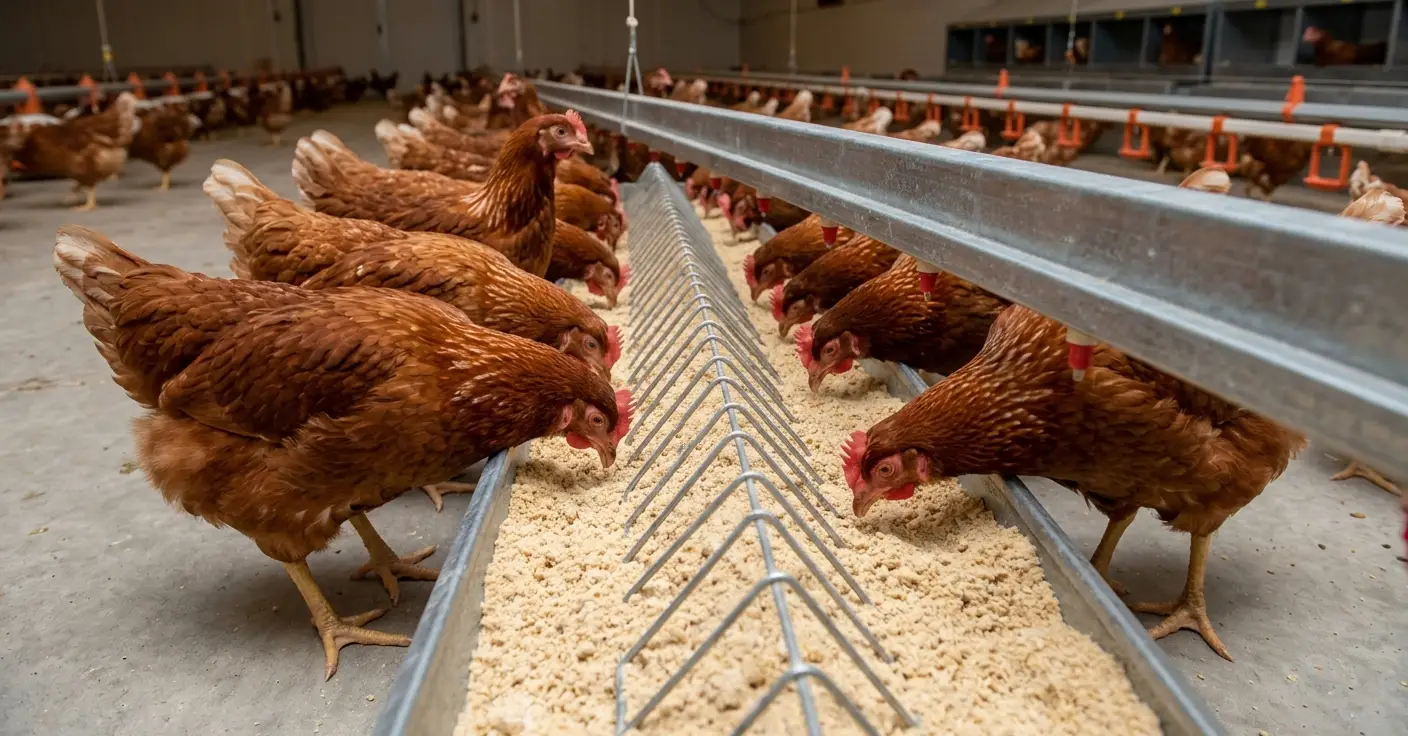
Raise the feeder height. A freshly trimmed bird has reduced beak reach and cannot comfortably pick up feed from a deep trough or from floor level. Raise chain feeder levels so feed is accessible at the trimmed beak’s reduced reach. Deep-fill feeders to allow birds to scoop rather than pick — shallow picking with a tender beak causes avoidance.
Maintain feed depth at 3–4 cm in all feeders for the first 10 days post-trimming. Birds recovering from beak trimming eat by scooping feed with the lower beak rather than precise pecking — a behavior that requires sufficient feed depth to work. Shallow feeders or feeders in the final third of their filling cycle leave recovering birds unable to feed efficiently.
Add extra supplemental feed trays on the litter or cage floor for the first 48–72 hours immediately after trimming. This provides an easy-access feed surface for birds whose beak is most tender immediately post-procedure.
Water access: Drinker height should not require significant head extension immediately after trimming. Adjust nipple drinker heights to the lower end of the acceptable range for the birds’ age during the recovery period. For bell drinkers, maintain water depth at 2–3 cm — sufficient to drink without requiring the bird to press the tender beak tip against the drinker base.
Nutritional Support During Recovery
Vitamin K (menadione): Add 2–4 mg/kg vitamin K to the feed or 1–2 mg/liter to drinking water for 3–5 days post-trimming to support coagulation at blade-trimmed cut surfaces and reduce post-procedure bleeding risk.
Vitamin C (ascorbic acid): Add 100–150 mg/liter to drinking water for 5–7 days post-trimming. Ascorbic acid supports wound healing through collagen synthesis and reduces corticosterone-mediated stress response associated with the procedure.
Electrolytes: Oral electrolyte supplementation for 2–3 days post-trimming supports birds that reduce feed and water intake during the initial recovery period. Maintaining hydration is critical — a dehydrated bird recovering from a painful procedure has a significantly longer and more damaging recovery trajectory.
Feed form: Switch from crumble to a softer mash or fine crumble for the first 7 days post-trimming if available. Hard crumble particles require more precision biting force than a tender post-trim beak can comfortably apply. The feed intake depression associated with beak trimming is partly a pain response and partly a physical inability to process the normal feed form — addressing the physical component reduces the overall intake drop.
Temperature and Light Management
Reduce light intensity to 5–10 lux during the first 48 hours post-trimming. Lower light intensity reduces activity level, reduces social interaction that could produce pecking at tender beaks, and reduces feed-seeking behavior intensity — giving the beak time to begin healing before the bird is under full behavioral demand.
Maintain house temperature at the upper end of the target range for the bird’s age for the first week post-trimming. Pain responses and reduced feed intake reduce heat generation from digestion; birds recovering from the procedure are more susceptible to chilling than unaffected birds in the same environment.
Monitoring During Recovery
Check the flock twice daily for the first 7 days post-trimming. Look for:
- Post-trim bleeding: Visible blood at the beak tip more than 2 hours after trimming indicates inadequate cauterization or trimming into the corium. Apply styptic powder or silver nitrate to the affected beak. A hemorrhage rate above 3% of trimmed birds indicates blade temperature or technique failure — stop and recalibrate before continuing.
- Feed intake: Weigh feed in and out daily for the first week. Feed intake depression of 5–15% is expected and acceptable for days 1–5. Intake depression exceeding 20% persisting beyond day 7 indicates excessive trimming depth, technique error, or concurrent health challenge.
- Body weight: Weigh a sample of 50 birds at day 7 and day 14 post-trimming. Compare to pre-trim weights and to the breed standard. Weight loss exceeding 5% at day 7 or failure to regain pre-trim weight by day 14 indicates a recovery management problem requiring immediate intervention.
- Beak healing: At day 7, examine a sample of trimmed birds. The cut surface should be dry, clean, and showing early keratin regrowth. Open, wet, or reddened cut surfaces at day 7 indicate infection or ongoing inflammation — consult a veterinarian regarding topical or systemic treatment.
The Regulatory and Welfare Context
Beak trimming is a contested welfare practice globally. The European Union has restricted conventional hot blade trimming and is moving toward the complete prohibition of beak trimming in several member states. In the United Kingdom, beak trimming is permitted only under specific conditions with infrared equipment. Animal welfare certification schemes — RSPCA Assured, Certified Humane, Global Animal Partnership — prohibit or restrict beak trimming depending on tier level.
For commercial layer producers in Cameroon and across West Africa, this regulatory landscape is not yet a domestic compliance requirement. It is, however, a market access consideration. Export contracts with European buyers, hotel supply chains with welfare audits, and premium retail positions increasingly require animal welfare declarations that include housing systems and beak-trimming practices.
Infrared beak treatment at day one — where hatchery capacity exists — is the practice that satisfies both production requirements and the direction of international welfare standards. Producers investing in commercial layer infrastructure today should consider whether their system can accommodate day-old infrared treatment as a standard rather than an exception.
Summary
Beak trimming in commercial layer pullets is a pain-producing procedure performed on a living, innervated sensory organ. That is the starting point for understanding why timing, technique, equipment calibration, and post-procedure care are not optional refinements — they are the determinants of whether the procedure produces a recovered, productive layer hen or a growth-suppressed, behaviorally compromised one.
The science supports a clear sequence: infrared treatment at day one where available; hot blade trimming at weeks 6–10 where it is not; precise depth limited to one-third of the upper beak; post-procedure nutritional and environmental support for 10–14 days; and monitoring that catches feed intake depression and beak healing problems while there is still time in the rearing period to correct them.
A flock that recovers fully from beak trimming by week 12 enters the laying house without a production deficit. A flock that was trimmed incorrectly or recovered poorly carries that deficit for 52 weeks.
The procedure takes minutes. The recovery takes weeks. Manage the recovery as carefully as the procedure.