The most sophisticated vaccination program, the most precisely formulated ration, and the most carefully engineered housing system in West Africa cannot protect a layer flock from a velogenic Newcastle disease virus that arrives on the boots of a feed truck driver who visited a live bird market that morning.
Biosecurity is not a checklist at the farm gate. It is the architecture of every decision about who enters the farm, how they enter, what they bring with them, and how they move between zones once inside. When that architecture is coherent and consistently enforced, it reduces pathogen introduction probability to a manageable level. When it is inconsistent — enforced with visitors but not with staff, practiced during inspections but not on routine days, applied at the front gate but abandoned inside the production area — it fails at the point where the gap exists.
Commercial layer farms in West and Central Africa operate in production environments with exceptionally high background disease pressure: endemic Newcastle disease in the surrounding smallholder poultry population, Salmonella and E. coli reservoirs in soil, water, and rodent populations, and Gumboro virus that persists in poultry house environments for months. In this context, biosecurity is not risk elimination — it is risk management. The goal is to reduce the frequency and magnitude of pathogen introduction events to a level that vaccine-induced immunity and flock health management can handle.
This article builds the complete biosecurity protocol system — from farm perimeter architecture to visitor communication, staff hygiene, zone management, and documentation — that makes consistent enforcement possible rather than dependent on individual vigilance every day.
The Biosecurity Risk Model: Understanding What You Are Managing
Before designing protocols, understand the risk architecture. Every biosecurity failure involves three elements: a pathogen source, a transmission vector, and a susceptible host. Biosecurity protocols interrupt one or more links in this chain.
The Primary Transmission Vectors for Commercial Layer Farms
Human movement (highest frequency vector): Staff who enter the production area daily are the highest-frequency potential vector on any farm — not because they pose more risk per individual visit than a feed truck driver or a veterinarian, but because they enter more frequently and their entry is the most routinely managed. A staff member who changes into farm footwear at the entrance every day for 50 weeks and skips it once on a rainy Friday afternoon represents a biosecurity failure. One failure event from one person on one day is all that is required for the introduction of a pathogen that has been excluded for months.
Vehicles (high-frequency, high-contamination vector): Feed delivery vehicles and egg collection vehicles visit the farm on weekly or twice-weekly schedules. Both make multiple farm stops — the feed truck from the mill has been to other farms; the egg truck has been to markets. Tire surfaces, wheel arches, and the undercarriage of vehicles contact poultry house effluent, fecal material, and contaminated litter at every farm stop. Each subsequent farm visit is a potential fomite transfer event.
Live poultry and poultry products (direct introduction vector): The introduction of birds from outside sources — replacement pullets from a hatchery, birds purchased from a live bird market, “gifts” of birds from neighbors — is the most direct introduction route for Newcastle disease, Gumboro, Mycoplasma, and Salmonella. Every bird introduced to the farm without a defined quarantine and health verification protocol is an uncontrolled biosecurity event.
Feed and water (continuous exposure vector): Feed contaminated with Salmonella (from the mill’s ingredient sourcing) or water contaminated with E. coli (from the distribution system) creates a continuous daily exposure event that no entry protocol can prevent. Feed and water biosecurity require separate management from physical entry controls.
Wild birds and rodents (environmental vector): Wild birds entering open-sided houses can carry Newcastle disease virus shed by infected village poultry. Rodents carry Salmonella, external parasites, and Ascaridia eggs. Neither carries an entry log nor obeys a footbath policy. Their exclusion requires structural and environmental management rather than procedural protocols.
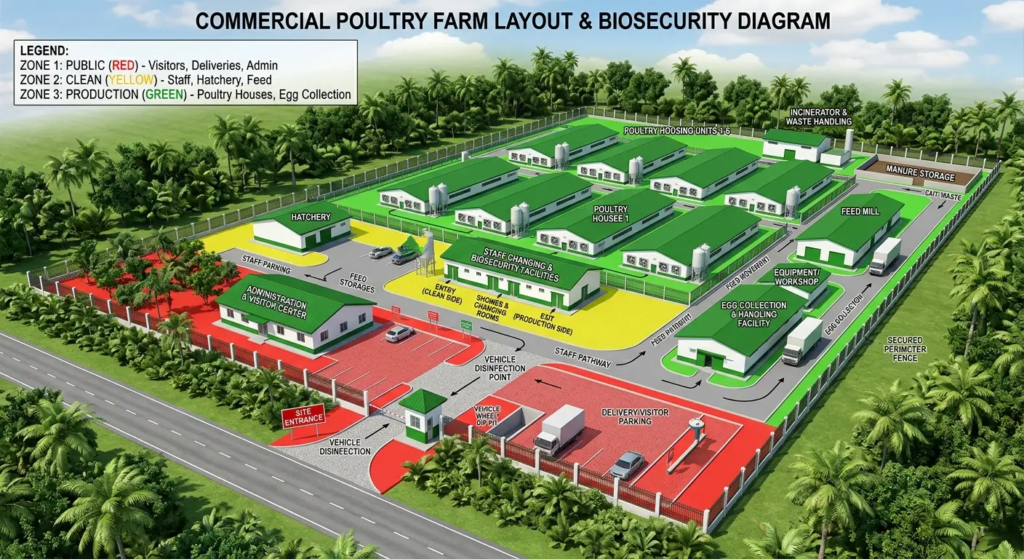
Farm Zone Architecture: The Physical Foundation of Biosecurity
Protocols work when they have a physical structure to operate within. A farm without clearly defined zones has no clear point at which biosecurity escalates from the outside world to the production area — and unclear zones produce inconsistent compliance.
Three-Zone Architecture
Zone 1 — Public Zone (outside the farm perimeter): Everything outside the farm boundary fence. No farm biosecurity protocols apply. Visitors and vehicles may arrive here.
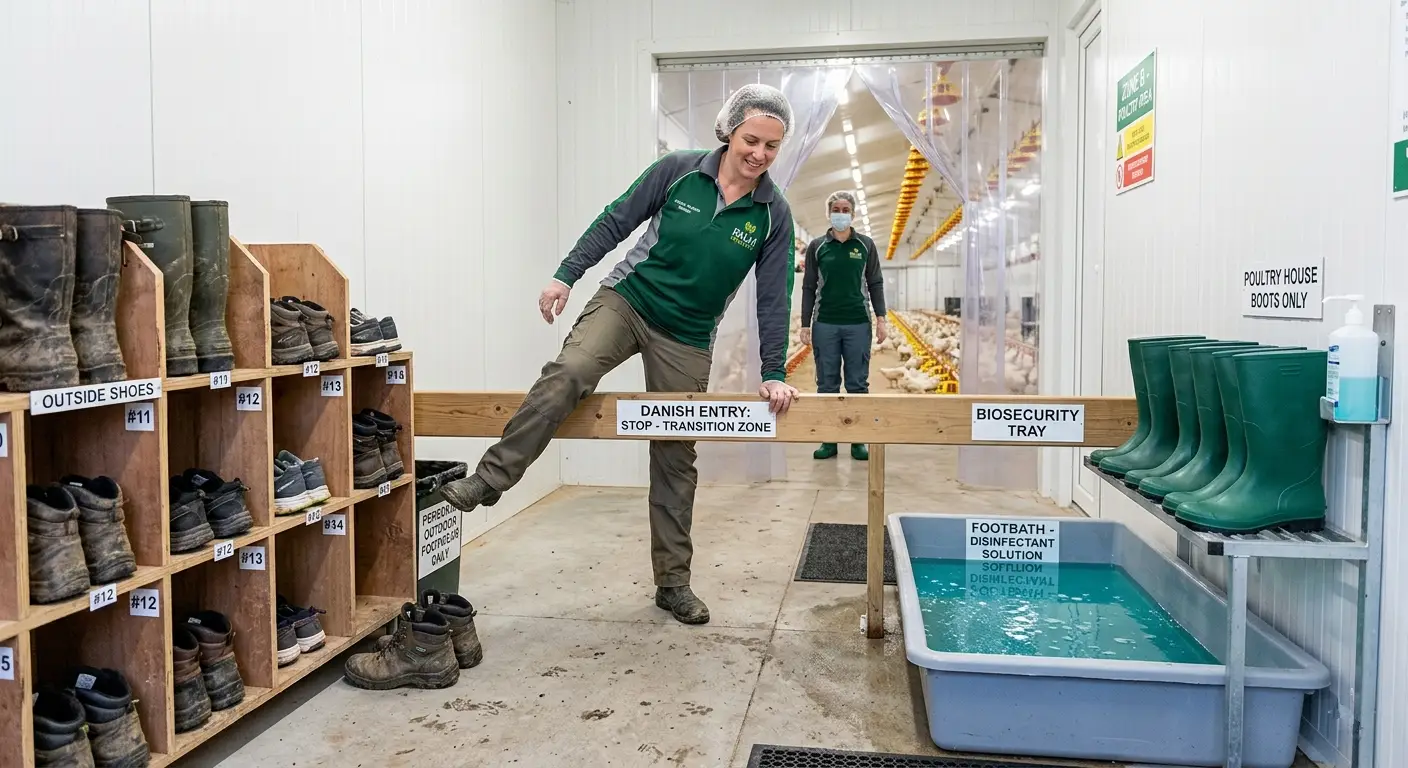
Zone 2 — Clean Zone (inside the farm boundary, outside production buildings): The area between the perimeter fence and the production houses — including the farm entrance, staff facilities, vehicle access roads, feed storage, and egg grading areas. Entry to Zone 2 requires: visitor log-in, footbath passage, and farm-provided footwear. Vehicles in Zone 2 must have passed a vehicle disinfection point.
Zone 3 — Production Zone (inside the poultry houses and their immediate environs): The highest-biosecurity zone. Entry requires: full clothing change (or addition of disposable coveralls over personal clothing), dedicated house footwear (separate from Zone 2 footwear), hand disinfection, and — for houses with active disease concern — shower entry or full personal protective equipment.
The physical boundary between Zone 2 and Zone 3 should be marked by a physical barrier — a door, a gate, or a clear line with a footbath — that makes the transition visible and unavoidable. Biosecurity protocols associated with an invisible, unmarked boundary are inconsistently observed.
The Footbath: The Most Mismanaged Biosecurity Tool on Most Farms
A footbath is only a biosecurity measure if it contains active disinfectant at the correct concentration, has sufficient depth to cover the sole and sides of the footwear being passed through, is maintained at that concentration across the day, and is renewed regularly.
A footbath containing dirty water at 5% of the original disinfectant concentration — the condition of most footbaths on most commercial farms 6 hours after they were set up — is theater, not biosecurity. It creates the appearance of an entry control without providing the protection.
Operating requirements for functional footbaths:
| Parameter | Requirement | Common Failure |
|---|---|---|
| Disinfectant concentration | Per label instruction; typically 0.5–2% for quaternary ammonium, 0.5% for sodium hypochlorite | Under-diluted to save product; diluted further by rainwater |
| Depth | Minimum 10 cm — enough to cover the sole and 5 cm up the side of the footwear | Shallow trays with 2–3 cm depth |
| Contact time | Minimum 30 seconds immersion | Staff stepping through without pausing |
| Renewal frequency | Every 4 hours under normal traffic; after each group of visitors | Changed daily at best; sometimes weekly |
| Organic load management | Discard when visibly turbid — organic matter neutralizes disinfectant | Used until completely brown |
| Mat at exit | Absorbent rubber mat to remove excess disinfectant solution | Every 4 hours under normal traffic, after each group of visitors |
Assign one person the responsibility of footbath maintenance at the start of each day. Verify concentration with a chemical test strip for chlorine or quaternary ammonium solutions. Record the time of each renewal. The footbath is the single most inspected biosecurity point by auditors and veterinarians — it is also the point most frequently found non-functional on routine days when no inspection is expected.
Staff Biosecurity Protocols: The Daily System
Staff represent the most frequent and most manageable entry vector. The biosecurity system for staff must be consistent enough that compliance is automatic — not a deliberate decision made fresh each entry event.
The Daily Staff Entry Protocol
Before entering Zone 2:
- All personal outdoor footwear is removed and stored in a dedicated locker or cubby outside the farm perimeter
- Farm-dedicated footwear (rubber boots or similar) is put on
- Footbath passage at the Zone 1-to-Zone 2 boundary
Before entering Zone 3 (production house):
- Dedicated house footwear put on (stored inside or immediately outside each house, not shared between houses)
- Personal outer clothing covered with a house-dedicated coverall or a cleaned farm uniform if worn into the house
- Hand wash and disinfection — soap wash followed by alcohol-based hand sanitizer or 70% isopropyl alcohol spray
- If entering a house with known disease concern: add face mask, gloves, and eye protection before entry
After leaving Zone 3:
- Remove house coverall before exiting — fold inward to prevent external surface contact with clean surfaces
- Wash your hands again
- Do not enter another house with the same coverall or footwear without decontamination
The 48-Hour Live Bird Market Rule
The most important staff biosecurity rule on farms surrounded by significant Newcastle disease challenge: any staff member who has visited a live bird market must not enter the production zone for a minimum of 48 hours. During active Newcastle disease outbreaks in the surrounding area, extend to 72 hours.
This rule is difficult to enforce because it requires trust in staff self-reporting. Enforcement mechanisms:
- Include the rule in the employment contract with a documented disciplinary consequence for violation
- Designate specific non-production days as “off-farm personal days” — days on which staff who want to visit markets can do so without production impact
- Consider staff living on-farm (particularly for large commercial operations) to reduce the frequency of outside exposure events
Multi-House Movement Protocol
On farms with multiple production houses, staff movement between houses is the primary vector for intra-farm disease transmission. A disease established in House 1 moves to House 2, 3, and 4 through staff who clean, vaccinate, and collect eggs across all houses without decontamination between them.
Minimum protocol for multi-house movement:
- Designate a movement sequence from youngest to oldest flock — staff start at the house with the youngest, most immunologically vulnerable birds, and work toward the oldest. A pathogen shed by older birds is less likely to be introduced to younger birds if this sequence is maintained.
- Change house footwear at every house boundary. Do not enter House 2 with the footwear worn in House 1.
- Do not carry uncleaned equipment (litter forks, vaccination equipment, dead bird bags) between houses without disinfection. Use house-dedicated equipment where possible.
- If one house has a confirmed or suspected disease event, it becomes a restricted zone — all staff who enter it that day are finished for that house and do not enter other houses until they have showered and changed fully.
Visitor Management: The Protocol Most Often Absent
Most commercial layer farms in West Africa have no formal visitor protocol. Visitors — veterinarians, feed sales representatives, buyers, relatives, government inspectors — arrive, are greeted at the entrance, and are walked through production houses in their street clothing and shoes because turning them away or applying strict entry requirements feels inhospitable or risks offending them.
This social dynamic is the most difficult biosecurity challenge to manage — and the one most directly responsible for disease introductions that are later attributed to “we don’t know where it came from.”
Visitor Classification System
Classify visitors by risk profile before they arrive:
Low-risk visitors (Zone 2 only): Buyers, administrative visitors, government officials with no need to enter production houses. Can be received in an office, egg grading area, or Zone 2 meeting space without requiring production house entry. Most visitors fall into this category. Providing a professional meeting space in Zone 2 eliminates the social awkwardness of turning people away from the production area.
Medium-risk visitors (Zone 3 with standard protocol): Veterinarians, feed consultants, equipment suppliers, and other technical visitors with a legitimate need to enter production houses. Apply the full Zone 3 entry protocol: footbath, farm-provided footwear, dedicated coverall over personal clothing, hand disinfection. Have a supply of farm-branded coveralls and dedicated visitor boots at the Zone 2-to-Zone 3 boundary for this purpose.
High-risk visitors (Zone 3 with enhanced protocol): Veterinarians from diagnostic labs who handle sick birds from other farms, livestock extension officers who regularly visit multiple farms, or any visitor who has been on another poultry farm that same day. Apply the full Zone 3 protocol plus: request a 24-hour minimum interval between their last farm visit and entering your production houses. If a same-day visit to another farm is known, receive the visitor in Zone 2 only, regardless of the purpose of the visit.
Prohibited visitors (no entry to Zone 2 or 3): Anyone who has visited a live bird market or a backyard poultry operation that same day. Any visitor without a legitimate professional reason for farm entry. Children — not because children pose a higher disease risk, but because they are less likely to comply with entry protocols and often want to handle birds.
The Visitor Log
A visitor log is not a bureaucratic formality. It is the diagnostic tool that enables traceability when an unexplained disease event occurs. If Newcastle disease appears in a flock 10 days after an unscheduled veterinary visit, the visitor log tells you whether that visit preceded the onset — and whether the visiting veterinarian had been on another farm that day.
Visitor log minimum entries:
- Date and time of arrival and departure
- Visitor name and organization
- Purpose of visit
- Zone accessed (Zone 2 only / Zone 3 with standard protocol / Zone 3 with enhanced protocol)
- Whether the visitor had been on another poultry farm within the previous 48 hours (yes/no — requested verbally or by written declaration)
- Entry protocol applied (footbath confirmed, farm footwear provided, coverall provided, hand disinfection confirmed)
Maintain the visitor log in a bound book — not a loose-leaf or digital system that can be edited. The log is a legal document if a disease notification or food safety investigation occurs.
Vehicle Biosecurity: The Vector That Arrives Before the Driver
Vehicles are frequently larger biosecurity risks than the people inside them because their surfaces contact the ground at every farm visit and the ground at live bird markets, abattoirs, and other poultry farms that preceded your farm on the same route.
Vehicle Disinfection Point
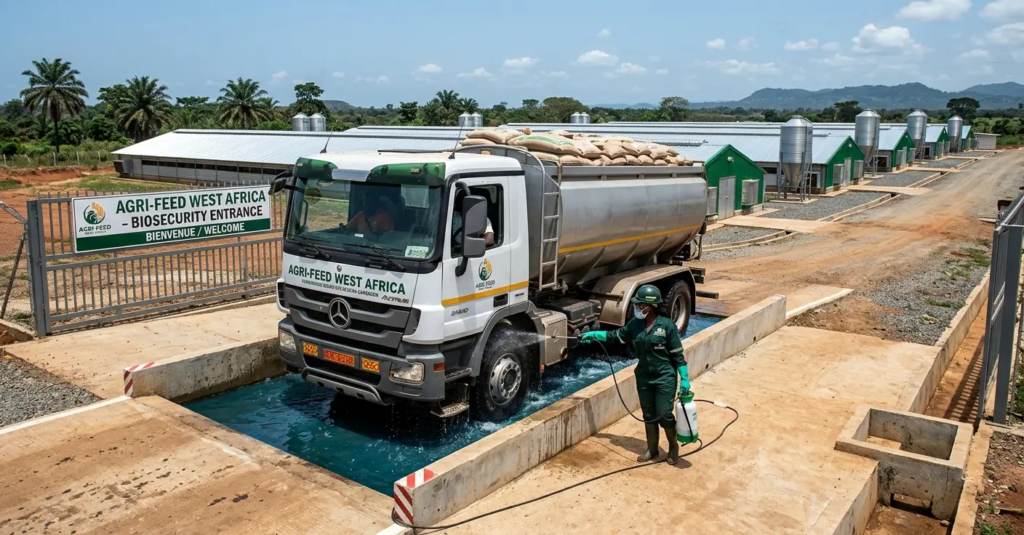
Position a vehicle disinfection point at the Zone 1-to-Zone 2 boundary — the point at which a vehicle must stop before entering the farm. At minimum, this is a wheel dip (a shallow trough wide enough for vehicle tires to pass through, containing a dilute disinfectant solution — 0.5% sodium hypochlorite or 1% quaternary ammonium).
For higher-biosecurity operations: add a spray arch or hand-spray disinfection of the vehicle’s undercarriage, wheel arches, and tires before entry is permitted.
Vehicle entry rules for common farm vehicle types:
| Vehicle Type | Risk Level | Protocol |
|---|---|---|
| Feed delivery truck | High — visits mill + multiple farms | Wheel dip; driver stays in vehicle; no cab entry to Zone 3 |
| Egg collection truck | High — visits markets + multiple farms | Wheel dip; driver stays in vehicle or enters Zone 2 only |
| Veterinary vehicle | Medium — visits multiple farms | Wheel dip; full driver entry protocol |
| Farm-owned vehicle (exclusive farm use) | Wheel dip when returning from an off-farm trip; driver entry protocol | Wheel dip when returning from off-farm trip; driver entry protocol |
| Contractors (maintenance, construction) | Variable | Wheel dip; Zone 2 or 3 access based on purpose |
The dedicated parking area: All visitor vehicles should park in a designated area outside the Zone 1-to-Zone 2 boundary. No vehicle except farm-owned equipment should enter Zone 2 without the wheel dip protocol being applied. The feed truck should unload at a feed reception area positioned to prevent the truck from entering the main farm compound.
Feed and Litter Reception: Biosecurity at the Input Level
Biosecurity does not end at the perimeter. Inputs entering the farm — feed, day-old chicks, new litter material — are direct potential pathogen carriers.
Feed Reception
- Receive feed at a dedicated reception point at the Zone 1-to-Zone 2 boundary — not inside the production area
- Feed bags should be transferred to farm storage from the delivery vehicle without the delivery vehicle entering Zone 2
- If bulk feed is delivered by blower, the hose extends from outside the perimeter to inside — position the blower outlet inside the perimeter and the truck connection outside it
- Inspect feed bags for damage (torn bags allow moisture entry that promotes mold and Salmonella growth in the feed mass). Do not accept damaged bags
- Record the delivery date, mill name, batch number, and feed type on every delivery — this is the traceability record if a feed contamination event is suspected
Day-Old Chick Reception
Day-old chicks arriving from the hatchery are not automatically clean. The hatchery environment — particularly the setting, hatching, and vaccination areas — can be a source of Salmonella, Marek’s disease virus, and bacterial omphalitis pathogens.
- Receive chicks in a dedicated reception area that can be cleaned and disinfected after each delivery
- Inspect a random sample of chicks before they leave the transport boxes — check navel closure, eye brightness, activity level, and crop feel
- Record hatchery name, hatch date, box count, and chick count received
- Notify the hatchery the same day if the navel infection (omphalitis) rate exceeds 2% in the sample
New Litter Material
Fresh litter material — wood shavings, rice hulls, or straw — can carry Aspergillus spores, mold, and occasionally Salmonella from the processing or storage environment.
- Source litter from suppliers who provide a mold-free, dry product — verify by visual inspection and moisture measurement (target below 15% moisture)
- Store litter in a covered area away from rodent access
- Do not use sawdust from hardwoods — certain hardwoods contain resins toxic to poultry at high concentrations
- Consider propionic acid treatment of new litter at 0.2–0.3% by weight if Aspergillus contamination from sawdust sources is a concern in your area
Documentation: The System That Makes Consistency Auditable
Biosecurity that is not documented cannot be verified, cannot be audited, and cannot be improved systematically when gaps are identified. Documentation transforms a behavioral system (staff complies because they believe it matters) into an auditable system (staff complies because compliance is recorded).
Minimum Documentation for a Commercial Layer Biosecurity System
1. Farm Biosecurity Standard Operating Procedure (SOP): A written document describing every biosecurity protocol in use on the farm — zone definitions, entry requirements, staff responsibilities, visitor classification, vehicle protocols, and documentation requirements. The SOP is the reference document against which compliance is measured. Update it when protocols change; do not allow informal verbal changes to supersede the written document.
2. Visitor Log (as described above)
3. Disinfectant Usage Record: Record the date, disinfectant product name and batch number, concentration prepared, and the person responsible for each footbath and vehicle dip preparation. This record verifies that disinfectants are being prepared at the correct concentration and renewed at the correct frequency.
4. Staff Training Record: Document each staff member’s biosecurity training — the date, the topics covered, and the staff member’s signature confirming they have been trained. Retrain at the start of each new production cycle and whenever a new staff member joins. Training that is not documented has not, from an audit or liability perspective, occurred.
5. Flock Health Event Log: A daily record of observations — mortality count, behavioral changes, egg production anomalies, feed or water intake deviations — that forms the baseline against which a disease event is identified and timed. When a disease event occurs, the flock health event log tells you when it started, what changed first, and what biosecurity events preceded the first signs by 7–14 days.
6. Between-Flock Cleanout Record: Document each step of the between-flock cleanout and disinfection protocol — the date litter was removed, the date washing was completed, the disinfectant products used and their concentrations, the environmental swab result before restocking, and the date of restocking. This record is required for premium buyer audit requirements and for Salmonella-free certification programs.
Building a Biosecurity Culture: The Human Element
Protocols are designed. Culture is behavior. The gap between them is the biosecurity failure most commercial layer operations experience: protocols exist on paper, compliance is inconsistent in practice, and the farm manager knows it but lacks a systematic approach to close the gap.
The Five Practices That Build Biosecurity Culture
1. Explain the why, not just the what. Staff who understand that skipping the footbath once creates the possibility of introducing a pathogen that could kill 80% of the flock in two weeks follow the protocol for a different reason than staff who follow it because they were told to. Understanding changes behavior more durably than instruction alone. Hold a brief training session at the start of each production cycle that explains, with specific examples, what each protocol prevents and why it matters.
2. The farm owner/manager demonstrates compliance first. If the farm owner walks through the production area in street shoes “just to check something quickly,” every staff member who observes it has just received permission to do the same. The protocol is applied consistently by everyone or it is not a protocol — it is a suggestion.
3. Make compliance easier than non-compliance. Farm-provided boots that fit properly and are positioned exactly where they are needed. Coveralls that are clean, dry, and immediately accessible. Footbaths that are refilled so staff do not arrive to find a dry tray. Hand sanitizer that does not sting or cause skin irritation. When compliance is physically convenient, it happens. When it requires extra effort or produces discomfort, it is skipped.
4. Conduct internal audits on routine days. An audit conducted before a veterinary inspection or a buyer visit confirms that staff can comply on demand. An audit conducted on a random Tuesday morning confirms that compliance is the actual operating standard. Conduct internal audits quarterly and record the findings. Address failures as management system gaps, not individual failures.
5. Acknowledge and reward sustained compliance. In the farm’s performance review or team meeting, acknowledge the production cycles that were completed without a disease introduction. The absence of a Newcastle outbreak is a success that deserves recognition — it happened because the biosecurity system worked. Naming that success reinforces the behavior that produced it.
Summary
Biosecurity is the system that determines what pathogens reach the birds. Vaccination, nutrition, and housing determine how the birds respond to what reaches them. A flock with perfect vaccination records, precise rations, and optimal housing that is exposed to velogenic Newcastle disease through a biosecurity gap will experience outbreak mortality. A flock with adequate but not perfect management that is protected by a consistently maintained biosecurity system will not.
The protocols in this article are not aspirational standards designed for European intensive production systems. They are the minimum operational requirements for commercial layer production in the high disease-pressure environment of West and Central Africa, where Newcastle disease is endemic in surrounding poultry populations, Salmonella is present in the soil and water, and Gumboro persists in house environments between flocks.
Every protocol is manageable. Every protocol has a failure point. The biosecurity system that prevents outbreaks is the one that identifies its own failure points through documentation and internal audits — and corrects them before a pathogen does.
Build it deliberately. Enforce it consistently. Document it completely.