A flock of 5,000 pullets does not lay as one bird. It lies as a population, and the shape of that population at the point of sexual maturity determines the shape of the production curve for the entire 52-week laying cycle.
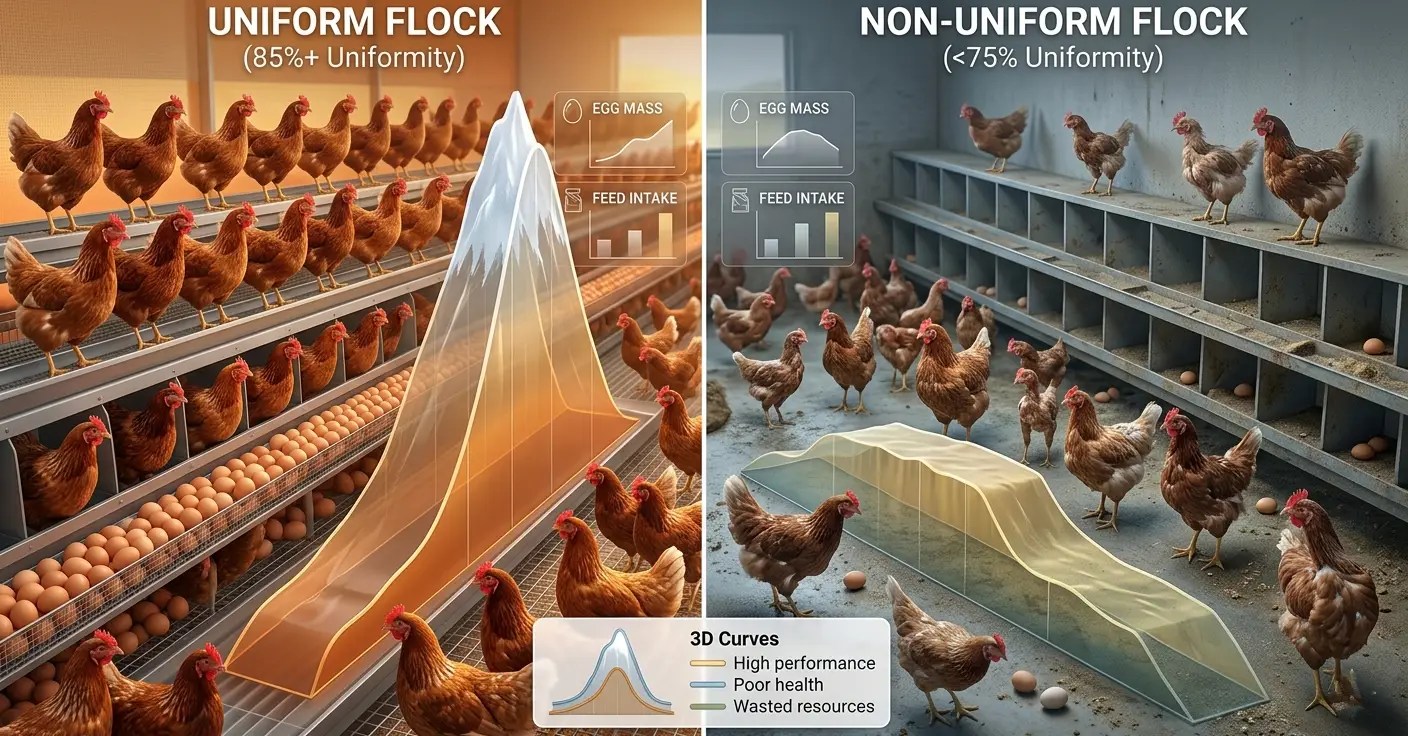
When uniformity is high — 85% or more of birds within 10% of the target body weight at 16 weeks — the flock reaches sexual maturity in a tight cluster. Hens come into lay within days of each other, peak production climbs steeply, and that peak is sustained because the entire flock is cycling in near-synchrony. The production curve looks like a sharp mountain: a rapid rise, a sustained plateau, and a gradual decline.
When uniformity is poor — below 75% — the flock reaches sexual maturity in waves. Light birds mature early and are underprepared. Heavy birds mature late and may be overfat. The production curve flattens into a plateau that never fully peaks, and persistence collapses earlier than it should. Feed cost per egg rises. Revenue per bird falls.
Uniformity is not a welfare metric. It is a production and profitability metric. And it is almost entirely a management outcome — not a genetic one.
What Layer Chicken Uniformity Actually Measures
Uniformity is defined as the percentage of birds in a flock whose body weight falls within ±10% of the flock average weight at the time of measurement.
The calculation:
- Weigh a representative sample of birds (minimum 2% of flock, never fewer than 50 birds)
- Calculate the average weight of the sample
- Determine the ±10% range (e.g., if average = 1,400g, the range is 1,260g–1,540g)
- Count the percentage of sampled birds within that range
That percentage is your uniformity coefficient.
Uniformity benchmarks:
| Uniformity % | Classification | Production Implication |
|---|---|---|
| Above 85% | Excellent | Tight lay onset, strong peak, high persistency |
| 80–85% | Good | Acceptable commercial performance |
| 75–80% | Fair | Irregular lay onset, reduced peak rate |
| Below 75% | Poor | Significant production and revenue loss |
The target for commercial layer pullets is above 80% at every weighing point from week 4 through week 16, with particular emphasis on uniformity at week 5–6 (the critical early grading window) and week 15–16 (the pre-transfer assessment).
Why Uniformity Breaks Down: The Root Causes
Poor uniformity is never the result of a single failure. It accumulates through repeated small deficiencies across the rearing period, each one widening the weight spread between the heaviest and lightest birds in the flock.
Feed Access Competition
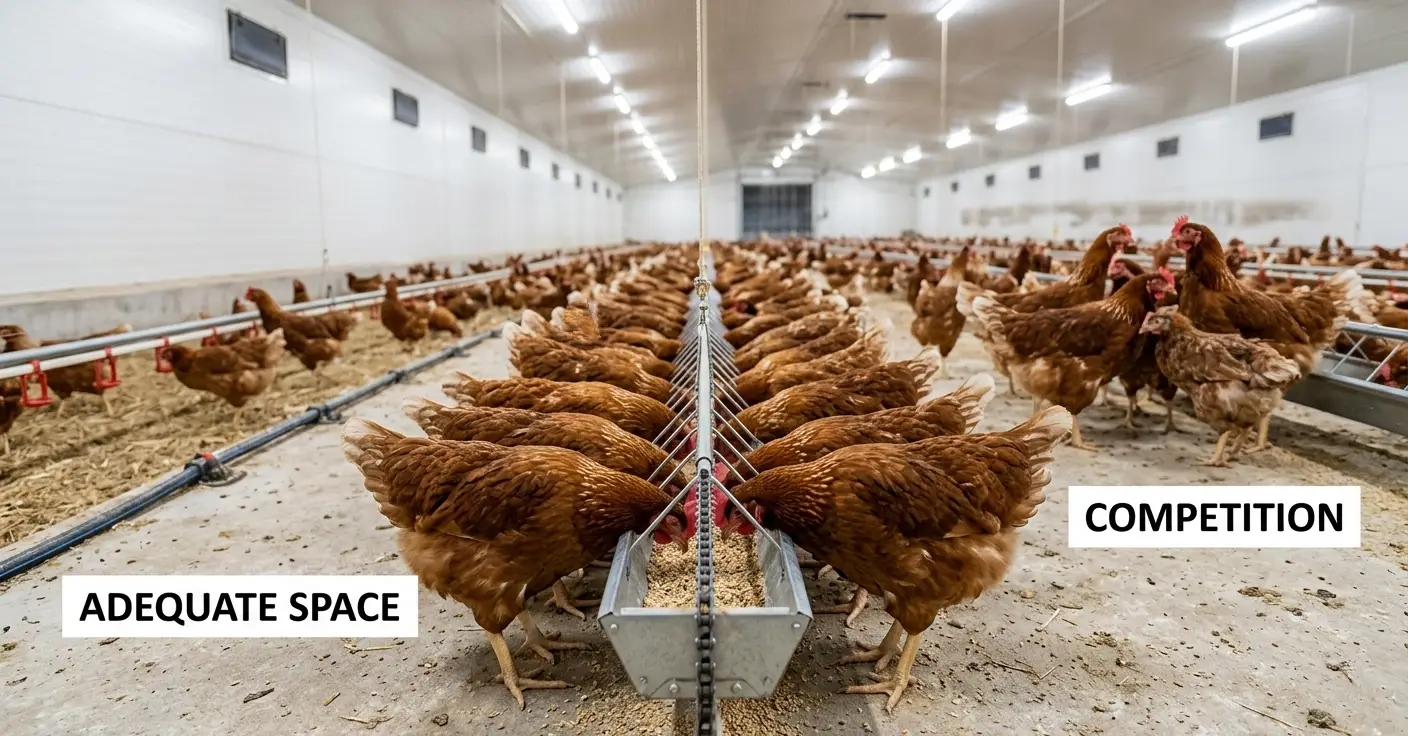
The most common driver of poor uniformity is inadequate feeder space relative to flock size. In a well-managed pullet house, all birds eat simultaneously during feeding periods. When feeder space is insufficient, subordinate birds in the social hierarchy — typically the smallest birds already — are displaced from feeders by dominant birds. They eat less per feeding period, fall further behind in weight, and the gap widens each week.
Minimum feeder space for pullets:
- Chain feeder: 15 cm per bird (both sides of the trough counted separately)
- Pan feeder: 1 pan per 35–40 birds
- Tube feeder: 1 per 25 birds
These are minimum standards, not targets. In flocks already showing poor uniformity, increasing feeder space by 20–30% above minimum is one of the fastest corrective actions available.
Feed Distribution Across the House
Even when total feeder space is adequate, feed distribution across the house determines whether all birds have access to the same quality of ration. Feed in a chain feeder segregates during distribution — fine particles (mineral and vitamin premix, amino acid supplements) fall to the bottom and accumulate at the feed delivery start point, while coarser particles (grain, oilseed meal) travel further along the chain.
Birds feeding at the start of the chain receive a nutrient-dense, fine-particle ration. Birds at the far end receive a coarser, energy-dense but relatively nutrient-dilute ration. Over weeks, this gradient produces systematic weight variation along the length of the house — lighter birds consistently at one end, heavier birds at the other.
Solutions: feed meal or fine crumble rather than coarse mash; ensure full chain circulation before birds access feeders; clean chain feeders weekly to prevent buildup at delivery points.
Water Access Variation
Pullets that drink less, eat less. Water-to-feed intake ratio in pullets is approximately 1.8:1 by weight. Nipple drinker pressure variation across a long house — high pressure near the header, low pressure at the far end — produces systematic water intake differences that mirror feed intake differences and compound weight spread.
Verify drinker pressure at both ends of the house at weekly intervals. Target 20–25 mbar at the nipple during the growing phase. Adjust header pressure and line gradient to equalize delivery across the full house length.
Flock Density and Space
Birds in overcrowded conditions spend more energy on social navigation — avoiding dominant birds, competing for perch space, queuing for feeders and drinkers — and less energy on growth. Stocking density above 8 birds per square meter in the growing phase accelerates uniformity breakdown, particularly in flocks that already have a wide initial weight spread from brooding.
Disease Events
A subclinical disease challenge — respiratory Mycoplasma, early coccidiosis pressure, infectious bronchitis — does not affect all birds equally. Birds at the lower end of the weight range have less reserve capacity and are hit harder by the same pathogen load. The weight gap that existed before the disease event widens significantly after it.
Post-disease flock recovery should always include a weighing event to quantify uniformity damage and trigger a corrective feeding response.
The Weekly Weighing Protocol: How to Measure Accurately
Uniformity data is only useful if the weighing method is consistent. Inconsistent technique produces data that cannot be compared across weeks and masks the trend that management decisions depend on.
Sample Size and Selection
- Weigh a minimum 2% of flock or 100 birds, whichever is greater
- Select birds randomly — do not pick birds that are easy to catch or that appear average weight
- Weigh from multiple points across the house: front, middle, back, and both sides
- Weigh at the same time each week, ideally 2–3 hours after morning feeding when crop fill is consistent
Technique
- Use a digital hanging scale calibrated weekly. Scale accuracy of ±5g is required. Kitchen scales are not adequate for flock management.
- Weigh birds individually. Do not batch-weigh groups and divide.
- Record individual weights, not just averages. The distribution of individual weights is the data — the average alone conceals the spread.
- Handle birds calmly. Stressed birds burn glycogen during weighing and can show apparent weight variations of 30–50g from handling alone.
Data Recording and Analysis
After weighing, calculate:
- Average weight
- Standard deviation (SD)
- Coefficient of variation (CV) = (SD ÷ Average) × 100
- Uniformity percentage (% within ±10% of average)
CV is a more sensitive uniformity metric than the simple ±10% coefficient. A CV below 8% indicates excellent uniformity. A CV above 12% signals a significant spread that requires active intervention.
Plot average weight against the breed standard weight curve (Lohmann Brown, Hy-Line Brown, ISA Brown — each breed supplier publishes weekly weight targets). A flock consistently below the standard curve is underfed. A flock consistently above is at risk of early sexual maturity and skeletal problems. A flock on target weight but with poor uniformity has a feed distribution or competition problem, not a ration deficiency.
Grading: The Practical Tool for Restoring Uniformity
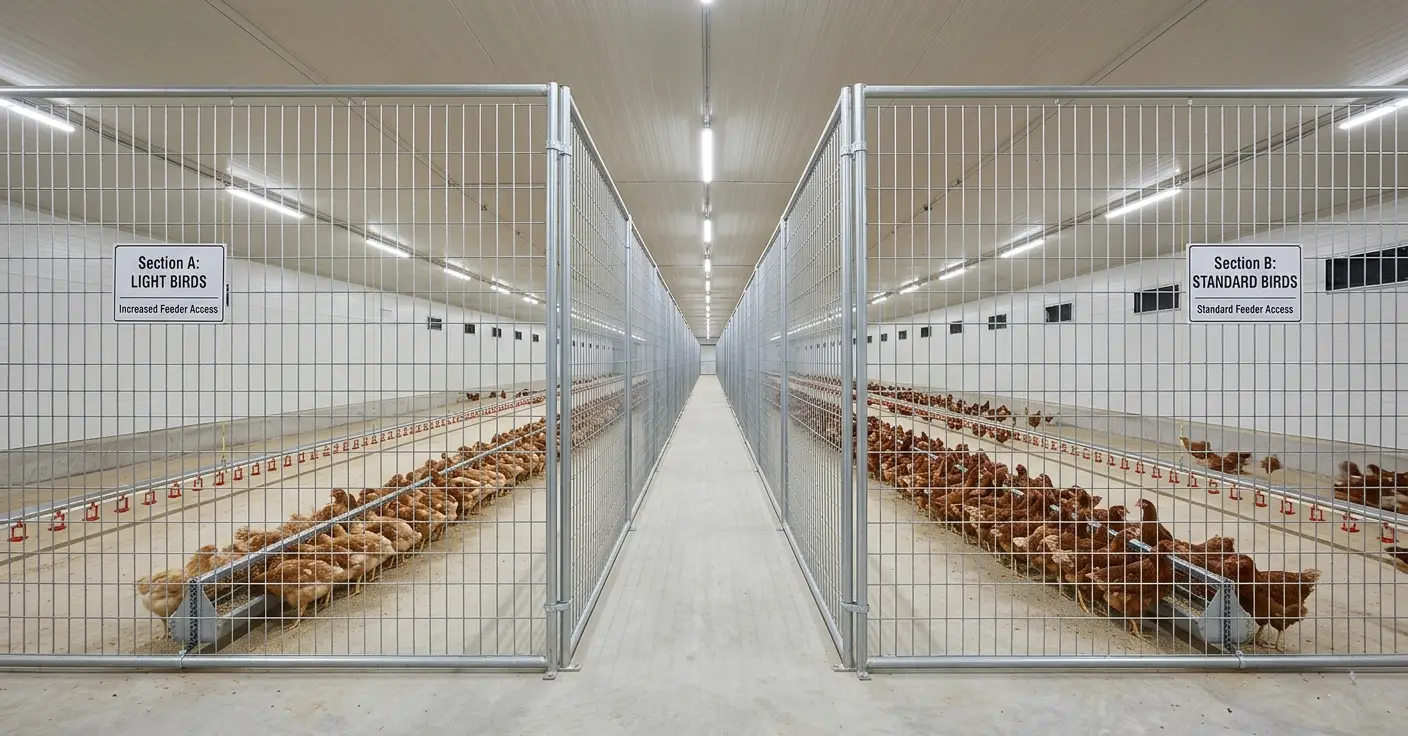
When uniformity falls below 80% at any weighing point, passive feeding adjustments alone are insufficient. The flock must be graded — physically separated by body weight into groups that receive differentiated feeding programs.
How to Grade a Pullet Flock
Grading is typically done at week 5–6 (first grading window) and again at week 10–12 if uniformity has not recovered. The process:
- Weigh every bird in the section to be graded (or weigh a sample first to establish cutoff weights)
- Establish three weight categories:
- Heavy birds: More than 10% above average
- Average birds: Within ±10% of average
- Light birds: More than 10% below average
- Separate each category into distinct pens or house sections
- Apply differentiated feeding protocols to each group
Feeding differentiation by grade:
| Group | Feed Adjustment | Duration |
|---|---|---|
| Light birds | Increase feed allocation by 10–15%; higher protein ration if possible | Until the weight gap closes to within 10% of the average group |
| Average birds | Maintain standard breed schedule and feed allocation | Ongoing |
| Heavy birds | Reduce feed allocation by 5–10%; maintain protein; do NOT restrict to the point of nutrient deficiency | Until weight normalizes |
The goal of grading is to compress the weight distribution — accelerate the light birds, slow the heavy ones — until the three groups can be reunited within a uniform weight band. Reunification typically occurs 3–4 weeks after grading when the groups’ average weights have converged.
Never attempt to correct poor uniformity by restricting feed to the entire flock. Restricting the whole flock depresses average weight without improving the spread between heaviest and lightest birds — and it may push already-light birds into a nutrient deficit from which they cannot recover.
Body Weight Targets by Phase: The Benchmarks That Matter
Uniformity without a weight target is meaningless. Birds that are 85% uniform but consistently 15% below the breed standard body weight at 12 weeks are not a well-managed flock. They are a uniformly underfed one.
The following targets apply to the most common commercial brown-egg layer breeds used in West and Central Africa (Lohmann Brown Classic, Hy-Line Brown, ISA Brown). Verify against your specific breed supplier’s management guide.
| Age (Weeks) | Target Body Weight (g) | Uniformity Target |
|---|---|---|
| 4 | 320–350 | ≥ 85% |
| 6 | 480–520 | ≥ 85% |
| 8 | 660–720 | ≥ 82% |
| 10 | 860–940 | ≥ 82% |
| 12 | 1,060–1,150 | ≥ 80% |
| 14 | 1,240–1,340 | ≥ 80% |
| 16 | 1,420–1,540 | ≥ 80% |
| Transfer (17–18 wks) | 1,550–1,650 | ≥ 80% |
Falling below target weight at any two consecutive weighing points is a trigger for immediate ration or feed access review — not a reason to wait and see.
The Body Weight–Sexual Maturity Relationship
The most important reason to manage pullet weight uniformity is the direct relationship between body weight at sexual maturity and laying performance.
Sexual maturity in commercial layer pullets is triggered by a combination of photoperiod stimulus and body weight. When light is increased to stimulate lay onset at 17–18 weeks, the flock’s reproductive response depends entirely on whether individual birds have reached the minimum body weight threshold for their breed — typically 1,450–1,550g for brown-egg commercial hybrids.
Light birds below the threshold at the time of light stimulation respond to the photoperiod signal with an immature reproductive tract. They produce a first egg that is underweight, may prolapse due to inadequate pelvic development, and enter the laying cycle with a compromised production trajectory that they will not recover from.
Heavy birds above the threshold are at risk of excessive fat deposition in the abdominal cavity, which physically compresses the oviduct and reduces peak laying rate. Overfat pullets also show higher rates of double-yolk eggs early in the cycle — not a market advantage in most commercial contexts.
Birds at target weight respond to light stimulation with a fully developed reproductive tract, enter lay with appropriately sized eggs, and drive the flock’s production curve toward its genetic potential.
This is why uniformity is a production metric. When 85% of the flock is at target weight at the point of light stimulation, 85% of the flock enters lay as productive birds simultaneously. When uniformity is 65%, only 65% of the flock is ready, and the remaining 35% is either too early or too late.
Pre-Transfer Assessment: The Final Uniformity Check
The pre-transfer assessment at week 16–17 is the last opportunity to make management corrections before birds move to the laying house. It is one of the most important assessments in the entire rearing cycle and one of the most frequently skipped.
What to Assess Before Transfer
Body weight and uniformity: Confirm that average weight is within 5% of breed target and that uniformity is at or above 80%. If uniformity is below 80% at this stage, delay light stimulation by one week and increase feed allocation for light birds during that week. Transferring a non-uniform flock and hoping the laying house corrects the problem is not a strategy — the laying house cannot fix what rearing failed to build.
Frame development (shank length): Shank length is a proxy for skeletal frame size independent of fat or muscle mass. A pullet with adequate body weight but short shank length is carrying the weight in fat, not frame — an overfat bird at risk of reproductive problems. Target shank length of 98–108 mm for most commercial brown-egg breeds at week 16.
Sexual maturity indicators: Comb and wattles should be reddening and enlarging in response to increasing feed intake and approaching light stimulation. A flock at 17 weeks with pale, underdeveloped combs is physiologically behind schedule. Delay light stimulation, maintain feed on the rearing program, and re-assess in one week.
Uniformity of development, not just weight: In a flock with good weight uniformity but poor development uniformity — some birds reddening, others still pale and immature — the uniformity coefficient understates the true spread. Assess a sample of 50 birds visually and record the percentage showing clear signs of sexual maturity onset. Below 60% showing visible maturation signs at week 17 indicates the flock is not ready for light stimulation, regardless of body weight data.
Feeding Strategy Through the Rearing Period
Pullet feeding is not a single program. It is a sequence of rations matched to the bird’s changing nutrient priorities across four distinct phases.
Phase 1 — Starter (Week 1–6): Crude protein 18–20%, ME 2,800–2,900 kcal/kg. Support early gut development and skeletal growth and libitum access.
Phase 2 — Grower (Week 7–12): Crude protein 15–16%, ME 2,750–2,850 kcal/kg. Skeletal frame development is the priority. Controlled feeding — not restriction, but accurate allocation matched to breed weight targets — prevents excess fat deposition during this phase.
Phase 3 — Developer (Week 13–16): Crude protein 14–15%, ME 2,700–2,800 kcal/kg. Reduced protein prevents premature stimulation of reproductive development before the skeleton is ready. Calcium is kept low (0.9–1.0%) during this phase — high calcium before lay onset damages the kidneys in young pullets.
Phase 4 — Pre-lay (Week 17–18): Crude protein 17–18%, ME 2,800–2,900 kcal/kg. Calcium increases to 2.0–2.5% to begin building a calcium reserve in bone before the full laying ration is introduced. This phase bridges the developer ration and the full layer ration and prevents the skeletal calcium depletion that occurs when birds are moved directly from a low-calcium developer to a high-calcium layer ration.
Common Uniformity Mistakes and How to Avoid Them
Weighing too infrequently. Monthly weighing catches problems four weeks after they started. Weekly weighing catches them in time to correct. The cost of a weekly weighing program is one hour of labor. The cost of discovering poor uniformity at week 14 with no time to correct it is a production cycle of underperformance.
Averaging the average. Recording only means flock weight misses the spread entirely. A flock averaging 1,400g could be 90% uniform or 60% uniform — the average cannot tell you. Always record and analyze the full weight distribution.
Grading is too late. Grading at week 12 or 13 is largely ineffective because the remaining rearing time before transfer is insufficient to close a large weight gap. Grading must happen at week 5–6 when there are 10–12 weeks of rearing time left to bring light birds up to target.
Using feed restriction to correct overweight birds. Restricting feed to overfat pullets without maintaining protein and micronutrient density produces birds that are lighter but nutritionally deficient. Reduce energy density (lower the fat or oil content of the ration) before reducing total feed volume.
Ignoring water as a uniformity driver. Every uniformity investigation that does not include a drinker pressure check at both ends of the house is an incomplete investigation. Correcting feeders while leaving uneven water access in place will not close the weight gap.
Pullet weight uniformity is the single most controllable predictor of laying flock performance. It is built through weekly measurement, honest data analysis, early grading when uniformity degrades, differentiated feeding for graded groups, equalized feed and water access across the entire house, and a pre-transfer assessment that confirms the flock is genuinely ready before light stimulation begins.
The laying cycle is 52 weeks long. The rearing period that determines how well those 52 weeks perform is 17 weeks long. The uniformity decisions that shape the rearing outcome are mostly made in the first 12 weeks.
A uniform flock at transfer is not luck. It is a week-by-week management record. And it shows up — every single day — in the egg count.