Water is the first nutrient a layer hen consumes every morning and the last she consumes before the lights go out. It is the medium through which every metabolic reaction in her body occurs — nutrient transport, temperature regulation, eggshell calcification, kidney function, and immune response. She consumes 1.7–2.0 times more water by weight than feed every day of her productive life.
It is also the nutrient that most commercial layer farmers in West and Central Africa test least frequently, manage least deliberately, and blame last when production underperforms.
That sequence neglects first, investigates last, and is expensive. Poor water quality does not announce itself with acute mortality or obvious clinical signs. It suppresses production quietly: egg size trending 3–5 grams below breed standard, laying rate plateauing 8–10% below genetic potential, shell quality declining faster than expected in late lay, and antibiotic treatments producing incomplete recovery because the water line delivering the treatment is the source of the pathogen load. By the time the investigation reaches water quality, the production losses have been running for weeks or months.
This article makes the case that water quality is a primary production input — not a background condition — and covers every variable in drinking water that directly affects egg size, laying rate, shell quality, and overall flock performance in commercial layer operations.
Why Water Intake Drives Egg Size Directly
The relationship between water intake and egg size is not indirect or theoretical. It is physiological and measurable.
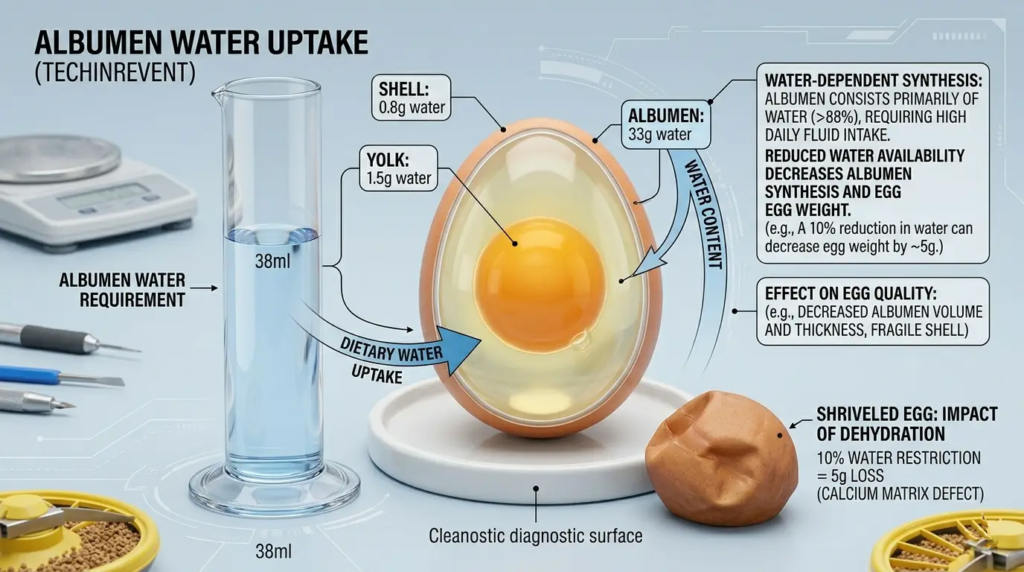
An egg is approximately 74% water by weight. The albumen (egg white) — which constitutes 58% of the egg’s total weight — is 88% water. Producing a 65-gram egg requires the oviduct to secrete approximately 35–38 mL of water into the albumen during the 3-hour magnum transit phase of egg formation.
That water comes entirely from the hen’s blood plasma, which is replenished by drinking. A hen that drinks less than her physiological requirement — because water is inaccessible, unpalatable, contaminated, or the wrong temperature — produces less albumen, which produces a smaller egg, at a frequency that is directly proportional to the degree and duration of the water deficit.
The Quantified Relationship
Research across multiple commercial layer studies establishes a consistent relationship: a 10% reduction in daily water intake reduces daily egg weight by approximately 3–5 grams and reduces laying rate by 2–4 percentage points. These reductions persist for as long as the water restriction continues and require 5–7 days of full hydration to recover, not 24 hours.
In a 5,000-bird flock producing 65-gram eggs at 90% lay rate, a 10% reduction in water intake costs:
- 5,000 × 0.9 × 3g = 13,500 grams of egg weight per day — eggs grading into a smaller, lower-value category
- 5,000 × 2% = 100 fewer eggs per day
At typical commercial egg pricing in Cameroon and Nigeria, that is a daily revenue loss that accumulates rapidly when water quality issues persist for weeks without diagnosis.
The Six Water Quality Parameters That Affect Layer Production
1. pH: The Baseline That Affects Everything Downstream
Water pH determines the chemical environment in which every other water quality interaction occurs. It affects:
- The stability of vaccines and medications administered through drinking water
- The solubility of minerals and the rate of scale formation in drinking lines
- Bacterial growth rates in the water distribution system
- The palatability of water and voluntary intake
Target pH for layer hen drinking water: 6.0–7.5
Water below pH 6.0 is corrosive — it leaches metal from pipe fittings and drinker components, increasing heavy metal contamination in the water supply downstream. It also reduces vaccine stability for drinking water vaccination events. Water above pH 8.0 tastes alkaline to the hen, reducing voluntary intake. Highly alkaline water (pH above 9.0) can cause mild crop impaction and alkalosis in prolonged exposure.
The interaction between pH and water hardness is particularly important: hard water at high pH precipitates calcium carbonate scale inside drinking lines. This scale harbors biofilm — the polysaccharide matrix in which bacterial communities embed themselves and become resistant to chlorination. A drinker line encrusted with scale cannot be adequately sanitized regardless of chlorine dose.
Correction: For acidic water (pH below 6.0), add food-grade sodium bicarbonate to raise pH. For alkaline water (pH above 8.0), use food-grade citric acid or phosphoric acid (water acidifier) at a dose that brings pH to the 6.0–7.0 range. Measure pH monthly and after any change in water source.
2. Total Dissolved Solids (TDS) and Salinity
Total dissolved solids — the combined concentration of all dissolved minerals in water, measured in mg/L or ppm — is an index of water’s overall mineral load. High TDS water places a processing burden on the kidney and may reduce water palatability. Very low TDS water (soft water) can have its own implications for mineral balance if it is the primary mineral delivery route.
TDS thresholds for layer production:
| TDS Level (mg/L) | Classification | Production Impact |
|---|---|---|
| Below 1,000 | Excellent | No restriction |
| 1,000–2,000 | Satisfactory | Monitor; acceptable for most flocks |
| 2,000–3,000 | Moderate concern | May reduce water intake in heat-stressed birds |
| 3,000–5,000 | Poor | Significant reduction in water intake; avoid if possible |
| Above 5,000 | Unacceptable | Not suitable for layer production |
High sodium specifically — from saline groundwater, which is common in some areas of coastal West Africa and the Sahel zone — suppresses water intake and increases renal stress. Sodium above 50 mg/L in drinking water contributes to total sodium intake in ways that are not accounted for in the ration formulation. When layer hens receive high dietary sodium from the feed and high sodium from contaminated water simultaneously, the combined load can reach levels that cause excessive water intake (polydipsia), wet litter, footpad dermatitis, and increased ammonia production — all of which suppress production through independent pathways.
3. Bacterial Contamination: The Silent Production Suppressor
Total bacterial count (TBC) in drinking water is the parameter most directly associated with production loss in commercial layer flocks. Yet it is the parameter most rarely tested in the West African commercial layer sector.
Acceptable bacterial standards for poultry drinking water:
| Organism | Maximum Acceptable Count | Notes |
|---|---|---|
| Total bacterial count (TBC) | < 100 CFU/mL | At point of consumption (drinker level) |
| Total coliforms | < 50 CFU/100 mL | Indicator of fecal contamination |
| E. coli | 0 CFU/100 mL | Presence indicates active fecal contamination |
| Salmonella | 0 (absent in 1L sample) | Zoonotic risk; zero tolerance |
Well water and surface water used without treatment routinely exceed these limits by 10–100-fold in tropical environments. Water tested at the source may appear acceptable; water tested at the drinker — after passing through biofilm-coated lines, nipple fittings that birds contact repeatedly, and bell drinkers that birds walk through — frequently shows counts 20–50 times higher than at the source.
How bacterial load suppresses production without causing visible disease:
Chronic exposure to elevated bacterial loads in drinking water maintains a low-grade immune activation state in the flock — elevated heterophil-to-lymphocyte ratio, elevated corticosterone, and chronic low-level intestinal inflammation. The bird is not clinically sick. She does not show elevated mortality. She simply redirects a portion of her metabolic budget from egg production to immune activation. That diversion costs 3–6% of laying rate and 2–4 grams per egg — quietly, persistently, month after month.
The clinical picture of a flock with contaminated water that has not been investigated is: below-standard production for age, small eggs relative to breed expectations, intermittent loose droppings, antibiotic responses that produce partial improvement followed by relapse when the antibiotic course ends. The antibiotic cleared the pathogen temporarily. The water line reintroduced it within days.
4. Water Hardness: Calcium and Magnesium in the Drinking Water
Water hardness is determined by the concentration of dissolved calcium and magnesium ions. Both are divalent cations that interact with carbonate and sulfate anions to form scale in water distribution systems.
Hardness classification:
| Total Hardness (mg/L as CaCO₃) | Classification |
|---|---|
| 0–60 | Soft |
| 61–120 | Moderately hard |
| 121–180 | Hard |
| Above 180 | Very hard |
Direct effect on layer production:
Calcium in drinking water contributes to total calcium intake — a factor that is not accounted for in most rations’ calcium calculations. In areas with very hard water (calcium above 150 mg/L), the drinking water alone may provide 300–500 mg of calcium per bird per day, 7–12% of the total daily calcium requirement. Rations formulated to standard calcium percentages without accounting for water calcium may be slightly over-supplementing calcium in these areas — an excess that is generally benign, but that matters in precision ration formulation.
More significantly, hard water reduces the efficacy of drinking water vaccination. Calcium and magnesium ions at high concentrations interfere with live vaccine viral replication by denaturing viral surface proteins. A vaccine administered in water with hardness above 200 mg/L without prior water treatment will produce lower and less consistent seroconversion rates than the same vaccine administered in soft or treated water.
Protocol before drinking water vaccination: Add sodium hexametaphosphate (water softener) at 1–2 g/liter to the vaccination water to chelate calcium and magnesium ions. Alternatively, use reverse osmosis-treated water for the vaccination event if available. Always add skim milk at 2–4 g/liter to stabilize the vaccine against residual ions and chlorine simultaneously.
5. Iron and Manganese: The Oxidative Pair
Iron and manganese are two trace minerals that occur naturally in groundwater, particularly in deep borehole water and in water from laterite soil areas common across West and Central Africa. At the concentrations found in untreated groundwater in these regions, both have documented negative effects on layer production.
Iron (Fe):
- Above 0.3 mg/L: Water has a metallic taste that reduces voluntary intake in sensitive birds
- Above 0.5 mg/L: Promotes rapid growth of iron-oxidizing bacteria (Gallionella, Leptothrix) in water lines — these produce a characteristic orange-brown slime biofilm that is particularly difficult to remove with standard chlorination
- Above 1.0 mg/L: Oxidizes to form ferric hydroxide precipitate (rust) that clogs nipple drinkers, produces intermittent flow restriction, and creates red-brown staining that reduces bird willingness to drink from visibly discolored drinkers
- Interacts with vitamin E in the ratio — high dissolved iron acts as a pro-oxidant that degrades vitamin E in water and in the gut, contributing to deficiency even when the ration contains adequate vitamin E
Manganese (Mn):
- Above 0.05 mg/L: Can suppress immune function through interference with manganese-dependent superoxide dismutase (Mn-SOD) regulation when combined with excess manganese
- Above 0.2 mg/L: Contributes to black-brown biofilm in water lines in combination with manganese-oxidizing bacteria
Treatment: Iron and manganese in groundwater require oxidation filtration — an aeration step followed by a sand or catalytic media filter. Chlorination alone does not remove dissolved iron and manganese effectively; it oxidizes them to insoluble forms that then precipitate inside the water line, worsening biofilm conditions. Install iron removal filtration before the drinker line if well water iron exceeds 0.3 mg/L.
6. Nitrates: The Fertility and Stress Signal
Nitrates in drinking water are an indicator of agricultural runoff contamination — fertilizer nitrogen that has leached into groundwater from surrounding farmland. In West Africa’s intensively cultivated peri-urban areas, where most commercial layer farms operate, nitrate contamination of shallow well water is increasingly common.
Nitrate thresholds:
- Below 44 mg/L (as NO₃⁻): Acceptable
- 44–88 mg/L: Moderate concern — monitor and retest quarterly
- Above 88 mg/L: Not suitable; find an alternative water source or treat with reverse osmosis
Nitrates are reduced to nitrites in the avian gut by intestinal bacteria. Nitrites oxidize hemoglobin to methemoglobin — a form that cannot carry oxygen — causing mild chronic oxygen delivery impairment. At subacute nitrate exposure levels (44–88 mg/L range), the clinical picture is not acute methemoglobinemia — it is a flock that appears slightly less active than expected, with marginally depressed feed intake and laying rate that cannot be explained by other factors. Nitrate testing of the water source is rarely considered in this diagnostic picture, which means the cause goes undetected.
Waterline Sanitation: The System That Determines What Gets to the Bird
The water source quality is the starting point. What reaches the bird at the drinker nipple is the endpoint that matters. Between source and nipple, the water passes through storage tanks, distribution lines, pressure regulators, and drinker fittings — each of which is a potential site for contamination introduction, bacterial proliferation, and water quality degradation.
Biofilm: The Persistent Enemy
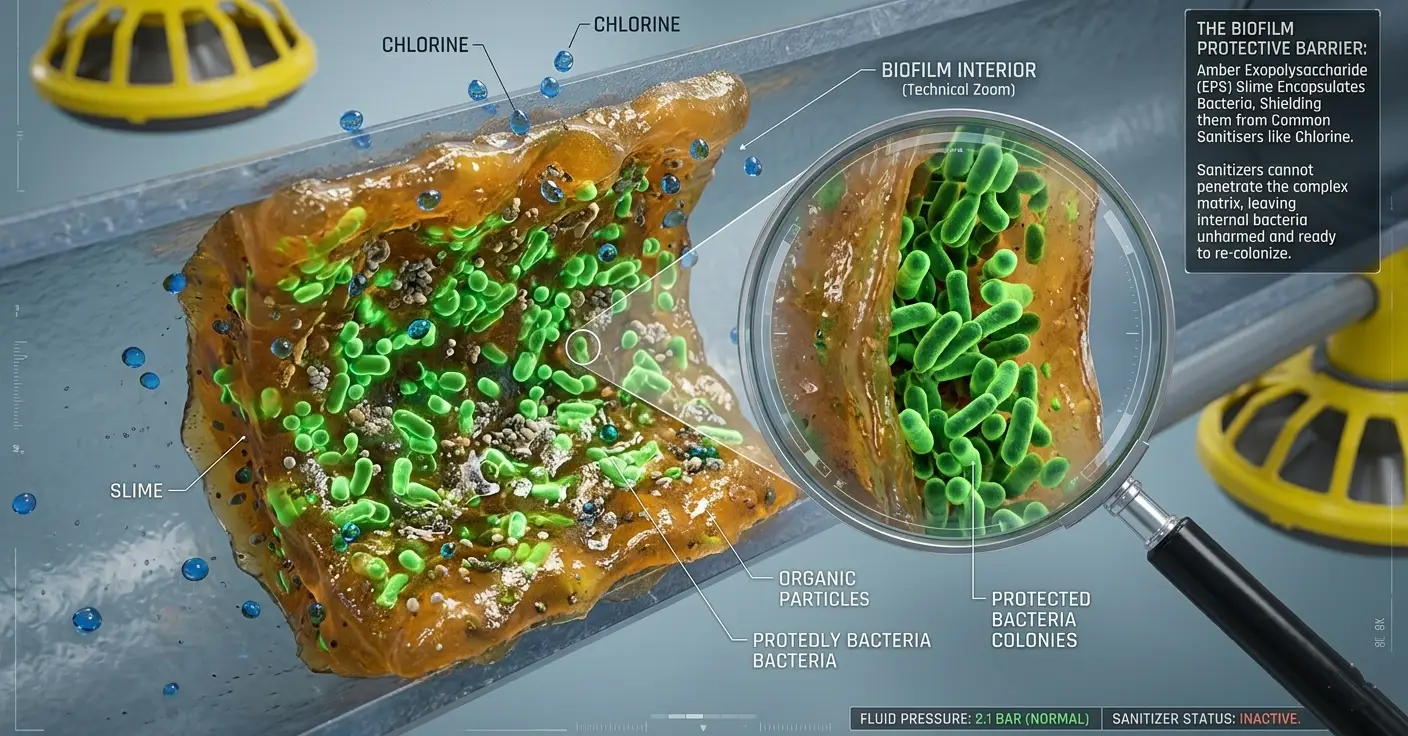
Biofilm is a structured community of microorganisms — primarily bacteria, sometimes fungi — embedded in a self-produced polysaccharide matrix that adheres to the inner surface of water lines. It develops within 24–48 hours of a water line being colonized by even a small number of bacteria and, once established, is dramatically resistant to standard chlorination.
A chlorine residual of 1–2 ppm — the standard recommended level in most poultry water sanitation guidelines — kills planktonic (free-floating) bacteria in the water column. It penetrates biofilm to a depth of approximately 0.1 mm. A mature biofilm may be 0.5–2 mm thick. The bacteria at the center of the biofilm matrix are entirely protected from chlorine at standard residuals. They emerge continuously into the water column, replenishing planktonic bacterial counts within hours of treatment.
This is why flushing waterlines with chlorinated water reduces bacterial counts temporarily — and why they return to previous levels within days without the biofilm being addressed.
Biofilm elimination protocol:
- Flush lines with hot water (above 60°C) at the start of each house cleanout between flocks — heat disrupts biofilm architecture
- Apply a biofilm-penetrating cleaner (hydrogen peroxide at 3–5% concentration, or a commercial peroxygen-based poultry line cleaner) at between-flock cleanout — allow 30–60 minute contact time before flushing
- Follow with a chlorine sanitization at 50–100 ppm (shock chlorination) — much higher than the in-production residual, applied between flocks when birds are not present
- Flush completely before restocking
- Maintain 3–5 ppm free residual chlorine in the water line during production — test at the far-end nipple, not at the header
Drinker Equipment Maintenance
Nipple drinkers that are functioning correctly deliver water at the touch of a bird’s beak. Nipples that are flowing slowly — partially blocked by scale, rust, or biofilm at the valve — create water restriction that the farmer may not detect without individual nipple flow-rate testing.
Nipple flow rate testing: Collect water from 10 randomly selected nipples at the far end of the line (lowest pressure zone) for exactly 60 seconds each. At the target pressure (20–40 mbar for laying hens), each nipple should deliver 40–60 mL per minute. Nipples delivering below 30 mL per minute are partially blocked and will restrict intake in the birds served by that drinker.
Replace nipple drinker components every 2–3 production cycles. The cost of nipple replacement is trivial relative to the production cost of restricted water intake across an entire laying cycle.
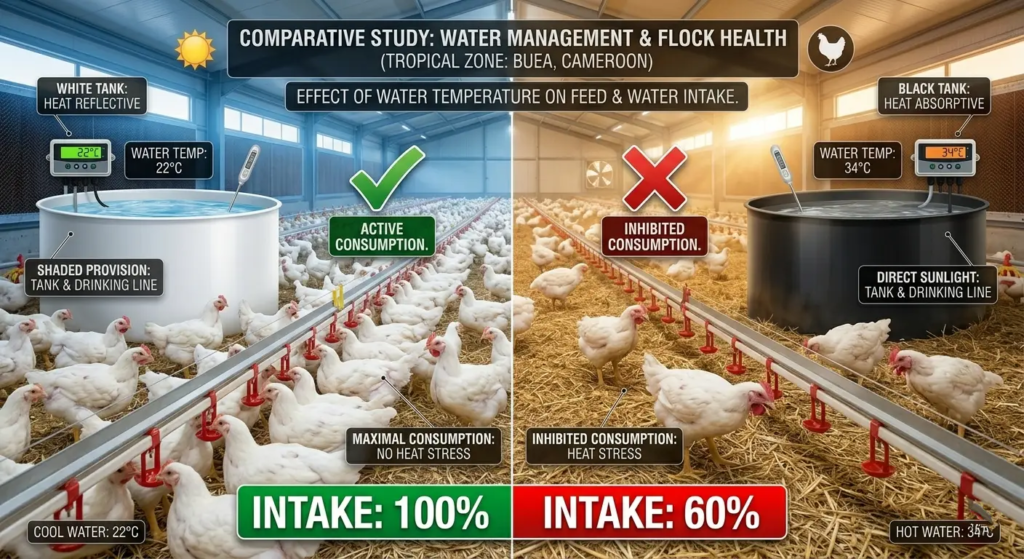
Water Temperature: The Intake Variable Nobody Monitors
Water temperature is the most straightforward water quality parameter to manage and the most consistently ignored. Hens are selective about water temperature in ways that directly affect voluntary intake:
- Water below 10°C (cold dry-season nights in highland areas of Cameroon and Nigeria): Hens reduce intake significantly. Cold water causes a transient reduction in crop temperature that suppresses feed intake alongside water intake — a double reduction in nutrient delivery.
- Water above 30°C (tropical afternoon temperatures in unshaded storage tanks or overhead lines): Palatability drops sharply. Hens drink less voluntarily. The bacteria-temperature relationship also means that water held at 28–35°C in a drinker line supports bacterial proliferation at 4–8× the rate of water at 20°C.
Target water temperature at the drinker: 10–25°C.
Practical measures for thermal management of drinking water in tropical operations:
- Insulate overhead water lines and storage tanks with reflective foil wrap or paint tanks white to reduce solar heating
- Flush lines at the start of the active day to replace thermally elevated standing water with cooler water from the source
- Position water storage tanks in shade or inside the house rather than on the roof in direct sunlight
- If water temperature exceeds 28°C at the nipple during peak afternoon hours, flush lines twice during the afternoon to keep temperature below the palatability threshold
Water Testing: The Minimum Monitoring Program
Water quality testing is not a laboratory exercise reserved for when problems appear. It is a routine monitoring program that provides the data needed to make informed decisions about treatment, sanitation, and ration adjustment.
Minimum Testing Frequency and Parameters
| Parameter | Test Method | Testing Frequency | Acceptable Range |
|---|---|---|---|
| pH | Portable pH meter or test strips | Monthly | 6.0–7.5 |
| Total bacterial count | Laboratory culture | Quarterly (at drinker) | < 100 CFU/mL |
| Total coliforms / E. coli | Laboratory culture | Quarterly | 0 E. coli |
| Total dissolved solids | TDS meter (in-house) | Monthly | < 1,000 mg/L |
| Total hardness | Test kit or laboratory | Every 6 months | < 180 mg/L |
| Iron | Laboratory or field test kit | Every 6 months | < 0.3 mg/L |
| Nitrate | Laboratory or field test kit | Every 6 months | < 44 mg/L |
Where to sample: Always sample at the point of consumption — at the far-end nipple or the furthest bell drinker from the header — not at the source or at the header. The far-end nipple is the worst-case point in the system: lowest pressure, longest residence time, most biofilm exposure. If the far-end sample is acceptable, the rest of the system is acceptable. If source water is tested without the distribution system being included, contamination introduced by the line is invisible.
Field Testing vs. Laboratory Testing
pH, TDS, and temperature can be measured reliably with affordable field instruments — a digital pH meter (under $30) and a TDS/EC meter (under $20) provide actionable data in seconds. Every commercial layer operation should have both instruments and use them monthly without exception.
Bacterial culture — TBC, coliforms, E. coli — requires laboratory incubation and cannot be done reliably in the field. In Cameroon, Nigeria, and Ghana, veterinary diagnostic laboratories and some private agricultural laboratories offer water bacteriology testing. The cost of quarterly bacterial water testing is a small fraction of one day’s production loss from a contaminated water supply.
Water Treatment Options for West African Layer Operations
Not every operation has access to clean municipal water. Most commercial layer farms in West and Central Africa rely on borehole wells, shallow wells, or surface water — all of which require treatment before they meet the standards above. The following options are available at different capital and operating cost points:
Chlorination (most common, lowest cost): Sodium hypochlorite (bleach) at 5.25–6% active chlorine added to achieve 3–5 ppm free residual at the far-end nipple. Requires testing the residual — not just the dose — because chlorine demand varies with organic load, pH, and temperature. Calcium hypochlorite (granular chlorine, 65–70% active) is more stable in tropical conditions than liquid bleach, which degrades rapidly in heat and sunlight.
Acidification: Water acidifiers (citric acid, phosphoric acid, or commercial poultry water acidifier products) reduce pH to 5.5–6.5, which suppresses bacterial growth, improves vaccine stability for vaccination events, and reduces scale formation in hard water areas. Can be used alongside chlorination for enhanced biofilm control.
Ultraviolet (UV) sterilization: UV units installed in-line kill planktonic bacteria without chemical residue. Effective for continuous disinfection of clear water, but fails in turbid or high-iron water (particles shield bacteria from UV exposure). Does not address biofilm in the downstream lines. Best used in combination with filtration and periodic chlorine shock treatment.
Reverse osmosis (RO): The most complete water treatment for high-TDS, high-hardness, or nitrate-contaminated sources. Removes dissolved minerals, bacteria, and organic contaminants to near-zero levels. High capital cost and ongoing membrane replacement cost. Appropriate for operations where water quality is severely compromised, and no alternative source is available.
Summary
Water is the most consumed nutrient in layer production. Its quality determines how much albumen the hen can secrete per egg, how efficiently the immune system functions, how effectively vaccines are absorbed, how reliably the kidney regulates blood calcium, and how many hours per day the bird voluntarily approaches the drinker.
Every deviation from the targets in this article — pH outside range, bacterial count above threshold, iron above 0.3 mg/L, water temperature above 28°C, nitrate above 44 mg/L — costs production. Not catastrophically, in most cases. Quietly. Persistently. In ways that look like feed problems, breed underperformance, or late-lay decline — until the water supply is tested and the data tells the real story.
Test the water at the nipple. Test it quarterly. Fix what is out of range before the investigation reaches feed, genetics, or management — because in most cases, when production is below what it should be, and nothing obvious is wrong, the water line is where the answer is.