Point of lay is not a date on a calendar. It is a biological state — a convergence of skeletal maturity, reproductive tract development, hormonal readiness, and behavioral change that signals the pullet is physiologically prepared to begin producing eggs.
The calendar is a guide. The bird is the data.
A flock managed on schedule but assessed only by age will miss what the birds are actually telling. Some flocks reach the point of lay at week 16. Some are not ready until week 20. The difference between stimulating a ready flock and stimulating an unready one is the difference between a production curve that climbs cleanly to peak and one that staggers, plateaus prematurely, or produces excessive early-cycle problems — small first eggs, prolapse, poor shell quality, low peak rate — that define the entire laying cycle’s economic outcome.
Recognizing the point of lay maturity requires reading a constellation of signs simultaneously: physical changes in the comb and wattles, skeletal pelvic changes, body weight relative to breed standard, behavioral shifts in nesting and social activity, and the condition of the vent and oviduct. No single sign is sufficient. All of them together give a reliable picture of where the flock stands reproductively.
This article covers each sign in detail — what it looks like, what it means biologically, and what to do when the signs are inconsistent or absent.
The Hormonal Cascade That Drives the Point of Lay
Before reading the signs, understand what is producing them. Every visible indicator of point of lay maturity is an external manifestation of an internal hormonal cascade — and understanding the cascade explains why the signs appear in the sequence they do.
As the rearing photoperiod increases — either naturally as days lengthen in seasonal environments, or through artificial light stimulation in controlled houses — the suprachiasmatic nucleus in the hypothalamus detects the change in day length through extra-retinal photoreceptors in the brain. This detection triggers the release of gonadotropin-releasing hormone (GnRH) from the hypothalamus.
GnRH reaches the anterior pituitary gland, which responds by releasing follicle-stimulating hormone (FSH) and luteinizing hormone (LH). FSH stimulates follicular development in the ovary — the hierarchical arrangement of yellow yolk-filled follicles that will become eggs. LH triggers ovulation of the largest mature follicle.
Simultaneously, the developing follicles produce estrogen, which drives the secondary changes visible from the outside: comb and wattle development, pelvic widening, vent enlargement, and behavioral changes associated with reproductive activation. Estrogen also triggers medullary bone development — the calcium reserve that the hen will draw on during shell calcification.
Every sign discussed in this article is a downstream effect of this hormonal cascade. Reading the signs accurately means knowing which hormone is producing which change and how advanced the cascade is when a particular sign appears.
Sign 1: Comb and Wattle Development
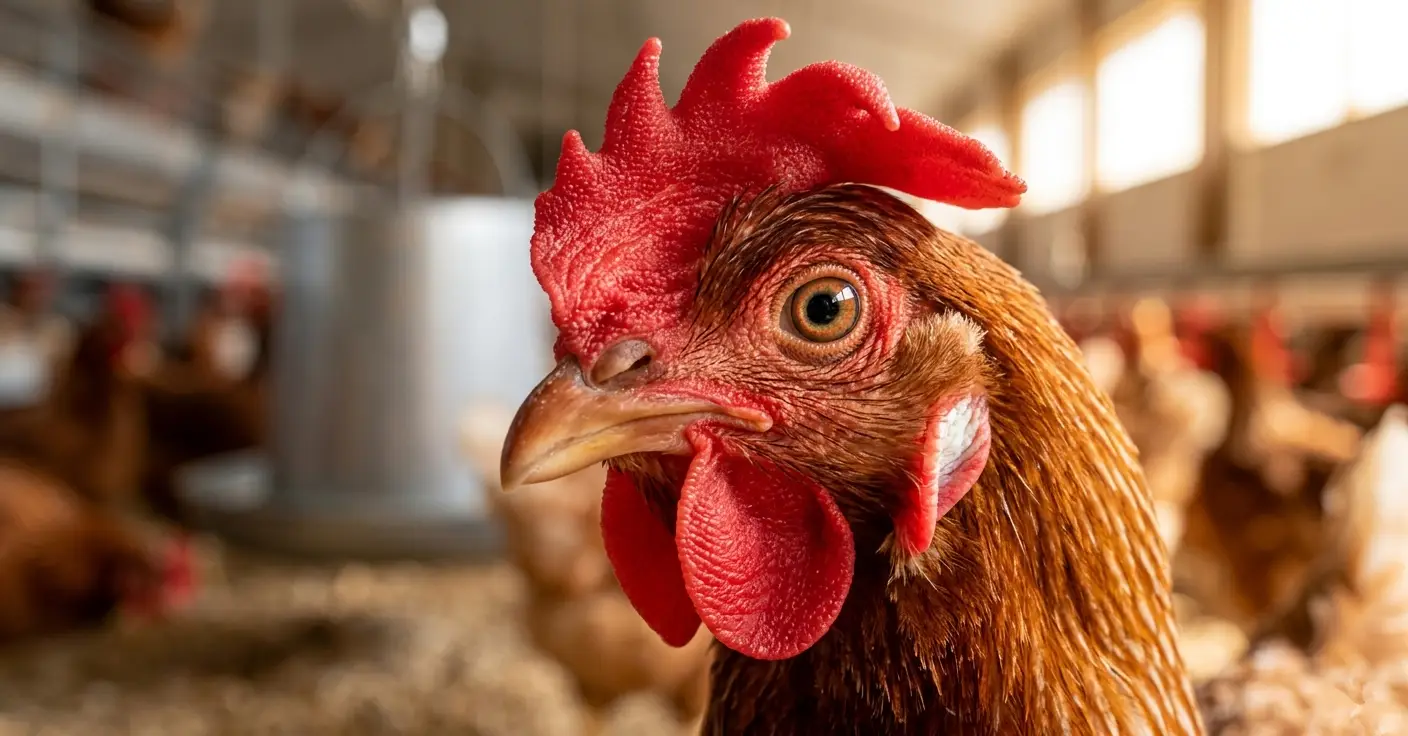
The comb and wattles are the most visible and most reliably read indicators of reproductive maturity in commercial layer breeds. They are responsive to estrogen — which rises progressively as follicular development advances — and their size, color, and texture change in a predictable sequence as the bird approaches the point of lay.
What to Look For
Color progression: In a pre-pubertal pullet, the comb is pale pink or pale red, small, and folded flat against the head. As estrogen levels rise in the weeks preceding lay, the comb develops a progressively deeper red color driven by increased blood flow to the highly vascularized comb tissue. By the time of the first egg, the comb of a commercially mature brown-egg layer breed should be bright scarlet to deep red — not pink, not dark crimson, but the vivid medium red that indicates peak blood flow and estrogen-driven vascularization.
Size progression: The comb more than doubles in size during the 3–4 weeks preceding the first egg. A comb that is large relative to the bird’s head and falls to one side (a “falling comb” or “floppy comb”) in single-comb breeds is characteristic of full maturity — the comb has grown large enough that it cannot stand upright.
Wattle development: Wattles (the paired fleshy lobes below the beak) follow the same estrogen-driven development pattern as the comb, but are slightly less sensitive indicators. Fully developed wattles are large, plump, and bright red. Underdeveloped wattles — small, pale, or shriveled in appearance — indicate that estrogen levels have not reached the reproductive maturity threshold.
Temperature: A mature comb is noticeably warm to the touch — reflecting the increased blood flow driven by estrogen vasodilation. A cold or cool comb in a bird at the target body weight is a sign that reproductive activation has not occurred.
What Inconsistency Means
A flock with 30% bright red, falling combs and 70% pale, upright combs at week 17 is not a flock at point of lay — it is a flock with 30% of birds at point of lay and 70% behind schedule. This is a uniformity problem with a reproductive consequence: early-maturing birds will begin laying while the majority of the flock is still pre-pubertal, creating a long, drawn-out lay onset that suppresses peak production.
Sign 2: Pelvic Width — The Mechanical Readiness Check
The pelvis is a structural indicator of reproductive maturity that is independent of hormonal status. It reflects the skeletal remodeling that prepares the bird’s body to pass an egg — approximately 4–5 cm in diameter — through the vent without trauma.
How to Measure Pelvic Width
Place the bird on a flat surface or hold it firmly with one hand. Insert two fingers (index and middle) between the two pelvic bones — the sharp-tipped pubic bones located on either side of the vent. The gap between these two bones is the pelvic width.
Interpretation:
| Pelvic Width | Fingers | Reproductive Status |
|---|---|---|
| Less than 2 finger-widths | 0–1 | Pre-pubertal; not ready for lay |
| 2 finger-widths | 2 | Approaching maturity; 1–3 weeks from first egg |
| 3 finger-widths | 3 | Sexually mature; first egg imminent or already laying |
| 4+ finger-widths | 4+ | Fully active laying; may have already laid several eggs |
Pelvic bones that are flexible and slightly mobile (rather than rigidly fused) indicate active skeletal remodeling driven by estrogen-mediated calcium mobilization — another sign of advancing maturity.
This assessment should be conducted on a minimum of 50 birds, randomly selected from across the house, at week 16 and again at week 18. A flock where fewer than 60% of sampled birds show 2+ finger-width pelvic separation at week 17 is not ready for light stimulation — stimulating an immature flock forces unready birds into production before their pelvis can safely pass an egg, directly increasing prolapse rate.
Sign 3: Vent Appearance and Oviduct Development
The vent — the shared external opening of the reproductive and excretory tracts — changes significantly in size, shape, moisture, and color as the oviduct develops and reproductive cycling begins.
Pre-Pubertal Vent
In a pre-pubertal pullet, the vent is small, dry, round, and pale pink to pale yellow in color. The oviduct behind it is a thin, undeveloped tube. There is no follicular development in the ovary beyond small, immature white follicles (the “white follicle hierarchy”).
Mature Vent at Point of Lay
In a pullet approaching first egg, the vent is significantly enlarged, moist, and oval rather than circular in shape — reflecting the oviduct’s development from a thin tube to a muscular, functional organ capable of passing an egg. The vent color deepens to a moist, bright pink or reddish-pink. The skin surrounding the vent is loose and pliant rather than tight, accommodating the mechanical demands of egg laying.
Gently everting the vent (applying light pressure to the surrounding tissue) in a mature pullet reveals a moist, pink oviduct opening. In a pre-pubertal pullet, eversion reveals a dry, small, pale opening.
The Regression Sign
A vent that was large and moist and has become dry, pale, and small again — in a bird that was previously identified as approaching lay — indicates reproductive regression. This occurs when a stressor (disease, feed deprivation, temperature shock, light disruption) has suppressed the hormonal cascade. Regression after apparent maturity onset is a warning sign that the production environment has disrupted reproductive development and requires investigation before light stimulation is applied.
Sign 4: Body Weight and Condition at Point of Lay
Reproductive maturity requires a minimum body weight threshold. Below that threshold, the hormonal cascade cannot complete — the hypothalamic-pituitary-ovarian axis does not activate fully without adequate metabolic reserves signaling to the neuroendocrine system that the bird has sufficient energy and protein stores to sustain egg production.
Breed-Specific Body Weight Targets at POL
| Breed | Target Body Weight at First Egg |
|---|---|
| Lohmann Brown Classic | 1,600–1,700g |
| Hy-Line Brown | 1,550–1,650g |
| ISA Brown | 1,550–1,650g |
| Lohmann LSL (white egg) | 1,350–1,450g |
| Bovans Brown | 1,600–1,700g |
Birds below 90% of target body weight at the time of light stimulation will produce smaller first eggs, show lower peak production rates, and have compressed productive life compared to birds at or above target weight. The body weight threshold is not aesthetic — it reflects the metabolic minimum required to sustain daily calcium deposition, oviduct function, and maintenance simultaneously.
Body Condition Scoring
Body weight alone does not distinguish between a well-muscled bird at target weight and an overfat bird at the same weight. Body condition scoring — a hands-on assessment of breast muscle coverage and abdominal fat deposition — adds this distinction.
Breast muscle assessment: Run the thumb along the keel bone (sternum). In a bird with good body condition, the keel is covered by a firm, moderately thick layer of breast muscle on both sides. In an underconditioned bird, the keel is sharp and prominent with minimal muscle coverage. In an overconditioned bird, the keel is buried under a thick, soft fat layer.
Abdominal fat assessment: Gently palpate the abdomen between the keel and the vent. A moderate layer of soft tissue indicates appropriate energy reserves. An excessively thick, doughy abdominal fat pad indicates overconditioned birds at risk of fatty liver syndrome and reduced reproductive performance. A concave, empty abdomen in a bird at target weight indicates muscle rather than fat as the weight carrier — generally positive for reproductive performance.
Sign 5: Behavioral Changes Preceding First Egg
Behavioral observation is the most continuous and lowest-cost assessment tool available to the layer farmer. Pullets approaching the point of lay change their behavior in observable, predictable ways — and these behavioral changes can be monitored daily without individual bird handling.
Nest-Seeking Behavior
In the 3–7 days before a pullet lays her first egg, she begins spending increasing time in exploratory walking, investigating potential laying sites — corners, darkened areas, lower cage levels, or nest box locations. This behavior is driven by the progesterone surge that accompanies the pre-ovulatory LH surge and signals that follicular maturation is complete.
In a flock approaching the point of lay, this nest-seeking behavior appears as increased restlessness and purposeful movement during the mid-morning hours (08:00–12:00) — the natural peak laying window. Birds that were previously resting or feeding at these hours begin moving systematically through the house.
Increased Vocalization
The pre-laying call — a distinctive, repetitive clucking pattern different from normal flock vocalization — increases in frequency and volume as first-egg production begins. Individual birds producing this call have typically laid or are about to lay within 30–60 minutes. When this call appears in 10–20% of the flock simultaneously, lay onset is underway.
Changes in Social Structure
As estrogen rises, dominance behaviors intensify temporarily before stabilizing. There is often increased sparring, displaced feeding behavior, and competition for roosting positions in the days surrounding lay onset. This behavioral turbulence is normal and self-limiting — it resolves within 1–2 weeks as the flock’s social hierarchy reestablishes around the new energy demands of laying.
Increased Feed and Water Intake
A pullet approaching first egg increases her feed intake by 5–10% above the rearing phase average as her energy and protein demands for oviduct function, shell calcification, and increased metabolic rate kick in. Monitoring daily feeder consumption — and noting when consumption begins increasing beyond the expected trajectory for age — provides a flock-level early signal that reproductive activation is underway.
Sign 6: The Laying Sequence Check — First Eggs as Maturity Confirmation
The first eggs a pullet produces tell you more about her reproductive readiness at the point of lay than any pre-lay assessment can.
Small, Irregular First Eggs
The first eggs of a laying cycle are always smaller than the breed standard. In commercial brown-egg breeds, first-egg weight is typically 45–50g, rising to 58–62g by week 6 of lay and 63–68g by peak lay. A percentage of first eggs that are excessively small — below 40g — or irregular in shape (wrinkled shells, thin shells, no shell) indicates that a portion of the flock was stimulated into lay before the oviduct was fully mature.
Soft-shelled or shell-less first eggs in more than 5% of the first-week production indicate either a pre-lay ration calcium failure (the bird began laying before her medullary bone reserve was built) or premature light stimulation of an immature flock.
Double-Yolk Eggs
A cluster of double-yolk eggs in the first two weeks of lay is normal — it reflects the ovary releasing two follicles within a short interval before the ovulatory cycle fully synchronizes. Double-yolk percentage above 5% in the first month indicates that a high proportion of the flock entered lay with a very rapid follicular maturation sequence — usually a sign of good maturity and adequate pre-lay nutrition.
Production Rate Trajectory
The production rate trajectory in the first four weeks of lay is the ultimate validation of the point of lay assessment accuracy. A correctly stimulated, mature flock reaches 50% production within 10–14 days of first egg and climbs to peak (90–95%) within 4–6 weeks. A flock stimulated prematurely reaches 50% production slowly, peaks lower than the genetic potential, and descends from the peak earlier than expected.
Plotting daily production rate against breed standard curves from week 1 of lay backward confirms whether the point of lay assessment and light stimulation timing were correct — and provides the data to calibrate the next flock’s program more precisely.
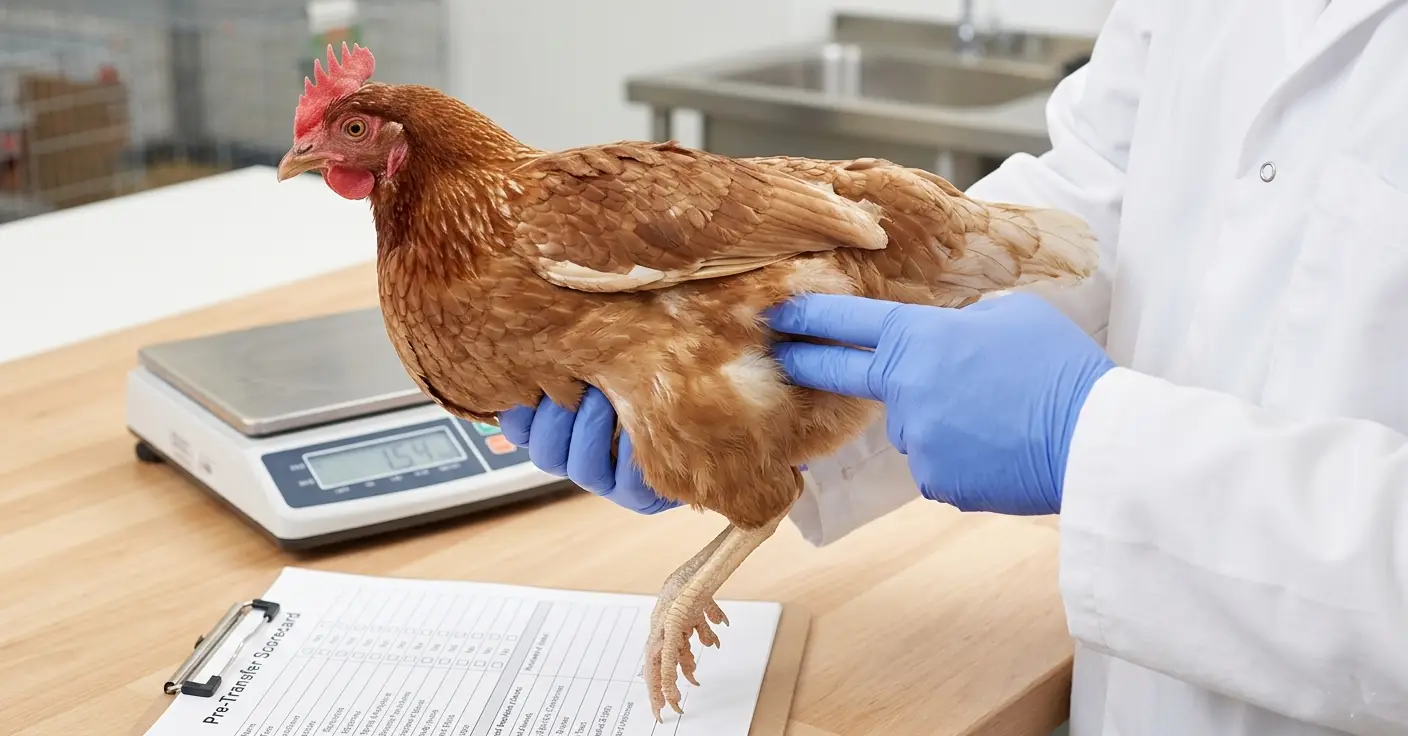
Assessing Flock Readiness: The Pre-Transfer Scorecard
No single sign confirms the point of lay readiness. The assessment must be conducted across the full sign constellation and quantified across a representative flock sample. The following scorecard provides a practical framework for the pre-transfer assessment at week 16–18.
Sample size: Minimum 50 birds, randomly selected from across the full house length and width.
| Assessment | Ready Threshold | Action If Below Threshold |
|---|---|---|
| Comb color | ≥ 70% bright red, falling combs | Delay light stimulation 1 week; review feed program |
| Pelvic width | ≥ 60% showing 2+ finger gap | Delay light stimulation for 1 week; check body weight |
| Vent appearance | ≥ 60% enlarged, moist, oval vents | Review nutrition and photoperiod history |
| Body weight | ≥ 90% of flock within 5% of breed target weight | Increase feed allocation; recheck in 1 week |
| Behavioral signs | Nest-seeking and increased activity are visible during 08:00–12:00 | Monitor daily; do not stimulate until behavior appears |
| Uniformity coefficient | ≥ 80% of flock within ±10% of average weight | Grade and differentially feed before stimulation |
If three or more of these six indicators fall below the ready threshold at week 17, delay light stimulation by one week and recheck. The cost of a one-week delay is trivial. The cost of stimulating an immature flock — compressed peak, high prolapse rate, small first-egg percentage, premature production decline — is carried for the entire 52-week cycle.
When Signs Are Inconsistent: Diagnosing the Problem
A flock at week 18 with poor comb development, narrow pelvic bones, and no nest-seeking behavior is not an anomaly — it is a flock that received a management failure somewhere in the rearing program. Identifying which failure occurred determines the correct response.
Poor comb development despite adequate body weight: Most commonly caused by inadequate light stimulation during the transition phase — insufficient lux intensity, a timer malfunction that reduced the actual photoperiod below the programmed one, or a light-tight failure allowing dark-period disruption. Check the lighting program first.
Adequate comb development but narrow pelvis: Skeletal frame too small for reproductive maturity — typically caused by inadequate mineral nutrition during weeks 1–12, resulting in a bird whose hormonal system is active but whose skeleton has not developed the pelvic width to safely pass an egg. Delay stimulation and do not rush — this is a structural problem that additional weeks of rearing will partially but not fully address.
Good physical signs but no behavioral changes: Consider subclinical disease suppression of reproductive hormone secretion — NDV, Mycoplasma, or a respiratory challenge that is elevating corticosterone and suppressing LH release. Investigate flock health before applying light stimulation.
Correct signs in 30% of the flock, absent in 70%: This is a uniformity problem with a reproductive consequence. The 30% that are ready will lay early; the 70% that are not will be forced into premature lay by the light stimulation designed for the ready birds. Grade the flock if time allows and apply differentiated light stimulation if possible — or accept the production deficit from the unready birds and plan to address uniformity management in the next rearing cycle.
Summary
Point of lay readiness is a biological state confirmed by six concurrent signs: comb and wattle development driven by estrogen, pelvic widening from estrogen-mediated skeletal remodeling, vent enlargement reflecting oviduct development, body weight at breed-standard threshold, behavioral shifts in nesting and social activity, and trajectory of first-egg quality and production rate in the initial weeks of lay.
The flock that is correctly assessed — scored across all six indicators, stimulated only when the threshold is met, transferred with adequate pre-lay nutrition and skeletal maturity — enters its laying cycle positioned to reach genetic peak production.
The flock that is stimulated on schedule regardless of biological readiness enters the same cycle already behind, and it will stay behind for every one of the 52 weeks that follow.
The calendar is a guide. The bird is the data. Read the bird.