In tropical climates, a 2°C spike in house temperature can wipe out 5% of your flock in 4 hours. That is not a worst-case scenario — it is a documented production reality for open-sided house farmers during the dry season.
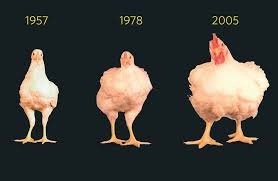
The reason is biological: modern broilers are internal heat engines. The same genetics that make the Cobb 500 convert feed into meat at record speed also generate enormous metabolic heat inside the bird’s body. In a climate-controlled tunnel-ventilated house, that heat is manageable. In an open-sided house on a dry-season afternoon, it kills.
The verdict of this article will prove: While the Cobb 500 wins on speed and FCR in climate-controlled houses, the Ross 308 consistently wins on livability in open-sided tropical houses where power cuts and manual curtains are everyday realities.
Biological Comparison: Metabolism vs. Thermoregulation
Cobb 500 — The Metabolic Heat Problem
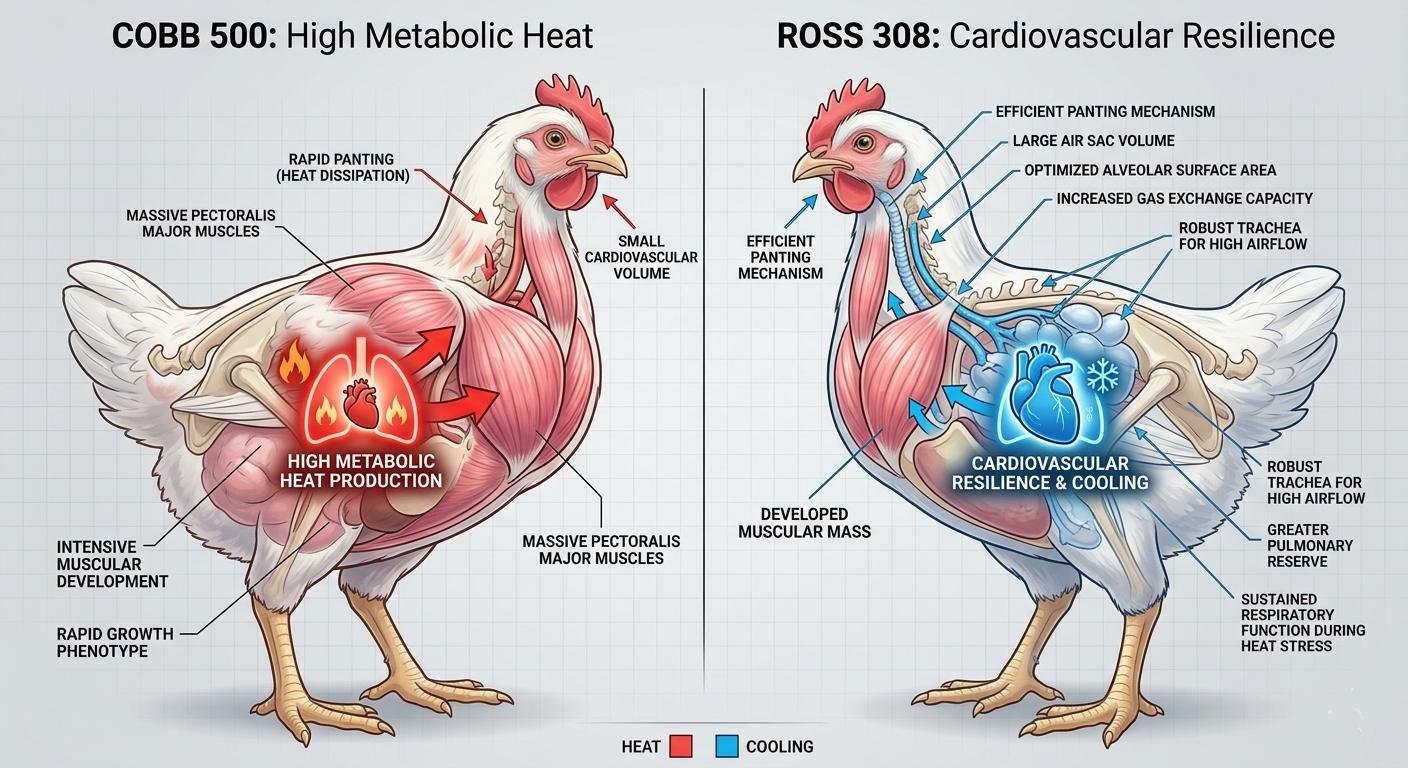
The Cobb 500’s aggressive FCR (1.55–1.65 under optimal conditions) is the direct product of an extremely high-output metabolism. That same metabolic engine generates more internal body heat per kilogram of live weight than almost any other commercial broiler strain.
Above 28°C ambient, this becomes a liability. The bird must divert energy to thermoregulation — primarily panting — while simultaneously growing. Above 32°C, it is producing heat faster than it can dissipate it, and its cardiovascular system begins to fail under the combined load.
Ross 308 — The Cardiovascular Advantage
The Ross 308 carries a well-documented advantage in heart and lung capacity. These are the two organs that matter most when a bird is panting to stay cool.
Panting is a broiler’s primary thermoregulatory tool. It is cardiovascular-intensive — the heart must rapidly pump blood to the lung and skin capillary beds to shed heat through exhaled air. A bird with stronger cardiac and pulmonary capacity sustains this response longer, at higher temperatures, before physiological collapse. That is why Ross 308 mortality figures are consistently lower than Cobb 500 in uncontrolled heat events.
The Feathering Factor
Dense feather coverage is insulation — useful in cold climates, counterproductive in the tropics. Both strains have similar feather development timelines, but management practices that slow early feathering (adjusted brooder temperatures, lower early stocking density) can marginally improve heat dissipation during weeks 3 and 4, when metabolic heat output peaks.
Performance Data at 32°C — Side-by-Side Table
| Performance Metric | Cobb 500 Performance | Ross 308 Performance | Tropical Winner |
| Heat Stress Resilience ($32^{\circ}\text{C}$ – $35^{\circ}\text{C}$) | |||
| Water Intake Ratio | $3.2\times$ – $3.5\times$ baseline | $2.8\times$ – $3.2\times$ baseline | Ross 308 |
| Feed Intake Depression | $18\%$ – $25\%$ drop | $13\%$ – $20\%$ drop | Ross 308 |
| Mortality Risk ($35^{\circ}\text{C}$ for $6$ hrs) | $8\%$ – $14\%$ cumulative | $4\%$ – $9\%$ cumulative | Ross 308 |
| FCR Degradation (Heat) | $+0.15$ to $+0.22$ | $+0.10$ to $+0.16$ | Ross 308 |
| Final Weight Loss to Heat | $180$ – $240\text{ g/bird}$ | $120$ – $180\text{ g/bird}$ | Ross 308 |
| Ideal Condition Performance ($20^{\circ}\text{C}$ – $24^{\circ}\text{C}$) | |||
| FCR (Optimal) | $1.55$ – $1.65$ | $1.62$ – $1.72$ | Cobb 500 |
| Daily Growth Rate | $\sim 78\text{ g/day}$ | $\sim 72\text{ g/day}$ | Cobb 500 |
| Overall Resilience | |||
| Open-Sided House Livability | Lower Resilience | Higher Resilience | Ross 308 |
The pattern is simple: Cobb 500 wins every metric at optimal temperature. Ross 308 wins every metric under heat stress. Your breed decision must be driven by what the thermometer reads inside your house — not what the data sheet says at 20°C.
Environmental Management — The Three Variables That Determine Survival
1. Ventilation: Minimum Air Velocity by Breed
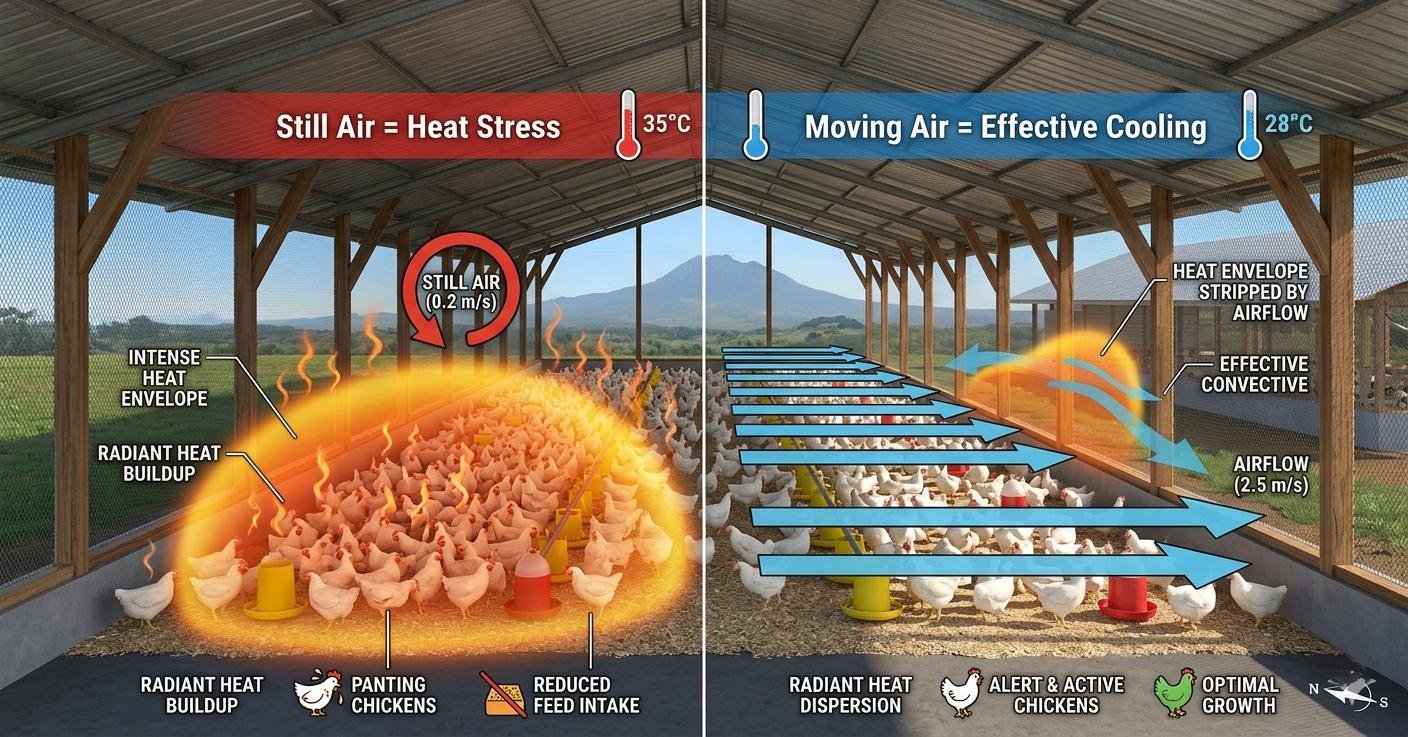
Moving air does not lower the temperature, but it dramatically lowers the effective temperature felt by the bird through increased evaporative heat loss. This wind-chill principle is your most powerful heat management tool.
- Cobb 500 requires a minimum sustained air velocity of 2.5 m/s at bird level at 32°C+ to maintain thermoregulation.
- Ross 308 can maintain acceptable performance at 1.8–2.2 m/s due to its stronger cardiovascular response.
If you cannot guarantee 2.5 m/s reliably in your house — especially during afternoon peak heat — the Ross 308 gives you a meaningful safety margin. Every 0.5 m/s above 1.0 m/s adds approximately 1°C of effective cooling comfort for the flock.
2. Stocking Density — Reduce During the Hot Season
Every bird is a heat generator. Reduce stocking density during peak heat months:
- Cobb 500: Reduce by 15–20% from your cool-season baseline. At 15 birds/m², target 12–13 birds/m² in the dry season.
- Ross 308: Reduce by 10–15% from your cool-season baseline. The lower metabolic heat output gives slightly more headroom, but the reduction is still non-negotiable.
3. Water Temperature — The 24°C Hard Limit
If your drinking water exceeds 24°C, breed choice does not matter. Hot water does not cool birds. Water at 30°C+ consumed in large volumes requires additional metabolic energy to process, potentially worsening heat load.
Check water temperature at the drinker level — not at the header tank — during the afternoon peak. Insulate overhead pipelines. Shade your header tanks. If your water is routinely above 24°C, you have an infrastructure problem that will kill birds regardless of genetics.
Nutritional Interventions for Heat Stress
Electrolyte Therapy
Panting causes respiratory alkalosis (loss of CO₂) and significant electrolyte depletion. During sustained heat stress (ambient above 30°C for 4+ consecutive hours), add to drinking water:
- Sodium Bicarbonate (NaHCO₃): 0.3–0.5 g per litre. Corrects alkalosis and restores blood buffering. Do not exceed 0.5 g/L — higher doses suppress water intake.
- Vitamin C (Ascorbic Acid): 200–300 mg per litre. Supports immune function, reduces cortisol response, and improves adrenal function. Heat-stressed birds cannot synthesise adequate vitamin C endogenously.
- Potassium Chloride: 0.15–0.20 g per litre. Restores potassium balance lost through panting. Check your commercial electrolyte blend before adding additional KCl.
Energy Sourcing — Reduce the Heat Increment of Feeding
Every nutrient digested generates metabolic heat. The Heat Increment of Feeding (HIF) differs significantly by macronutrient:
- Carbohydrates (starch): high HIF
- Fats (oils): substantially lower HIF
Replacing 2–3% of dietary starch calories with added vegetable oil (palm, soybean, or sunflower) reduces metabolic heat production by approximately 8–12% per unit of energy consumed, with no reduction in energy density. Ask your feed compounder to implement this for hot-season rations.
Feeding Time — The 12-Hour Offset Rule
Feed digestion generates heat. The worst time to have a full crop is during peak afternoon temperature (12:00–16:00).
The rule: Restrict or significantly reduce feed access from 11:00–15:00. Maximise feeding between 20:00–06:00. Birds will consume the majority of their daily intake during cooler night hours, separating peak digestion from peak ambient temperature. Livability improvement: typically 2–4 percentage points in hot-season batches, with minimal impact on final body weight when combined with good electrolyte management.
Breed Decision — Two Scenarios, One Hybrid Strategy
Scenario A: Fully Automated Tunnel-Ventilated House
✔ Consistent air velocity ≥ 2.5 m/s ✔ Backup generator for uninterrupted cooling ✔ Temperature controlled within ±2°C of setpoint ✔ Chilled or insulated water supply
Verdict: Run Cobb 500. You have the infrastructure to exploit the genetics. Push the FCR.
Scenario B: Open-Sided House With Manual Curtains
✔ Manual curtain management (human-dependent) ✔ No backup generator or intermittent power ✔ Air velocity variable and uncontrolled ✔ Ambient temperature regularly above 32°C
Verdict: Run Ross 308. Prioritise livability over raw speed. The breed is not slower — it is smarter about survival in your conditions.
The Otto’s Farms Hybrid Calendar Approach
For open-sided house farmers in a seasonal tropical climate, a fixed breed choice is a false constraint.
| Season | Breed | Reason |
|---|---|---|
| Hot / Dry Season | Ross 308 | Livability, resilience, land owner medication costs |
| Rainy / Cool Season | Cobb 500 | Superior FCR and daily gain when temperatures cooperate |
Over a full production year, this hybrid approach consistently outperforms a fixed single-breed strategy by 4–7 percentage points in annual flock livability.
Conclusion
The question is not which breed is best. The question is which breed is best for your thermometer.
If your house is consistently below 30°C — because you have invested in tunnel ventilation and reliable power — run Cobb 500 and push the genetics to their limit.
If your house regularly exceeds 32°C — because open-sided construction, manual management, and load-shedding are your reality — run Ross 308 and protect your livability first.
Match your genetics to your environment. Apply the management and nutritional principles in this guide. Your mortality figures will confirm the right decision within one batch.