The Jersey Giant is the largest purebred chicken in the world. A mature male can reach 5.9 kg (13 lbs) on the hoof, with a carcass presence that stops people in their tracks at a farmers’ market table. Breeders have been promoting that size as a selling point since the breed was developed in New Jersey in the 1880s, and the myth persists today: big bird equals big profit.
It does not.
Profit is a function of time versus feed versus price received. A bird that requires six months to reach harvest weight, consuming feed every single day of those six months, is not automatically profitable because it is large. It is potentially the most expensive bird per kilogram of meat you can produce — and in a 2026 market where your Cornish Cross competitor is turning a flock every 42 days, the opportunity cost of housing a Jersey Giant for 20+ weeks is a number most farmers have never actually calculated.
This article calculates it. The verdict is not simple — there are genuine scenarios where the Jersey Giant makes commercial sense — but they are specific, limited, and require a completely different business model than standard broiler production. If you are considering Jersey Giants for commercial meat production, read this before you order chicks.
Performance Metrics: The Industrial Comparison
The Growth Gap Is Not a Gap — It Is a Chasm
The comparison between a Jersey Giant and a Cornish Cross is not a comparison between two broiler breeds with different characteristics. It is a comparison between two fundamentally different biological strategies for converting feed into meat.
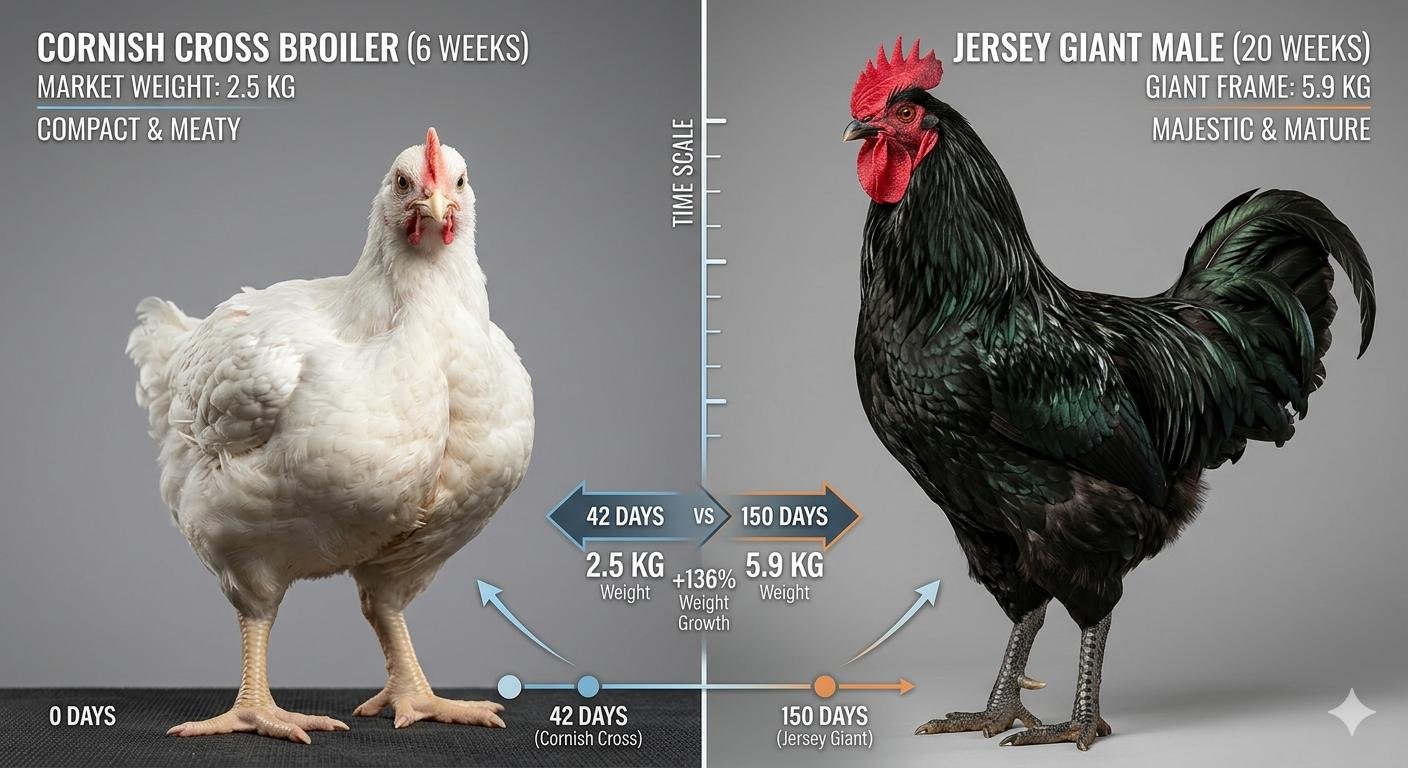
A Cornish Cross reaches 2.5 kg live weight at 6 weeks. A Jersey Giant reaches 2.5 kg live weight at 4–5 months. At the point where your Cornish Cross flock is processed, cleaned, and generating revenue, your Jersey Giant is approximately one-third of the way through its production cycle and has consumed roughly the same amount of feed as the Cornish Cross, for the same body weight.
By the time the Jersey Giant reaches a meaningful harvest weight of 4.5–5.5 kg at 20–24 weeks, it has consumed feed for 140–168 days. That same house space, managed with Cornish Cross genetics, would have completed three full production cycles and generated three times the revenue from the same square meters.
FCR: Where the Economics Break Down Completely
Feed conversion ratio is the most important number in commercial poultry production. It measures kilograms of feed consumed per kilogram of live weight gained. A Cobb 500 achieves 1.55–1.65. A Ross 308 achieves 1.62–1.72. These figures represent decades of genetic selection pressure for feed efficiency.
The Jersey Giant was never selected for FCR. It was selected for size, temperament, and dual-purpose utility. As a result, its feed conversion deteriorates severely as the bird ages. In the early weeks, FCR is not dramatically worse than heritage breeds — approximately 2.5–3.0. But as the bird’s growth rate slows and maintenance energy requirements increase relative to productive growth, FCR climbs. By harvest at 20–24 weeks, a Jersey Giant’s cumulative FCR commonly reaches 4.0–5.5.
At current commercial feed prices, that figure makes the cost per kilogram of Jersey Giant meat two to three times higher than Cornish Cross meat — before accounting for labor, housing, and opportunity cost.
The Economic Gap — Production Cost Table
| Metric | Cornish Cross (Cobb 500) | Jersey Giant | Difference |
|---|---|---|---|
| Days to 2.5 kg live weight | 38 – 42 days | 120 – 150 days | +82 – 108 days |
| Days to harvest weight | 38 – 42 days | 140 – 168 days | +100 – 126 days |
| Harvest live weight | 2.5 – 3.2 kg | 4.5 – 5.9 kg | Giant heavier |
| Total feed consumed per bird | 4.5 – 5.5 kg | 22 – 32 kg | 5× – 6× more feed |
| Cumulative FCR at harvest | 1.55 – 1.72 | 4.0 – 5.5 | 2.5× – 3.5× worse |
| Production cycles per year (same house) | 6 – 7 cycles | 2 cycles maximum | 3× – 3.5× fewer |
| Feed cost per kg of meat produced | $0.90 – $1.30 | $3.20 – $4.80 | $2.30 – $3.50 more |
| Opportunity cost (cycles foregone) | Baseline | High | Significant |
Feed cost estimates based on commercial grower ration at $0.45–0.55/kg. Your figures will vary by location and feed source.
The table above explains why no commercial integrator in the world runs Jersey Giants for volume meat production. The economics are not marginal — they are prohibitive at scale.
The Specialty Niche: When the Giant Actually Wins
Dismissing the Jersey Giant entirely based on commodity production economics misses the point. The breed was not designed for a commodity market, and forcing that comparison is the wrong frame. The right question is not “can Jersey Giants compete with Cornish Cross?” — they cannot, and will never. The right question is “Is there a market willing to pay a price that reflects the actual cost of producing a Jersey Giant?” In specific niches, the answer is yes.
Skeletal Integrity — Legs of Steel
Every farmer who has raised both Cornish Cross and Jersey Giants comments on the same thing: Jersey Giants do not go down on their legs. They do not develop the tibial dyschondroplasia, valgus-varus deformities, or locomotion failures that plague fast-growth commercial breeds. They do not die from sudden death syndrome or ascites. A healthy Jersey Giant at 20 weeks is genuinely healthy — structurally sound, cardiovascularly robust, and capable of ranging, foraging, and self-maintaining without the intensive welfare monitoring that fast-growth birds require.
For a farm whose brand is built on authentic animal welfare — not welfare-washed marketing, but genuine low-stress, low-intervention production — the Jersey Giant is honest. There is no gap between the brand promise and the production reality.
The Capon Market — A Genuine 2026 Opportunity
Historically, the Jersey Giant was the premier capon breed in the United States. Capons — surgically or chemically castrated male chickens raised to 6–9 months — produce carcasses of 5–8 kg with exceptional fat marbling, tender texture, and a flavor profile that no fast-growth bird can approach. They were the centerpiece of holiday feasts before the industrial broiler industry made them economically obsolete.
In 2026, they are not obsolete. They are rare, which is commercially equivalent to valuable. A finished Jersey Giant capon at 6–8 kg, positioned and sold correctly, commands $60–$120 per bird in premium urban markets, high-end butchers, and farm-to-table restaurant supply channels. The production cost at that weight is high — $25–$40 per bird in feed and labor — but the margin at premium pricing is real. This is a limited-volume, high-touch product, not a volume play. Managed accordingly, it is profitable.
Foraging and Low-Input Production
Jersey Giants are functionally self-sufficient in a way that no commercial broiler strain is. They forage aggressively, range widely, handle temperature variation without the metabolic fragility of fast-growth birds, and can maintain reasonable body condition on lower-specification feed supplemented by pasture. For homesteaders, small farms, or operations in regions where commercial feed is expensive or unreliable, the Jersey Giant’s ability to extract significant nutrition from the environment reduces the cash input per bird — partially offsetting the FCR disadvantage.
This is not a solution to the FCR problem at a commercial scale. But for a 50–200 bird operation on quality pasture where labor is owned rather than hired, the economics shift enough to make the breed viable.
Culinary Profile: The Chef’s Argument
Dark Meat Depth and Intramuscular Fat
A Jersey Giant processed at 20–24 weeks is biologically a different product from a 42-day industrial broiler. The extended production period, combined with genuine physical activity, produces intramuscular fat distribution throughout the dark meat that is simply not present in fast-growth birds. The flavor is deeper, richer, and more complex. The texture is firmer — requiring adjusted cooking technique — but responds exceptionally well to slow braising, confit, and traditional roasting methods.
Chefs at serious farm-to-table restaurants who have cooked Jersey Giant dark meat alongside industrial dark meat describe the difference as comparable to the gap between commodity and heritage pork. It is not subtle. It is the difference between protein and an ingredient.
Bone Broth — The Carcass Value No One Is Capturing
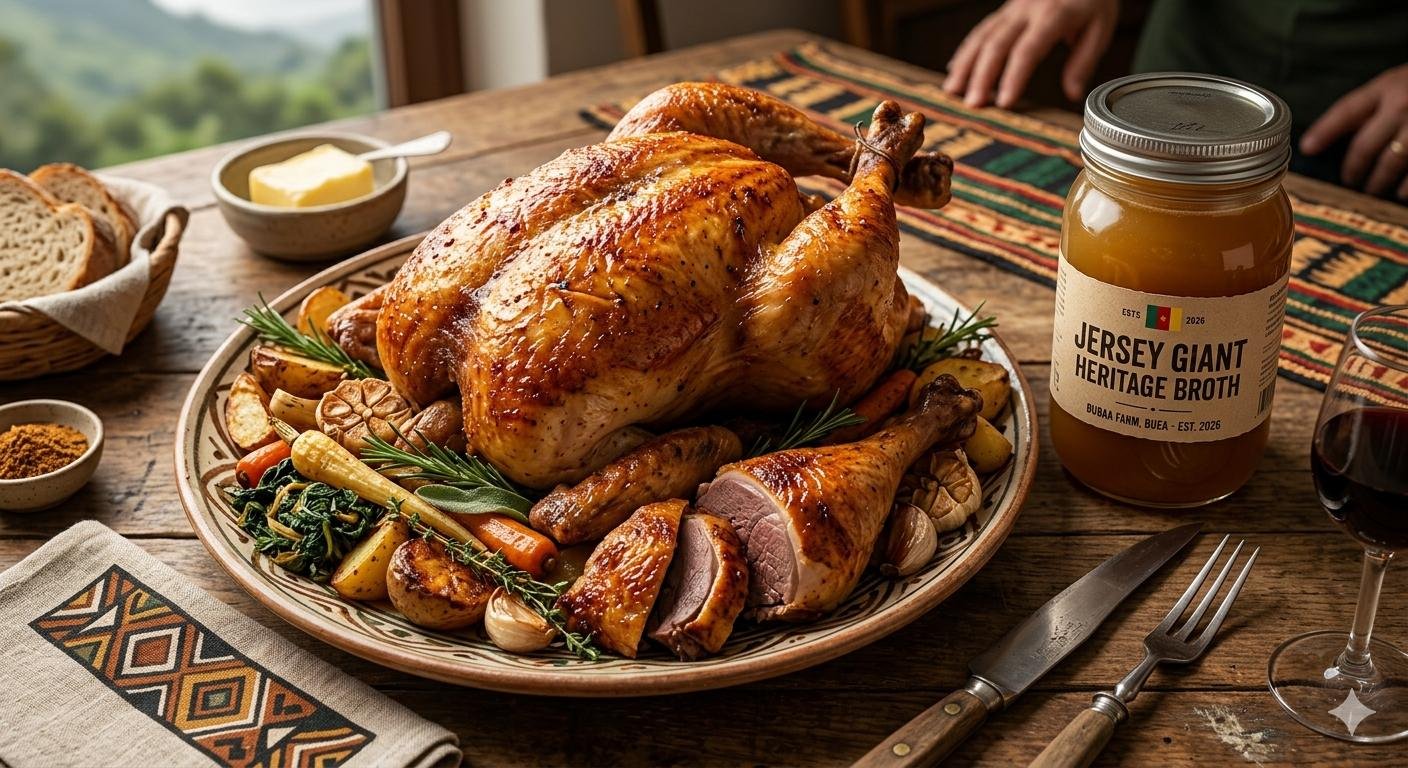
This is the most underutilized revenue stream in heritage poultry production. A Jersey Giant carcass at 5–6 kg live weight produces a skeletal frame, connective tissue volume, and collagen yield that an industrial broiler carcass cannot approach. The bone-to-meat ratio is higher, the joint cartilage is dense and intact, and the resulting broth is thick, gelatinous, and deeply flavored after 12–24 hours of simmering.
Premium bone broth retail pricing in 2026 ranges from $12–$28 per litre for verified heritage chicken broth. If you are processing Jersey Giants and discarding or devaluing the carcass frames, you are leaving significant revenue per bird on the table. Package the frames separately. Sell them to restaurants, direct-to-consumer, or produce finished bone broth yourself if your operation has the kitchen capacity. The carcass of a Jersey Giant is not a byproduct — it is a second product.
Selling the Heritage Roaster — Not the Chicken
The strategic reframe for any farmer considering Jersey Giants commercially is this: you are not selling chicken. The commodity chicken market is a race to the bottom on price, and you cannot win it with a bird that costs three times more to produce. You are selling a heritage roaster — a specific, rare, story-rich product with a culinary history, a physical presence, and a flavor profile that the commodity market cannot replicate.
Every element of your marketing for a Jersey Giant product should reinforce this framing. The breed’s 19th-century New Jersey origins. The six months of genuine outdoor life. The carcass weight that feeds eight people from a single bird. The collagen-rich broth that comes from a frame that actually had something to it. These are not compensations for the high price — they are the reasons for it.
Management Challenges You Need to Price In
Housing Longevity and Opportunity Cost
The opportunity cost of housing Jersey Giants is the number most prospective producers fail to calculate honestly. A standard broiler house running Cornish Cross genetics completes 6–7 production cycles per year. The same house running Jersey Giants completes 2 cycles per year, maximum. The fixed costs of that house — depreciation, insurance, utilities, land — are spread across 2 harvests instead of 6. Every kilogram of Jersey Giant meat must carry 3× the fixed overhead of a kilogram of Cornish Cross meat before a single variable cost is considered.
If your house has alternative use during the months the Jersey Giants occupy it — if it would otherwise sit empty, or if you are using structures that would not run Cornish Cross regardless — the opportunity cost is lower. If you are diverting active Cornish Cross house capacity to Jersey Giants, the true cost per bird is substantially higher than your feed bill suggests.
Pinfeather Processing — The Black Feather Problem
Black Jersey Giants have dark, highly pigmented pinfeathers — the immature feather shafts that remain in the skin at processing time. On a pale-skinned bird destined for retail, dark pinfeathers are a serious carcass presentation problem. They are visible, they do not blend with the skin color, and hand-removal at processing adds significant labor time per bird.
There are three practical approaches. First, process birds at the age when pinfeather development is minimal — typically immediately before or after a full molt cycle, when mature feathers are fully developed, and new pin growth is at its lowest. Second, use a scald temperature optimized for heritage birds — slightly higher than the standard commercial scald — to loosen pinfeather shafts for mechanical removal. Third, if your market is restaurants or direct sales where you control the presentation framing, position the coloring as authenticity: a dark pinfeathered heritage bird is visibly different from a commodity product, and knowledgeable buyers read that correctly.
For retail channel supply where carcass appearance standards are enforced by a buyer’s specification sheet, the pinfeather issue is a genuine production challenge that requires either specialized processing equipment or significant additional hand labor.
Breeding Your Own Stock — Does Zero Chick Cost Change the Math?
Unlike Cobb 500 or Ross 308 — which are proprietary hybrids that cannot be reliably reproduced on-farm — Jersey Giants breed true. Maintain a breeding flock of quality stock, and your day-old chick cost is zero beyond the feed and housing cost of the breeders. In markets where day-old chick prices are high or supply is unreliable, this is a genuine operational advantage.
The honest calculation, however, must include the full cost of maintaining the breeding flock year-round: feed, housing, labor, and the egg incubation infrastructure. For small operations running 200–500 birds per year, on-farm breeding typically does not reduce cost per production bird meaningfully once all inputs are accounted for. At a larger scale — 1,000+ birds per year from a well-managed breeding program — the math improves. Run the numbers for your specific scale before assuming zero chick cost translates to significant savings.
The Otto’s Farms Final Verdict
The No — Volume Commercial Production
If you are evaluating Jersey Giants as a replacement for or supplement to a Cornish Cross commercial operation, the answer is no. The FCR is too high, the production cycle is too long, the opportunity cost of house utilization is too high, and no premium pricing is achievable for a whole bird in a standard retail environment, closing the cost gap. Any farmer telling you otherwise has not done the full cost accounting.
The Yes — Boutique, Heritage, and Holiday Production
There are three commercial scenarios where Jersey Giants make genuine economic sense in 2026.
The first is a boutique heritage brand with direct-to-consumer sales infrastructure — farmers market presence, a CSA meat program, or a farm store — where the full story of the bird can be told at point of sale and pricing reflects real production cost. A properly marketed Jersey Giant at $22–$30 for a 3.5–4.5 kg dressed bird, or $50–$80 for a premium roaster at 5+ kg, is profitable when production cost is managed carefully.
The second is capon production for premium restaurant and butcher supply, as described above. Low volume, high margin, relationship-dependent sales to buyers who understand the product and price it correctly.
The third is a limited-edition holiday offering — Christmas roasters, Thanksgiving centerpieces, Easter heritage birds. The seasonal scarcity model allows premium pricing that a year-round commodity cannot sustain. Customers who plan a significant meal around a centerpiece bird are less price-sensitive than weekly grocery shoppers, and a 5–6 kg Jersey Giant roaster on a holiday table is a genuinely extraordinary product.
The Brand Mascot Strategy
Even for farms that run Cornish Cross or slow-growth breeds as their primary production, maintaining a small Jersey Giant flock of 20–50 birds serves a specific marketing function. These birds are visually dramatic — large, black, structurally imposing, and behaviorally confident. They photograph well. They stop visitors on farm tours. They generate social media content that a uniformly colored commercial flock simply does not.
The Jersey Giant, as a brand mascot, costs you feed and housing for a small flock. In return, it provides a visual identity, a heritage story, and a premium limited-edition product line that differentiates your farm from every operation running standard genetics. That differentiation has measurable value in premium direct-to-consumer markets that is difficult to quantify but consistently reported by farms that use it.
Managing Expectations — Size Is Not Efficiency
The Jersey Giant will not pay your feed bill through volume. It is the slowest-growing commercially relevant meat chicken in existence, with feed economics that make commodity production impossible. Any analysis that ignores that reality is doing you a disservice.
What it will do, for the right operation with the right market and the right pricing discipline, is produce a product that nothing else in your breed selection can match: a genuine heritage roaster with structural integrity, culinary depth, carcass presence, and a story that premium buyers in 2026 are actively seeking and willing to pay for.
Size is not efficiency. But in the right market, rarity is profitability — and no commercial breed is rarer on a serious dinner table than a well-raised Jersey Giant.