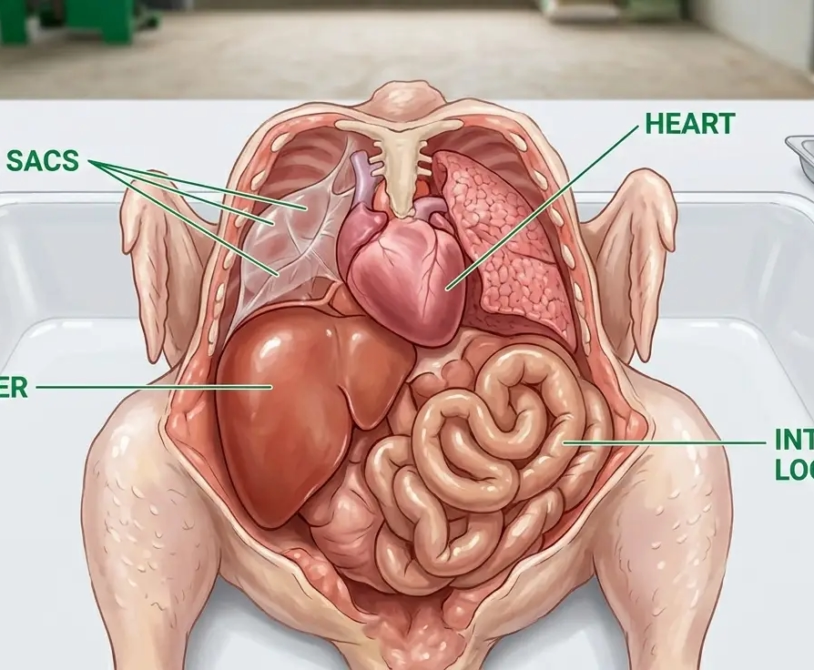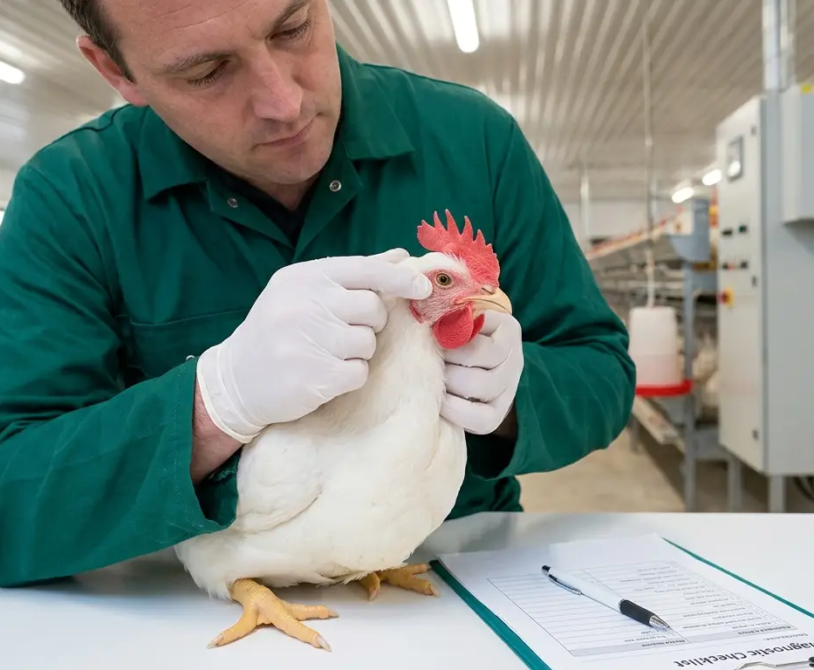
In the high-stakes world of commercial egg production, a single viral outbreak can “crash” your entire system, leading to 100% flock loss and total capital depletion. As a software engineer, I view Biosecurity as the farm’s “Cybersecurity” protocol. Your birds are the sensitive data, and pathogens like Avian Influenza or Newcastle Disease are the viruses attempting to breach your firewall.
To protect Otto’s Farms and your investment, biosecurity must be “hardcoded” into the physical layout of the farm. It is not just a set of rules; it is a series of physical barriers and logical workflows.
Perimeter Fencing: The External Firewall
The first line of defense is your perimeter. In the Southwest Region of Cameroon, communal farming and free-roaming local chickens are common, making a physical boundary essential.
Structural Exclusion
Your farm should be completely enclosed by a secure fence. This isn’t just to prevent theft; it’s to stop “unauthorized packets” (stray animals, neighbors, and wild scavengers) from entering the production zone.
-
The Vegetation Buffer: Maintain a clear, 3-meter-wide “no-man’s-land” of gravel or short-cut grass around the fence. This removes the “code” (habitat) for rodents and snakes that carry mites and diseases.
Controlled Entry Points
There should be only one entrance for people and vehicles. This allows you to monitor and “sanitize” everything that enters the system.
Footbaths and Sanitation Gates: The Checksum Protocol
Humans are the most common “vectors” for disease. Pathogens hitch a ride on the soles of shoes and the tires of trucks.
Engineering the Footbath
A footbath is a shallow trough filled with a strong disinfectant (like Virkon S or chlorine-based solutions) placed at the entrance of every poultry house.
-
The “Contact Time” Logic: A footbath only works if the boots are clean. If boots are caked in mud, the disinfectant cannot reach the “virus.”
-
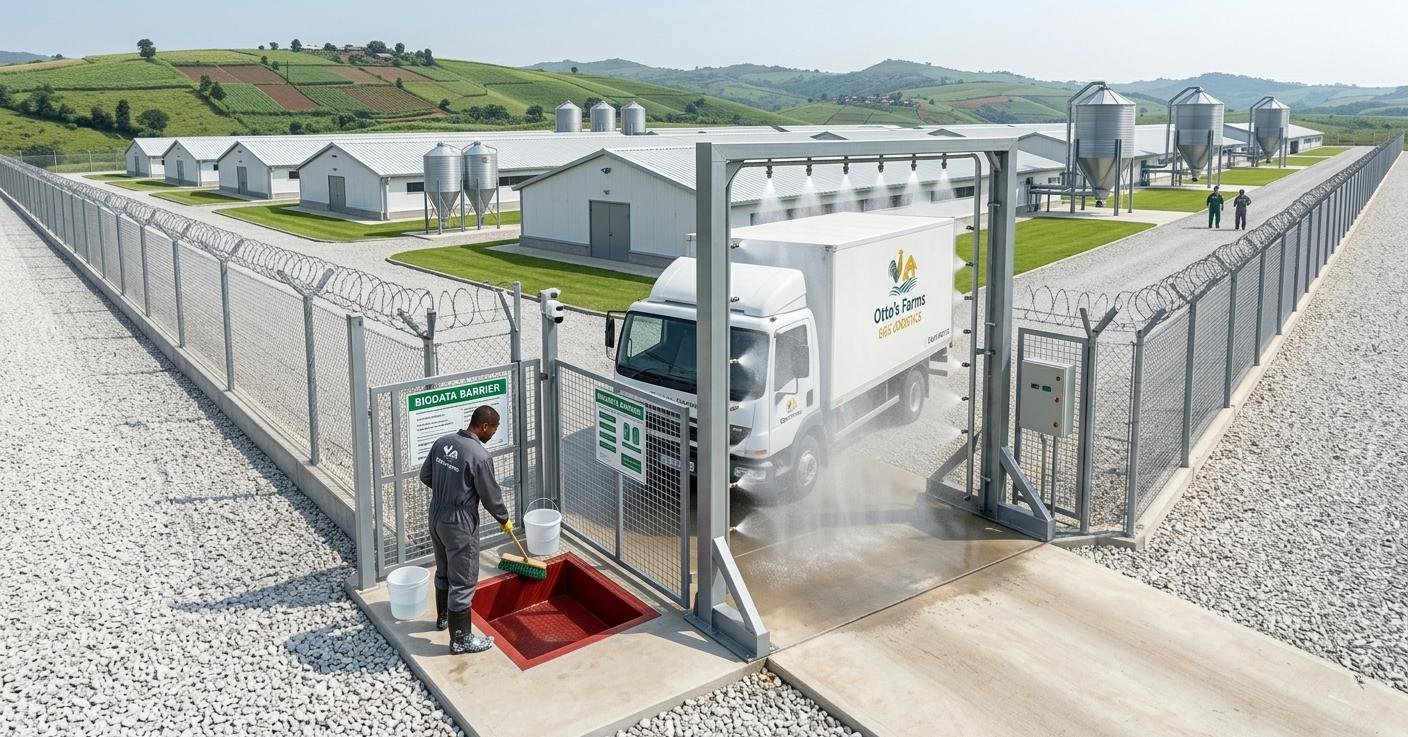
The Scrub Station: Every footbath should be preceded by a water bucket and a hard brush. Staff must “scrub the data” (clean the boots) before “running the script” (stepping into the disinfectant).
Tire Dips and Sprays
For large-scale farms, a vehicle tire dip or a pressurized spray gate ensures that delivery trucks don’t bring pathogens from other farms into your “Clean Zone.”
“Clean-to-Dirty” Workflow Patterns
This is the logical architecture of your daily operations. Pathogens usually move from older, more resistant birds to younger, highly vulnerable chicks.
The Directional Flow
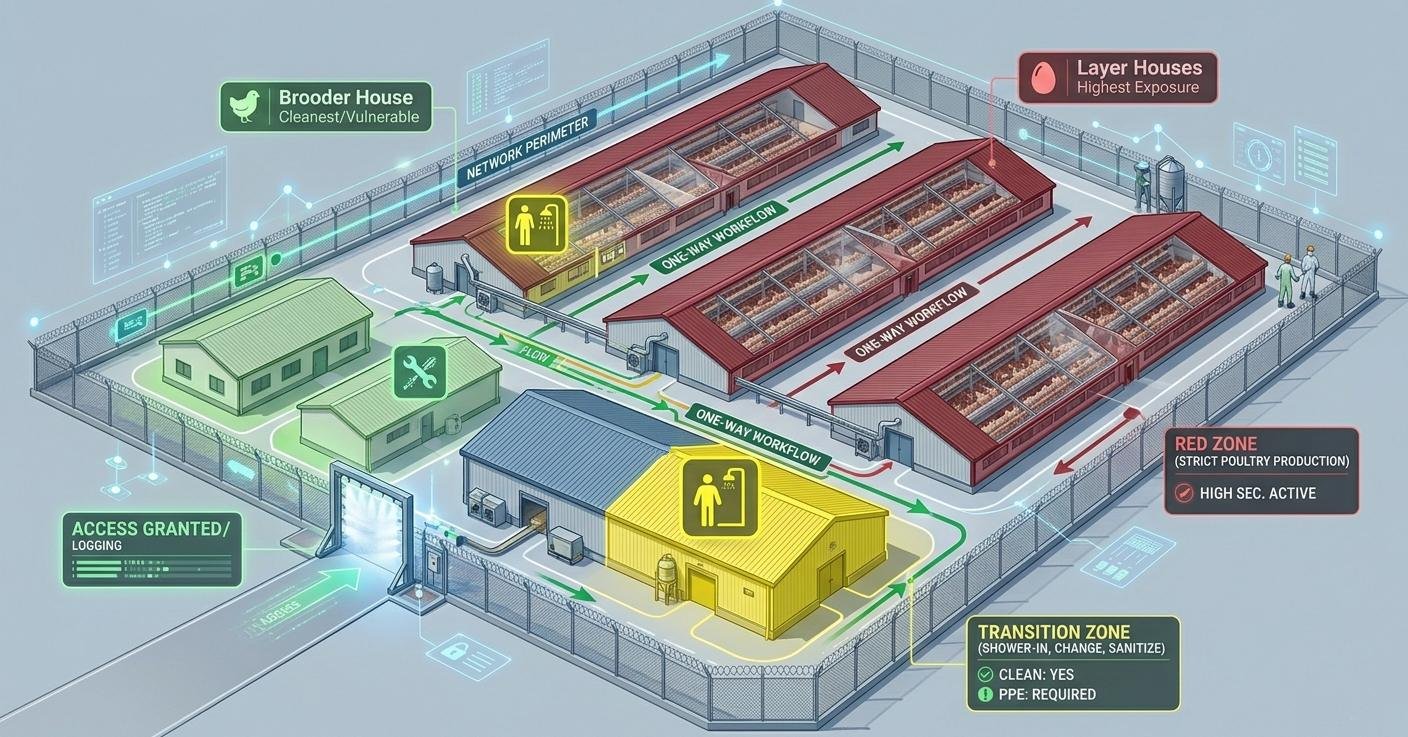
Your farm layout and staff movement should always follow a strict One-Way Workflow:
-
The Brooder House (Cleanest): Start your day with the youngest chicks. Their immune systems are the “most vulnerable.”
-
The Grower Pens: Move next to the teenage pullets.
-
The Layer Houses (Dirtiest): End your day with the adult layers. While they are productive, they have the highest “viral load” and exposure history.
The “Yellow Zone” (Transition Area)
Designate a “Changing Room” or a neutral zone where staff must swap “Street Clothes” for “Farm Uniforms.” Dedicated farm-only boots are the single most effective way to prevent cross-contamination between the outside world and your flock.
Logical Zoning: Red, Yellow, and Green
To simplify management for your team, use a “Traffic Light” zoning system in your farm design:
-
Green Zone (Office/Storage): General access for visitors and deliveries.
-
Yellow Zone (Transition): Where the “Antivirus” (showering/changing) happens.
-
Red Zone (Poultry Houses): The “Core Server Room.” Only essential, sanitized staff are allowed inside. No visitors, ever.
Biosecurity is Insurance
Many farmers view biosecurity as an annoying “latency” in their daily routine. However, at Otto’s Farms, we view it as the ultimate insurance policy.
Building a fence, installing footbaths, and training your staff on “Clean-to-Dirty” patterns costs significantly less than replacing 5,000 layers. By treating your farm layout as a secure network, you ensure that your “uptime” remains at 100% and your production remains profitable year-round.