
An egg is a commodity — until you make it something else. At XAF 110 (USD 0.18), it is interchangeable with every other egg on the market. At XAF 180 (USD 0.30), it is a branded, traceable, specification-compliant product that a hotel purchasing manager pays for without negotiating. The price difference between those two eggs is not the production cost. It is market positioning. And the ability to move from one price to the other — or at minimum to understand which market the farm is selling into and why that price exists — is the financial intelligence that determines whether a layer operation is sustainable or perpetually marginal.
Egg prices in West Africa are not random. They move in response to identifiable forces: seasonal demand cycles, feed cost transmission, competitor flock dynamics, import competition, festival and holiday demand spikes, and weather events that disrupt supply. A farmer who understands these forces can anticipate price movements rather than discover them at the point of sale — and can make production cycle timing, market channel, and flock management decisions that protect margins rather than simply absorb whatever the market offers on collection day.
This article maps the price drivers, seasonal patterns, regional variations, and market intelligence methods that give layer farmers in West and Central Africa the information they need to manage egg price exposure as deliberately as they manage feed cost and flock health.
The West African Egg Market: Structure and Price Formation
How Egg Prices Are Set
Egg prices in West African markets are set through a combination of supply-demand dynamics at the local level, feed cost transmission at the producer level, and import price signals at the wholesale level. Unlike commodity markets with formal price discovery mechanisms (exchanges, published benchmarks), West African egg prices are negotiated bilaterally — each producer and each buyer agrees a price through direct negotiation at the time of sale.
This bilateral price setting creates significant price variation between channels, locations, and buyer relationships — and creates the opportunity for informed producers to command above-market prices through supply reliability, quality differentiation, and relationship management.
The price stack in Cameroon (2026 reference):
| Channel | Typical Price per Egg | USD Equivalent | Notes |
|---|---|---|---|
| Farm gate (bulk wholesale) | XAF 100–120 | USD 0.17–0.20 | Lowest price; buyer collects from farm |
| Wholesale market (central trader) | XAF 110–130 | USD 0.18–0.22 | Lowest price; buyer collects from the farm |
| Open-air retail (market stall) | XAF 130–160 | USD 0.22–0.27 | Highest retail quality grade and brand required |
| Semi-formal retail (small shop) | XAF 140–170 | USD 0.23–0.28 | Slightly higher due to convenience premium |
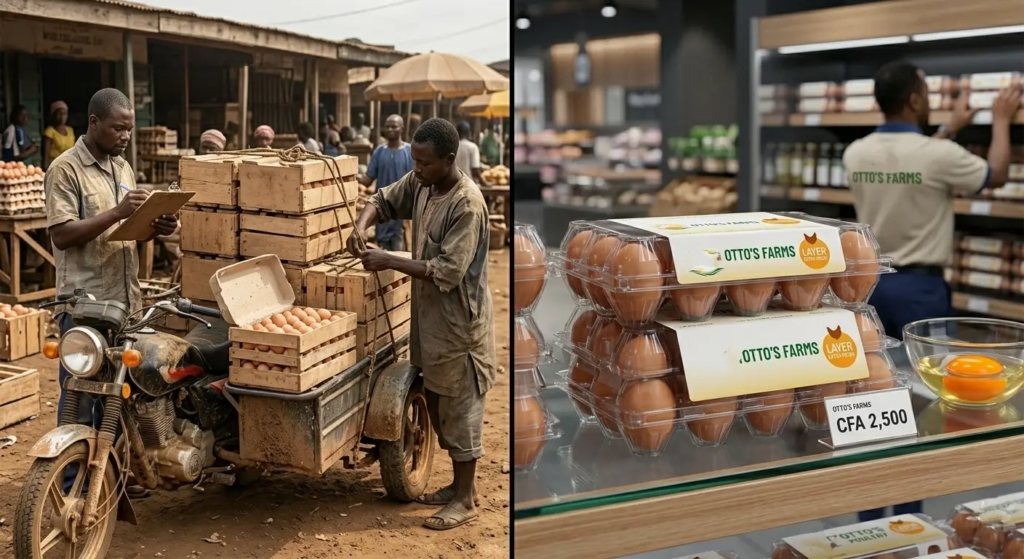
| Hotel/restaurant supply | XAF 150–200 | USD 0.25–0.33 | Premium for quality specification and reliability |
| Supermarket shelf | XAF 160–210 | USD 0.27–0.35 | The trader adds margin for assembly and transport |
The spread between farm gate wholesale (XAF 110–120 / USD 0.18–0.20) and supermarket shelf (XAF 160–210 / USD 0.27–0.35) represents the margin captured by the intermediary chain. A farm that sells exclusively at the farm gate wholesale captures only 55–60% of the final consumer price. A farm that sells directly to hotels and retail captures 80–90% of the consumer price. The financial impact of this channel difference on a 5,000-bird farm:
- Farm gate wholesale at XAF 115 average: XAF 115 × 4,000 eggs/day × 300 days = XAF 138,000,000 (USD 230,000) per cycle
- Hotel + retail at XAF 165 average: XAF 165 × 4,000 eggs/day × 300 days = XAF 198,000,000 (USD 330,000) per cycle
The channel difference at this scale is XAF 60,000,000 (USD 100,000) per production cycle — revenue that exists in the market but is captured by the intermediary chain rather than the producer when no direct channel relationship exists.

The Five Price Drivers in West African Egg Markets
Driver 1: Feed Cost Transmission
The most fundamental structural driver of egg prices in West Africa is feed cost. Layer farmers set floor prices based on feed cost — a price below which selling is loss-making — and the market equilibrium price reflects the aggregate of producers’ cost floors.
The feed cost → egg price transmission mechanism:
When maize or soybean meal prices rise significantly, producers either raise prices or exit production (temporarily depopulate or reduce flock size). Reduced supply puts upward pressure on market price until a new equilibrium is reached. This transmission typically takes 3–6 months to flow fully from input cost increase to market price adjustment.
2022–2026 feed cost trajectory in Cameroon:
- 2022: Maize approximately XAF 200–220/kg (USD 0.33–0.37); layer mash XAF 280–310/kg (USD 0.47–0.52)
- 2023: Maize XAF 220–260/kg (USD 0.37–0.43); layer mash XAF 310–340/kg (USD 0.52–0.57) — post-Ukraine war grain price transmission
- 2024: Maize XAF 240–280/kg (USD 0.40–0.47); layer mash XAF 330–365/kg (USD 0.55–0.61)
- 2025: Maize XAF 250–290/kg (USD 0.42–0.48); layer mash XAF 340–380/kg (USD 0.57–0.63)
- 2026 estimate: Maize XAF 260–300/kg (USD 0.43–0.50); layer mash XAF 345–390/kg (USD 0.58–0.65)
Feed cost has increased approximately 30–40% over these four years. Egg prices have not increased proportionally in all market channels — the commodity wholesale channel has absorbed some of this cost increase as margin compression, while the premium channel (hotels, supermarkets) has transmitted more of the cost increase to buyers. This asymmetric transmission is one of the structural arguments for investing in premium channel development.
Driver 2: Seasonal Demand Cycles
Egg demand in West Africa follows predictable annual cycles tied to cultural, religious, and climatic patterns. Understanding these cycles allows producers to time production peaks toward demand peaks and avoid oversupply during demand troughs.
Annual demand cycle for Cameroon and Nigeria:
| Period | Demand Level | Price Tendency | Key Driver |
|---|---|---|---|
| January (post-Christmas) | Low | Declining | Post-holiday spending fatigue |
| February–March | Moderate | Stable | Normal consumption; Lenten demand in Catholic-majority areas |
| April (Easter period) | High | Rising | Easter egg demand; end of Lenten period |
| May–June | Moderate | Stable | Normal consumption |
| July–August | High–Very High | Rising | School feeding programs reopening; Eid al-Adha (varies) |
| September | Moderate–High | Stable-to-rising | Back-to-school baking and food service |
| October–November | Moderate | Stable | Normal consumption |
| December | Very High | Peak | Christmas + New Year festivities; maximum household and restaurant demand |
December and April are consistently the highest-price months across most West African egg markets. A flock at peak production (90%+ laying rate) during December commands significantly higher revenue than the same flock at the same production rate in January or February.
Production cycle timing strategy: A flock placed at week 0 in mid-March reaches first egg at week 18 (mid-July) and peaks at week 24–26 (October–November). This timing places peak production precisely at the October–December holiday demand peak — the highest price period of the year. A flock placed in November reaches first egg in March and peaks in May–June — during a moderate demand period at moderate prices.
The 4–6 months from placement to peak production is the planning horizon that allows deliberate demand-cycle alignment.
Driver 3: Seasonal Supply Variations
Supply side: Layer farmer stocking decisions are often correlated — many farmers stock simultaneously in response to the same favorable market signals, creating supply peaks 4–5 months later that coincide with the production peaks of all those flocks simultaneously.
This supply synchronization creates the “boom-bust” price pattern familiar across West African markets: many farmers stock in January (optimistic after Christmas prices), all reach peak production simultaneously in May–June, supply exceeds demand, prices compress. Many farmers depopulate in frustration, supply falls, prices recover in December, and many farmers restock in January.
Breaking the synchronization cycle: A farmer who deliberately stocks counter-cyclically — placing birds in May when others are stocking in January — peaks during the December holiday demand period at above-average prices. Counter-cyclical production is the simplest and most reliable market timing strategy available, requires no additional capital or infrastructure, and is executed by a minority of producers in any given market.
Driver 4: Import Competition
Nigeria imports significant quantities of eggs from Brazil, Morocco, and Eastern Europe during periods when domestic supply cannot meet demand or when import prices undercut domestic production. Cameroon faces competition from eggs imported from neighboring countries — primarily Côte d’Ivoire and Senegal — as well as from informal cross-border flows.
Import price signals affect the commodity wholesale channel primarily — the farm gate and wholesale market prices. The premium channel (hotels, restaurants, supermarkets serving quality-conscious consumers) is less affected by import competition because imported eggs typically cannot meet the freshness, yolk color, and shell quality specifications that premium buyers require.
The import competition buffer: Nigerian import restrictions on eggs have been periodically implemented and withdrawn in response to domestic production conditions. A domestic producer who has invested in quality differentiation and direct buyer relationships is less exposed to import competition than one selling exclusively through the commodity wholesale channel.
Driver 5: Festival and Event-Driven Demand Spikes
Beyond the regular seasonal cycle, specific festivals, events, and institutional demand drivers create short-term price spikes that well-positioned producers can capture.
Event-driven demand opportunities in Cameroon and Nigeria:
- Christmas and New Year (December): The largest single demand event of the year. Hotel and catering demand for eggs increases 40–80% above normal. Egg shortage is common in many markets during the final week of December.
- Easter (March–April): Significant demand for eggs in Catholic-majority regions of Cameroon and among Christian communities in Nigeria. Baking demand drives above-normal egg consumption for 2–3 weeks.
- Ramadan Iftar breaking of fast: Egg-based dishes are common in Iftar meals, creating a seasonal demand increase in Muslim-majority areas of northern Nigeria and northern Cameroon during Ramadan.
- School feeding programs: Government and NGO-funded school feeding programs in Nigeria and Cameroon are periodic institutional buyers that, when funded and operational, purchase large volumes of eggs at negotiated prices. These are not reliable year-round buyers, but when programs are active, they represent an above-market-volume sales opportunity.
- Expatriate and diplomatic community demand: In Yaoundé and Abuja, the diplomatic and expatriate community creates a stable premium demand for consistent-quality eggs at prices typically 20–35% above the general retail market.
Regional Price Variation: The Geography of Egg Pricing
Egg prices are not uniform across West Africa. They vary significantly by country, by urban vs. rural location, by proximity to competing production zones, and by buyer sophistication.
Cameroon
Douala: Highest egg prices in Cameroon — dense urban consumer population, active hotel and restaurant sector, and the port of entry for food imports that creates price competition pressure on commodity grades but premium differentiation for locally produced quality eggs. Wholesale: XAF 105–125 (USD 0.18–0.21); hotel supply: XAF 155–200 (USD 0.26–0.33); retail: XAF 140–175 (USD 0.23–0.29).
Yaoundé: Slightly below Douala in commodity prices but with a larger government and diplomatic sector that supports premium channel pricing. Wholesale: XAF 110–130 (USD 0.18–0.22); diplomatic/hotel: XAF 160–210 (USD 0.27–0.35); retail: XAF 145–180 (USD 0.24–0.30).
Secondary cities (Bafoussam, Buea, Limbe, Ngaoundéré): Lower wholesale prices (XAF 90–110 / USD 0.15–0.18) due to lower consumer density and lower buyer competition. Premium channel is smaller but exists through hotel accommodation demand at tourist and business locations.
Cross-border opportunity: Gabon, Equatorial Guinea, and Chad all import eggs from Cameroon through formal and informal channels. Export price to these markets: XAF 130–160 (USD 0.22–0.27) per egg — above domestic wholesale but below premium domestic channels. Export adds volume sales at above-commodity prices but requires transport coordination and informal or formal trade documentation.
Nigeria
Nigeria’s egg market is the largest single egg market in sub-Saharan Africa by population and consumption volume. Price formation is more complex due to the country’s size, regional dietary variation, and the formal and informal nature of supply chains.
Lagos and Abuja: Highest prices in Nigeria due to consumer density and income levels. Farm gate wholesale: NGN 250–320 (USD 0.15–0.19); hotel/supermarket supply: NGN 350–480 (USD 0.21–0.29); retail: NGN 300–400 (USD 0.18–0.24).
Kano and northern Nigeria: A significant egg market driven by protein demand in a region with limited alternative, affordable protein sources. Prices slightly below Lagos. Import competition from Northern Africa and the Middle East is more significant than in Lagos.
Southern Nigeria (Enugu, Port Harcourt): Active domestic production in Enugu reduces prices relative to Lagos, but proximity to the oil economy creates a premium consumer segment in Port Harcourt. Farm gate: NGN 230–290 (USD 0.14–0.18); retail: NGN 280–360 (USD 0.17–0.22).
Building a Market Intelligence System
What Market Intelligence Means in Practice
Market intelligence for a layer farmer is not macroeconomic analysis or commodity market forecasting. It is four specific pieces of information, updated weekly:
- What is the current market price at each channel this week? — Farm gate wholesale, open market retail, and any institutional supply price paid to competing farms in the same area
- Is the price trend rising, stable, or falling relative to last week and last month?
- What are buyers reporting about their demand levels? — Are hotel buyers reporting full occupancy (high demand) or low occupancy (lower egg demand)?
- What are other producers in the area doing? — Are competitors stocking, depopulating, or holding? A cluster of local restocking decisions predicts a supply glut in 18–20 weeks.
Data Sources for Market Intelligence
Weekly market price visits: Visit two wholesale egg buyers and one retail market stall weekly. Ask what they are paying and what they are charging. Record the prices. Plot the weekly trend. This information costs 30 minutes per week and is available to any producer willing to ask.
Feed mill representative conversations: Feed mill sales representatives visit multiple farms and have visibility into regional flock dynamics — which farms are restocking, which are depopulating, which are scaling up. Feed mill representatives are often the most informed source of regional supply forecasting available.
Agricultural extension officer and cooperative networks: Where poultry producer cooperatives or associations exist — and they do exist in most Cameroonian regions and Nigerian states — the cooperative provides price information sharing, collective bargaining leverage, and early warning of disease events in the local area that will affect supply.
Hotel and restaurant buyer direct contact: Call your hotel and restaurant buyers monthly for a brief update: “Are your booking levels up or down this month compared to last?” Booking level is the leading indicator for egg demand at that buyer in the next 2–4 weeks.
Social media market groups: Poultry producer WhatsApp groups and Facebook groups (Aviculteurs du Cameroun, Poultry Nigeria, and similar regional groups) share market price information, disease outbreak reports, and supply disruption information in near-real time. Join the groups relevant to your region and track the information flow.
Building a Price Tracking Sheet
A simple price tracking sheet — updated weekly — is the minimum market intelligence tool:
| Week | Farm Gate Price (XAF/egg) | Market Retail (XAF/egg) | Hotel Price (XAF/egg) | Trend | Feed Cost (XAF/kg) | Feed Cost-to-Price Ratio |
|---|---|---|---|---|---|---|
| Week 1 | 115 | 145 | 165 | — | 350 | 3.05 |
| Week 2 | 112 | 140 | 165 | ↓ | 350 | 3.13 |
| Week 3 | 110 | 138 | 162 | ↓ | 352 | 3.20 |
| Week 4 | 108 | 135 | 160 | ↓ | 352 | 3.26 |
The Feed Cost-to-Price Ratio (feed cost per kg ÷ farm gate price per egg) is the single most important indicator on the sheet. When the ratio rises above 3.5 — meaning a kg of feed costs more than 3.5× the price of one egg — the farm is approaching margin compression at the farm gate channel. At a ratio above 4.0, the farm gate channel is loss-making and institutional/retail channels must absorb a higher proportion of production to maintain overall profitability.
Price Protection Strategies: Building a Floor Into the Business
Market intelligence tells you where prices are and where they are going. Price protection strategies determine how much of that market risk the farm absorbs vs. transfers.
Strategy 1: Supply Contracts with Fixed or Minimum Prices
Negotiating a minimum price guarantee with a hotel, restaurant, or institutional buyer protects the farm against downside price movements. The buyer accepts a price floor in exchange for supply reliability and priority access during shortage periods.
Typical contract structure:
- Minimum price: XAF 155–165 (USD 0.26–0.28) per egg — negotiated above current farm gate wholesale to reflect quality premium
- Volume commitment: The farm guarantees delivery of 50–150 trays (1,500–4,500 eggs) per week, consistently
- Price review: Quarterly review linked to feed cost index — if feed cost increases more than 10%, egg price adjusts proportionally
- Exclusivity: The farm reserves the buyer’s order as first priority. In periods of high market demand, the contract buyer is supplied before spot market sales.
A supply contract with two hotels taking 100 trays per week each (6,000 eggs/week combined) at XAF 160 per egg creates a minimum weekly revenue floor of XAF 960,000 (USD 1,600) from contracted supply alone — approximately 25–30% of a 5,000-bird farm’s weekly egg output sold at above-market prices with price protection.
Strategy 2: Buyer Diversification
No single buyer should represent more than 40% of total production sales. A buyer who purchases 40%+ of your production has pricing leverage — they know that losing them creates a market absorption problem. A buyer who purchases 20% of your production is commercially important but not existentially so.
Target distribution for a 5,000-bird farm at peak:
- 1–2 hotel/restaurant contracts (20% of production each): XAF 165–190/egg
- 1 supermarket supply relationship (15–20% of production): XAF 170–200/egg
- 2–3 wholesale buyers (20–30% of production combined): XAF 115–130/egg
- Direct retail/household sales (10–15% of production): XAF 145–165/egg
- Volume-weighted average price target: XAF 145–165 (USD 0.24–0.28) per egg
This distribution builds the average price above the commodity floor while maintaining volume throughput through wholesale channels.
Strategy 3: Production Timing Against the Demand Cycle
The single most capital-efficient price protection strategy is aligning flock placement timing with the seasonal demand cycle. No additional cost. No contract negotiation. No buyer relationship development required. Simply place chicks 18–20 weeks before the December holiday peak.
A flock placed in the first week of August reaches first egg in late November and peaks in December and January — the highest-price period of the year. The 4–6 weeks of peak production during December generate revenue at XAF 160–200 (USD 0.27–0.33) per egg rather than XAF 110–130 (USD 0.18–0.22) during a trough period. At 4,000 eggs per day for 30 peak-season days, the price difference between XAF 130 and XAF 170 is:
4,000 × 30 × (XAF 170 − XAF 130) = XAF 4,800,000 (USD 8,000) in additional revenue from timing alone
This is not speculative. December egg demand peaks are observable, consistent, and quantifiable from 5 years of any region’s price data.
Strategy 4: Quality Differentiation
A farm that produces eggs at DSM 11–13 yolk color, consistent shell quality, 55–65g grade, from a traceable flock with documented health records is selling a different product from an undifferentiated commodity egg — even if the bird, the feed, and the production system are identical.
The premium attached to quality differentiation in West African markets ranges from XAF 15–45 (USD 0.03–0.08) per egg above the commodity price. This premium requires:
- Yolk color management through the pigmentation program (marigold + paprika or canthaxanthin)
- Shell quality management through correct calcium and vitamin D₃ at all production stages
- Egg grading to weight classes at a 2,000+ bird scale
- Packaging in labeled trays with farm name, contact information, and production date
The packaging investment alone — farm-branded trays at approximately XAF 800–1,200 (USD 1.33–2.00) per 30-egg tray vs. unbranded XAF 500–700 (USD 0.83–1.17) — is recovered in the first 1–2 premium sales at the resulting price premium.
Protecting Against Market Downturns
Even a well-managed price strategy cannot fully insulate a farm against a significant market downturn — when regional disease events reduce demand, when import competition compresses commodity prices, or when a cluster of large farms simultaneously reaches peak production and floods the local market.
The downside scenarios and their mitigation:
Scenario: 20% price compression in the commodity channel
- Farm gate price drops from XAF 115 to XAF 92 (USD 0.15)
- Break-even price at base case production: XAF 72 per egg — still above the compressed price
- Impact: Significant margin reduction but not loss-making
- Mitigation: Premium channel relationships absorb 30–40% of production at XAF 160–180 (USD 0.27–0.30) — blended price remains above break-even
Scenario: Extended period of above-normal supply (competitor overstock)
- Market remains 15% oversupplied for 3–4 months
- Farm gate price compression: XAF 100–105 (USD 0.17–0.18) for an extended period
- Impact: Farm gate margin compressed to near zero; premium channel and direct retail remain profitable
- Mitigation: Diversified channels ensure only 20–30% of production is sold at a compressed farm gate price
Scenario: Disease outbreak in local commercial farms (competitor flock losses)
- Regional supply shortage drives prices above normal
- Farm gate prices: XAF 135–155 (USD 0.23–0.26); hotel/retail: XAF 180–220 (USD 0.30–0.37)
- Impact: Significantly above-normal revenue for duration of shortage (typically 6–12 weeks)
- Strategic note: A farm with strong biosecurity that avoids the disease event while competitors suffer losses captures an exceptional revenue windfall. This is the most compelling ROI argument for biosecurity investment that most farmers never quantify.
Summary
Egg prices in West Africa are not beyond a farmer’s influence. They are the outcome of forces that are identifiable, trackable, and in significant part predictable — and of market channel decisions that the farmer controls entirely.
The farmer who sells exclusively at the farm gate wholesale is selling at the bottom of the price stack, absorbs all commodity price volatility, and has no relationship protection when prices compress. The farmer who has built hotel supply contracts, direct retail relationships, and branded product differentiation is selling at 1.3–1.8× the commodity price, has contractual price floors in at least one channel, and has buyers who call them during shortages rather than waiting to be called.
Market intelligence is not complex. Track prices weekly. Understand the seasonal cycle. Know when competitors are restocking. Time production toward demand peaks.
Price protection is not complex either. Build two supply contracts. Develop three market channels. Differentiate quality visibly. Align flock placement with the December demand peak.
The egg that sells at XAF 180 (USD 0.30) and the egg that sells at XAF 110 (USD 0.18) came from the same type of bird, ate the same feed, and cost the same to produce. The difference is the farmer who sold them, and the market work they did before the first egg was laid.
Download the analysis in PDF here is the link: Ottos_Farms_Egg_Market_Analysis.pdf