In 2026, over 200 of the world’s largest food companies have signed the Better Chicken Commitment. The list includes KFC, Unilever, Compass Group, Sodexo, Marks & Spencer, and Nestlé — collectively representing hundreds of billions of dollars in annual food procurement. Every one of these companies has made a legally binding public commitment to source chicken that meets specific welfare, breed, and environmental standards by defined deadlines.
This is not a European trend that will take a decade to reach Africa. These brands are already operating in Cameroon, Nigeria, Kenya, Ghana, and South Africa. Their procurement standards travel with them. The KFC franchise opening in Douala in 2027 or 2028 will not source chicken on different ethical terms than the KFC in London or Amsterdam — because the commitment is brand-wide, not geography-specific.
The question for every commercial poultry producer in Africa reading this article is not whether BCC requirements will affect your market. They will. The question is whether you will be positioned to supply the contracts that meet those requirements — or whether you will watch those contracts flow to the farms that prepared early.
What Is the BCC? The 2026 Standard Explained
The Better Chicken Commitment is a set of five minimum standards that signatory companies require their chicken suppliers to meet. Understanding each standard precisely is essential before evaluating what farm-level transition actually requires.
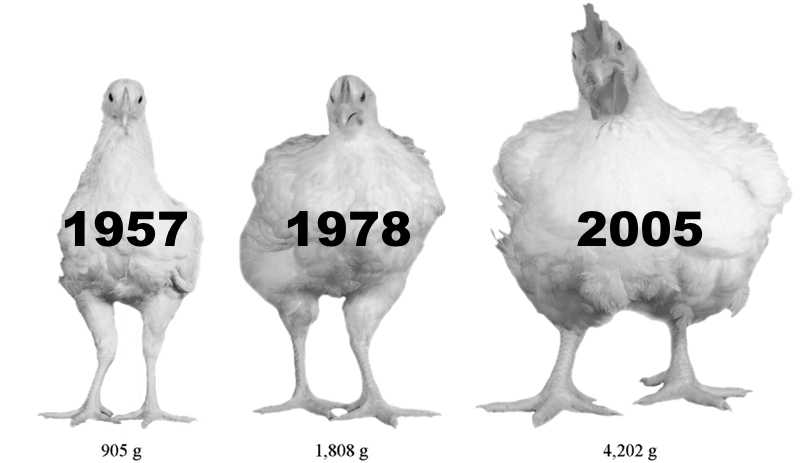
Breed specification is the most operationally significant requirement. BCC-compliant production must use breeds from an approved list of slower-growing genetics — strains that reach market weight no faster than the maximum growth rate specified by the commitment. In practice, this means moving away from Cobb 500 and Ross 308 toward approved strains, including the Hubbard JA757, Hubbard JYKX, and equivalent slow-growth lines. These birds take 56–63 days to reach market weight compared to 35–42 days for standard commercial strains. The production implications of this single requirement — longer housing cycles, higher total feed consumption per bird, lower throughput per house per year — are substantial and are examined in detail in the economics section below.
Stocking density under BCC is capped at a maximum of 30 kg of live weight per square meter of usable floor space. Standard commercial practice in most African markets runs 38–42 kg/m², and some high-density operations exceed this. The BCC standard requires a reduction of 20–30% in birds per square meter — directly reducing output per house per cycle relative to current practice.
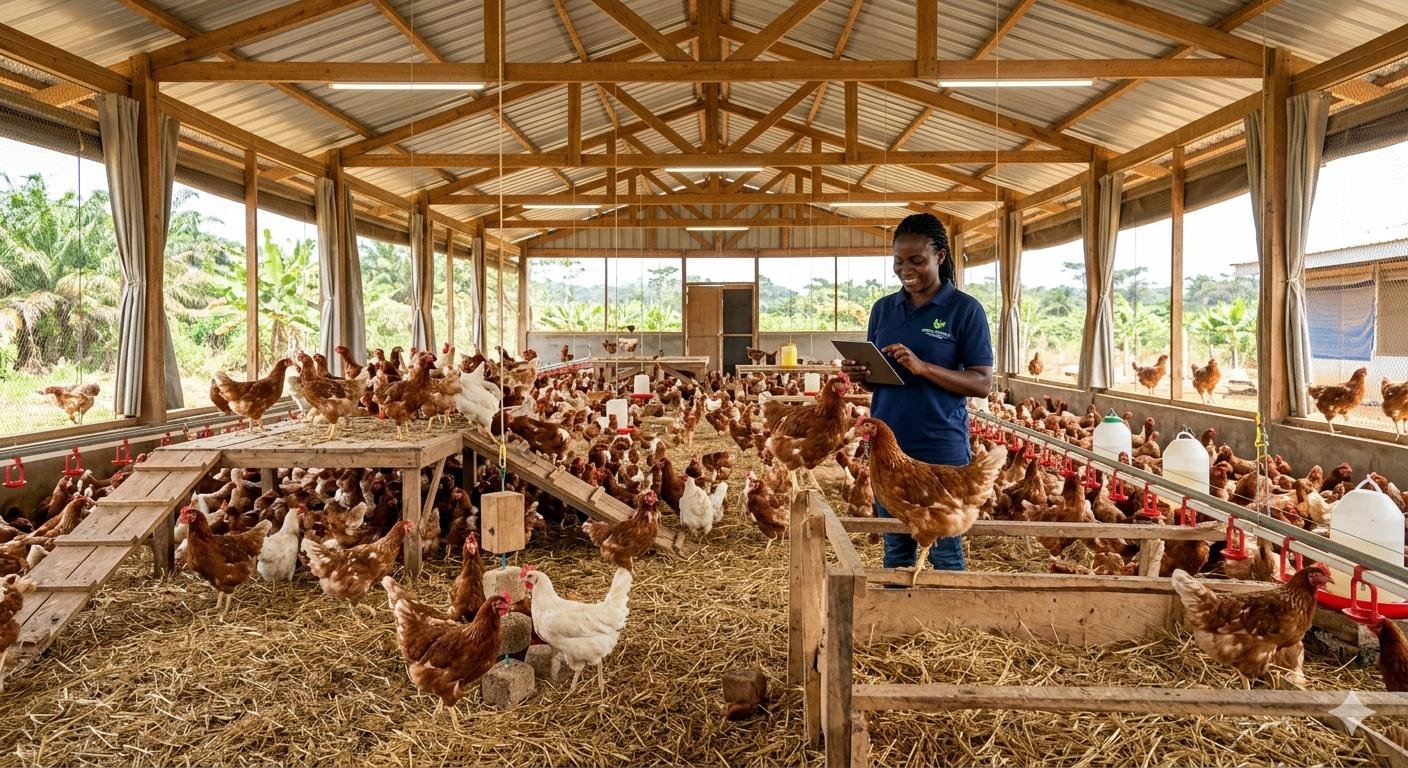
Environmental enrichment and lighting requirements mandate a minimum of 50 lux of light intensity throughout the house during light periods, provision of enrichment materials — pecking objects, elevated platforms, or equivalent stimulation — and a minimum of 6 hours of continuous darkness per 24-hour period. These are manageable in modern housing with modest modification, but require investment in lighting infrastructure in houses currently running below 50 lux.
Controlled atmosphere stunning (CAS) is the processing standard component of the BCC. It requires that birds be rendered unconscious through gas stunning before shackling and slaughter, replacing the conventional electrical water-bath stunning system used in most commercial plants. CAS is a significant capital investment at the processing plant level — not the farm level — but it is a requirement that affects which processing facilities your birds can be slaughtered through if you are supplying BCC-certified contracts.
Meaningful outdoor access or enriched indoor environment at the higher tier of BCC compliance represents the ceiling of the standard — the specification required for premium-tier contracts and export markets. For entry-level BCC compliance serving regional institutional buyers, the breed, density, lighting, and stunning requirements are the operative thresholds.
The African Context: Honest Assessment of Challenges and Opportunities
The Infrastructure Reality
The majority of commercial broiler production in Cameroon and across West and Central Africa operates in open-sided housing with manual curtain ventilation, minimal lighting infrastructure, and stocking densities calibrated for fast-growth industrial strains. Transitioning this infrastructure to BCC compliance is not a paperwork exercise — it is a capital investment programme with specific, calculable costs.
Lighting retrofits to achieve 50 lux uniformly across a standard open-sided house of 1,000–1,200 m² floor area require installation of LED fixtures at calculated spacing and height, connected to a timer-controlled circuit. In Cameroon’s 2026 construction and electrical materials market, this installation costs approximately CFA 800,000–1,500,000 per house, depending on house dimensions and existing electrical infrastructure.
Stocking density reduction to 30 kg/m² requires either accepting 25–30% lower bird numbers per house per cycle — with proportionally lower revenue per cycle — or building additional house capacity to maintain total flock volume. For most existing operations, the practical first step is accepting the density reduction on one house operated as a BCC pilot, rather than attempting to compensate with immediate capacity expansion.
The litter management standards implicit in BCC — dry, friable litter maintained throughout the production cycle, with proactive management of wet spots — are achievable in open-sided houses with good curtain management and appropriate litter amendment protocols, but require more active daily management than the practices common in standard commercial production.
The Feed Cost Problem in Volatile Grain Markets
Slower-growing BCC-compliant birds spend 56–63 days on feed compared to 38–42 days for Cobb 500. In a market where maize prices are stable and predictable, this longer production cycle is a manageable cost variable. In Cameroon’s maize market — characterised by significant seasonal price variation, supply chain disruptions, and the structural pressure of competing demand from human food consumption and industrial starch processing — extending the production cycle by 2–3 weeks represents meaningful exposure to feed price volatility.
The risk management response to this exposure is forward contracting: agreeing on feed prices with your supplier at batch placement rather than purchasing at spot price throughout the cycle. This requires a relationship with a feed supplier willing to offer forward pricing and your own financial discipline to honour the commitment regardless of spot price movement. It is standard commercial practice in integrated poultry operations globally and will become standard practice for BCC-compliant African producers who cannot afford the margin risk of a 63-day cycle on unpredictable spot feed prices.
The second response is the premium revenue offset examined in the economics section — a BCC-certified bird selling at 25–35% above conventional market price fundamentally changes the feed-cost-to-revenue ratio, making the extended cycle financially viable even in a volatile feed cost environment, provided the premium price is contractually secured before the birds are placed.
The Export Opportunity — Why This Changes Everything
This is the strategic opportunity that most current discussions of BCC in African markets underweight. BCC-certified, welfare-verified poultry production in Cameroon is not merely a tool for accessing premium local institutional buyers. It is a credential for accessing the EU and Middle Eastern export markets — markets that pay significantly higher prices for certified welfare-compliant chicken products than any domestic African buyer.
The EU’s Farm to Fork strategy and its associated import standards increasingly require third-country suppliers to demonstrate animal welfare compliance equivalent to EU domestic production standards. A Cameroonian processing facility attached to BCC-certified farms is positioned to supply EU private label chicken products, hotel and food service chains operating across Europe, and the rapidly growing halal premium segment in the Gulf Cooperation Council markets — all of which command export prices substantially above domestic Central African market rates.
The farms that invest in BCC infrastructure and certification in 2026 and 2027 are not simply chasing a local premium. They are building the compliance architecture for export market access that will define the competitive landscape of African commercial poultry in the 2030s.
Economics: The Price of Welfare
Production Cost and Revenue Reality
| Parameter | Conventional Production | BCC-Compliant Production | Difference |
|---|---|---|---|
| Breed | Cobb 500 / Ross 308 | Hubbard JA757 / approved slow-growth | Slower growth, higher welfare score |
| Days to market weight | 38 – 42 days | 56 – 63 days | +18 – 21 days on feed |
| Stocking density | 38 – 42 kg/m² | Maximum 30 kg/m² | 25 – 30% fewer birds per house |
| Feed cost per bird | Baseline | +25 – 35% (more days on feed) | Higher per bird, lower FCR penalty |
| Total production cost per kg | Baseline | +15 – 20% above conventional | Real cost increase — must be recovered in price |
| Achievable retail/contract price | Baseline | +25 – 35% above conventional | Premium exceeds cost increase when the market is correctly targeted |
| Certification and traceability cost | Minimal | CFA 2 – 5 million initial setup | One-time infrastructure, recoverable within 2–3 cycles at a premium price |
| Net margin per kg vs. conventional | Baseline | +8 – 15% higher net margin | The business case — premium more than offsets cost increase |
The economics only work when the premium price is contractually secured before production begins. A BCC-compliant bird sold at conventional market rates is a loss-making exercise. The entire financial model depends on pre-securing supply agreements with buyers who will pay the certified premium — hotels, international franchises, export processors, and premium urban retailers — before converting production capacity to BCC standards.
The African Middle Class Demand Signal
The domestic demand foundation for premium certified chicken in Cameroonian urban markets is not hypothetical. Douala and Yaoundé have demonstrated consumer segments — concentrated in the professional and expatriate communities, the international NGO and diplomatic sector, and the emerging urban professional class — with demonstrated willingness to pay premium prices for verified food quality and production standards.
These consumers are currently buying imported certified chicken products from South African retailers and European-origin frozen imports at prices substantially above local fresh chicken market rates — not because local fresh chicken is unavailable, but because certified quality and production transparency are unavailable locally. A domestically produced BCC-certified fresh chicken from Otto’sFarms, competitively priced against imported certified alternatives, substitutes local production for imports in a premium market segment, and captures the full margin advantage of lower logistics cost relative to imported product.
The urban middle-class demand signal is already present in the market. The certified supply is not. This is the market gap that early-moving BCC-compliant African producers will fill.
CEO Strategy: The Three-Step Transition
Step 1 — Pilot Before Converting
The single most common and costly error in BCC transition planning is whole-farm conversion before the operational model is understood. Slow-growth breeds require different brooding protocols, different feed programmes, different stocking management, and different processing logistics than fast-growth commercial strains. Attempting to learn all of this simultaneously across an entire farm operation while maintaining revenue from the existing flock is operationally complex and financially risky.
Dedicate one house — your most structurally sound, best-ventilated house — to a single pilot batch of BCC-compliant slow-growth birds. Run it for two full cycles. Track FCR, mortality, Days to weight, and processing yield against your conventional production benchmarks. Understand where your management requires adjustment before extending the model. The knowledge accumulated in two pilot cycles will prevent errors that would cost significantly more than the pilot investment if made at full-farm scale.
During the pilot phase, pursue your BCC certification and traceability infrastructure in parallel — so that by the time your third cycle completes, you have both operational competence and commercial certification ready simultaneously.
Step 2 — Implement Digital Traceability
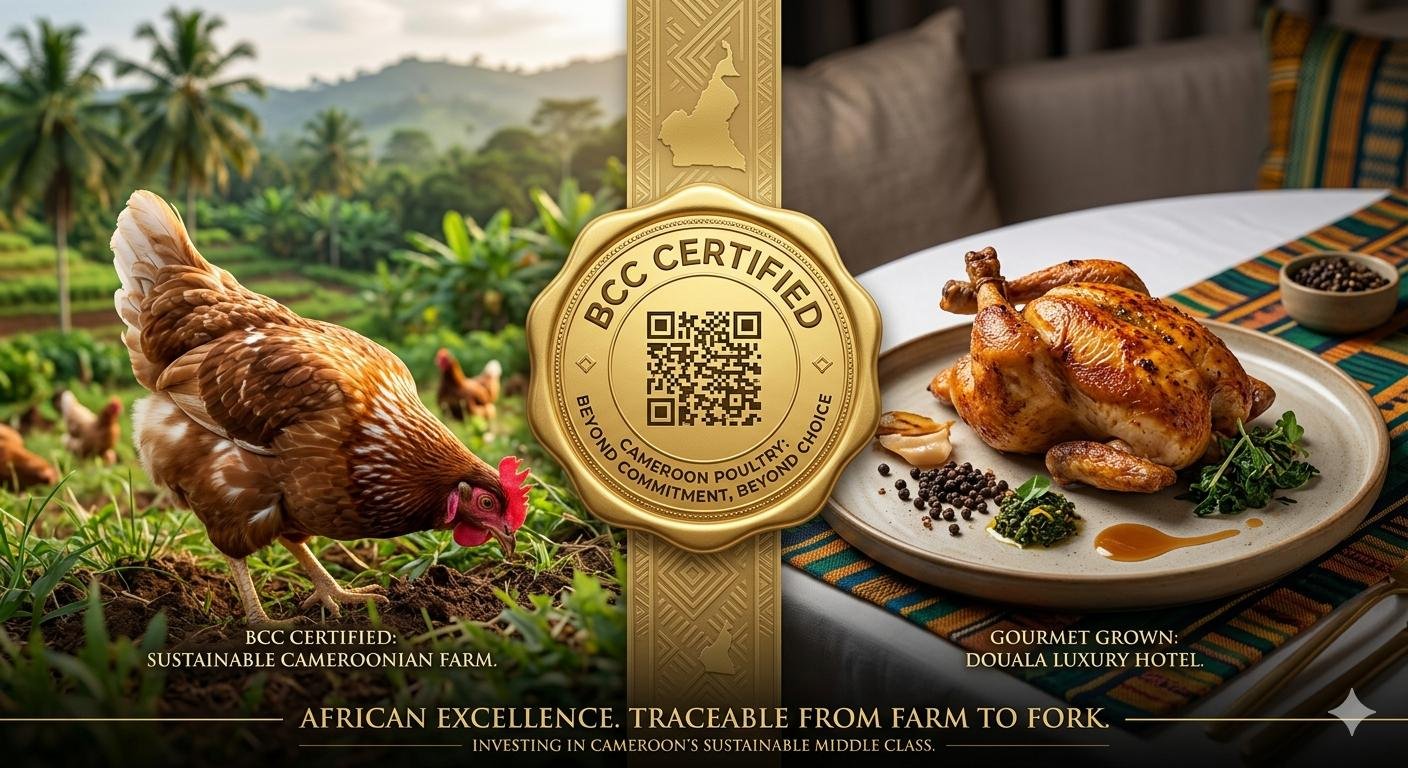
A BCC-certified bird that cannot be documented and verified is commercially worthless as a certified product. The certification is the product — the actual chicken is the delivery mechanism for that certified status. Institutional buyers paying a 25–35% premium are paying for documented proof that the bird was raised to the standard they have publicly committed to. If you cannot produce that documentation in a format their procurement systems can verify, the premium disappears regardless of how carefully you raised the bird.
Digital farm-to-fork traceability does not require enterprise software or significant technology investment at the farm level. It requires systematic batch records — breed documentation with hatchery certification, placement date and stocking density records, feed delivery records with mill certification, daily management logs including lighting and litter records, mortality logs, and processing plant chain-of-custody documentation. These records, maintained digitally in a simple structured format and linked to a batch reference number that travels with the carcass to the buyer, constitute the traceability chain that certification auditors and institutional procurement officers require.
Invest in a basic farm management software system or, at a minimum, a disciplined, structured spreadsheet system before your first BCC-certified batch is placed. Retrofitting traceability documentation after the batch is complete is unreliable and will not satisfy a serious institutional buyer’s audit requirements.
Step 3 — Secure Direct Supply Agreements Before Scaling
The open market — selling to aggregators, traders, or spot buyers at prevailing daily prices — is incompatible with BCC-compliant production economics. The premium that makes BCC financially viable must come from a pre-agreed, relationship-based supply contract with a buyer who has both the requirement for certified product and the budget to pay for it.
Target three categories of direct buyers in the Cameroonian and regional market. International hotel groups operating in Douala and Yaoundé — Hilton, Pullman, Radisson, and their equivalents — have corporate procurement standards that increasingly align with BCC or equivalent welfare requirements and the food service budget to pay certified prices. International food service operators with franchise operations in the region are under corporate BCC commitments that their African franchise operators will eventually need to fulfil through local supply. Regional export processors with EU or Gulf export licences represent the highest-value offtake channel and are actively seeking certified farm supply to fill export contracts they currently cannot service from domestic sources.
Approach these buyers before your pilot is complete — not after. The supply agreement development timeline is typically 3–6 months from first contact to signed contract. Beginning buyer conversations while your pilot is running means your commercial infrastructure and your operational competence arrive at the market simultaneously.
The Verdict: Blue Ocean or Barrier?
The Better Chicken Commitment is simultaneously the highest barrier to entry in African commercial poultry and the most significant margin opportunity available to producers willing to cross it. For farms that continue conventional production without engagement with welfare standards, the BCC represents a gradual but accelerating exclusion from the most valuable B2B contracts in the market — as international brands in Africa standardise their supply chains to match their global commitments.
For farms that invest in the transition — deliberately, in stages, with pilot discipline and pre-secured buyer relationships — the BCC represents access to a market segment that conventional producers cannot serve. That market segment pays 25–35% more per kilogram, offers contractual price stability that the open spot market does not, and grows in value every year as international brand penetration of African urban food markets deepens.
The farms that build BCC compliance infrastructure in 2026 and 2027 are not responding to current market demand. They are positioning for the market that will exist in 2028–2032, when the brands that have signed the BCC begin enforcing it through their African supply chains in earnest. In markets where first-mover advantage is real and replicable, certified supply is scarce; being two years early is not inefficiency. It is the entire strategy.
Otto’sFarms is not simply raising birds. It is building the production infrastructure, the certification credentials, and the buyer relationships that define what professional African agribusiness looks like in the next decade. The BCC is not a compliance burden — it is the entry ticket to the market that is being built around it.