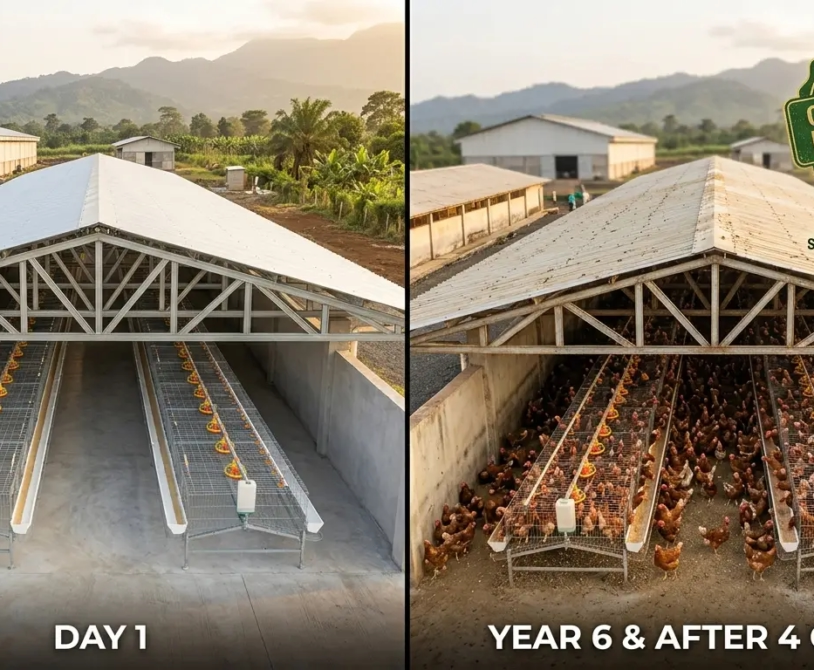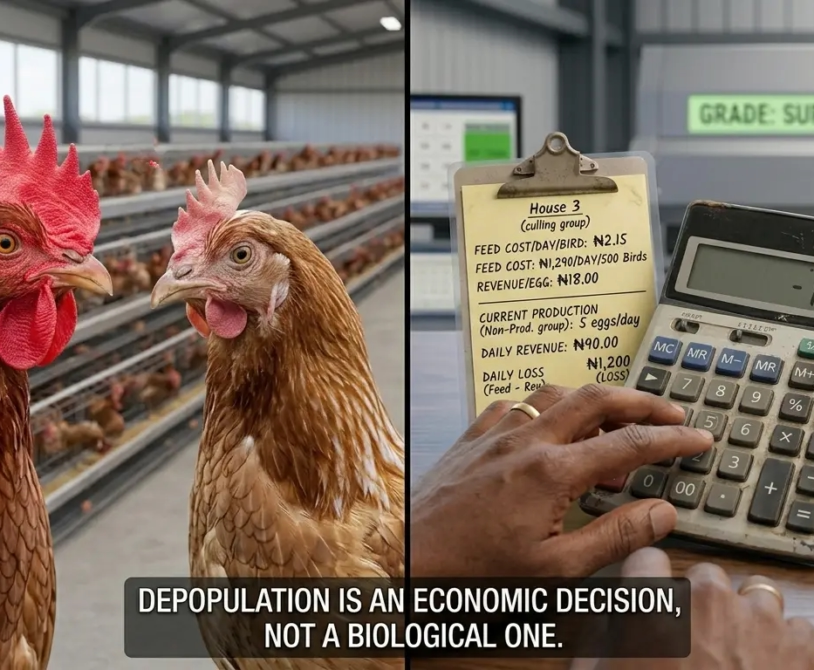
Every commercial layer operation in West and Central Africa started somewhere smaller. The farmer with 5,000 birds producing 4,000+ eggs per day was once managing 200 birds in a backyard structure, selling eggs to neighbors, and reinvesting whatever was left after costs. The path from 200 birds to 5,000 is not straight. It is not smooth. And it is not, as many smallholder farmers assume, simply a matter of “doing the same thing but bigger.”
Scaling a layer operation is a series of system transitions — points at which the management approach, infrastructure design, financial structure, and market strategy that worked at the previous scale must be rebuilt for the next scale. A farmer who scales from 200 to 2,000 birds using the same tools, same feeding system, same record-keeping approach, and same market channel that served 200 birds will not be managing 2,000 birds profitably. They will be managing a 200-bird system that is overwhelmed by 2,000 birds.
This article maps the scaling journey at each critical threshold: the financial requirements, the infrastructure upgrades, the management changes, and the market strategies required at each stage — with realistic cost and revenue figures for West and Central Africa in 2026 that include USD equivalents for regional comparison.
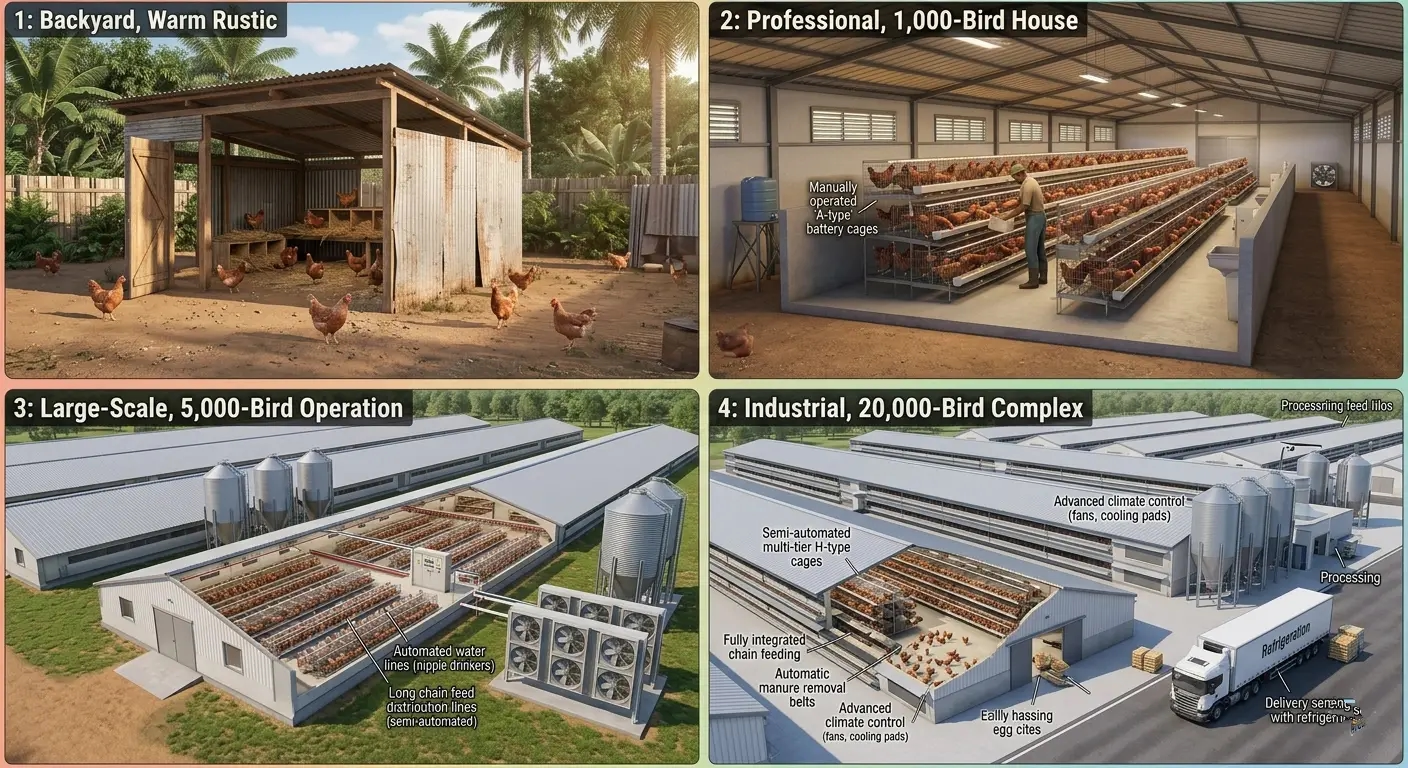
The Four Scaling Stages: A Framework
Commercial egg production in the West African context can be mapped across four stages, each defined by flock size and the management complexity it demands:
Stage 1 — Micro-Scale (50–200 birds): Subsistence-to-supplementary income. Managed by family labor. Deep litter floor housing. Informal market sales only.
Stage 2 — Small Commercial (200–1,000 birds): Entry-level commercial production. First dedicated poultry housing. First hired labor. First documented record-keeping.
Stage 3 — Medium Commercial (1,000–5,000 birds): True commercial operation. Battery or colony cage systems. Multiple market channels. Dedicated management structure. Full financial accounting.
Stage 4 — Large Commercial (5,000–20,000+ birds): Industrial-scale operation. Automated or semi-automated systems. Formal business registration. Multiple employees. Supply contract relationships with institutional buyers.
Most scaling failures occur at the transition from Stage 2 to Stage 3 — the move from 1,000 birds to 2,000–5,000 birds — because this is the transition where every underlying management system must be formalized simultaneously. This article focuses most heavily on that transition, while mapping the complete path from Stage 1 through Stage 4.
Stage 1 to Stage 2: The First Commercial Step (50–200 to 200–1,000 Birds)
The Financial Reality at Stage 1
A 100-bird deep litter flock producing 80 eggs per day at XAF 140 per egg generates XAF 11,200 per day in revenue, or approximately XAF 336,000 (USD 560) per month. Feed costs for 100 birds at 115g per day at XAF 345/kg = XAF 3,968 per day in feed alone. After feed, labor (usually family), and health inputs, net cash flow at 100 birds is approximately XAF 150,000–200,000 (USD 250–333) per month — a meaningful supplementary income but not a viable primary livelihood.
The decision to scale to 200–1,000 birds is driven by the recognition that the per-egg margin is adequate, but the volume is too small to support the household. This is the correct observation. The error is assuming that 1,000 birds is simply 10× the management of 100 birds.
What Changes at Stage 2
Housing: Deep litter floor housing works at 100 birds. At 500–1,000 birds on a continuous deep litter floor, disease pressure from coccidiosis and internal parasites rises sharply, litter management becomes a full-time job, and egg cleanliness drops to unacceptable levels for any market above the basic open-air trade. Stage 2 requires purpose-built housing with a clean floor, proper ventilation, and either battery cages or raised wire floor pens.
Infrastructure capital requirement:
- 500-bird cage system in a purpose-built house: XAF 3,500,000–6,000,000 (USD 5,833–10,000)
- 1,000-bird cage system: XAF 7,500,000–9,500,000 (USD 12,500–15,833) [as detailed in the cost analysis article]
Record-keeping: A 100-bird flock can be managed from memory. Daily egg count, feed purchase, and mortality can be tracked in a notebook or not at all. At 500+ birds, the volume of transactions — feed deliveries, egg sales, health interventions, mortality events — exceeds what memory reliably tracks. Stage 2 requires basic written records at a minimum: daily egg count, daily feed consumption, weekly mortality, and weekly revenue.
Market formalization: A 100-bird flock produces 80 eggs per day — one tray of 30 eggs is sold to two neighbors. A 500-bird flock produces 400+ eggs per day — 13+ trays that require at least 3–4 regular buyers or one wholesale relationship to clear without waste. Stage 2 requires market development before the flock is stocked, not after.
Capital and Revenue at Stage 2 (500 Birds)
- CAPEX: XAF 4,000,000–6,500,000 (USD 6,667–10,833)
- Rearing period reserve: XAF 2,200,000–2,700,000 (USD 3,667–4,500)
- Total startup capital: XAF 6,200,000–9,200,000 (USD 10,333–15,333)
- Peak daily egg revenue: 450 eggs × XAF 140 = XAF 63,000 (USD 105) per day
- Monthly net cash flow at peak: XAF 500,000–700,000 (USD 833–1,167) per month
- Annualized ROI: 40–65% on total investment
This is the scale at which layer farming becomes a viable primary income source for a single household — generating XAF 500,000–700,000 per month net is roughly equivalent to two professional salaries in most Cameroonian peri-urban markets.
Stage 2 to Stage 3: The Critical Transition (1,000 to 5,000 Birds)
This is the transition at which most scaling failures occur. The farmer who has successfully managed 1,000 birds for one or two cycles arrives at this transition with confidence built from that experience. That confidence is appropriate for the management systems at 1,000 birds. It is not appropriate for what 5,000 birds require.
Why This Transition Is Different in Kind, Not Just Degree
Flock health complexity scales nonlinearly. A disease event in a 1,000-bird house affects 1,000 birds. A disease event on a 5,000-bird farm — where five houses share workers, equipment, water supply, and air space — has five infection routes rather than one. The same biosecurity failure that costs 50 birds at a 1,000-bird scale costs 500–1,000 birds at a 5,000-bird scale. Management precision that was adequate at 1,000 birds is insufficient at 5,000 birds.
Feed management requires formal systems. At 1,000 birds consuming 115 kg/day, feed management means one delivery per week and visual inspection of feeders. At 5,000 birds consuming 575 kg/day, it means feed inventory tracking, multi-supplier relationships, bulk purchase negotiation, quality testing for mycotoxins and moisture, and daily consumption records by house. These are not the same activities at a larger volume — they are genuinely different management functions.
Financial management requires accounting. At 1,000 birds, a notebook and weekly cash count are adequate. At 5,000 birds generating XAF 200,000–250,000 (USD 333–417) in daily revenue and paying multiple staff, suppliers, and creditors simultaneously, informal accounting is inadequate. Tax obligations, supplier payment scheduling, payroll management, and cash flow forecasting require a basic accounting system.
Market volume requires formal buyer relationships. A 1,000-bird farm selling 700 eggs per day can clear that volume through informal retail. A 5,000-bird farm selling 3,500+ eggs per day requires wholesale buyer contracts, institutional supply relationships (hotels, restaurants, supermarkets), or a market distribution arrangement to prevent accumulation of unsold production.
Infrastructure Requirements: Stage 3 (5,000 Birds)
Option A — Build 5 × 1,000-bird houses simultaneously:
- 5 houses at XAF 7.5–9.5M each: XAF 37.5–47.5 million (USD 62,500–79,167)
- Equipment, systems, and infrastructure: approximately 85–90% of the single-house cost per additional house due to shared infrastructure savings
- Total CAPEX: XAF 32,000,000–42,000,000 (USD 53,333–70,000)
Option B — Build incrementally (add 1,000 birds per cycle):
- Start with 1,000 birds (XAF 7.5–9.5M) and add one house per production cycle, funded from the previous cycle’s profits
- Total CAPEX accumulates over 4–5 cycles (5–7 years) rather than upfront
- This is the lower-risk, lower-capital approach that most successful scaling journeys use
Option B is the recommended path for most smallholder-to-commercial transitions. It preserves cash, allows management capability to develop with flock size, and uses each cycle’s operational learning to improve the next house’s design and management before it is built.
Incremental Scaling Financial Model (Option B)
Cycle 1 (1,000 birds):
- Investment: XAF 8,500,000 (USD 14,167)
- Net profit (base case): XAF 24,300,000 (USD 40,500) over 17 months
- Profit after owner draw and reserve: approximately XAF 10,000,000–14,000,000 (USD 16,667–23,333) available for reinvestment
Cycle 2 (Add 1,000 birds, now 2,000 total):
- Second house cost: XAF 7,500,000–9,000,000 (USD 12,500–15,000) — slightly less than the first house due to shared infrastructure (water lines, fencing, storage)
- Funded entirely from Cycle 1 profits — no additional external capital required
- Combined 2,000-bird revenue: XAF 88,000,000–108,000,000 (USD 146,667–180,000) per cycle
- Combined net profit: XAF 40,000,000–52,000,000 (USD 66,667–86,667) per cycle
Cycle 3 (Add 1,000 birds, now 3,000 total):
- Third house cost: XAF 7,000,000–8,500,000 (USD 11,667–14,167) — further shared infrastructure savings
- Again, funded from Cycle 2 profits
- At 3,000 birds, the farm reaches Stage 3 minimum scale and begins to qualify for institutional supply contracts
Cycle 4 (Add 2,000 birds in one expansion, now 5,000 total):
- Two additional houses: XAF 14,000,000–17,000,000 (USD 23,333–28,333)
- Funded from accumulated profit reserves
- At 5,000 birds, the farm reaches full Stage 3 commercial scale
Total time to reach 5,000 birds from zero: 5–7 years. Total external capital required: XAF 8,500,000 (USD 14,167) — the first house only. Remaining scaling capital: Self-funded from operations
This incremental model is slower than simultaneous 5,000-bird development. It is also significantly more resilient — a disease event or market disruption that damages one house at a 1,000-bird scale does not threaten the entire farm enterprise. At 5,000-bird simultaneous development with a large loan, the same event can threaten solvency.
Stage 3 to Stage 4: Industrial Scale (5,000 to 20,000+ Birds)
At Stage 4, the operation transitions from a farm managed by its owner to a business managed by employees. The owner’s role changes from producer to manager — selecting and developing staff, managing supplier and buyer relationships, overseeing financial performance, and making strategic investment decisions.
Management Structure Required at Stage 4
10,000-bird operation minimum staffing:
- 1 Farm Manager (may be the owner in early Stage 4)
- 1–2 dedicated flock attendants per 5,000 birds (feeding, egg collection, daily health checks)
- 1 part-time veterinarian or veterinary technician on retainer (quarterly flock health review)
- 1 part-time bookkeeper (monthly financial accounts)
- 1 driver/delivery person (if operating own egg distribution)
Labor cost at 10,000 birds:
- 2–3 farm workers: XAF 45,000–70,000 each/month = XAF 90,000–210,000 (USD 150–350) per month
- Farm manager (if separate from owner): XAF 100,000–180,000 (USD 167–300) per month
- Veterinary retainer: XAF 50,000–100,000 (USD 83–167) per month
- Bookkeeper (part-time): XAF 30,000–60,000 (USD 50–100) per month
- Total management and labor: XAF 270,000–550,000 (USD 450–917) per month
Infrastructure Capital at Stage 4 (10,000 Birds)
10 × 1,000-bird houses or 2 × 5,000-bird houses:
| Infrastructure Item | 10,000-Bird Farm Estimate (XAF) | USD Equivalent |
|---|---|---|
| 10 × 1,000-bird houses | 70,000,000–90,000,000 | USD 116,667–150,000 |
| OR 2 × 5,000-bird houses (more efficient) | 55,000,000–75,000,000 | USD 91,667–125,000 |
| Cage systems for 10,000 birds | 25,000,000–45,000,000 | USD 41,667–75,000 |
| Automated/semi-automated feeding systems | 8,000,000–18,000,000 | USD 13,333–30,000 |
| Tunnel ventilation + evaporative cooling | 12,000,000–22,000,000 | USD 20,000–36,667 |
| Egg grading machine (manual or semi-auto) | 3,500,000–9,000,000 | USD 5,833–15,000 |
| Cold storage (egg holding) | 2,500,000–6,000,000 | USD 4,167–10,000 |
| Generator (backup power, 15–25 kVA) | 3,500,000–8,000,000 | USD 5,833–13,333 |
| Feed storage (15+ tonne capacity) | 1,500,000–3,000,000 | USD 2,500–5,000 |
| Total Stage 4 CAPEX | 80,000,000–120,000,000 | USD 133,333–200,000 |
At this CAPEX level, external financing — bank loans, agricultural development finance, cooperative equity, or investor partnerships — is typically required unless the farm has been built incrementally from Stage 2 to Stage 4 over several years, accumulating the capital from operations.
Formal Business Registration and Compliance at Stage 4
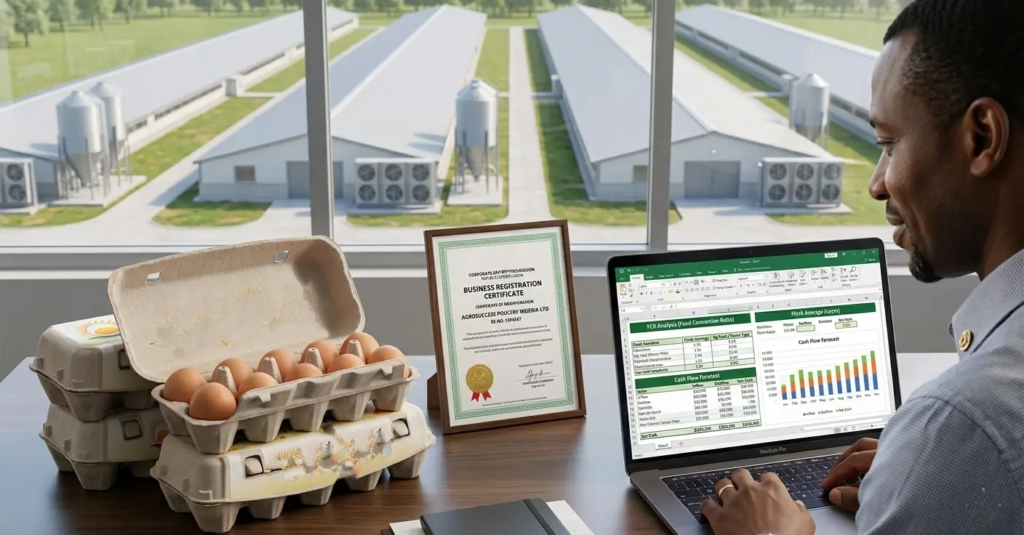
A 10,000-bird farm generating XAF 350,000,000–500,000,000 (USD 583,333–833,333) per year in egg revenue is a formal business by any measure — operating at a scale that attracts tax authority attention, requires formal employment contracts, and must be legally registered to access supply contracts with institutional buyers.
Stage 4 compliance requirements:
- Business registration: RCCM (Registre du Commerce et du Crédit Mobilier) in Cameroon; CAC registration in Nigeria
- Tax identification number and VAT registration (above the VAT registration threshold in Cameroon: turnover above XAF 50,000,000 per year (USD 83,333))
- Formal employment contracts and CNPS (social security) enrollment for employees
- An environmental permit if the operation exceeds the threshold for regulated agricultural activity in the local commune
- Food safety certification for supply to hotels, supermarkets, or export channels — increasingly required as buyers formalize their supply chain standards
These compliance requirements are not bureaucratic friction — they are the credentials that unlock the supply contracts, institutional financing, and premium market channels that justify Stage 4 capital investment.
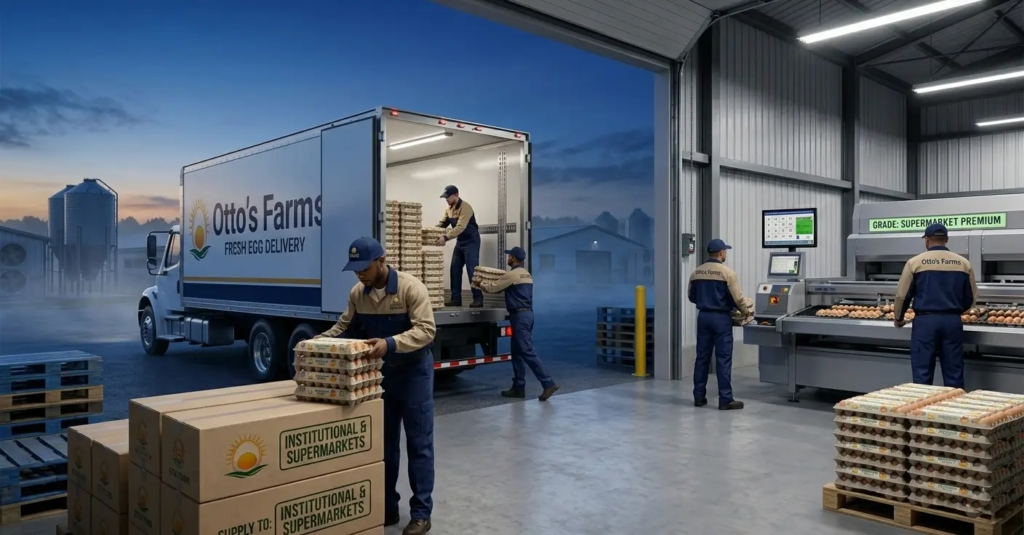
Market Strategy by Scale: What Changes at Each Stage
The market channel available to a layer farm is largely determined by its scale — because buyers at each level require minimum supply volumes, consistency of supply, and product specifications that only specific scale operations can deliver.
Stage 1 (100–200 birds): Informal Retail Only
- Neighbors, household buyers, open-air market traders
- No volume commitment, no quality specification, no packaging requirement
- Price is negotiated per tray at market, typically XAF 1,200–1,500 (USD 2.00–2.50) per 30-egg tray
Stage 2 (200–1,000 birds): Informal + First Wholesale Buyer
- Begin supplying 1–2 regular wholesale buyers who commit to buying 5–10 trays per day
- Price typically XAF 1,000–1,300 (USD 1.67–2.17) per tray (wholesale discount from retail)
- Packaging requirement: standard egg trays
- No specification on egg size, yolk color, or shell quality beyond basic acceptability
Stage 3 (1,000–5,000 birds): Wholesale + Institutional + Premium
- At 3,000+ birds producing 2,400+ eggs per day (80 trays per day), the farm can supply:
- 2–3 wholesale buyers taking 20–30 trays each per day
- 1–2 hotels or restaurants taking 10–20 trays per day at XAF 1,400–1,800 (USD 2.33–3.00) per tray
- Direct retail at XAF 1,500–2,000 (USD 2.50–3.33) per tray for 20–30% of production
- Quality requirements begin to matter: consistent egg size (55–65g), DSM yolk color 10–13, cracked egg rate below 2%
- Basic packaging with farm branding begins to differentiate the product at premium channels
Stage 4 (5,000–20,000 birds): Institutional + Supermarket + Export Potential
- Volume justifies supply contracts with supermarket chains (minimum 200 trays per day for most regional supermarkets)
- Hotel chains and catering companies (XAF 1,600–2,200 (USD 2.67–3.67) per tray with size and yolk color specification)
- Egg grading machine justifies investment at 5,000+ birds — sizes eggs by weight for premium and standard tier pricing
- Export potential to neighboring countries (Gabon, Equatorial Guinea, Chad from Cameroon; Benin, Togo from Nigeria) requires food safety certification and consistent specification compliance
- Farm brand and packaging become competitive advantages — not just marketing — because they enable price differentiation at retail
The Skills That Must Scale With the Farm
Every scaling transition requires not just capital and infrastructure but management capability. These are the specific skills that must be developed at each transition:
| Transition | Critical New Skills Required |
|---|---|
| Stage 1 → Stage 2 | Basic financial records, feed procurement, vaccination program administration, cage management |
| Stage 2 → Stage 3 | Basic financial records, feed procurement, vaccination program administration, and cage management |
| Stage 3 → Stage 4 | Staff recruitment and performance management, supplier negotiation, institutional buyer relationship management, financial accounting, regulatory compliance, equipment maintenance systems |
The most common reason scaling fails is that the farmer’s management skills do not keep pace with flock size. A farmer who expands from 1,000 to 3,000 birds before developing health monitoring, FCR tracking, and cash flow forecasting capabilities will manage a 3,000-bird farm with the tool set of a 1,000-bird farmer — and will produce 1,000-bird results from 3,000 birds.
Practical skills development pathway:
- Master and document management systems at the current scale before scaling up
- Train at a well-managed farm at the target scale before building infrastructure at that scale — spend two weeks observing a 5,000-bird operation before building a 5,000-bird operation
- Join a poultry producer cooperative or association — the experienced members at larger scales are the fastest practical education available at no formal cost
- Engage a farm management consultant for the first cycle at each new scale — the fee is typically recovered in improved FCR and disease prevention within the first 6 weeks
The Single Largest Scaling Mistake: Speed Before Systems
The most consistent pattern in scaling failures across West and Central African layer operations is the same: a farmer with capital — from a prior business, an inheritance, a government program, or a bank loan — decides to build a 5,000-bird operation as a first commercial investment, with no prior experience at 500 or 1,000 birds.
The capital is real. The infrastructure gets built. The birds arrive. And then:
- The vaccination program is incorrectly timed because maternal antibody profiles were not mapped
- The feed FCR is 2.6 when it should be 2.1 because feed wastage and heat stress management were never learned at a smaller scale
- The first E. coli outbreak kills 8% of the flock before anyone recognizes what it is, because diagnostic skills were never developed
- The market cannot absorb 4,000 eggs per day because buyer relationships were not built before the birds arrived
- The cash runs out in week 14 of rearing because the cash flow model was never built
XAF 35,000,000–45,000,000 (USD 58,333–75,000) of capital invested. A failed first cycle that produces a fraction of the expected revenue. A debt obligation against an operation that has not yet proven its management capacity.
The solution is sequential competence development: build and master 1,000 birds before investing in 5,000. The 1,000-bird learning cycle costs less, teaches more, and produces the cash that funds the next stage. The farmer who reaches 5,000 birds through incremental scaling has developed every management capability the 5,000-bird operation requires — paid for by the production cycles that built each capability.
Speed costs more than patience in layer farming. The farmer who reaches 5,000 birds in 6 years through incremental scaling arrives with competence, capital, and market relationships. The farmer who reaches 5,000 birds in year 1 through a loan may not survive to year 2.
The Scaling Checklist: Criteria for Moving to the Next Stage
Before scaling from one stage to the next, confirm that the following criteria are met:
Technical readiness:
- ✓ Current flock achieving target laying rate (85%+ for current breed at peak)
- ✓ FCR within breed standard range (2.0–2.2 egg mass FCR at peak)
- ✓ Mortality below 0.5% per month consistently for the past two cycles
- ✓ Able to identify and provisionally diagnose the three most common disease presentations in the flock without veterinary consultation
- ✓ Can calculate flock FCR, laying rate, and break-even price from raw data
Financial readiness:
- ✓ Current cycle has generated net profit above the cost of the next expansion
- ✓ Rearing period reserve for the next stage is fully funded and liquid
- ✓ CAPEX for the next stage is funded without requiring all available capital (minimum 20% contingency reserve maintained)
- ✓ Cash flow model built for the next scale cycle before construction begins
Market readiness:
- ✓ At least 2 confirmed buyers for the expanded production volume secured before the new birds are ordered
- ✓ Current market relationships are reliably absorbing 95%+ of current production at the target price
- ✓ The expanded production volume has a known sales plan that does not rely on a single buyer
If any of these criteria is not met, the scaling decision should be delayed until it is. A delay of 3–6 months to close a readiness gap costs far less than a premature scale-up into a technical or financial gap that costs 12–18 months of below-potential performance.
Summary
Scaling from smallholder to commercial egg producer is one of the most reliable wealth-building pathways available in West and Central African agricultural entrepreneurship. The economics — 40–130% annualized ROI at various scale stages, primary income generation from 500 birds upward, self-funded growth from Stage 2 through Stage 4 when managed correctly — are compelling by any investment standard.
The path is not complex. But it is sequential. Management skills, infrastructure, market access, and financial systems must all scale together — none can lag without constraining all the others. The farmer who skips stages, speeds timelines, or takes on capital before developing the management capability to deploy it effectively will discover that more birds produce more problems rather than more profit.
The commercial layer farmers who have successfully reached 5,000–20,000 birds across West and Central Africa followed the same sequence: master the current scale, build the reserve from the current scale’s profits, develop the market access for the next scale, build the infrastructure, and transition the management systems. Repeat.
It is a slow process relative to the ambition most farmers bring to it. It is a reliable process relative to the losses that shortcuts produce.
Scale deliberately. Scale from surplus. Scale with buyers already waiting.
Download the analysis in PDF here is the link: Ottos_Farms_Scaling_Guide.pdf