Ventilation is not about moving air. It is about removing heat, moisture, ammonia, and carbon dioxide from the bird’s immediate environment and replacing it with fresh, cooler air. Get that exchange rate right, and hens stay productive. Get it wrong, and every other management input — feed quality, genetics, lighting — underperforms.
The central question for most layer producers is not whether to ventilate. It is whether to rely on natural airflow, mechanical systems, or a calculated combination of both. Each approach has a different cost profile, performance ceiling, and set of conditions where it works.
This article breaks down the physics behind natural ventilation — specifically the stack effect and cross-ventilation — and explains when artificial systems become necessary and how to integrate them without running up electricity costs.
Why Ventilation Strategy Starts With House Design
Ventilation cannot be retrofitted effectively. The position of inlets, ridge height, wall openings, and house orientation all determine what airflow is physically possible inside a structure. A house designed for mechanical ventilation performs poorly when run naturally. A house designed for natural ventilation wastes money when fans are added without repositioning inlets.
Before choosing a strategy, understand the two natural ventilation mechanisms available to layer producers.
The Stack Effect: Using Heat to Drive Airflow
What It Is
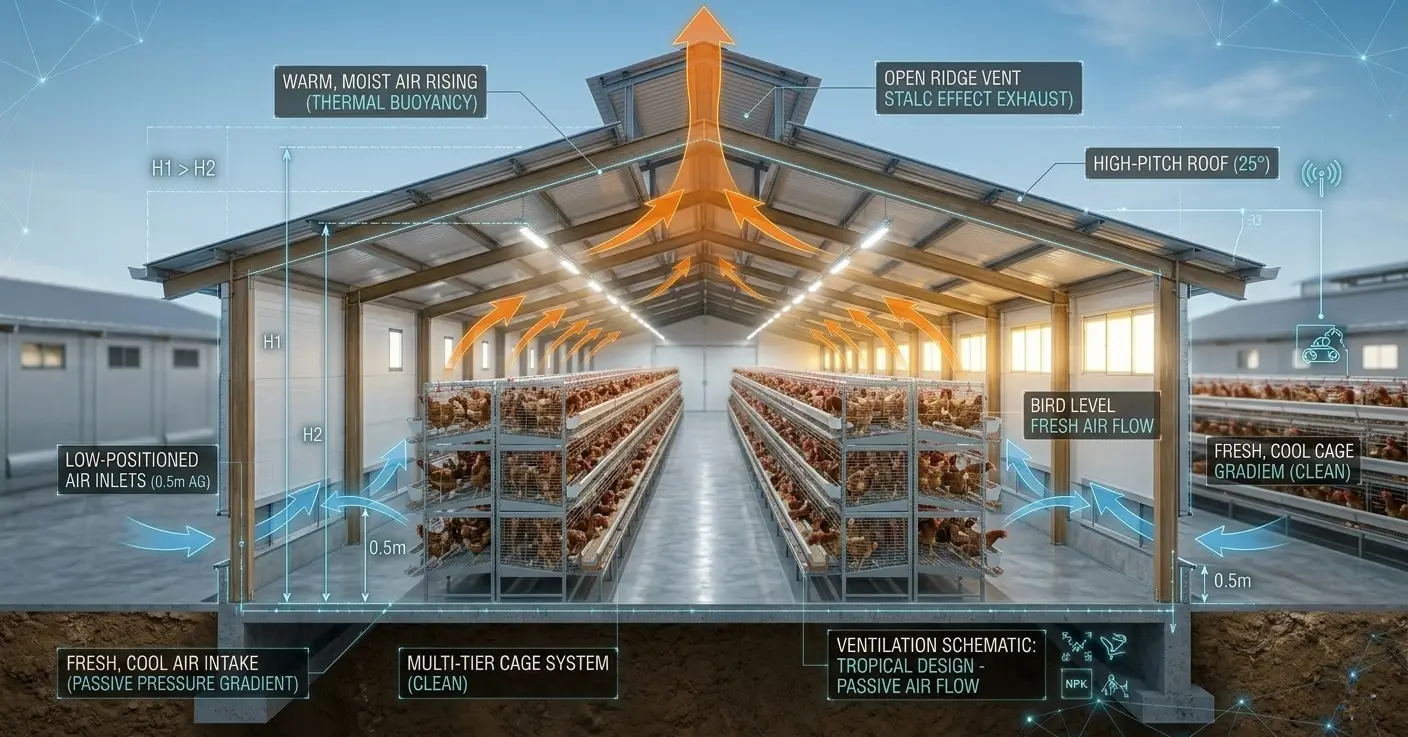
The stack effect — also called the chimney effect or thermal buoyancy — is a passive ventilation mechanism driven entirely by temperature difference. Warm air is less dense than cool air. When warm air builds up inside a poultry house, it rises and escapes through high openings at the ridge. As it exits, it creates a pressure differential that draws cooler outside air in through low sidewall openings.
No fans. No electricity. The heat the birds produce drives the system.
How It Works in Layer Houses
The driving force behind the stack effect is the temperature difference between inside and outside air (ΔT) multiplied by the height between the inlet and the outlet. The greater the height difference and the greater the temperature differential, the stronger the airflow.
This is why ridge height matters so much in naturally ventilated poultry houses. A house with a 4-meter ceiling peak performs significantly better under the stack effect than one with a 2.5-meter peak, all else being equal. Every additional meter of vertical distance between the inlet and the outlet increases the passive pressure driving air movement.
Structural Requirements for Stack Effect Ventilation
- Ridge openings: Continuous ridge vents or adjustable ridge caps running the length of the house allow warm, moist air to escape freely. Blocked or undersized ridges are the most common reason stack effect ventilation underperforms.
- Low sidewall inlets: Openings positioned 0.5–1.0 meters above floor level allow cool incoming air to enter at bird level rather than dropping straight to the floor from a high inlet.
- Roof pitch: A steeper roof pitch (≥ 25°) increases the vertical distance between inlets and the ridge and improves thermal buoyancy. Low-pitch roofs significantly reduce stack effect performance.
- Minimal internal obstructions: Cage tiers, feed lines, and equipment that block airflow from the inlet to the ridge reduce the system’s effectiveness.
Limitations
The stack effect depends on a temperature differential to function. On extremely hot days — when inside and outside temperatures are nearly equal — ΔT collapses, and airflow slows to near zero. This is precisely when birds need ventilation most.
Stack effect ventilation also cannot be controlled precisely. Airflow rate changes with weather, wind, and cloud cover. In high-density housing or during peak summer heat, passive thermal buoyancy alone is rarely sufficient.
Cross-Ventilation: Using Wind to Move Air Laterally
What It Is
Cross-ventilation uses prevailing winds to push air horizontally through the house — entering through openings on one side and exiting through openings on the opposite side. Unlike the stack effect, which is driven by internal heat, cross-ventilation depends on external wind speed and direction.
How It Works
When wind strikes the windward wall of a poultry house, it creates positive pressure on that side. The leeward side experiences negative pressure. That pressure gradient drives air through the building at a rate directly proportional to wind speed and inlet area.
At wind speeds of 2–4 m/s (7–14 km/h), cross-ventilation can move substantial volumes of air through a correctly oriented house. At low wind speeds — common in mid-afternoon when temperatures peak — cross-ventilation stalls.
House Orientation for Cross-Ventilation
House orientation is critical. The long axis of the house should be perpendicular to the prevailing wind direction so the broadest wall face captures maximum airflow. In most tropical and subtropical regions, prevailing winds come from the south or southwest. A house oriented east-west captures these winds most effectively.
Where prevailing wind direction is inconsistent, sidewall openings on both sides — with adjustable shutters — allow producers to open the windward side and partially close the leeward side to create directional flow regardless of wind direction.
Inlet Sizing and Placement
The total inlet area should be 1.5–2 times the total outlet area. This creates a slight restriction at the inlet that accelerates airflow as it enters — the venturi effect — increasing air velocity at bird level where it matters.
Inlets positioned too high push cool air up over the birds’ heads before it mixes down. Inlets at 0.5–1.0 meters above floor level deliver air directly into the occupied zone.
Limitations
Cross-ventilation is unreliable when wind speeds drop below 1.5 m/s. In sheltered valleys, areas surrounded by trees or other buildings, or during calm weather events, the system provides little cooling. It also produces uneven airflow distribution in long houses — the first 20 meters of a 100-meter house receive far more air movement than the far end.
When Natural Ventilation Is Enough
Natural ventilation — stack effect and cross-ventilation working together — is sufficient when all of the following conditions apply:
- Stocking density is below 6 birds per square meter
- Outside temperatures stay below 30°C for most of the year
- The house is correctly oriented and designed with adequate ridge height and sidewall openings
- Wind speeds at the site average above 2 m/s during critical afternoon hours
In these conditions, a well-designed naturally ventilated house can maintain internal temperatures within 2–3°C of outside ambient — close enough to protect production without any mechanical input.
Many small and medium-scale layer operations in highland tropical regions or temperate climates meet these criteria for most of the year.
When Artificial Ventilation Becomes Necessary
Mechanical ventilation is not a replacement for natural ventilation. It is an upgrade layer that covers the conditions where passive systems fail.
The threshold for adding fans is practical: when peak internal temperatures regularly exceed 30°C for more than two hours during the laying period, egg production, shell quality, and feed conversion all begin to deteriorate measurably. At that point, the cost of mechanical ventilation is outweighed by the cost of underperformance.
The two primary mechanical systems used in layer houses are tunnel ventilation and cross-flow fan ventilation.
Tunnel Ventilation
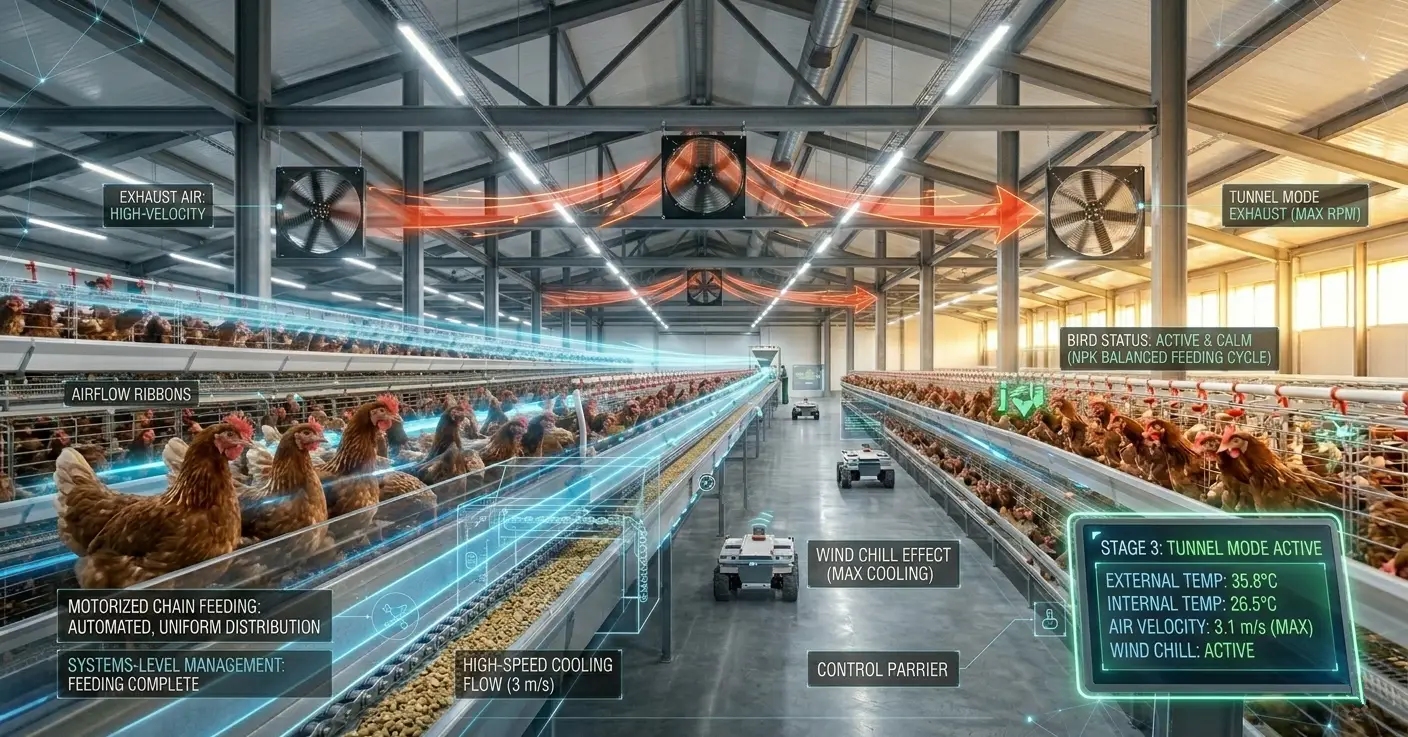
Tunnel ventilation pulls air in through one end of the house (the inlet end) and exhausts it through large fans at the opposite end. It creates a single directional airflow along the entire length of the house, generating air velocities of 2–3 m/s or more at bird level. That wind chill effect reduces the bird’s perceived temperature by 4–8°C even when the actual air temperature stays the same.
Tunnel ventilation is the most effective mechanical system for hot climates. It works regardless of wind direction or outside conditions. Its limitation is the electricity cost: tunnel fans are large, and running them continuously during a six-month hot season is a significant operating expense.
Design requirements:
- Inlet area at the cool end sized to match fan capacity (target 2 m/s inlet velocity)
- Fans sized to achieve one full air exchange every 60–90 seconds at peak capacity
- Houses longer than 80 meters benefit most; short houses lose efficiency in tunnel mode
Cross-Flow Fan Ventilation
Cross-flow systems place fans along one sidewall and inlets on the opposite wall, mechanically replicating cross-ventilation when wind is insufficient. Fans operate at lower capacity than tunnel systems and can be staged — running one or two fans during mild conditions and adding more as the temperature rises.
Cross-flow systems are less effective than tunnel ventilation in extreme heat but are significantly cheaper to install and run. They suit operations where peak temperatures are moderate and natural ventilation handles most of the work most of the time.
Combining Natural and Artificial Systems: The Hybrid Approach
The most cost-effective strategy for most commercial layer operations is a hybrid system designed in three stages:
Stage 1 — Natural ventilation: Ridge vents open, sidewall curtains adjusted to capture prevailing wind. No electricity used. Handles ambient temperatures below 27°C.
Stage 2 — Supplemental fan assist: Two to four cross-flow fans activate when the temperature exceeds 27°C. Boosts airflow through the same inlets the natural system uses. Partial electricity cost.
Stage 3 — Full tunnel mode: All fans run at maximum capacity when temperatures exceed 32°C. Curtains on the leeward side close. The inlet end opens fully to the tunnel configuration. Maximum airflow at maximum electricity cost, but only during peak hours.
A temperature controller with humidity override manages the transitions between stages automatically. The result is a system that runs naturally for the majority of operating hours and mechanically only when conditions demand it.
On most sites in tropical Africa, a properly staged hybrid system runs fans for 3–5 hours per day during the hottest months — a fraction of the cost of a fully mechanical operation running tunnel ventilation all day.
Reducing Electricity Costs in Mechanical Systems
When fans must run, the following practices lower operating costs without sacrificing performance:
Variable speed drives (VSDs): Stage fans at 50–70% speed during moderate heat rather than running fewer fans at full speed. Air volume scales linearly with speed; electricity consumption scales with the cube of speed, so running fans slower saves disproportionately more power.
Fan positioning and sealing: Each fan that runs draws air through every other gap in the house — around poorly sealed curtains, cracks in walls, and open doors. Seal the building envelope tightly so all incoming air travels through designated inlets at the intended velocity.
Morning pre-cooling: Run fans at full capacity for 30–45 minutes before peak afternoon heat to flush warm air built up overnight and drop the house temperature before birds experience stress. This short burst is more cost-effective than reactive cooling mid-afternoon.
Solar panel integration: In off-grid or partial-grid operations, a 3–5 kW solar array can cover fan electricity costs during the daytime hours when fans run most. The alignment between solar generation peak and ventilation demand peak (both midday to mid-afternoon) makes this one of the highest-return solar applications in poultry production.
Monitoring Ventilation Effectiveness
Airflow is invisible. The only reliable way to know whether a ventilation strategy is working is to measure results at the bird level.
Place thermometers and hygrometers at three points along the house length and at bird height — not at ceiling level or near doors. Log data every 15 minutes. A working ventilation system will show:
- Internal temperature within 3°C of outside ambient during natural ventilation periods
- A measurable temperature drop along the house length in tunnel mode (inlet end should be 3–6°C cooler than exhaust end)
- Relative humidity below 70% during active ventilation
Birds that are panting, standing away from feeders, reducing water intake, or clustering near sidewalls are signaling that the ventilation system is not keeping pace with heat load — regardless of what the thermostat reads.
Summary
The stack effect and cross-ventilation are not outdated techniques. They are the lowest-cost, zero-electricity ventilation tools available to layer producers — and when house design supports them, they handle the majority of thermal management work throughout the year.
Artificial ventilation — tunnel systems and cross-flow fans — fills the gaps that natural systems cannot: extreme heat days, low-wind periods, and high stocking densities. The key is designing for natural ventilation first and adding mechanical capacity as a staged supplement, not as a replacement.
Producers who understand both systems and know when to switch between them get the performance of a fully mechanized house at a fraction of the electricity cost.