Farrowing is the most time-sensitive management event in commercial pig production. The difference between a stockperson who arrives at the farrowing house to find a sow halfway through an unattended delivery — with the first several piglets potentially chilled, potentially crushed, and potentially without adequate colostrum intake — and a stockperson who was present from the first contraction, having correctly read the pre-farrowing signs in the preceding hours, is measured in the number of piglets alive at the end of that farrowing event.
The signs that precede farrowing are not random or subtle. They form a recognizable, progressive sequence that begins roughly 48 hours before birth and intensifies through predictable stages to the definitive indicators that farrowing is minutes rather than hours away. A farm manager or stockperson who understands this sequence, observes it systematically, and knows which specific signs to check at what intervals can predict farrowing timing with enough accuracy to schedule staff attendance, prepare the farrowing crate, and be positioned for the critical first-piglet moments that establish the foundation for every piglet in the litter.
This guide works through the complete sign sequence — what each sign indicates physiologically, how to assess it practically, how reliably it predicts timing, and how individual signs interact to create the composite picture that gives the most accurate farrowing prediction available without laboratory or ultrasound equipment.
The Physiological Framework — Why These Signs Occur
Understanding why pre-farrowing signs occur makes them easier to recognize and interpret, because each sign directly reflects a specific physiological change in the sow’s hormonal and physical preparation for delivery.
The Hormonal Cascade
Approximately 24–48 hours before farrowing, a cascade of hormonal changes initiates the physiological transitions that produce the observable signs:
Progesterone withdrawal: Progesterone, the hormone that maintains pregnancy by preventing uterine contractions, declines sharply in the final 24–48 hours before farrowing. This decline removes the suppression of uterine contractile activity — allowing the oxytocin-mediated contractions of labor to begin.
Prostaglandin F2α surge: Prostaglandins produced by the regressing corpora lutea (the ovarian structures that have maintained progesterone production throughout pregnancy) trigger both the final progesterone decline and the initial uterine contractions. Prostaglandins also cause the relaxation of the cervix and pelvic ligaments that is necessary for the physical passage of piglets.
Estrogen rise: As progesterone declines, estrogen (still being produced by the placenta) becomes the dominant sex hormone — responsible for the vulva swelling and edema that is one of the earliest visible signs.
Prolactin surge: The dramatic increase in prolactin in the hours preceding farrowing triggers milk secretion into the mammary glands — the physiological basis for the milk letdown that is the most reliable and most practically useful single predictor of farrowing timing.
Oxytocin pulses: As labor begins, pulses of oxytocin are released — stimulating the regular uterine contractions that dilate the cervix and subsequently propel each piglet through the birth canal.
The 48-Hour Indicators — Early Warning Signs
Udder and Mammary Development
What to observe: The mammary glands enlarge progressively through the final 3–4 weeks of gestation, but the 48 hours before farrowing mark a distinct acceleration of this process — the udder becomes visibly fuller, firmer, and more prominent than in the preceding days.
How to assess: Compare the appearance of the udder against the previous day’s observation — progressive development visible over 24 hours is a meaningful sign. The glands should feel warm but should not show the localized heat, pain, or discoloration that would indicate mastitis.
Reliability as a timing predictor: Udder development is an early warning indicator — it tells you that farrowing is probably within 48 hours, but its predictive precision for a specific timing window is limited by the individual variation between sows in their rate of mammary development through the final stages of gestation.
Vulva Changes
What to observe: The vulva becomes progressively more swollen and reddened as estrogen levels rise in the pre-farrowing period. The skin around the vulva softens, and the vulvar lips separate slightly — quite distinct from the vaginal discharge and behavioral signs of estrus, with which it should not be confused given the obvious gestational context.
How to assess: Daily visual inspection of the vulva during the final week before expected farrowing — the change between days is more informative than any single observation, as it reflects the progressive rather than sudden nature of the estrogen-driven tissue response.
Reliability as a timing predictor: Vulva changes are a 24–48 hour indicator with significant individual variation — some sows show pronounced vulva development for 2–3 days before farrowing, others show relatively subtle changes until closer to delivery. It is a useful supporting indicator rather than a stand-alone timing predictor.
Relaxation of the Pelvic Ligaments
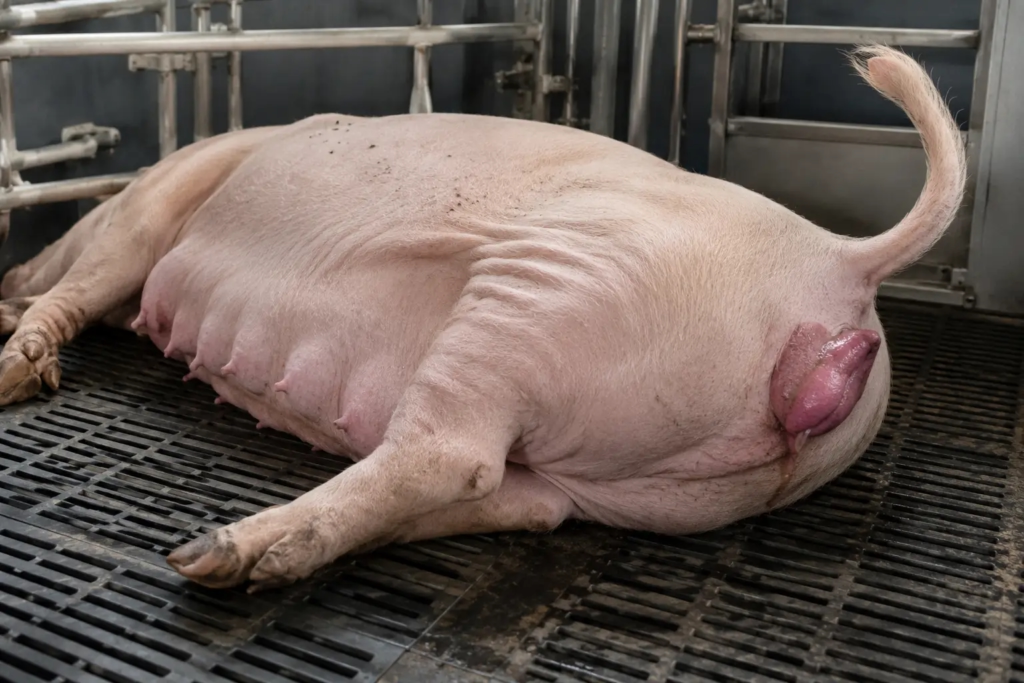
What to observe: The ligaments on either side of the tail base (the sacrotuberous ligaments) relax and soften as prostaglandins and relaxin act on the connective tissue supporting the pelvis — preparatory softening that allows the pelvis to widen adequately for piglet passage. In lean sows, this relaxation can be visible as a slight hollowing or dimpling on either side of the tail base as the previously prominent ligament outline disappears.
How to assess: With practice, palpating the area on either side of the tail base allows the change from the firm ligament of pregnancy to the softer, less defined tissue of pre-farrowing pelvic relaxation to be felt — the “hard vs. soft” distinction becoming increasingly detectable as farrowing approaches.
Reliability as a timing predictor: Pelvic ligament relaxation typically indicates farrowing within 24 hours, though the assessment requires practice to perform reliably and the degree of relaxation varies between individuals.
Behavioral Changes — Nesting Drive
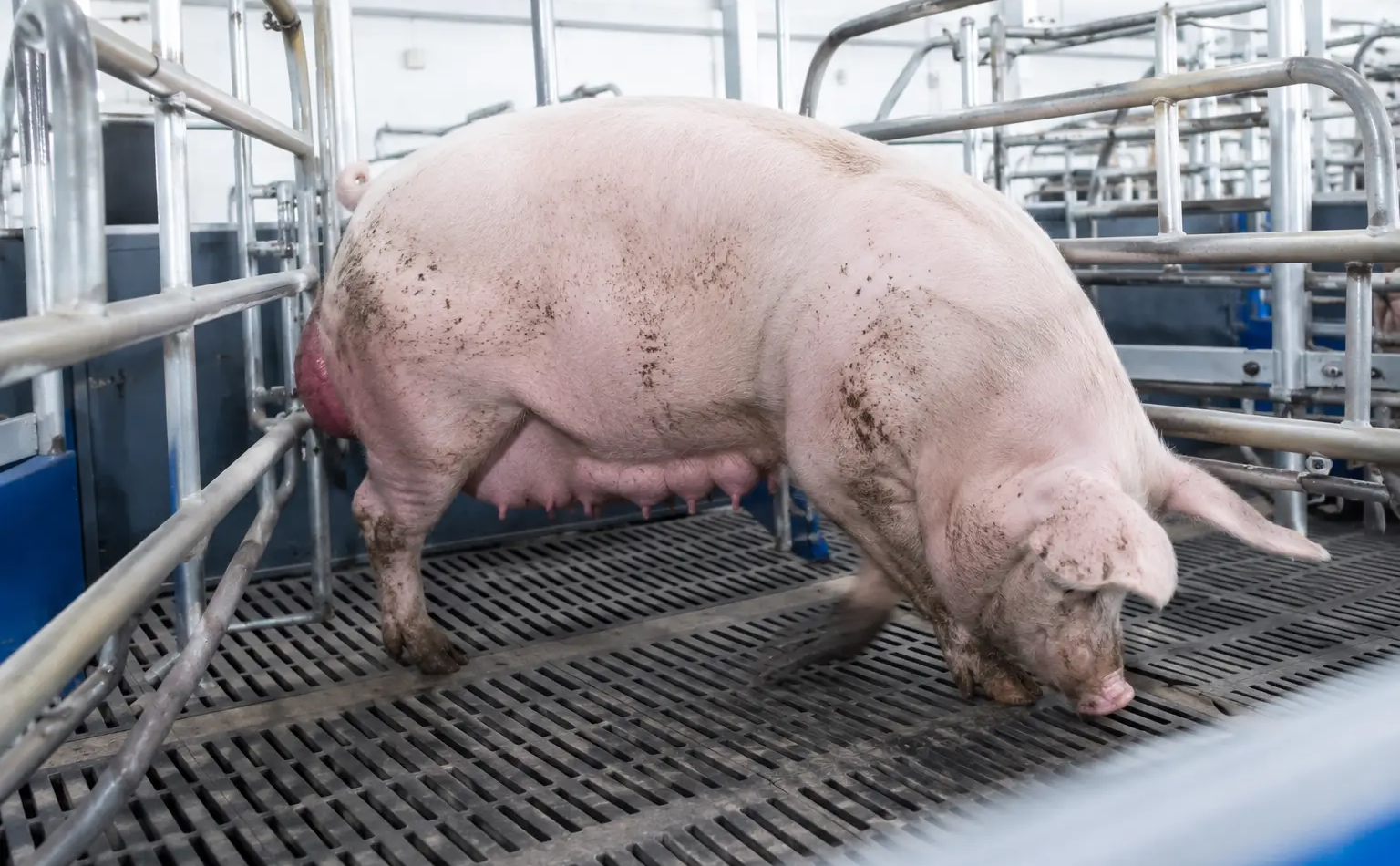
What to observe: Even within the confinement of a farrowing crate, sows in the pre-farrowing period demonstrate characteristic nesting behavior — repeated pawing at the floor of the crate, rooting at the crate bars, standing and lying repeatedly, and in sows with any access to bedding material, vigorous rearranging of whatever material is available.
How to assess: Increased restlessness compared to the preceding days is the key observation. A sow that was lying calmly for extended periods the previous day and is now rising and lying repeatedly, shifting position frequently, and showing obvious agitation is demonstrating the nesting drive response.
Reliability as a timing predictor: Nesting behavior typically intensifies within 24 hours of farrowing but is highly variable in expression between individuals — some sows show pronounced restlessness for a full day before farrowing; others show relatively calm behavior until quite close to active labor. It is most useful as a sign that prompts more frequent checking of the more reliable time-sensitive indicators.
The 6–12 Hour Indicators — Approaching Farrowing
Milk Letdown — The Most Reliable Indicator
Why this is the most valuable single sign: Colostrum production and letdown is triggered by the prolactin surge that precedes farrowing, and its progression from initial detectable letdown to freely flowing colostrum has the most consistent timing relationship to farrowing of any observable sign.
How to assess:
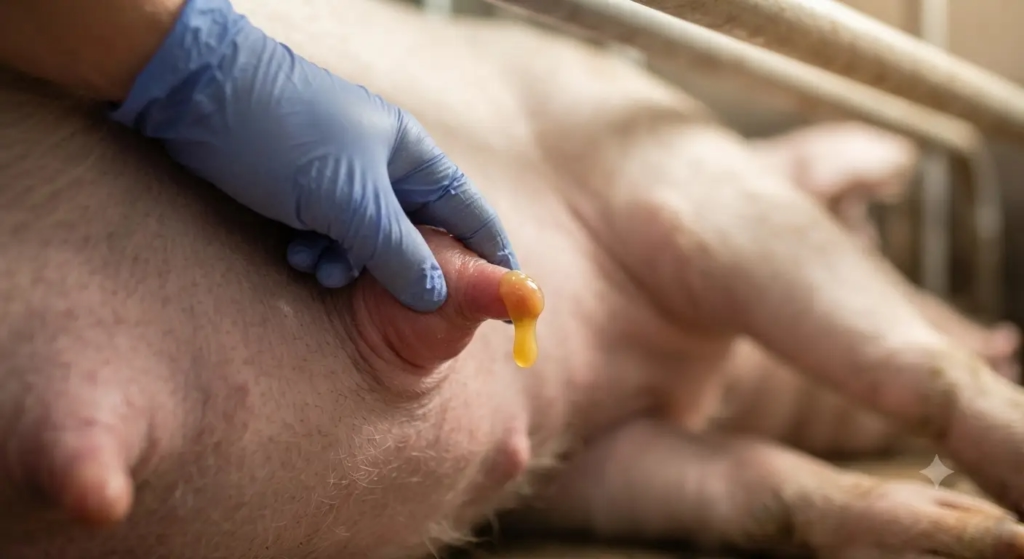
The assessment is simple and quick. With clean hands, apply gentle pressure to the rear pair of teats (the inguinal teats, which typically show the earliest and most pronounced milk letdown) between the thumb and index finger, applying a light milking pressure toward the teat end:
- No fluid expressed: Farrowing is likely more than 12 hours away (though udder development may be visibly progressing)
- Thin, clear to slightly yellowish watery fluid: Pre-colostrum is detectable — farrowing is likely within 6–24 hours
- Thick, yellowish, viscous colostrum freely expressible with gentle pressure: Farrowing is typically within 1–6 hours
- Colostrum flowing freely with minimal pressure, appearing from multiple gland pairs simultaneously: Farrowing is typically imminent — often within 1–2 hours
How often to check: Once milk is detectable at the “thin, watery” stage, checking every 2–3 hours and noting the progression toward freely expressible colostrum allows farrowing timing to be predicted within a workable window for attendance planning.
Individual variation note: The absolute timing of these stages varies between individual sows — younger sows and gilts may show faster progression than older sows, and total time from initial detectable letdown to farrowing can range from 4 hours to over 24 hours between individuals. The progression of the milk consistency (from watery to thick colostrum) is more informative than the absolute timing of first letdown, since it reflects the sow’s actual physiological stage rather than a time elapsed since an arbitrary first detection.
Reduced Feed Intake
What to observe: Most sows show a noticeable reduction in voluntary feed intake in the 12–24 hours preceding farrowing — sometimes refusing the morning feed entirely when farrowing is expected that day.
How to assess: Compare the sow’s feed consumption against her previous days’ intake — a sow that normally consumes her full allocation in two sessions who leaves significant feed in the trough is providing a behavioral indicator of approaching farrowing.
Reliability as a timing predictor: Useful supporting indicator, but not reliable enough for precision timing prediction on its own — feed intake reduction is also associated with illness, heat stress, and other conditions, and some sows maintain reasonable feed intake until quite close to farrowing.
Temperature Changes
What to observe: Some sows show a modest body temperature drop (0.5–1.0°C below their recent baseline) in the 12–24 hours before farrowing — an effect attributed to the progesterone withdrawal and associated metabolic changes.
How to assess: Taking rectal temperature at a consistent time each day during the final week of gestation — noting both the absolute value and any change from the previous day — can detect this mild hypothermic dip in sows where it is pronounced enough to measure.
Reliability as a timing predictor: This sign is inconsistent in its expression — it is present in some sows and absent or very subtle in others, limiting its reliability as a universal indicator. Where it is detectable, it supports rather than independently confirms approaching farrowing.
The Final Hour Indicators — Imminent Farrowing
Visible Contractions
What to observe: The onset of visible uterine contractions — observable as a rhythmic tensing of the abdominal wall, typically most visible in the flank area when the sow is in lateral recumbency. The contractions are initially irregular and mild, becoming stronger and more regular as labor progresses toward the first delivery.
How to assess: Observe the sow in lateral recumbency — the periodic visible rippling or tensing of the flank musculature, occurring at intervals that shorten as labor intensifies, is distinguishable from the general respiratory movement of normal breathing.
Reliability as a timing predictor: Once visible contractions are established and regular, the first piglet typically arrives within 30–60 minutes, though this varies. Visible contractions are the most reliable immediate predictor of imminent delivery.
Tail Movements
What to observe: A characteristic tail-raising and swishing behavior — periodic lifting of the tail, often accompanied by or alternating with the abdominal contraction pattern. Many sows show a very specific rhythmic tail-lifting pattern during active labor that is easily distinguished from normal tail movement once a stockperson has observed farrowing a few times.
How to assess: Observation of the sow’s tail behavior during lateral recumbency — the periodic, coordinated lifting that coincides with or immediately follows abdominal contractions is the sign to look for, distinct from casual tail movement associated with fly irritation or general restlessness.
Continuous Colostrum Dripping
What to observe: In many sows in the final minutes before the first delivery, colostrum begins dripping continuously or near-continuously from the teats without manual expression — a spontaneous letdown that reflects the peak of the oxytocin and prolactin surges associated with the active labor phase.
How to assess: Visual observation of moisture at the teat ends or visible colostrum dripping when the sow is in lateral recumbency — a clear sign that farrowing is extremely imminent.
Position and Breathing
What to observe: Most sows farrow in lateral recumbency (lying on their side) — a sow that has been shifting between standing and lying finally settling into sustained lateral recumbency, combined with the contraction and tail movement signs above, indicates the transition from pre-labor restlessness to active delivery.
Breathing pattern also changes — respiration becomes more rapid and slightly labored as contractions intensify, reflecting both the physical exertion of labor and the hormonal state of active parturition.
The Composite Assessment — Reading Multiple Signs Together
Why No Single Sign Is Sufficient
Each sign in the sequence provides information about a different aspect of the sow’s physiological state — and each sign has individual variation in its timing and expression that makes it unreliable when used in isolation. The practical prediction of farrowing timing is most accurate when multiple signs are assessed together, with their composite pattern providing a more reliable estimate than any single sign could deliver.
The three-tier composite assessment:
Tier 1 — Daily monitoring (all sows in the final week before expected farrowing):
- Udder development (visual assessment)
- Vulva condition (visual assessment)
- Feed intake recording
- General behavioral observation
When Tier 1 assessment identifies signs suggesting farrowing within 24–48 hours (progressive udder development, vulva swelling, reduced feed intake, increased restlessness), move to Tier 2 monitoring.
Tier 2 — Every 2–3 hours:
- Milk letdown assessment (manual expression from rear teats)
- Temperature check (optional, if baseline has been established)
- Behavioral observation (nesting intensity, restlessness level)
When Tier 2 assessment identifies signs suggesting farrowing within 2–6 hours (thick, freely expressible colostrum, pronounced restlessness, reduced activity alternating with labor-like positioning), move to Tier 3 monitoring.
Tier 3 — Continuous presence:
- Observation for visible contractions
- Tail movement monitoring
- Spontaneous colostrum letdown observation
- Full farrowing attendance readiness
The Practical Monitoring Schedule
| Expected Days to Farrowing | Monitoring Action | Frequency |
|---|---|---|
| 7–3 days | Daily observation of udder development, vulva, feed intake, behavior | Once daily |
| 3–1 days | Above plus milk letdown check | Twice daily (morning and evening) |
| Signs suggest within 24 hours | Full sign composite assessment | Every 2–3 hours |
| Thick colostrum expressible | Prepare farrowing crate, inform attending staff | Every 1–2 hours |
| Active labor signs | Continuous attendance | Until farrowing complete |
Part 6: First and Subsequent Litters — How the Signs Differ in Gilts
Why Gilts Warrant Extra Attention
Gilts — sows farrowing for the first time — typically show less pronounced or less consistent pre-farrowing signs than experienced sows, for several physiological reasons:
Less established mammary tissue: The mammary glands of a first-time farrowing gilt have less fully developed glandular tissue than a sow who has completed previous lactation cycles — milk letdown may be less prominent or may begin later relative to farrowing than in experienced sows.
Behavioral unpredictability: Gilts have no learned experience of the farrowing process and often show more variable and less predictable behavioral signs — some gilts are extremely restless for extended periods before farrowing, making the behavioral signs less useful as timing indicators; others show surprisingly little behavioral change until very close to active labor.
Higher complication rate: Gilts have a higher rate of farrowing complications (dystocia, prolonged intervals between piglets, positioning difficulties) than experienced sows — making attended farrowing particularly important for this category.
Practical adjustment for gilts: When monitoring a gilt approaching her expected farrowing date, apply the milk letdown assessment more frequently than for experienced sows (recognizing that the letdown may progress less predictably), maintain continuous attendance from the first signs of active labor (given the higher complication rate), and be prepared for behavioral signs that are more variable and less informative than in experienced sows.
Record-Keeping and Pattern Recognition
Individual Sow Farrowing Profiles
Over successive parities, a sow’s pre-farrowing sign pattern becomes a documented history that allows increasingly accurate prediction of her specific farrowing timing for subsequent parities:
- Some sows are early milk expressors: They show detectable milk letdown 18–24 hours before farrowing — for these sows, the threshold for moving to intensive monitoring should be set earlier in the milk progression sequence
- Some sows are rapid laborers: Once active contractions begin, they deliver the entire litter in under 1 hour — for these sows, attention at the first visible contraction sign is more critical than for sows with typically longer intervals
- Some sows are reliable sign-givers: Their behavioral signs (nesting, restlessness, feed refusal) consistently predict farrowing within a specific window — for these sows, behavioral observation alone provides adequate early warning
- Some sows are difficult to read: Their signs are subtle and poorly predictive of specific timing — for these sows, greater reliance on the milk letdown assessment (the most physiologically reliable sign across individuals) and earlier initiation of intensive monitoring provides the best protection
Documenting these individual patterns in the farm’s farrowing records — alongside the litter size, any complications, and the timing of first piglet delivery relative to the observed signs — builds a farm-specific farrowing prediction database that improves with every parity and reduces the reliance on generic guidelines that may not accurately represent the specific sow population on that farm.
Practical Staffing Implications
Converting Sign Recognition Into a Farrowing Attendance Schedule
The entire value of accurate sign recognition is only realized if it translates into the right person being present at the right time. The monitoring schedule in Part 5 is designed to allow this translation — giving a minimum 2-hour warning window for continuous attendance by the point at which freely expressible colostrum is detected, which is sufficient time to alert and position the person responsible for farrowing attendance.
Night farrowing: A significant proportion of farrowings occur during nighttime hours, reflecting the sow’s natural farrowing timing preferences and the extended duration of some farrowing events that begin in the evening and conclude in the early morning. The monitoring schedule should address nighttime farrowing risk through:
- A late-evening assessment (10:00 PM or similar) of all sows expected to farrow imminently, based on the sign profile developed through the day
- An early-morning check (4:00 AM or similar) for farms where overnight staffing is not continuous
- Consideration of simple alert systems (a sow that has been clearly in active labor for extended periods without birth requiring immediate attention) where staff cannot be continuously present
The investment in a monitoring schedule that catches farrowing within the first-hour window is one of the highest-returning time investments in commercial pig management — each piglet saved from the complications of unattended birth has the same production value as a piglet that required none of the additional feed, housing, and reproductive cost that producing an additional litter-member would represent.
Summary
Pre-farrowing signs form a reliable, progressive sequence — not a single event but a graduated series of physiological transitions that can be monitored systematically to predict farrowing timing with practical accuracy. Udder development and vulva changes provide the 48-hour warning that intensifies monitoring; milk letdown progression provides the 2–12-hour window that triggers attendance preparation; visible contractions and tail-lifting signs identify the final hour of active labor.
The milk letdown assessment is the most reliable practical predictor available at farm level without laboratory or imaging equipment — its progression from non-detectable through thin watery fluid to freely flowing thick colostrum directly reflects the prolactin and oxytocin surge that precedes delivery, and its consistency across individuals is higher than any behavioral sign. It warrants assessment twice daily from the point that 48-hour signs are detected, increasing to every 1–2 hours when thick colostrum is expressible.
For gilts farrowing for the first time, apply greater caution — begin intensive monitoring earlier, rely more heavily on the physiological milk letdown sign than on behavioral signs (which are more variable in gilts), and ensure continuous attendance from the first active labor indicators given the higher complication rate in this category.
The farm that reads these signs reliably and staffs the farrowing house appropriately is the farm that maximizes the return on its reproductive investment — turning more of the piglets that were born into the weaned pigs that generate revenue.