A floor egg is a failure of the environment, not behavior. When a hen lays on the floor instead of in a nest box, she is communicating that the available nesting space does not meet her instinctive criteria for a safe, enclosed, private laying site. The egg she leaves on the floor is dirtier, more likely to crack, harder to collect, and more likely to become a source of bacterial contamination than one laid in a properly designed nest.
Cracked shells are a separate but related problem. They occur when eggs are laid onto hard surfaces, dropped from excessive height inside poorly designed nests, or allowed to accumulate and press against each other in overcrowded boxes.
Both problems are infrastructure problems. They are solved by designing and positioning nest boxes around the hen’s nesting behavior, not around what is convenient for the producer to build or place.
This article covers the dimensions, materials, placement, ratios, and management practices that eliminate floor eggs and cracked shells in commercial and small-scale layer operations.
Understanding Nesting Behavior: What Hens Are Looking For
Before specifying hardware, understand the instinct driving the behavior.
A hen preparing to lay will spend 20–60 minutes searching for a suitable nest site. During this pre-laying period, she evaluates potential sites against several criteria: enclosure on three sides, low light intensity relative to the surrounding environment, a soft substrate underfoot, appropriate floor area to turn around in, and proximity to other hens already nesting (social facilitation).
When available nest boxes fail to meet these criteria — too bright, too open, too small, too hard, too crowded, or poorly positioned — hens bypass them and lay in corners, under feeders, or against walls where the criteria are naturally met. That is how floor eggs are produced.
Every design decision in nest box engineering either satisfies or violates these instinctive preferences.
Nest Box Dimensions: The Minimum That Works
Nest box dimensions are the most commonly miscalculated variable in layer house design. Boxes built too small prevent hens from turning comfortably and create reluctance to enter. Boxes built too large lose the enclosed, cave-like feel hens prefer and are shared by multiple birds simultaneously, which increases competition, stress, and floor eggs from displaced hens.
Recommended Internal Dimensions
| Parameter | Recommended Range | Minimum Acceptable |
|---|---|---|
| Width (per individual box) | 30–35 cm | 28 cm |
| Depth (front to back) | 35–40 cm | 30 cm |
| Height (interior clearance) | 35–40 cm | 30 cm |
| Entrance opening width | 25–30 cm | 22 cm |
| Entrance opening height | 25–30 cm | 22 cm |
These dimensions suit standard commercial layer breeds (Hy-Line, Lohmann, ISA Brown) with body weights of 1.5–2.0 kg. Heavier dual-purpose breeds require 10–15% larger boxes.
The entrance opening should be smaller than the interior dimensions — the contrast between a narrow entry and a larger interior space reinforces the enclosed, protected character hens prefer.
Perch at the Entrance
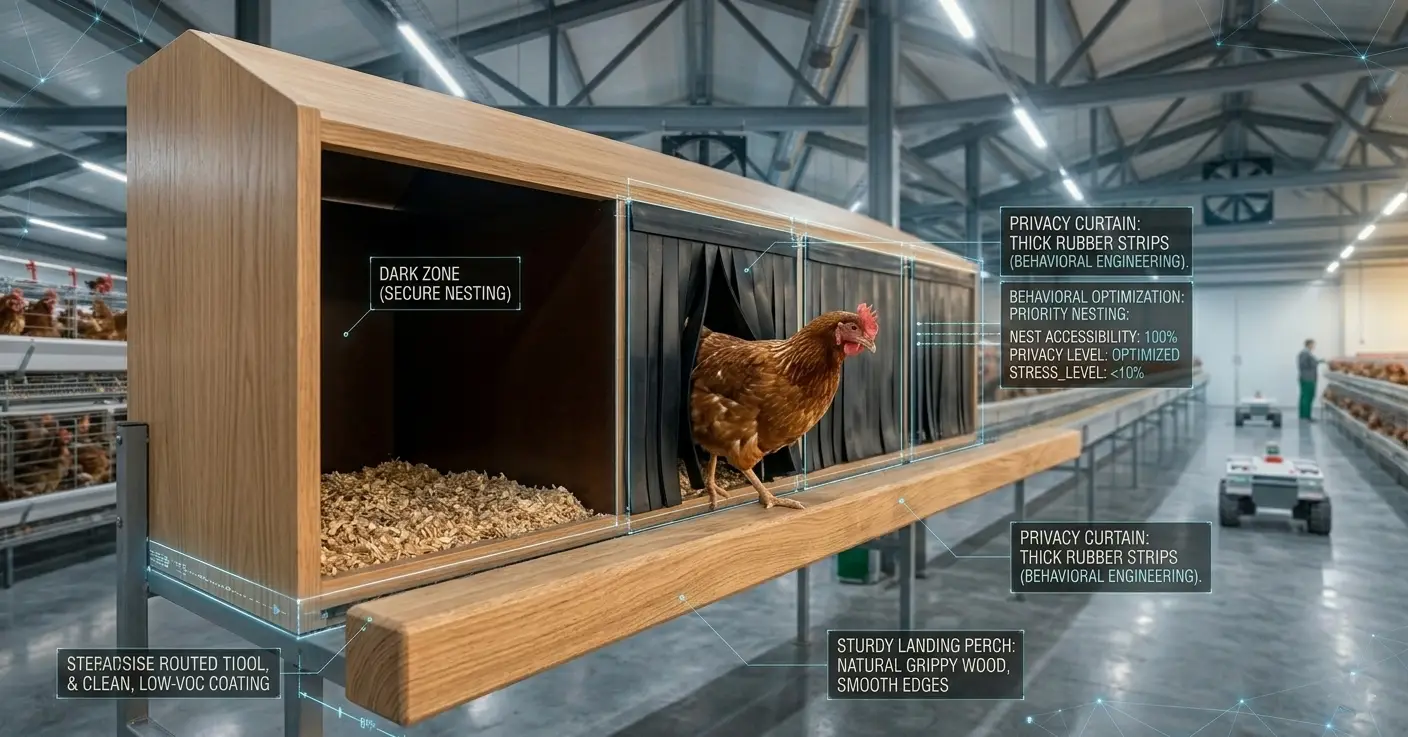
A landing perch positioned 10–15 cm below and 10–15 cm in front of the entrance opening allows hens to alight, orient themselves, and enter in a controlled posture. Without a landing perch, hens must jump directly into the box — a posture that increases egg-on-hard-surface impacts and discourages use in older or heavier birds.
The perch diameter should be 3–4 cm — thick enough to grip without causing foot fatigue, narrow enough to prevent roosting and overnight occupation of the box.
Hen-to-Nest Ratio: How Many Boxes Per Bird
Insufficient nest box numbers drive competition during peak laying hours (typically 08:00–13:00), force hens to wait, and push subordinate birds in the social hierarchy to lay on the floor.
Standard ratios:
- Individual nest boxes: 1 box per 4–5 hens (maximum 6)
- Community nest boxes: 1 square meter of nest floor area per 80–100 hens
Exceeding these ratios — through stocking density increases without adding boxes — is one of the most reliable predictors of floor egg rates above 3%. Floor egg rates below 1% are achievable and should be the operational target in well-designed systems.
Community Nest Boxes vs. Individual Nest Boxes
Individual nest boxes, where each compartment houses one hen at a time, are standard in small and medium operations. They provide reliable occupancy tracking, are easier to clean, and give each hen a discrete laying space.
Community (colony) nest boxes are large enclosed areas housing multiple hens simultaneously. Used in high-stocking-density barn systems, they require careful management of substrate depth and collection frequency to prevent egg accumulation and pecking damage. When designed correctly — with roll-away floors that move eggs away from the laying area immediately — they achieve lower cracked shell rates than individual boxes. When managed poorly, they produce the opposite result.
For most commercial operations below 20,000 birds, individual nest boxes in correctly calculated ratios are the simpler and more controllable system.
Placement Height: The Most Underestimated Variable
Where nest boxes are positioned vertically inside the house has a direct effect on adoption rate and floor egg incidence.
Optimal Height Above Floor
Nest boxes should be positioned with their entrance opening at 45–60 cm above the litter floor for ground-level housing systems. This height range reflects natural nesting site selection — hens in the wild prefer elevated sites above ground level that provide a visual advantage and perceived security from ground-based threats.
Boxes mounted too low (entrance below 30 cm) sit within the zone hens associate with ground-level predator risk. Use rates drop, and floor eggs increase.
Boxes mounted too high (entrance above 90 cm) require hens to fly or jump to access them — physically demanding for heavy breeds and older birds, leading to reduced use and potential leg injuries on landing.
In multi-tier cage systems, nest boxes are integrated into each tier level. The same logic applies: the nest entrance should be at a height that allows easy entry from the associated cage level without requiring significant vertical movement.
Horizontal Placement Within the House
Position nest boxes along the darker, lower-light areas of the house — typically along sidewalls rather than in the center. The natural light gradient in most houses is brightest in the center (especially in open-sided or translucent-roofed houses) and dimmer near the walls. This gradient naturally directs pre-laying hens toward the nest boxes.
Keep nest boxes away from:
- Feeders and drinkers: Activity around feed and water disturbs nesting hens and deters pre-laying birds from approaching
- Direct airflow paths: Fans or inlet positions that create high-velocity air movement across nest box entrances cool the interior below hen comfort and reduce occupancy
- High-traffic areas: Main walkways and entry points generate disturbance during collection and management — position nests in quieter zones where possible
Substrate: What Goes on the Nest Box Floor
The material inside the nest box directly affects the hen’s willingness to enter, egg breakage rate, and sanitation.
Effective Substrate Options
Wood shavings (pine): The standard choice for most operations. Soft, absorbent, provides cushioning that reduces cracked shells from impact, and is familiar to hens accustomed to litter floors. Depth of 5–8 cm provides adequate cushioning. Replace or top up every 2–4 weeks.
Rubber mats (nest pads): Purpose-made textured rubber pads sized to the nest box floor. Durable, washable, and maintain consistent cushioning over time. No depth management required. Upfront cost is higher than shavings, but labor cost over time is lower. Cracked shell rates with quality nest pads are comparable to deep shavings.
Artificial turf inserts: Used in some commercial operations as an alternative to rubber mats. Provides grip and cushioning, easy to remove and wash. Effective but degrades faster than rubber in high-humidity environments.
Avoid: Sand (hard surface, high breakage), straw alone without shavings beneath (compacts quickly, loses cushioning), synthetic fiber materials (hens reject unfamiliar textures), and any substrate with poor moisture management — wet nest floors dramatically increase bacterial load on eggshells.
Substrate Depth Management
Substrate depth below 3 cm provides inadequate cushioning and allows eggs to contact the hard floor beneath. Depth above 10 cm becomes unstable and causes eggs to roll to the sides of the box rather than resting centrally. Target 5–8 cm and maintain it consistently.
Roll-Away Nest Box Floors: Eliminating Post-Lay Egg Contact
In systems where eggs remain in the nest box after laying, two problems develop: hens returning to inspect or peck laid eggs (the primary cause of egg-eating behavior initiation), and eggs accumulating in stacks that increase breakage pressure.
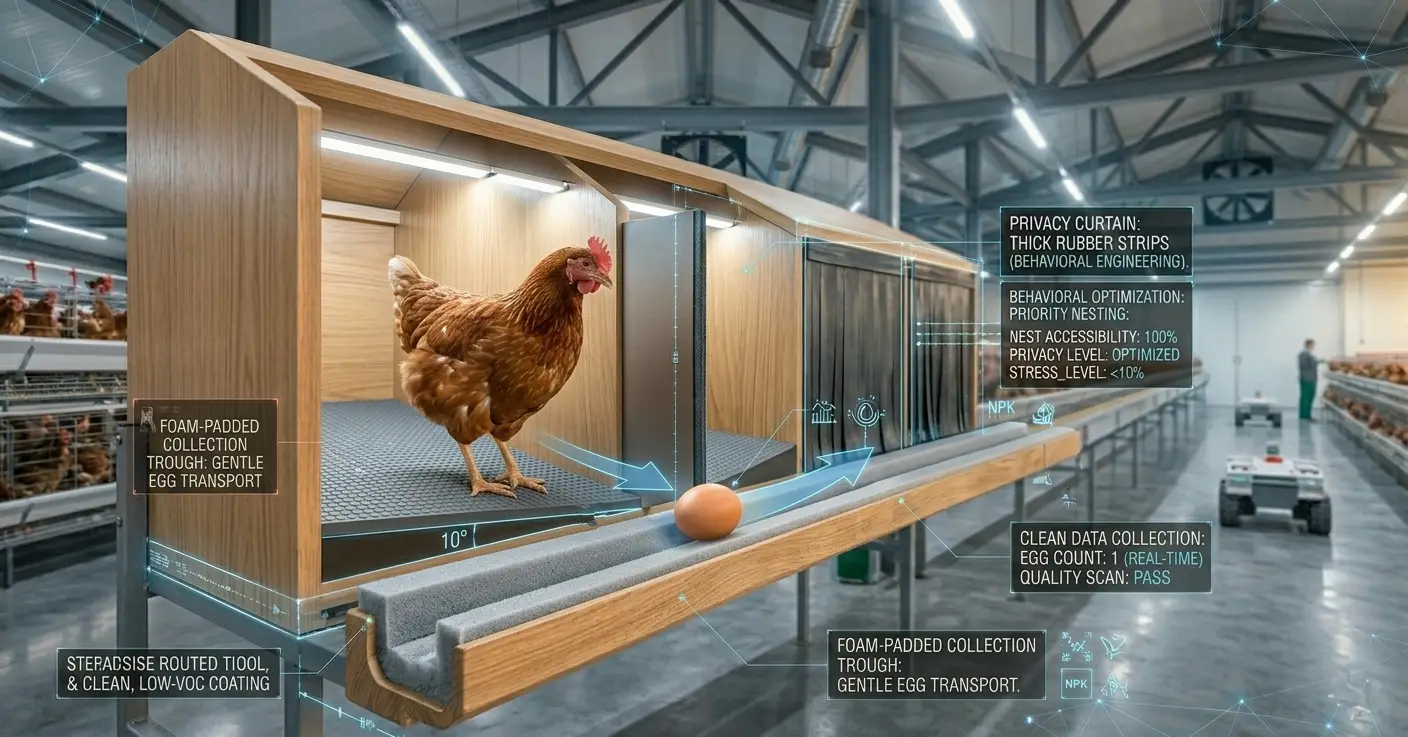
Roll-away nest box floors solve both problems. The floor is angled at 8–12° so that immediately after laying, the egg rolls gently out of the box through a rear gap into a covered collection trough. The hen never has access to the egg after it exits the nest.
Benefits:
- Eliminates the primary trigger for egg-eating behavior
- Reduces egg-to-egg contact and associated breakage
- Improves egg hygiene by separating eggs from nest substrate immediately
- Reduces collection labor — eggs accumulate in the trough rather than requiring individual box retrieval
Roll-away systems require precise floor angle calibration. Below 8°, eggs do not roll consistently. Above 14°, eggs roll too fast and collide with the collection trough wall — increasing rather than reducing breakage.
The collection trough should be lined with rubber or foam padding, and eggs should be collected at least twice daily to prevent trough overcrowding.
Curtains and Partitions: Controlling Light and Privacy
The single most effective modification to increase nest box adoption in houses with floor egg problems is adding entrance curtains.
A curtain of rubber strips or heavy-duty plastic sheeting hung across the nest box entrance — cut to allow hens to push through but fall back into place afterward — reduces interior light intensity by 60–80% and creates the enclosed, private environment hens instinctively prefer.
Operations that add curtains to previously curtain-free nest boxes consistently report floor egg rate reductions of 30–60% within the first week of installation.
Curtains also reduce the “sitting hen deterrent” effect — where a hen approaching a box sees another hen already inside and turns away. The curtain conceals the interior occupant, reducing perceived competition for the space.
Side partitions between individual nest boxes are equally important. Without partitions, a hen in the process of laying can see and be disturbed by activity in adjacent boxes. Full-height internal partitions from the back wall to the entrance create individual, visually isolated laying spaces that maximize per-box occupancy.
Training Pullets to Use Nest Boxes
First-time layers that have never seen a nest box are at the highest risk of establishing floor-laying habits. A floor-laying habit established early in the laying cycle is difficult to break — hens that lay their first eggs on the floor will return to that location repeatedly.
Prevention is straightforward:
- Install nest boxes before the onset of lay. Boxes should be in the final position, stocked with substrate, and accessible at least two weeks before the flock reaches 5% production. Hens begin scouting potential nest sites before they lay their first egg.
- Lock nest boxes closed at night. Hens denied access to nest boxes after dark are prevented from roosting inside them overnight. Overnight roosting leads to fecal contamination of substrate, wet and dirty eggs, and nest box avoidance by other hens. Close box entrances 1–2 hours before lights-out and reopen them 1–2 hours after lights-on.
- Place decoy eggs. A ceramic or plastic egg placed inside each nest box during the first week of lay provides a visual cue that the box is a safe, established laying site. Hens are strongly attracted to already-occupied-looking nest sites. Remove decoys after the second week once the flock has established consistent box use.
- Collect floor eggs immediately. Allowing floor eggs to accumulate creates a visual cue that the floor is an acceptable laying site. Remove every floor egg at every collection round. The goal is zero floor eggs remaining in the house between collections.
Egg Collection Frequency: Its Role in Cracked Shell Rates
Nest box design determines where eggs are laid. Collection frequency determines what happens to them afterward. The two interact directly.
In individual nest boxes without roll-away floors, eggs accumulate. A hen entering an occupied box to lay will step on existing eggs, a primary cause of cracked shells in conventional nest box systems. At collection frequencies of once per day, peak-hour box occupancy means multiple eggs in each box for several hours before collection, increasing the probability of step-on damage.
Minimum collection frequency: Twice daily — once mid-morning after the peak laying period (10:00–11:00) and once late afternoon. Three collections per day in high-density operations measurably reduces cracked shell incidence compared to two.
Each collection point should be logged. Tracking the ratio of nest-box eggs to floor eggs at each collection round identifies peak floor-egg periods and helps diagnose whether the problem is nest box access competition (peak hours), lighting issues (outside peak hours), or specific house locations (spatial analysis of floor egg positions).
Summary
Floor eggs and cracked shells are not flock behavior problems. They are design and placement failures that humans respond to predictably.
Nest boxes positioned at the correct height, in low-light zones away from feeders and high-traffic areas, sized to breed specifications, stocked with adequate substrate depth, curtained for privacy, and provided in correct hen-to-box ratios will be used. Hens will not lay on the floor when a properly designed alternative is available.
The return on investment is direct: every floor egg prevented is a clean, uncracked, fully marketable egg gained. In a 5,000-bird operation running 2% floor eggs, eliminating floor eggs through correct infrastructure recovers approximately 100 eggs per day, every day of the laying cycle.
That is not a behavioral outcome. It is an engineering outcome.