Pale gills in catfish can indicate a health problem, environmental stress, or an abnormality that requires further investigation. Healthy gill tissue plays an essential role in oxygen uptake, so changes in gill colour should be assessed alongside fish behaviour, feeding activity and water quality.
In African catfish (Clarias gariepinus), pale gills do not identify one specific disease. Possible explanations include anaemia, blood loss, gill damage, and other health or environmental problems. A reliable diagnosis requires more than visual inspection.
What Do Pale Gills Look Like?
Pale gills appear lighter than expected, with reduced pink or red coloration. The appearance may affect part or all of the visible gill tissue.
The significance depends on the fish’s condition and the presence of other signs, including:
- Reduced appetite
- Weakness or lethargy
- Rapid gill-cover movement
- Increased surface breathing
- Abnormal swimming
- Visible parasites or gill damage
- Unexplained mortality
Pale gills should not automatically be classified as a bacterial, fungal or parasitic infection.
What Causes Pale Gills in Catfish?
1. Anaemia
Anaemia occurs when the blood has insufficient functional red blood cells or haemoglobin to transport oxygen normally. Because gill colour is partly influenced by blood circulation, anaemia can contribute to pale-looking gills.
Possible underlying causes must be investigated rather than assuming that pale gills alone confirm anaemia.
2. Blood loss
External injuries, tissue damage, or certain parasite infestations may contribute to blood loss. Significant blood loss can affect the fish’s condition and the appearance of its gills.
Inspect affected fish for skin injuries, ulcers, damaged fins, and other visible abnormalities.
3. Gill parasites
Some parasites damage or irritate the gills, potentially interfering with normal gill function. However, pale gills are not a reliable way to identify a particular parasite.
Microscopic examination may be needed to establish whether parasites are present.
4. Water-quality problems
Unsuitable water conditions can cause respiratory distress and gill abnormalities. Important parameters to investigate include dissolved oxygen, ammonia, nitrite, pH, and temperature.
Low dissolved oxygen can cause fish to struggle to obtain sufficient oxygen, while ammonia and nitrite can interfere with normal physiological function through different mechanisms.
These problems may occur alongside other diseases.
5. Other health conditions
Bacterial infections, other gill disorders, and systemic illness may affect the appearance or function of the gills. Their presence cannot be confirmed by colour alone.
How Pale Gills Affect Catfish Health
The gills are essential for oxygen uptake and help maintain the fish’s internal physiological balance. When gill function or blood oxygen transport is impaired, affected fish may experience:
- Reduced activity and feeding
- Poor growth or declining condition
- Increased respiratory effort
- Greater difficulty coping with environmental stress
- Severe illness or mortality when the underlying problem is serious
The effects depend on the cause and severity of the condition.
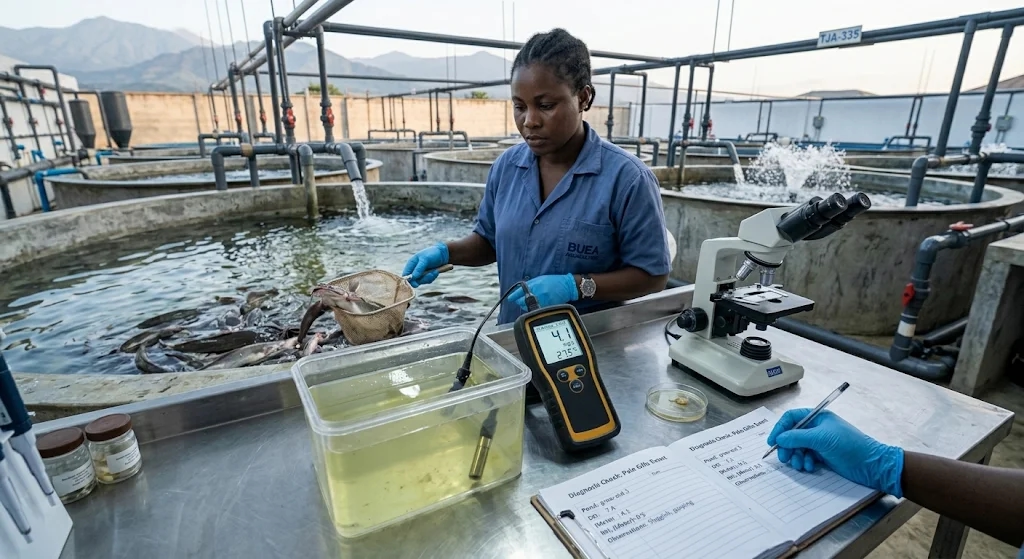
How to Diagnose Pale Gills in Catfish
Step 1: Observe the affected fish
Record how many fish have pale gills, whether symptoms are spreading and whether feeding or swimming behaviour has changed.
Step 2: Examine other visible signs
Look for ulcers, injuries, damaged fins, excess mucus, abnormal gill tissue and other visible abnormalities. Handle fish carefully to avoid causing additional stress.
Step 3: Test the water
Measure:
- Dissolved oxygen
- Ammonia
- Nitrite
- pH
- Water temperature
Record the readings and compare them with the operating targets appropriate for the farming system.
Step 4: Investigate parasites and blood-related problems
If water quality does not explain the symptoms, seek a more detailed examination. A fish-health professional may recommend gill microscopy, blood assessment or other diagnostic procedures based on the findings.
Step 5: Seek laboratory confirmation when needed
Professional assessment is particularly important when many fish are affected, mortality is increasing, or the cause remains unclear.
What to Do When Catfish Have Pale Gills
The correct response depends on the underlying cause.
- Assess water quality promptly. Correct confirmed oxygen or water-quality problems using suitable procedures.
- Reduce unnecessary handling. Avoid additional stress while fish are unwell.
- Review feeding and waste management. Avoid excessive feeding and investigate accumulating organic waste.
- Inspect affected fish carefully. Look for injuries, ulcers, abnormal gills, or signs that suggest parasites.
- Avoid unconfirmed treatment. Do not use antibiotics, antiparasitic chemicals, or other medications solely because the gills look pale.
- Seek professional advice. Obtain a diagnosis if the condition persists, spreads, or is accompanied by significant mortality.
Do not assume that improving oxygen alone will resolve pale gills. If the cause is anaemia, blood loss, parasitism or another disease, additional investigation may be necessary.
How to Prevent Pale Gills in Catfish
Maintain good water quality
Monitor dissolved oxygen, ammonia, nitrite, pH and temperature. Consistent records help identify problems before fish health deteriorates.
Practise effective feeding
Provide suitable feed in quantities appropriate for fish size, biomass and appetite. Avoid excessive feeding that increases organic waste.
Maintain appropriate stocking density
Ensure that the system’s oxygen supply, water exchange and waste-removal capacity are appropriate for the number and size of fish.
Reduce injury and handling stress
Use careful procedures during grading, transport and routine management. Investigate injuries promptly.
Apply farm biosecurity
Clean equipment appropriately, quarantine new fish, and avoid transferring potentially contaminated equipment between ponds without proper cleaning and disinfection.
Monitor fish regularly
Check gill appearance, feeding response, swimming behaviour, and mortality during routine inspections. Early detection helps farmers investigate the underlying problem sooner.
Pale Gills Versus Other Gill Abnormalities
| Observation | Possible explanation |
|---|---|
| Pale or unusually light gills | Anaemia, blood loss, gill disorders or other health problems |
| Swollen gills | Irritation, infection, parasites or environmental injury |
| Rapid gill movement | Respiratory distress from several possible causes |
| Excess mucus on the gills | Irritation, parasites, infection or unsuitable water conditions |
| Pale gills with weakness | A potentially significant health problem requiring investigation |
| Pale gills with increasing mortality | Urgent need for water-quality assessment and professional diagnosis |
These are investigative clues, not definitive diagnoses.
Frequently Asked Questions
Are pale gills always a sign of disease?
No. Gill colour should be interpreted in context. Persistent or pronounced paleness, especially with abnormal behaviour or mortality, warrants investigation.
Can ammonia cause pale gills in catfish?
Ammonia can injure or irritate gill tissue and affect fish health. However, pale gills alone do not establish ammonia toxicity. Water testing is necessary.
Can parasites cause pale gills?
Parasites can damage gill tissue and affect fish health. Microscopic examination may be required to confirm an infestation and identify the organism.
Should I give antibiotics to catfish with pale gills?
Not without a diagnosis and appropriate professional guidance. Pale gills do not prove that a bacterial infection is present.
When should I seek help?
Seek professional assistance if the paleness persists, several fish are affected, fish become weak or stop feeding, or deaths occur.