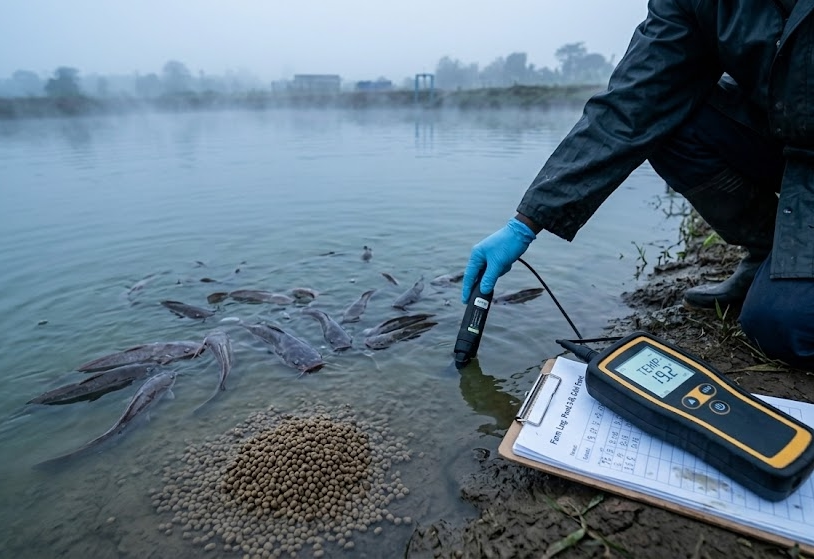
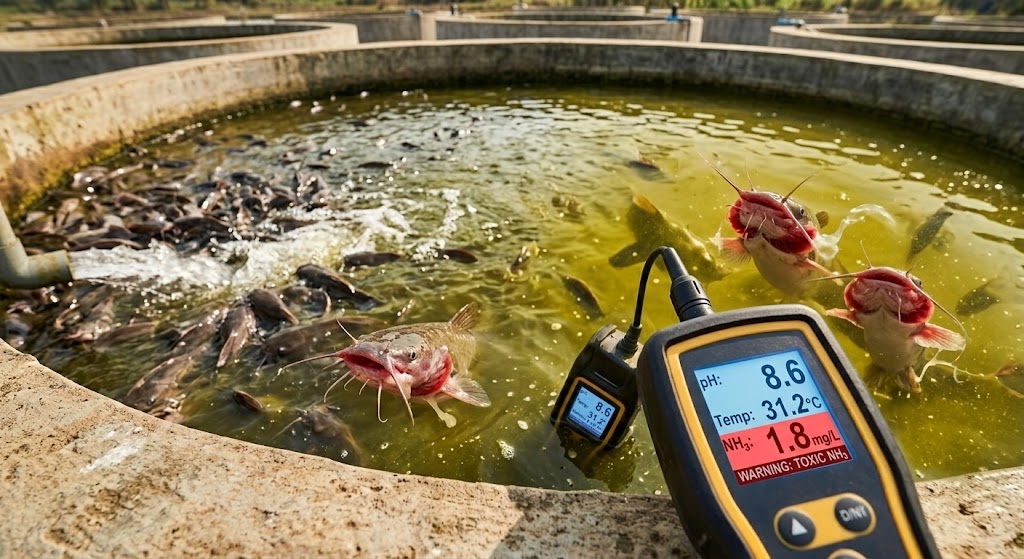
Nitrite is a water-quality contaminant that can interfere with oxygen transport in fish. When nitrite accumulates in catfish ponds or tanks, affected fish may show respiratory distress, reduced feeding, weakness, and, in severe cases, mortality.
In African catfish (Clarias gariepinus), nitrite toxicity can resemble low dissolved oxygen, ammonia toxicity, and gill disease. Farmers should test the water rather than relying on symptoms alone to identify the cause.
What Is Nitrite in Catfish Farming?
Nitrite (\(\mathrm{NO_2^-}\)) is an intermediate product in the biological conversion of ammonia to nitrate. In a functioning biological filtration system, microorganisms convert ammonia into nitrite and then into nitrate.
Nitrite can accumulate when these biological processes are disrupted or cannot keep pace with the waste produced by fish.
Unlike ammonia, which can directly damage gill tissue, nitrite is especially concerning because it can enter the bloodstream and interfere with the ability of blood to transport oxygen.
How Nitrite Affects Catfish Gills and Oxygen Transport
1. Interference with oxygen transport
Nitrite can enter fish through the gills and oxidise haemoglobin, the oxygen-carrying protein in red blood cells, into methemoglobin. Methemoglobin cannot transport oxygen normally.
This condition reduces the blood’s capacity to deliver oxygen to tissues, even when dissolved oxygen in the water appears adequate.
2. Respiratory distress
Affected catfish may show increased gill movement, unusual surface breathing or other signs of respiratory stress.
Because African catfish can breathe atmospheric air, increased surface activity must be assessed alongside water-quality measurements and other symptoms.
3. Reduced feeding and activity
Nitrite exposure can impair normal physiological function. Fish may become less active, eat less, or show abnormal behaviour.
4. Increased stress and disease vulnerability
Prolonged poor water quality places additional stress on fish and may make them less able to cope with other environmental or health challenges.
5. Mortality
Severe nitrite exposure can be fatal. The outcome depends on the concentration, duration of exposure, water chemistry, species, and life stage.
Symptoms of Nitrite Toxicity in Catfish
Potential warning signs include:
- Increased respiratory effort
- Unusual surface breathing
- Reduced appetite
- Lethargy or abnormal swimming
- Weakness or loss of normal activity
- Sudden or increasing mortality
These symptoms are not specific to nitrite poisoning. Low oxygen, ammonia toxicity, parasites and infectious diseases may produce similar signs.
A water test is essential. Fish behaviour alone cannot reliably distinguish nitrite toxicity from other causes.
What Causes Nitrite to Accumulate?
Excessive feeding and waste production
Uneaten feed and fish waste increase the nitrogen load in the production system. If waste processing cannot keep pace, water-quality problems may develop.
High stocking density
A high fish biomass can increase waste production and the demand placed on biological filtration and water exchange.
Disrupted biological filtration
In recirculating aquaculture systems, damaged, immature or poorly functioning biological filters may fail to convert nitrite efficiently into nitrate.
Inadequate water management
Insufficient water exchange or ineffective waste management can contribute to the accumulation of nitrogen compounds.
Changes in operating conditions
Sudden changes in water conditions or filtration performance can disturb biological processes. Monitoring ammonia and nitrite together helps identify developing problems.
How to Test for Nitrite in Catfish Ponds and Tanks
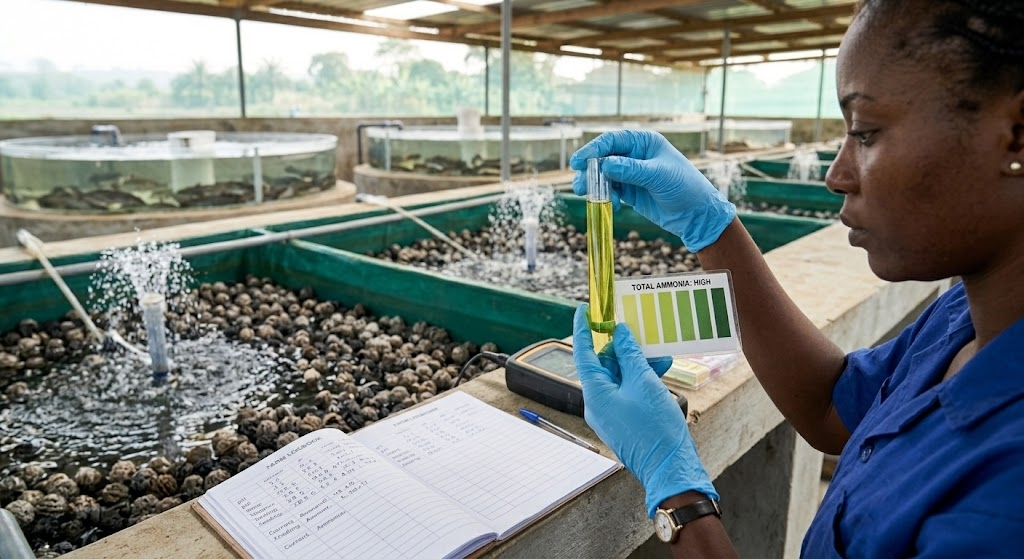
Step 1: Use a suitable nitrite test
Use an appropriate test kit or meter and follow its instructions. Check whether the result is reported as nitrite (\(\mathrm{NO_2^-}\)) or nitrite-nitrogen (NO₂-N), because these are different reporting units.
Step 2: Test ammonia and dissolved oxygen
Ammonia accumulation and low dissolved oxygen can occur alongside nitrite problems. Testing these parameters helps identify multiple contributing factors.
Step 3: Measure pH and temperature
Record pH and temperature to build a complete picture of water quality and help interpret the fish’s condition.
Step 4: Review filtration and feeding
Check recent feeding levels, fish biomass, water exchange and the performance of any biological filtration system.
Step 5: Record results
Keep dated records of water-quality measurements, fish behaviour, mortality and corrective actions. These records help reveal recurring problems.
What to Do When Nitrite Is High
If nitrite toxicity is suspected, act promptly while confirming the water conditions.
- Test the water immediately. Measure nitrite, ammonia, and dissolved oxygen.
- Support oxygen availability. Provide suitable aeration if oxygen is low or fish are distressed.
- Reduce the nitrogen load. Temporarily adjust feeding where appropriate and avoid adding feed that fish cannot consume.
- Check biological filtration. In filtered systems, investigate whether the filter is functioning correctly and avoid unnecessary disruption of its biological community.
- Assess water exchange. Where appropriate, consider controlled water exchange using suitable replacement water. Avoid abrupt changes that may cause additional stress.
- Seek system-specific advice. Consult an aquaculture professional if nitrite remains elevated, fish continue to show symptoms or mortality increases.
- Retest and monitor. Confirm that water quality is improving and observe the fish’s response.
Do not apply a universal chemical treatment or dosage without assessing the production system and water chemistry.
Can Salt Help With Nitrite Toxicity?
Chloride can reduce nitrite uptake through the gills in many fish species. For this reason, chloride management is sometimes used as part of nitrite-toxicity control in aquaculture.
However, salt treatment is not a universal solution. The appropriate approach depends on the fish species, water chemistry, nitrite concentration, production system, and applicable product guidance.
Before adding salt or another treatment, obtain advice appropriate to the system. Correcting the underlying source of nitrite accumulation remains essential.
How to Prevent Nitrite Toxicity in Catfish
Maintain appropriate stocking density
Match fish biomass to the system’s water exchange, aeration, filtration, and waste-processing capacity.
Avoid overfeeding
Feed according to fish size, biomass, and appetite. Excess feed increases waste production and places additional pressure on water-quality management.
Maintain biological filtration
For recirculating systems, ensure biological filters are properly established and maintained. Monitor nitrite after changes to filtration, stocking or feeding.
Monitor nitrogen compounds
Test ammonia and nitrite routinely, especially in intensive systems and during periods of operational change.
Maintain good water management
Remove excessive organic waste and use appropriate water-exchange procedures when necessary.
Keep farm records
Record stocking levels, feed inputs, filtration maintenance, water-quality readings and mortality. This makes it easier to identify the source of recurring nitrite problems.
Nitrite Toxicity Versus Other Catfish Health Problems
| Observation | Possible explanation |
|---|---|
| Elevated nitrite test result | Nitrite accumulation requiring investigation |
| Respiratory distress despite adequate dissolved oxygen | Nitrite toxicity or another health problem |
| Elevated ammonia and nitrite together | Nitrogen-processing or waste-management problem |
| Abnormal gill appearance | Possible infection, parasite infestation or environmental injury |
| Poor feeding and lethargy | Water-quality stress, disease or other environmental factors |
| Continued mortality after correcting nitrite | Additional causes may need investigation |
This comparison supports troubleshooting but does not replace a professional diagnosis.
Frequently Asked Questions
Can nitrite damage catfish gills?
Nitrite enters fish primarily through the gills, but its major recognised toxic effect is interference with oxygen transport in the blood. Respiratory distress should not automatically be interpreted as direct gill damage.
Can catfish die from nitrite poisoning?
Yes. Severe nitrite exposure can prevent adequate oxygen delivery to tissues and cause mortality.
Can nitrite poisoning occur when dissolved oxygen is normal?
Yes. Nitrite can interfere with oxygen transport in the blood even when the water contains an apparently adequate amount of dissolved oxygen.
Why should ammonia and nitrite be tested together?
Both are part of the nitrogen cycle in aquaculture systems. Testing both helps identify problems with waste production, biological filtration or water management.
Is nitrite the same as nitrate?
No. Nitrite is an intermediate nitrogen compound, while nitrate is the product formed when nitrite is further oxidised. Their toxicity profiles differ, so they should not be treated as interchangeable measurements.