At Otto’s Farms, we track shell quality as a revenue metric, not a welfare indicator. A cracked shell is not just a compromised egg; it is a lost sale, a downgrade at the collection point, a bacterial contamination risk, and a signal that something in the nutritional program is not delivering what the hen needs at the moment she needs it.
Shell quality failures, thin shells, soft shells, cracked shells, and misshapen shells are almost always nutritional in origin. Not because the ration is missing calcium entirely, but because the calcium in the ration is the wrong form, the wrong particle size, present in the wrong ratio to phosphorus, or arriving at the wrong time relative to when the shell gland actually needs it.
Formulating a high-calcium mash that produces consistently strong eggshells requires understanding the biology of shell formation first, and then reverse-engineering the ration to match it. That is the approach we use at Otto’s Farms, and it is the approach this guide will walk you through.
The Biology of Eggshell Formation: What the Hen Is Doing Every 24 Hours
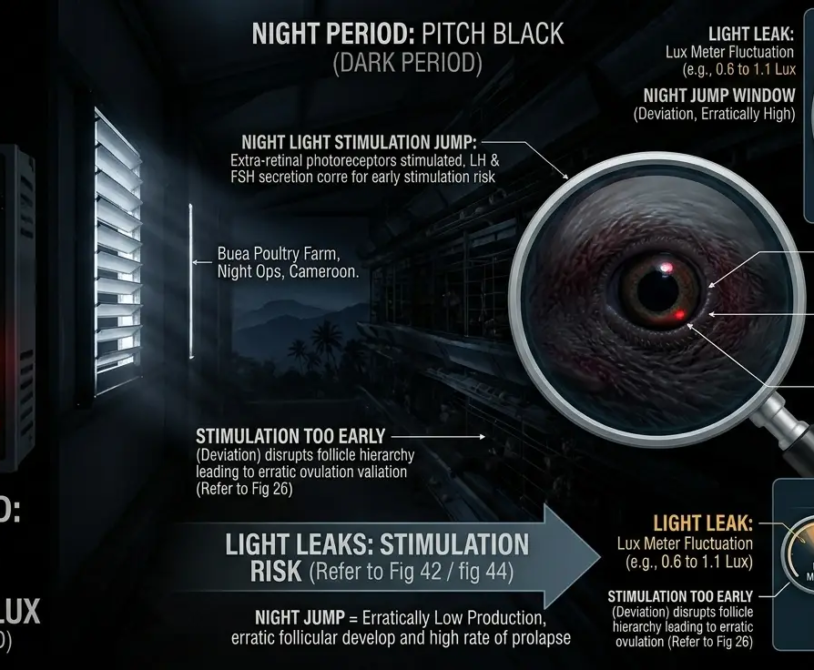
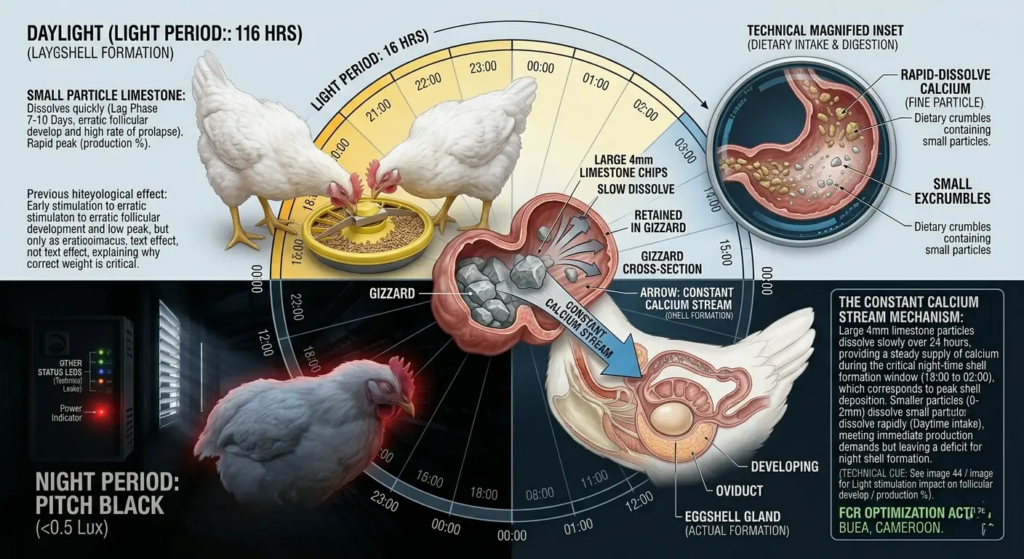
A commercial layer hen produces one egg approximately every 24–26 hours. The shell calcification process — depositing 2.0–2.2 grams of calcium carbonate onto the outer surface of the egg — takes 16–20 hours and occurs almost entirely during the dark period when the hen is not eating.
This timing creates the central challenge in high-calcium mash formulation: the hen’s peak calcium demand occurs precisely when she has no access to dietary calcium. She meets this demand through three sources in combination:
- Calcium is stored in the gizzard from coarse limestone particles consumed during the day that have not yet dissolved
- Medullary bone resorption — drawing calcium from the rapidly mobilizable bone reserve in the medullary cavity of long bones
- Residual intestinal absorption from feed consumed in the hours before lights-out
The ration must supply calcium in forms and at timing windows that align with all three of these sources — not just deliver the correct total daily calcium amount in a single form.
Getting this right is the difference between a flock averaging 3.8% cracked shells and one averaging 0.8%. At 10,000 birds producing 300 eggs per cycle, the difference between those two crack rates is 90,000 eggs per cycle — each one either a revenue event or a loss event depending on how the mash was formulated.
Calcium Requirements: How Much, and How It Changes
The daily calcium requirement for a commercial laying hen varies across the laying cycle and with ambient temperature — two variables that are non-negotiable inputs in any serious ration formulation exercise.
Daily Calcium Intake Targets
| Production Phase | Daily Calcium Requirement | Dietary Calcium % (at 110g intake) |
|---|---|---|
| Early lay (weeks 18–30) | 3.8–4.0 g/day | 3.4–3.6% |
| Peak lay (weeks 30–50) | 4.0–4.2 g/day | 3.6–3.8% |
| Late lay (weeks 50–72) | 4.2–4.5 g/day | 3.8–4.1% |
Note the trajectory: calcium requirements increase as the laying cycle advances. This reflects two biological realities — egg size increases through the cycle (larger eggs need more shell calcium), and the hen’s intestinal calcium absorption efficiency declines with age, requiring higher dietary calcium to deliver the same absorbed amount.
A single static ration used from week 18 through week 72 will be adequate in early lay and deficient in late lay. Shell quality decline in the second half of the laying cycle — often attributed to “old hen shell problems” — is frequently a formulation failure: the ration was not adjusted upward to compensate for declining absorption efficiency.
At Otto’s Farms, we use a phase-feeding approach with two laying rations: Layer 1 (weeks 18–45) and Layer 2 (weeks 46–72). The calcium increase between the two ratios is 0.3–0.4 percentage points. That adjustment, made at the right time, sustains shell quality through the second half of the cycle at a feed cost increase of less than 1%.
Heat Stress and Calcium: The Tropical Adjustment
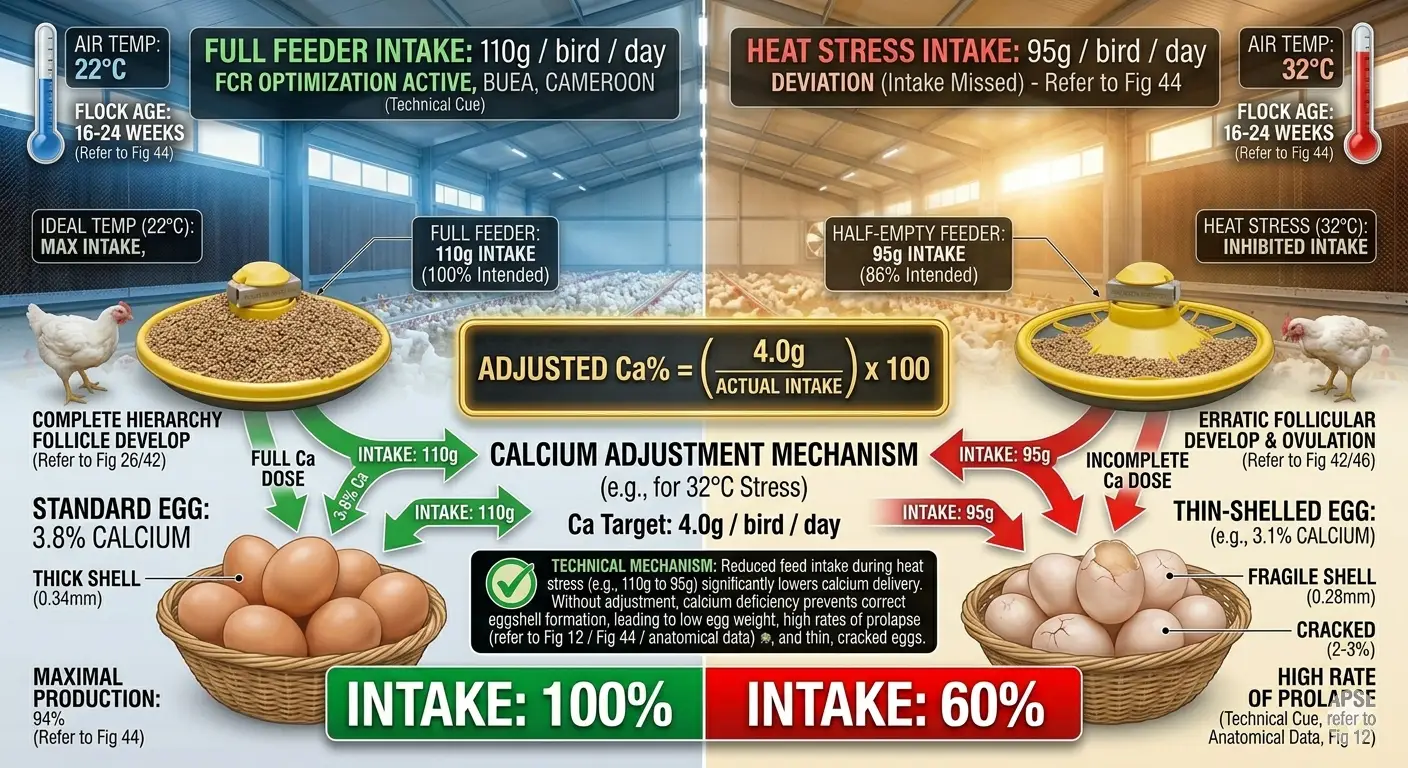
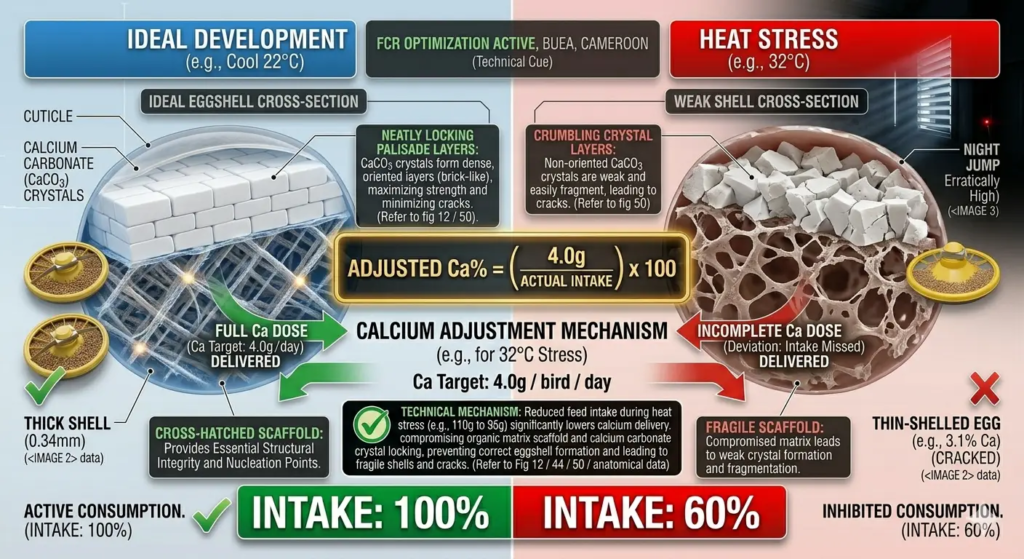
In the tropical climate of Cameroon and across West Africa, ambient temperatures regularly exceed 30°C during the long dry season. A laying hen at 30°C eats approximately 8% less feed than she does at 22°C. At 35°C, that reduction reaches 12–15%.
If the ration calcium percentage is not adjusted upward to compensate for reduced feed intake volume, the hen is receiving less total calcium per day than she needs — even when the ration percentage appears correct on paper.
The heat adjustment formula:
Adjusted Calcium % = (Target daily calcium intake in grams ÷ Actual average daily feed intake in grams) × 100
If your flock is eating 95g per bird per day during peak dry-season heat instead of the expected 110g, and the target daily calcium intake is 4.0g:
Adjusted Calcium % = (4.0 ÷ 95) × 100 = 4.21%
Not the standard 3.6–3.8%. The ratio must increase by 0.4–0.6 percentage points to deliver the same daily calcium intake at reduced feed volume. This calculation should be performed monthly during the hot season and the ratio adjusted accordingly. We cover this in more detail in our feed management resources at Otto’s Farms.
Calcium Sources: Choosing What Goes in the Mash
The calcium source is as important as the calcium quantity. Not all calcium sources are equal in bioavailability, particle size distribution, or dissolution rate — and the dissolution rate determines when the calcium becomes available to the hen during the 24-hour shell formation cycle.
Fine Limestone (Ground Calcium Carbonate)
Fine limestone — particle size below 0.5 mm — dissolves rapidly in the proventriculus and is absorbed within 2–3 hours of ingestion. It provides a fast pulse of available calcium during and immediately after feeding. This rapid availability makes it appropriate for:
- The morning feeding period, when the hen needs to rebuild the medullary bone reserve depleted during overnight shell calcification
- Situations where immediate calcium availability is the priority
Limitations: Fine limestone that is not absorbed within the digestion window is excreted. It does not contribute to the slow-release overnight calcium pool. A ration containing only fine limestone leaves the hen dependent entirely on medullary bone resorption during the 8-hour dark period — accelerating the rate at which medullary bone is exhausted across the laying cycle and degrading shell quality progressively.
Coarse Limestone (Limestone Chips / Oystershell Grit)
Coarse limestone — particle size 2–4 mm — does not dissolve rapidly in the proventriculus. Particles of this size are retained in the gizzard, where muscular grinding and acidic gastric juice slowly release calcium over 8–12 hours. This slow-release mechanism sustains blood calcium availability through the dark period when the shell gland is most active and no feed is being consumed.
This is the most important property of coarse limestone in laying hen nutrition: it provides calcium at the exact time the shell gland needs it most.
Research consistently shows that rations incorporating 30–50% of total limestone in coarse particle form produce:
- Lower rates of thin-shelled eggs
- Higher shell breaking strength measured in Newtons
- Better shell thickness measured in micrometers
- Reduced medullary bone depletion rates across the laying cycle
At Otto’s Farms, our standard layer mash uses a 50:50 blend of fine and coarse limestone as the base calcium source. This ratio has consistently produced shell quality outcomes we track at every collection round.
Oystershell vs. Limestone: Is There a Difference?
Oystershell and limestone are both calcium carbonate (CaCO₃) and have essentially the same calcium content (38–39%). The primary difference is particle size distribution and surface area. Oystershell particles tend to be more irregular in surface texture than milled limestone, which may marginally increase surface area available for acid dissolution in the gizzard.
In practice, the difference between high-quality oystershell and properly sized coarse limestone in the same particle size range is small. The critical variable is particle size — not the label on the bag. Verify particle size with your supplier and measure it yourself if there is any doubt.
Dicalcium Phosphate (DCP)
DCP contributes both calcium (approximately 21%) and available phosphorus (approximately 18%) to the ration. It is a primary phosphorus source, not a primary calcium source, and its inclusion rate is determined by the phosphorus requirement, not the calcium requirement. The calcium it contributes must be accounted for in the total calcium calculation, but cannot be increased without simultaneously increasing phosphorus beyond the target level.
The Calcium-to-Phosphorus Ratio in the Layer Mash
Calcium and phosphorus interact directly in bone metabolism and calcium absorption. An incorrect ratio between them — even when absolute levels of both are adequate — impairs the shell quality outcome the ratio is intended to produce.
Why the Ratio Matters More Than Absolute Levels
High dietary calcium relative to phosphorus (the condition in a correctly formulated layer ration) drives calcium absorption and shell calcification efficiently. High dietary phosphorus relative to calcium interferes with calcium absorption in the intestine and increases urinary calcium loss through the kidney, reducing the calcium available for shell formation even when the dietary calcium level appears adequate.
Target calcium-to-phosphorus ratios for layer mash:
| Production Phase | Dietary Calcium | Available Phosphorus | Ca:P Ratio |
|---|---|---|---|
| Early lay | 3.6–3.8% | 0.35–0.38% | 9.5–10.5:1 |
| Peak lay | 3.8–4.0% | 0.35–0.38% | 10.0–11.0:1 |
| Late lay | 4.0–4.2% | 0.33–0.36% | 11.0–12.5:1 |
Note that available phosphorus decreases slightly in late lay — not because the hen needs less phosphorus, but because excess phosphorus at high calcium levels accelerates the calcium absorption impairment. Maintaining a tight Ca:P ratio as calcium increases requires simultaneously pulling phosphorus down to stay within the target range.
Phosphorus excess in laying rations is the most underdiagnosed cause of shell quality decline in commercial operations that use phytase without recalculating the effective phosphorus contribution. If phytase is included in the ration — which it should be, for cost and environmental reasons — the phosphorus released by phytase from phytate-bound sources must be subtracted from the total available phosphorus calculation. Failing to do this produces phosphorus excess that degrades shell quality without any visible change in the ration composition.
Vitamin D₃: The Absorption Enabler That Makes Calcium Work
Calcium in the feed is useless without the biological machinery to absorb it. That machinery — specifically, the calcium transport proteins calbindin-D28k and TRPV6 expressed in the intestinal epithelium — is upregulated by calcitriol, the biologically active form of vitamin D₃.
The Vitamin D₃ Metabolism Chain
Dietary vitamin D₃ → liver hydroxylation → 25-hydroxyvitamin D₃ (calcidiol) → kidney hydroxylation → 1,25-dihydroxyvitamin D₃ (calcitriol) → intestinal calcium transporter expression → calcium absorption
Every step in this chain can become a bottleneck. Liver function impairment (from fatty liver syndrome, mycotoxin exposure, or chronic drug use), kidney damage (from prior calcium nephrosis or infectious bronchitis nephropathogenic strain), or inadequate dietary vitamin D₃ at any point produces calcium malabsorption, which manifests as shell quality failure regardless of how much calcium is in the ration.
Vitamin D₃ Requirements for Laying Hens
| Phase | Minimum | Target | Hot Climate Adjustment |
|---|---|---|---|
| Early lay | 2,500 IU/kg | 3,000 IU/kg | +10–15% (heat accelerates degradation in feed) |
| Peak lay | 3,000 IU/kg | 3,500 IU/kg | +10–15% |
| Late lay | 3,000 IU/kg | 4,000 IU/kg | +10–15% |
In tropical storage conditions — feed stored at 28–35°C with humidity above 70% — vitamin D₃ degrades significantly faster than the manufacturer’s stated shelf life assumes. Feed stored for two weeks in a hot, humid feed room may deliver 70–80% of the labelled vitamin D₃ content. Formulate with a 15% safety margin above the target, and rotate feed stocks to minimize storage time.
Other Shell-Quality Nutrients: What the Mash Must Also Contain
Calcium and vitamin D₃ are the dominant shell quality nutrients, but they do not work in isolation. Three additional nutrients have documented effects on shell strength, shell thickness, and shell membrane integrity that are frequently absent from rations formulated only around calcium and protein.
Manganese
Manganese is a cofactor for glycosyltransferase enzymes involved in the synthesis of the organic matrix of the eggshell — the scaffold on which calcium carbonate crystals are deposited. Without adequate manganese, the crystal matrix is structurally irregular, producing shells that are weaker per unit thickness than shells formed on a properly structured matrix.
Target: 80–100 mg manganese per kg of ration (as manganese sulfate or organic manganese chelate). Organic manganese chelates show 15–20% higher bioavailability than inorganic sulfate forms — worth the premium in a high-value shell quality program.
Manganese deficiency is frequently seen in rations based heavily on maize and soybean meal without supplemental trace mineral premix — both ingredients are poor manganese sources. Verify your premix manganese inclusion against the above target, not against the minimum requirement tables designed for the prevention of deficiency rather than the optimization of shell quality.
Zinc
Zinc is required for carbonic anhydrase — the enzyme that produces bicarbonate ions (HCO₃⁻) in the shell gland. Bicarbonate is the carbonate source for calcium carbonate crystal deposition. Without adequate zinc, carbonic anhydrase activity is reduced, bicarbonate production is limited, and calcium carbonate deposition slows — producing thinner shells even when blood calcium levels are adequate.
Target: 80–100 mg zinc per kg of ration. Same bioavailability advantage for organic zinc chelates as for manganese.
Vitamin C (Ascorbic Acid) in Heat Stress Conditions
Laying hens normally synthesize sufficient vitamin C endogenously. Under heat stress — sustained ambient temperatures above 28°C — endogenous synthesis is insufficient, and dietary supplementation at 150–200 mg/kg of ration has documented shell quality benefits: improved shell thickness and reduced crack rate in heat-stressed flocks compared to unsupplemented controls.
This is particularly relevant for Otto’s Farms and commercial operations across West and Central Africa, where seasonal heat stress is a production reality for 3–5 months per year. Adding vitamin C to the ration or drinking water during the hot season is one of the most cost-effective shell quality interventions available.
Formulating the Mash: A Step-by-Step Approach
Calcium mash formulation starts from the hen’s requirement and works backward to the ingredient combination that meets it. Here is the sequence we use at Otto’s Farms:
Step 1: Establish Daily Calcium Requirement
Determine the production phase (early, peak, or late lay) and the current average daily feed intake. Calculate the target calcium percentage using the adjusted formula:
Target Calcium % = (Daily Calcium Requirement in grams ÷ Average Daily Feed Intake in grams) × 100
During dry season heat, measure actual feed intake — do not assume breed standard intake. Birds eating less than expected need a higher calcium percentage to reach the same daily gram intake.
Step 2: Select Calcium Sources and Particle Ratio
For all phases of lay, use a 50:50 blend of fine and coarse limestone as the primary calcium source. Calculate the inclusion rate of each at the target calcium percentage:
- Fine limestone (38% calcium): Target inclusion = (Calcium from fine limestone ÷ 0.38) × 1,000 g/kg
- Coarse limestone (38% calcium): Target inclusion = (Calcium from coarse limestone ÷ 0.38) × 1,000 g/kg
Account for calcium contributed by DCP based on its inclusion rate for phosphorus — do not add additional DCP beyond the phosphorus requirement to meet the calcium target.
Step 3: Set the Phosphorus Level and Verify the Ca:P Ratio
Calculate total available phosphorus from all sources: DCP, phytase release (typically 0.10–0.15% available phosphorus equivalent at 500 FTU/kg), and the plant-source phosphorus matrix of maize and soybean meal. Verify the Ca:P ratio falls within the phase-appropriate target range. Adjust DCP inclusion rate if the ratio is outside the target — but adjust calcium concentration first before adding DCP, which simultaneously increases both minerals.
Step 4: Verify Vitamin D₃ and Trace Mineral Inclusion
Confirm the premix supplies at least 3,000–3,500 IU vitamin D₃ per kg of finished ration at the target inclusion rate. Confirm manganese and zinc inclusion rates meet the 80–100 mg/kg target. If heat stress conditions apply, add vitamin C at 150–200 mg/kg.
Step 5: Laboratory Verification
Have the finished ration analyzed at a feed laboratory for crude protein, calcium, phosphorus, and moisture before feeding to a new flock or after any ingredient source change. Book values for locally sourced maize and limestone vary meaningfully from published tables — particularly for calcium, where limestone quality and particle size distribution differ between suppliers. Formulating on book values without verification is the most common source of undiagnosed calcium deficiency in small and medium commercial operations.
Common Shell Quality Problems and Their Nutritional Causes
Progressively thinning shells through the second half of lay: Calcium percentage did not increase for late-lay phase requirements or declining absorption efficiency. Switch to a late-lay ration with 0.3–0.4% higher calcium at week 45–50.
Soft-shelled or shell-less eggs in the early morning: Insufficient overnight calcium supply — ration contains only fine limestone, leaving the shell gland without a calcium source after midnight. Introduce 50% coarse limestone into the ration.
Consistent thin shells across the whole flock: Check vitamin D₃ degradation in stored feed. Check kidney function in a sample of birds — nephropathogenic IBV or prior calcium nephrosis from early-life high-calcium feeding reduces the kidney’s capacity to hydroxylate calcidiol to calcitriol.
Shell quality failure only during hot months: Heat stress reduces feed intake and simultaneously impairs endogenous vitamin C synthesis. Apply the heat adjustment to the calcium percentage and add dietary vitamin C at 150–200 mg/kg.
Speckled or rough-textured shells: Often manganese deficiency in the organic matrix. Increase manganese supplementation to 80–100 mg/kg and verify premix bioavailability form.
Cracked shells clustering at one end of the house: Uneven feed distribution — birds at that section are receiving less calcium per day than birds at the feed distribution start point. Check chain feeder circulation and particle size segregation along the trough length.
Summary
Strong eggshells are a formulation outcome — not a calcium percentage on a bag label. They require the correct total daily calcium delivered at the right time through a particle size blend that matches the hen’s 24-hour shell calcification cycle, a calcium-to-phosphorus ratio that does not undermine its own absorption, vitamin D₃ at levels that survive tropical storage conditions and support active transport across the intestinal mucosa, and trace minerals that build the organic matrix on which calcium carbonate crystals are deposited.
At Otto’s Farms, shell quality is tracked at every collection round, and the data feeds back into formulation decisions every season. The goal is not an adequate shell. The goal is a shell strong enough that the egg survives collection, grading, transport, and retail without cracking — and represents full revenue at every step.
That goal is a formulation decision. Make it deliberately.
Want to dig deeper into layer nutrition and farm management? Visit Otto’s Farms for practical tools, feeding calculators, and production guides built specifically for commercial layer operations in West and Central Africa.