A consumer picking up two trays of eggs at a market stall in Douala, Yaoundé, or Lagos does not read the feed formulation sheet. She cracks an egg. If the yolk is pale yellow, she puts the tray back. If it is deep orange-yellow, she buys.
Yolk color is a purchasing signal in every egg market in West and Central Africa. In rural open-air markets, pale yolks are associated with “factory eggs”, produced without access to grass, insects, or natural foraging. Deep yellow to orange yolks are associated with free-range production, nutritional richness, and the taste memory of the farm eggs that older generations grew up eating. Urban supermarket and hotel buyers have formalized this consumer preference into supplier specifications: yolk color grade 10–13 on the DSM Yolk Color Fan (YCF) is the standard requirement for premium retail positioning in most regional markets.
The commercial layer hen does not naturally produce deep orange yolks. Left on a standard maize-soybean meal ration without pigment supplementation, most commercial breeds produce yolks scoring 5–7 on the DSM YCF — a medium yellow that fails both the consumer preference test and the hotel buyer specification. The deep color that consumers associate with quality is produced not by the hen but by the pigments the farmer puts in the feed.
This is not deception. It is nutrition. The pigments that produce deep yolk color — xanthophylls, carotenoids, and their synthetic analogs — are the same compounds found in grass, maize, insects, marigold petals, and paprika that free-range hens consume through foraging. Supplementing them in the ration replicates the nutritional profile of genuinely free-range production in an intensive setting, at controllable cost and consistent quality.
This article covers the biology of yolk pigmentation, the natural sources available to commercial layer farmers in West and Central Africa, the inclusion rates and formulation strategies that produce consistent DSM 10–13 results, and the factors that interfere with pigmentation regardless of supplementation.
The Biology of Yolk Pigmentation
The yolk color of an egg is determined entirely by the carotenoid content of the hen’s diet — specifically by the oxygenated carotenoids called xanthophylls, which are selectively deposited in the developing oocyte. The hen cannot synthesize carotenoids endogenously — she can only deposit what she consumes. No carotenoids in the feed means no carotenoids in the yolk, regardless of breed or production system.
The Xanthophyll Deposition Pathway
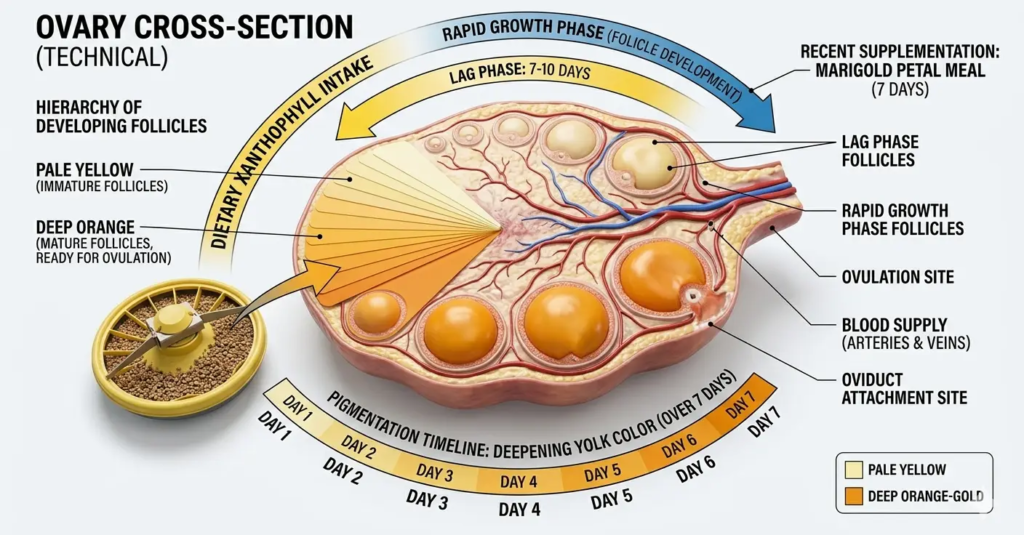
Dietary xanthophylls are absorbed in the small intestine, incorporated into chylomicrons (lipid transport particles), transported through the lymphatic system into the blood, and selectively extracted from the blood by the developing follicle during yolk formation. The follicle’s granulosa cells actively concentrate xanthophylls into the oocyte over the 7–10 days of rapid yolk growth preceding ovulation.
This deposition process has two important practical implications:
There is a 7–10 day lag between dietary change and yolk color change. When a xanthophyll source is added to the ration, yolk color begins improving within 7 days as newly deposited yolks reflect the new dietary input. Conversely, when a xanthophyll source is removed, yolk color fades over 7–10 days as the residual pigment already deposited is diluted by non-pigmented new yolk material.
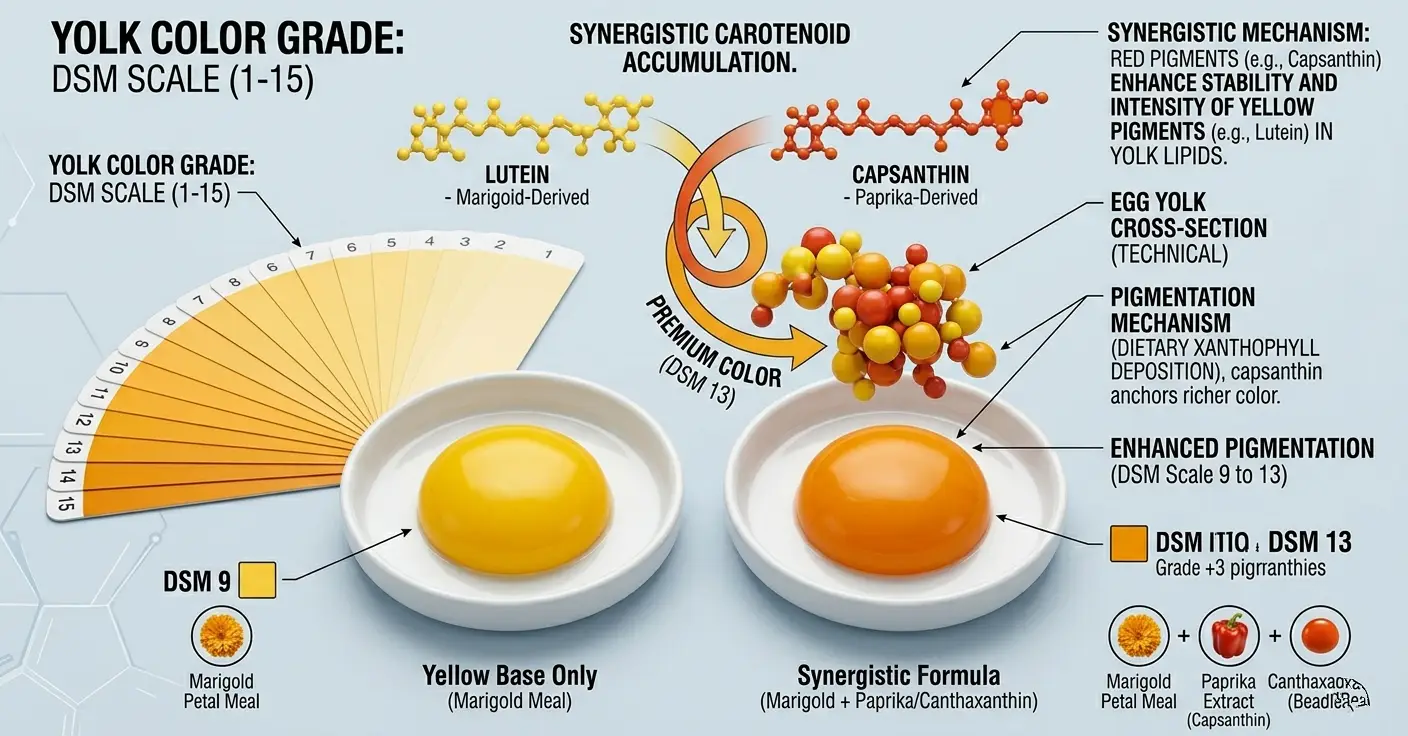
The deposition rate is selective. Different xanthophylls are deposited with different efficiencies. Yellow xanthophylls — lutein and zeaxanthin — are deposited preferentially and produce the yellow base tone. Red xanthophylls — canthaxanthin, capsanthin — are deposited less efficiently but produce the orange-red intensification that shifts color from DSM 8–9 (medium yellow) to DSM 11–13 (deep orange-yellow). Maximum color saturation requires both yellow and red xanthophylls simultaneously.
The DSM Yolk Color Fan: The Commercial Standard
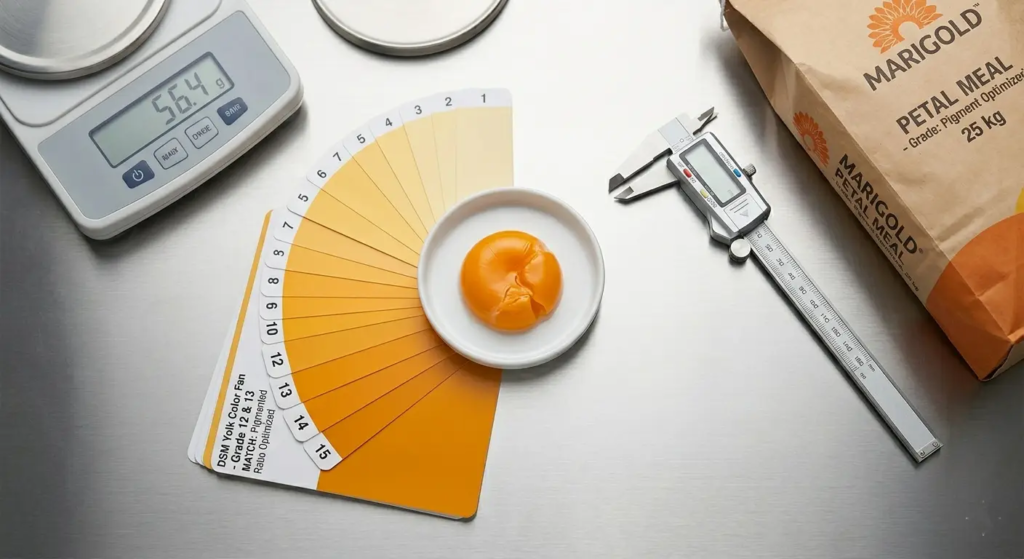
The DSM Yolk Color Fan (YCF) — also sold under the Roche brand as the Roche Color Fan — is the industry standard for yolk color measurement. It consists of 15 color grades from pale yellow (grade 1) to deep orange-red (grade 15). Grades are assigned by visually comparing a broken egg yolk against the fan under standard lighting.
Commercial color targets by market segment in West/Central Africa:
| Market Segment | Target YCF Grade | Notes |
|---|---|---|
| Rural open-air market | 10–12 | Strong preference for “natural” color |
| Urban supermarket | 10–13 | Category standard for premium shelf position |
| Hotels and restaurants | 11–13 | Specification-driven; often checked at delivery |
| Export / premium | 12–14 | Some European markets prefer lower grades (8–9) |
| Standard commercial | 8–10 | Minimum acceptable; below 8 risks rejection |
Hitting DSM 10–13 consistently is the formulation target for most West African commercial layer operations targeting any market above the entry-level price tier.
Why Standard Maize-Soybean Rations Produce Pale Yolks
Understanding why the base ratio produces pale yolks is necessary for understanding how to supplement it correctly.
Yellow maize contains lutein and zeaxanthin at approximately 20–25 mg per kg of grain. A hen consuming 115g of yellow maize-based layer feed (not pure maize, but a ration containing 50–60% maize) receives approximately 10–15 mg of total xanthophylls per day from the grain component alone. This produces a yolk color of approximately DSM 5–7 — medium-pale yellow.
White maize — widely grown and used in parts of Cameroon, Nigeria, and Ghana — contains essentially zero carotenoids. A ration based on white maize produces yolks scoring DSM 2–4 without supplementation: visibly pale, almost cream-colored yolks that are unmarketable in any premium channel.
Soybean meal contributes negligible carotenoids. Wheat is lower in xanthophylls than yellow maize. Cassava-based rations — common in smallholder operations in southern Cameroon — contain essentially zero pigment-producing carotenoids, producing the palest yolks of any common ration base.
The gap between a standard maize-soy ration (DSM 5–7) and a market-acceptable premium ration (DSM 10–13) must be closed by supplementation. The question is which supplements to use, at what inclusion rate, and how to formulate them for consistent results at the lowest cost per color unit.
Natural Pigmentation Source 1: Yellow Maize and Maize Gluten Meal
Yellow maize is the baseline pigment source in most West African layer rations. It is not a supplement — it is an ingredient — but its xanthophyll content is variable and often not accounted for in color target formulation.
Maize Gluten Meal (Corn Gluten Meal)
Maize gluten meal — the protein-rich fraction remaining after starch extraction from yellow maize — is concentrated in xanthophylls at 100–200 mg/kg, compared to 20–25 mg/kg in whole yellow maize. At a 5% inclusion rate in the ration (50g per bird per day at 115g total intake), maize gluten meal delivers 5–10 mg of additional xanthophylls per bird per day.
Yolk color contribution: 5% corn gluten meal typically advances yolk color by 2–3 DSM units above the base maize-soy ration. From a DSM 6 baseline, this brings color to DSM 8–9 — approaching but not consistently meeting the premium market target.
Practical limitation: Maize gluten meal is not consistently available at an acceptable quality in all West African markets. Crude protein content and xanthophyll concentration vary significantly between suppliers. If used, verify xanthophyll content from supplier data or laboratory analysis before incorporating into the color budget calculation.
Natural Pigmentation Source 2: Marigold Petal Meal (Tagetes erecta)
Dried marigold petal meal — produced from the flower heads of Tagetes erecta — is the most widely used and most reliable natural xanthophyll supplement in commercial poultry nutrition globally. It is produced in significant volumes in Kenya, Ethiopia, South Africa, India, and increasingly in West African markets.
Xanthophyll Content
Marigold petal meal contains lutein (yellow xanthophyll) at concentrations of 5,000–12,000 mg/kg depending on variety, growing conditions, and processing method. This concentration is 200–500 times higher than whole yellow maize per unit weight, making marigold meal an efficient inclusion at low dietary rates.
Typical commercial marigold meal products available in West Africa: 8,000–10,000 mg/kg total carotenoids, of which 80–90% is lutein (yellow) and 5–10% is zeaxanthin.
Yolk Color Response to Marigold Meal
The dose-response relationship between marigold meal inclusion and yolk color has been well characterized in research and commercial production:
| Marigold Meal Inclusion | Approximate Lutein Delivered/Bird/Day | Expected YCF Improvement | Resulting YCF (from DSM 6 base) |
|---|---|---|---|
| 0.50% of the ratio | 2.3–2.9 mg | +2 units | DSM 8 |
| 1.00% of the ratio | 4.6–5.8 mg | +3–4 units | DSM 9–10 |
| 1.50% of the ratio | 9.2–11.6 mg | +4–5 units | DSM 10–11 |
| 2.00% of the ratio | 13.8–17.4 mg | +5–6 units | DSM 11–12 |
| 2.00% of the ratio | 18.4–23.2 mg | +5–6 units | DSM 11–13 |
Values assume 10,000 mg/kg product, 115g daily feed intake, and a yellow maize base ration. Results vary with actual product xanthophyll content and feed intake.
Key observation: The color response to marigold meal shows diminishing returns above 1.5% inclusion. Increasing from 1.5% to 2.0% produces marginal additional color but a significant cost increase. The cost-optimal range for marigold meal in most formulations is 0.75–1.25% of the ration, bringing color to DSM 9–11. Achieving DSM 12–13 consistently requires adding a red xanthophyll source alongside marigold meal.
Practical Sourcing in West and Central Africa
Marigold petal meal must be sourced from suppliers who provide a certificate of analysis (CoA) specifying xanthophyll content in mg/kg. Products without CoA verification are unreliable — moisture content, adulteration with other plant material, and variations in extraction method all produce significant xanthophyll content variation. Require CoA with every lot purchase and spot-test with an in-house colorimetric test if volumes justify the investment.
Natural Pigmentation Source 3: Paprika (Capsicum annuum)
Paprika — dried and ground red capsicum — is a dual-function pigment source containing both yellow xanthophylls (lutein, zeaxanthin) and red xanthophylls (capsanthin, capsorubin). The red xanthophylls are the component that drives the orange intensification in yolk color — shifting the color tone from pure yellow toward the orange-gold that scores DSM 12–14 and is the most valued color in premium markets across West Africa.
Carotenoid Profile and Yolk Color Effect
Paprika at commercial feed-grade quality contains 3,000–7,000 mg/kg total carotenoids, with capsanthin and capsorubin contributing 30–50% of the total. This red fraction produces an orange-red intensification effect in the yolk that marigold meal alone cannot achieve.
The practical formulation strategy is to use marigold meal as the primary yellow base pigment (producing DSM 9–11) and paprika as the red intensifier (shifting the existing yellow toward orange-gold for an additional 1–3 DSM units):
| Combination | Expected Result |
|---|---|
| 1.0% marigold + 0.3% paprika | DSM 11–12 |
| 1.0% marigold + 0.5% paprika | DSM 12–13 |
| 1.25% marigold + 0.5% paprika | DSM 13–14 |
Paprika must be used at sufficient inclusion to contribute meaningful capsanthin; below 0.3% inclusion, the contribution is marginal. Above 1.0% inclusion, cost efficiency declines sharply.
Sourcing consideration: Commercial paprika oleoresin — a liquid extract standardized to carotenoid content — provides more consistent pigmentation than ground paprika powder, which varies in carotenoid content between harvest seasons and suppliers. Oleoresin forms must be mixed with the ratio fat fraction to ensure even distribution, which requires fat supplementation in the ratio (or a carrier vehicle) for homogeneous delivery.
Natural Pigmentation Source 4: Canthaxanthin
Canthaxanthin is a red xanthophyll found naturally in algae, crustaceans, and fungi. In poultry nutrition, it is produced synthetically and supplemented as a feed additive — but because it occurs naturally in biological systems, it is classified as a nature-identical rather than a purely artificial pigment in most regulatory frameworks.
Canthaxanthin is included here because it is the most efficient red intensifier available, widely used in commercial layer production globally, and increasingly available through veterinary and feed additive suppliers in West Africa.
Why Canthaxanthin Is Uniquely Effective
Unlike yellow xanthophylls, which are deposited selectively by the follicle, canthaxanthin has a high affinity for the yolk lipid fraction and is deposited efficiently even at low dietary concentrations. At 8 mg per kg of finished ration (0.0008% of ration — an almost homeopathic inclusion rate), canthaxanthin reliably intensifies yolk color by 2–3 DSM units above the yellow base established by lutein sources.
Practical formulation with canthaxanthin:
- 1.0% marigold meal (establishes DSM 9–11 yellow base) + 8 mg/kg canthaxanthin → DSM 12–13
- 1.25% marigold meal + 8 mg/kg canthaxanthin → DSM 13–14
This combination is the most cost-efficient route to DSM 12–13 for operations where canthaxanthin is available and price-competitive with paprika.
Regulatory Status
Canthaxanthin is approved for use in poultry feed in most jurisdictions, including Cameroon and Nigeria, at levels below 80 mg/kg of finished feed. It is included in the EU’s list of permitted feed additives with a maximum level of 8 mg/kg — a level that produces significant color intensification without approaching regulatory concern.
Natural Pigmentation Source 5: Spirulina (Arthrospira platensis)
Spirulina — the blue-green microalgae Arthrospira platensis — is an emerging natural pigment source with a dual benefit profile: it contains carotenoids that contribute to yolk pigmentation and has documented immune-stimulating and antioxidant effects that have independent production value beyond color.
Carotenoid Content and Yolk Color Contribution
Spirulina contains beta-carotene, zeaxanthin, and phycocyanin at total carotenoid concentrations of 1,000–3,000 mg/kg. It is not a high-concentration xanthophyll source by comparison with marigold meal, but at a 1–2% ration inclusion, it contributes 1–2 DSM units of yolk color improvement alongside its nutritional benefits.
The practical case for spirulina: It is most economically justified when the operation is also targeting the “natural additives” or “antibiotic-free” premium market positioning — where spirulina can be listed as a visible natural ingredient on product labeling or in farm transparency communications, adding marketing value alongside the modest color contribution.
At current spirulina prices in West African markets, it is not cost-competitive with marigold meal or canthaxanthin as a primary pigmentation strategy. It is a secondary supplement that adds value when the operation has other reasons to include it.
Other Local Natural Sources Available in West and Central Africa
Commercial pigment supplements can be complemented by locally available high-carotenoid ingredients that reduce supplementation cost without compromising color targets.
Palm Oil (Red Palm Oil)
Crude red palm oil — the unrefined form commonly available in Cameroon, Nigeria, and Ghana — contains beta-carotene and lycopene at 500–700 mg/kg. At 2–3% inclusion as an energy supplement (which it is also being used for), red palm oil contributes 1–2 DSM units of yolk color improvement while simultaneously increasing the ratio of ME density.
This dual function — energy supplementation and pigmentation — makes red palm oil one of the most cost-efficient ingredients available to West African layer formulations. Use unrefined red palm oil (not refined, bleached, deodorized palm oil, which has the carotenoids removed).
Dried Moringa Leaf Meal (Moringa oleifera)
Moringa leaf meal contains lutein and beta-carotene at 50–200 mg/kg. At 2.5–5.0% ration inclusion, it contributes 1–2 DSM units of yolk color improvement alongside significant nutritional benefits: crude protein contribution (25–30%), vitamin A precursor activity (beta-carotene), and documented anti-inflammatory effects.
Moringa is widely available in West and Central Africa and can be produced on-farm at very low cost. The constraint is consistent inclusion — moringa leaf quality varies significantly with drying method and leaf maturity. Sun-dried moringa retains more carotenoids than oven-dried; shade-dried at ambient temperature is optimal but requires longer processing time.
Practical inclusion protocol: 2.5–5.0% shade-dried moringa leaf meal in the ration. Verify that crude protein and energy levels are adjusted for the contribution of moringa before finalization. Do not exceed 5% inclusion without monitoring for reduced feed intake — high tannin content at elevated moringa levels can suppress palatability.
Dried Leaf Meal from Cassava (Manihot esculenta)
Cassava leaf meal, where available, contains beta-carotene at 150–400 mg/kg and contributes 1–2 DSM units of yolk color at 2–3% inclusion. Its primary nutritional limitation is a high hydrocyanic acid (HCN) content in fresh leaves — proper sun-drying reduces HCN to safe levels below 100 mg/kg. Only properly dried cassava leaf meal should be used; feeding fresh or inadequately dried cassava leaves is toxic.
Formulation Strategy: Building a Color-Consistent Program
Yolk color consistency is the market commitment that pigmentation supplementation must deliver. A consumer or buyer who receives DSM 12 eggs one week and DSM 8 eggs the next has not received a consistent product, and consistency is what premium market positioning depends on.
Achieving color consistency requires three things working together:
1. Fix the Xanthophyll Budget
Calculate the target daily xanthophyll delivery per bird:
- DSM target 10–11: 15–20 mg total xanthophylls per bird per day
- DSM target 11–13: 20–35 mg total xanthophylls per bird per day
- DSM target 13–14: 35–50 mg total xanthophylls per bird per day (including red xanthophyll fraction)
Calculate the xanthophyll contribution from every ingredient in the ration — yellow maize, maize gluten meal, marigold meal, paprika or canthaxanthin, palm oil, moringa — and verify that the total matches the target budget. Adjust inclusion rates until the budget is met.
2. Account for the Primary Interfering Factors
Xanthophyll deposition in the yolk is reduced by several factors that the formulation cannot overcome if they are not controlled:
Mycotoxins (particularly aflatoxin): Aflatoxin damages the intestinal brush border and reduces xanthophyll absorption efficiency. A flock on aflatoxin-contaminated maize will consistently score 2–4 DSM units below what the pigmentation budget predicts. Add a mycotoxin binder if grain quality is not laboratory-verified.
Cottonseed meal (gossypol): Gossypol — the polyphenol in cottonseed — binds to xanthophylls in the gut and inhibits absorption. If cottonseed meal is included at more than 5% of the ration, it will suppress yolk color significantly. Limit cottonseed meal to below 5% and use decorticated or gossypol-detoxified forms.
Drugs and antifungals: Certain coccidiostats (particularly nicarbazin) bind to xanthophylls and directly suppress yolk color deposition. Hens on nicarbazin-containing feed produce pale yolks regardless of supplementation. Switch to an alternative coccidiostat (salinomycin, monensin) during the laying period if color specifications must be met.
Fat malabsorption (bile acid dysfunction or gut health issues): Xanthophylls are fat-soluble and depend on micellarization with bile salts for intestinal absorption. Hens with poor gut health — from coccidiosis, necrotic enteritis, or chronic dysbiosis — absorb xanthophylls poorly. Address gut health before increasing pigmentation supplementation.
Low fat in the ration: Xanthophyll absorption improves with dietary fat. Rations below 2.5% total fat may absorb xanthophylls at 20–30% lower efficiency than rations with 3–5% fat. Ensure adequate fat inclusion — for this reason and for energy density — before increasing pigment supplementation.
3. Monitor Color Weekly and Adjust
Yolk color should be measured weekly by cracking 10 randomly selected eggs from different locations in the house and comparing them against the DSM YCF under natural light. Record the score and plot it weekly.
A color score declining from DSM 12 toward DSM 9–10 over 2–3 weeks without a ration change indicates:
- Feed ingredient source change with lower xanthophyll content (maize from a new supplier, or seasonal maize with different carotenoid content)
- Feed storage degradation reduces carotenoid content in stored marigold meal
- An interfering factor — mycotoxin loading, coccidiosis outbreak, nicarbazin in a new coccidiostat batch — reducing absorption
Respond to a declining score by identifying the cause, not by increasing the pigmentation supplementation dosage. Adding more marigold meal to a flock with aflatoxin-suppressed absorption produces an expensive dose increase with minimal color response. Removing the aflatoxin load restores absorption efficiency and recovers color at the same supplementation rate.
The Cost Calculation: Is Premium Color Worth the Investment?
Pigmentation supplementation has a cost. Determining whether it is justified requires a simple calculation: the revenue premium from the color upgrade versus the supplementation cost.
Example calculation for a 5,000-bird operation:
- Baseline production: 4,500 eggs/day (90% lay rate)
- Current yolk color: DSM 7 (standard maize-soy ration)
- Target yolk color: DSM 11–12 (premium market)
- Premium market price premium over standard: XAF 50 per egg (conservative estimate)
Supplementation cost (1.0% marigold meal + 0.3% paprika):
- Feed consumption: 5,000 × 115g = 575 kg/day
- Marigold meal at 1.0% = 5.75 kg/day at XAF 3,000/kg = XAF 17,250/day
- Paprika at 0.3% = 1.73 kg/day at XAF 4,500/kg = XAF 7,763/day
- Total supplementation cost: XAF 25,013/day
Revenue premium:
- 4,500 eggs × XAF 50 premium = XAF 225,000/day
Net daily benefit: XAF 225,000 − XAF 25,013 = XAF 199,987/day incremental revenue above supplementation cost
This calculation assumes the entire production is sold at the premium price, which requires market access to buyers who pay for the color specification. Where both premium and standard market channels are available, the calculation should be run on the proportion of eggs placed in the premium channel. Even at a 30–40% premium channel placement, the supplementation economics are strongly positive.
Summary
Yolk pigmentation is a market-driven nutritional intervention — one of the few in layer production where the cost of the input is directly recoverable in the price premium of the output.
The xanthophyll sources — marigold petal meal as the primary yellow base, paprika or canthaxanthin as the red intensifier, supplemented by locally available sources including red palm oil and moringa leaf meal — are all available in West and Central African markets, are increasingly accessible through regional feed additive suppliers, and produce consistent DSM 10–13 results when formulated against a calculated xanthophyll budget and monitored weekly against the DSM Yolk Color Fan.
The color the consumer sees when she cracks the egg is the color that determines whether she buys the next tray. Formulate for that color deliberately, consistently, and at the lowest cost per DSM unit that the supplementation economics allow.
The yolk earns the sale. The ration earns the yolk.