The breed decision is the most permanent choice a layer farmer makes before the first chick arrives. It determines the production ceiling of the flock, the nutritional program required to reach it, the tolerance the birds will have for the management imperfections that are inevitable in any real-world layer operation, and the hatchery relationships that will supply chick quality consistently across multiple production cycles.
In Cameroon — and across most of West and Central Africa — the practical breed choice for commercial brown-egg production narrows quickly to two commercially available options with established hatchery supply chains: ISA Brown and Lohmann Brown. Hy-Line Brown is present in some markets, but with a thinner supply chain. Bovans Brown and Novogen Brown appear occasionally. The majority of commercial layer flocks in the Douala-Yaoundé axis, the West Region, and most urban production zones in Cameroon are stocked with either ISA Brown or Lohmann Brown.
This comparison is not a theoretical breed evaluation. It is a practical analysis for Cameroonian production conditions: tropical climate, locally sourced feed with variable quality, predominantly open-sided natural ventilation housing, variable water quality, and a layer farming population at various stages of management sophistication. Both breeds are excellent. Neither is automatically better. The correct choice depends on specific farm conditions that this article will map against each breed’s known performance characteristics.
Breed Origins and Genetic Background
ISA Brown
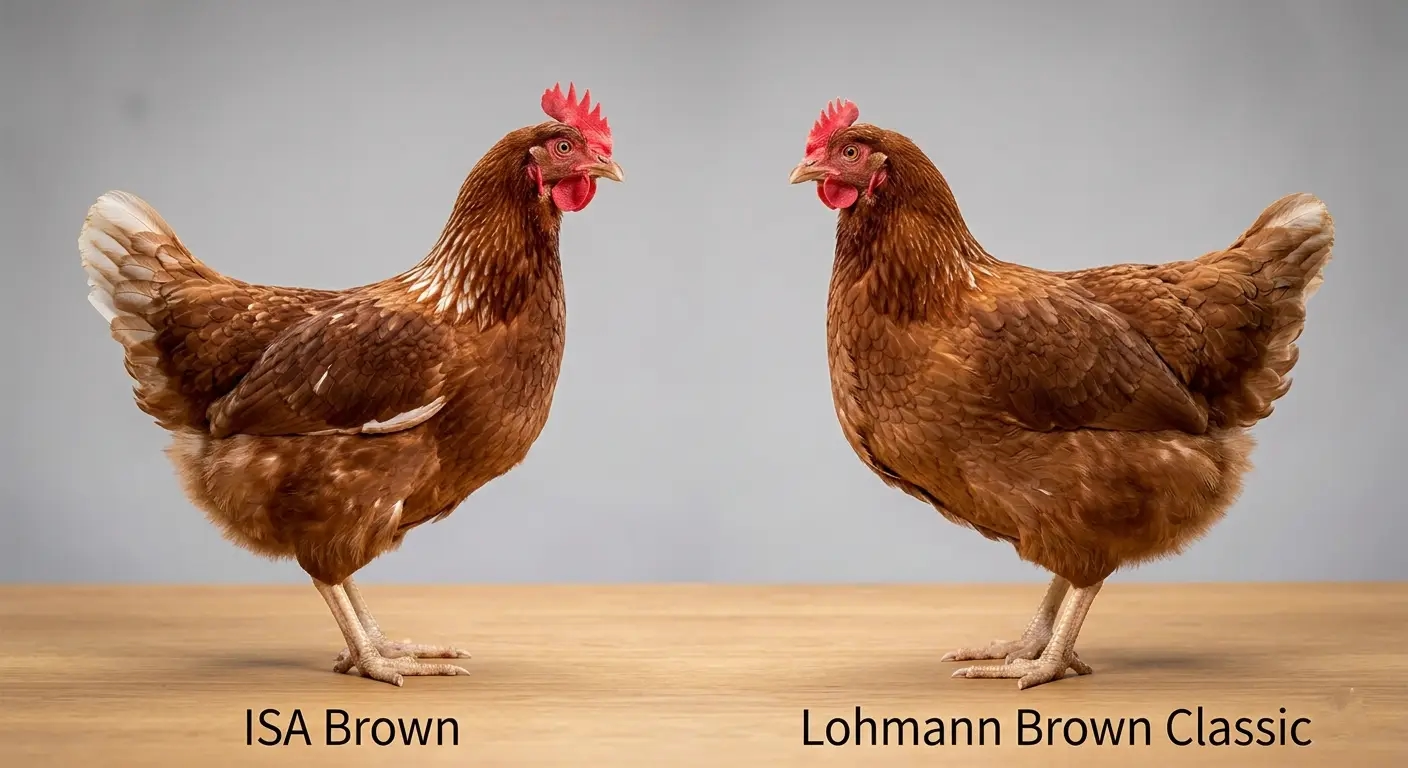
ISA Brown is a commercial hybrid developed by Institut de Sélection Animale (ISA), now part of Hendrix Genetics, headquartered in the Netherlands. The breed is a four-way cross between Rhode Island Red and Rhode Island White genetics, with proprietary selection pressure applied over decades for egg output, early sexual maturity, egg size consistency, and adaptability to intensive production systems.
ISA Brown has been one of the world’s most widely produced commercial layer breeds since the 1980s. It is distributed globally through Hendrix Genetics’ network of licensed breeders and hatcheries. In Cameroon, ISA Brown chicks are available through several registered hatcheries with parent flock operations, primarily in the Littoral and Centre regions.
Lohmann Brown
Lohmann Brown (specifically Lohmann Brown Classic or Lohmann Brown Extra) is developed and distributed by Lohmann Tierzucht GmbH, headquartered in Germany. Like ISA Brown, it is a four-way cross based on Rhode Island genetics, selected for commercial egg production performance. Lohmann Tierzucht has an independent breeding program from Hendrix Genetics despite the superficial similarity in breed type.
Lohmann Brown Classic is the standard product. Lohmann Brown Extra is a more recently developed line with slightly higher egg output targets and larger egg size averages — marketed specifically for operations with high management standards and consistent feed quality.
In Cameroon, Lohmann Brown is available through the same registered hatcheries that supply ISA Brown, with some hatcheries specializing in one breed and others offering both.
Performance Comparison: The Numbers That Matter
Both breeds publish breed management guides with performance targets at optimal management conditions. The following comparison uses the current breed standard figures from Hendrix Genetics (ISA Brown) and Lohmann Tierzucht (Lohmann Brown Classic).
Egg Production Targets
| Performance Metric | ISA Brown | Lohmann Brown Classic | Lohmann Brown Extra |
|---|---|---|---|
| Age at 50% production (days) | 140–150 | 140–150 | 138–148 |
| Peak production rate | 93–96% | 92–95% | 94–97% |
| Age at peak production | Week 26–30 | Week 28–32 | Week 26–30 |
| Hen-housed egg production (72 weeks) | 305–320 | 300–315 | 310–325 |
| Hen-housed egg production (80 weeks) | 340–360 | 335–355 | 345–365 |
| Laying persistency (% production at week 72 vs. peak) | 75–80% | 78–83% | 76–81% |
| Average egg weight (peak lay) | 62–65g | 63–66g | 64–67g |
| Average egg weight (early lay) | 56–60g | 57–61g | 58–62g |
Key observation: The headline production numbers are nearly identical between ISA Brown and Lohmann Brown Classic under optimal conditions. The difference between 305–320 and 300–315 eggs over 72 weeks is 5–20 eggs per hen, less than one week’s production difference. A management difference of equivalent magnitude — 1% average laying rate — produces the same 18-egg variation over 72 weeks.
The breed is not the production ceiling in most Cameroonian layer operations. The management is. A well-managed ISA Brown flock and a well-managed Lohmann Brown flock will produce similar egg numbers per cycle. A poorly managed flock of either breed will produce significantly less than the breed standard predicts.
Feed Conversion Ratio
| FCR Metric | ISA Brown | Lohmann Brown Classic |
|---|---|---|
| FCR (kg feed per kg egg mass, peak) | 2.05–2.15 | 2.00–2.10 |
| FCR (kg feed per dozen eggs, peak) | 1.38–1.45 | 1.35–1.42 |
| Daily feed intake (peak lay) | 110–118g | 112–120g |
| Daily feed intake (late lay) | 115–125g | 117–127g |
Lohmann Brown Classic shows a marginal FCR advantage — approximately 0.05 kg feed per kg egg mass — that reflects its slightly heavier egg weight at equivalent laying rate. This advantage is real but small: at a 1,000-bird farm producing 350,000 kg of egg mass per cycle, a 0.05 FCR difference is approximately 17,500 kg of additional feed for ISA Brown vs. Lohmann Brown — worth approximately XAF 6,125,000 (USD 10,208) at XAF 350/kg feed.
This is a meaningful FCR advantage if both breeds are being managed at their genetic potential under identical conditions. Under the variable management conditions of most Cameroonian commercial layer farms, the 0.05 FCR difference is typically overwhelmed by FCR variation from feed wastage, heat stress management, and disease events, which can produce FCR swings of 0.15–0.30 in either direction.
Body Weight Targets
| Body Weight | ISA Brown | Lohmann Brown Classic |
|---|---|---|
| Point of lay (18–20 weeks) | 1,550–1,650g | 1,600–1,700g |
| Peak lay (30–35 weeks) | 1,750–1,850g | 1,800–1,900g |
| Late lay (60–72 weeks) | 1,900–2,100g | 1,950–2,100g |
| Spent hen weight (72 weeks) | 1,900–2,100g | 1,950–2,150g |
Lohmann Brown Classic carries slightly more body weight through the laying cycle — a 50–100g advantage that becomes relevant at spent hen sale: heavier birds bring higher per-bird revenue from wholesale buyers. At 1,000 spent hens with a 100g average weight advantage for Lohmann Brown, the spent hen revenue advantage is:
1,000 birds × 0.100 kg × XAF 1,200/kg (USD 2.00/kg) = XAF 120,000 (USD 200) additional spent hen revenue per cycle
Shell Quality
Both breeds are bred for commercial shell quality parameters. Documented differences between the breeds under comparable conditions:
- Shell breaking strength: Lohmann Brown Classic shows marginally higher average shell breaking strength (3.0–3.5 N higher) in peer-reviewed production trials — a difference that is detectable in laboratory measurement but not necessarily visible in commercial cracked egg rates
- Shell thickness: Comparable between breeds at equivalent nutritional management
- Late-lay shell quality: Lohmann Brown Classic has a slight documented advantage in maintaining shell quality in late lay (weeks 55–72), attributed to higher body weight reserves for calcium mobilization in the late cycle. This is the most practically relevant shell quality difference between the two breeds for Cameroonian production.
Under correct calcium and vitamin D₃ management, both breeds produce commercially acceptable shell quality throughout the laying cycle. The Lohmann Brown Classic’s late-lay shell quality advantage becomes visible primarily when calcium or vitamin D₃ management is suboptimal — a condition more common in practice than the breed management guides assume.
The Cameroonian Context: Where the Differences Become Real
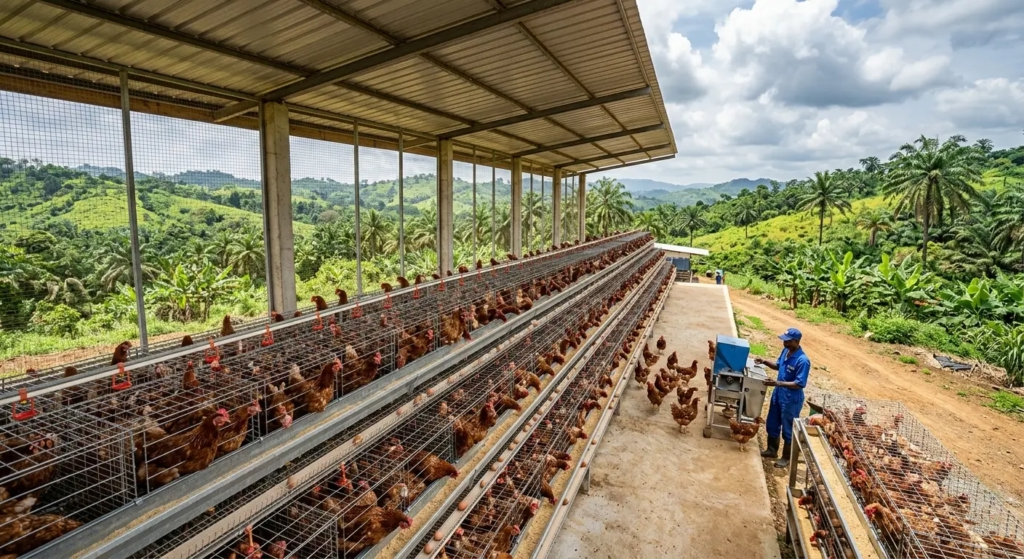
The breed standard performance data above was generated under controlled research station conditions with optimal nutrition, climate control, and disease management. Cameroonian commercial layer production differs from those conditions in three specific ways that affect breed choice:
Difference 1: Tropical Heat and Its Impact on Feed Intake
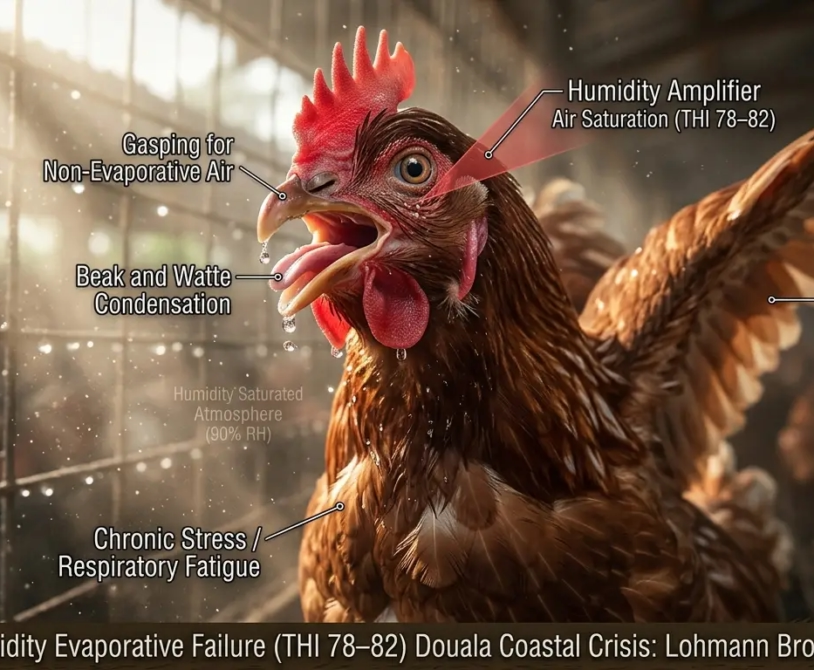
Both ISA Brown and Lohmann Brown are European-developed commercial breeds, optimized for temperate climate production environments. Neither is specifically bred for tropical heat tolerance — they are both “moderate heat tolerance” breeds that respond similarly to thermal challenge.
However, under sustained heat stress (ambient temperatures above 32°C for more than 4 hours per day), Lohmann Brown Classic maintains body condition marginally better than ISA Brown because its slightly higher body weight provides a larger thermal buffer and greater metabolic reserve for calcium mobilization during heat events. This is a real but small difference — measured in degrees of production resilience during extended heat periods rather than in production rate under moderate heat.
Practical implication: In highland production zones of Cameroon (Bafoussam, Mifi Division, Bamenda, Dschang — altitudes above 1,200m) where ambient temperatures are consistently cooler (20–28°C typical), both breeds perform similarly and the heat tolerance difference is irrelevant. In lowland and coastal zones (Douala, Kribi, Limbe) where temperatures regularly exceed 32–35°C, Lohmann Brown Classic’s body weight reserve provides a marginal production advantage during peak dry season heat events.
Difference 2: Feed Quality Variability
Commercial feed in Cameroon is produced from locally sourced maize, soybean meal, fishmeal, and imported amino acid supplements. Quality is variable between suppliers and between seasons — maize ME content changes with harvest year, moisture content, and storage duration; soybean meal protein digestibility varies with processing temperature.
ISA Brown’s response to variable feed quality: ISA Brown was developed with a strong emphasis on feed conversion efficiency — it extracts maximum production from the available nutrient supply. This trait also means that ISA Brown responds more sensitively to feed quality variation: when the ration underdelivers on energy or amino acids, ISA Brown’s production drops faster and further than Lohmann Brown Classic under comparable conditions.
Lohmann Brown Classic’s response: Lohmann Brown Classic has been selected with somewhat higher resilience to sub-optimal feeding conditions — a trait documented in its wider adoption in markets with variable feed quality, including parts of Eastern Europe, Sub-Saharan Africa, and Southeast Asia. This resilience is not immunity to feed quality variation — it is a slightly flatter production response curve when conditions deviate from optimal.
Practical implication for Cameroon: Farms with access to consistently high-quality commercial layer mash from a reputable mill, with laboratory-verified nutrient content and fresh milling (less than 14 days from mill to feeders), will see ISA Brown’s feed conversion efficiency advantage more clearly. Farms sourcing feed from variable-quality local mills, or mixing feed from local ingredients without regular laboratory verification, will generally see more stable production from Lohmann Brown Classic.
Difference 3: Management Intensity
Both breeds require intensive, precise management to reach their genetic production potential. But their tolerance for management imperfection — the production loss they experience when management falls short of the ideal — differs in ways relevant to the Cameroonian commercial layer landscape.
ISA Brown is a “high-ceiling, narrow-window” breed: exceptional performance when management is precise, more pronounced performance decline when it is not. Lohmann Brown Classic is a “good-ceiling, wider-window” breed: slightly lower peak potential under ideal conditions, more forgiving response when conditions are imperfect.
The management sensitivity test: If a layer farm in Cameroon can answer “yes” to all of the following, it is operating at the management precision level where ISA Brown’s advantages are captured:
- Ration formulated and laboratory-verified for every batch
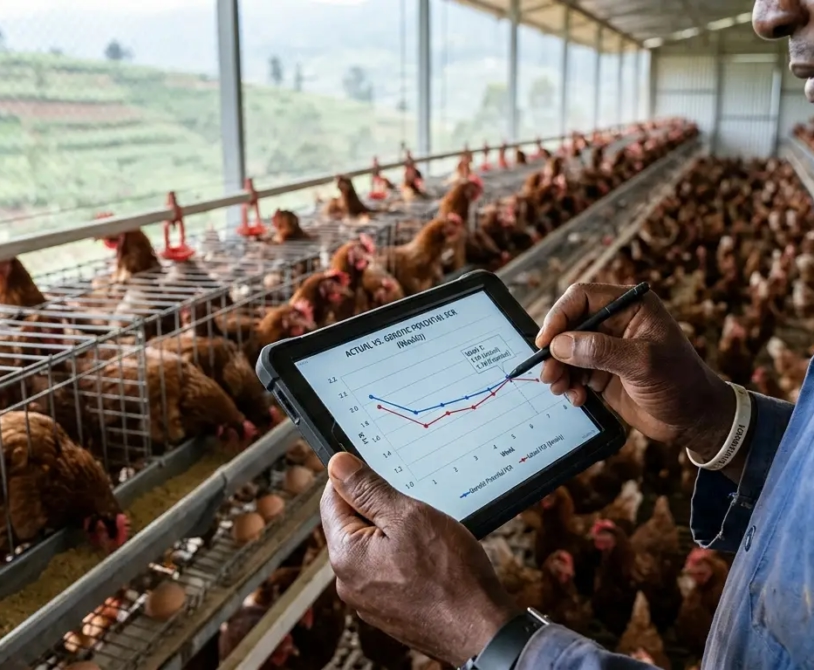
- FCR tracked weekly with breed standard comparison
- Vaccination program confirmed by post-vaccination serology
- Water is tested quarterly at the far-end nipple
- Lighting program verified by a lux meter and a timer log
- Flock health walk-through is documented daily
Farms that can confirm all six operate at the management level where ISA Brown’s feed conversion and production ceiling advantages are real and capturable. Farms where any three of these six are inconsistent will capture more of Lohmann Brown Classic’s production potential under their actual conditions.
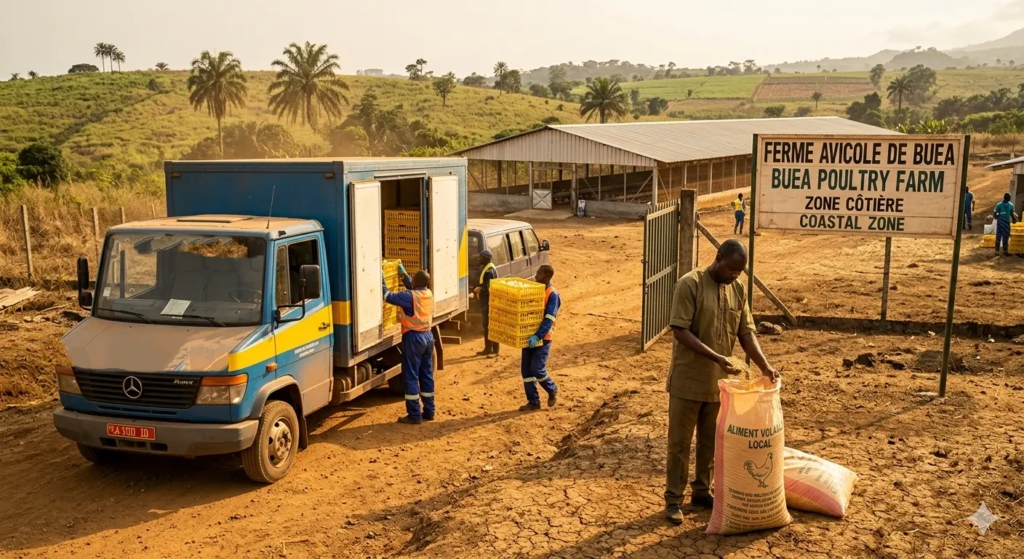
Chick Quality and Hatchery Supply: The Practical Factor That Trumps Breed Genetics
The most important breed decision for a Cameroonian layer farmer is not which breed’s genetics are marginally superior under optimal conditions. It is the breed’s chicks are consistently available from a hatchery whose cold chain, Marek’s disease vaccination, flock health status, and parent flock management are verifiable and reliable.
A genetically superior breed from a poorly managed hatchery — with inconsistent Marek’s vaccination, omphalitis incidence above 2%, maternal antibody variation from poorly managed parent flock health — will underperform a genetically equivalent breed from a hatchery whose production standards are consistently high.
Questions to ask any hatchery before committing to a breed:
- Can you provide the parent flock’s vaccination record for the last 3 months?
- What is the hatchability rate from your current parent flock (target above 82%)?
- What is the average omphalitis rate in day-old chicks (target below 1%)?
- How is Marek’s disease vaccine stored and administered — what is the time from thawing to administration?
- Can I speak to three commercial layer farmers who sourced your chicks in the last 6 months?
A hatchery that cannot or will not answer questions 1–4 specifically is a hatchery whose chick quality cannot be confidently assessed. Breed selection is meaningless if chick quality is inconsistent.
The practical recommendation: Select the breed whose chicks are available from the hatchery with the most verifiable and consistent quality standards in your region — not the breed with the marginally superior published performance data from a research station.
Price Comparison: Chick and Feed Cost
Day-Old Chick Prices (Cameroon, 2026)
| Breed | Price Range per Chick | USD Equivalent |
|---|---|---|
| ISA Brown | XAF 1,100–1,400 | USD 1.83–2.33 |
| Lohmann Brown Classic | XAF 1,100–1,400 | USD 1.83–2.33 |
| Lohmann Brown Extra | XAF 1,300–1,600 | USD 2.17–2.67 |
Day-old chick prices for ISA Brown and Lohmann Brown Classic are equivalent in the Cameroon market — neither carries a price premium over the other at the commodity layer chick level. Lohmann Brown Extra (the higher-specification line) carries a 15–20% price premium over Classic, reflecting its higher production target specifications.
Feed Cost Differences
Both breeds require essentially the same ration composition across the rearing and laying phases. The marginal FCR difference (0.05 kg feed per kg egg mass for Lohmann Brown Classic advantage) translates to a feed cost difference of approximately XAF 5,500,000–6,500,000 (USD 9,167–10,833) per 1,000 birds over a 72-week cycle — in Lohmann Brown Classic’s favor — assuming both breeds are performing at their genetic ceiling under identical conditions.
Under variable Cameroonian conditions where FCR is influenced by heat stress, water quality, feed quality variation, and management precision, this theoretical feed cost difference is rarely realized in full. The realized difference at most commercial Cameroonian layer farms is likely XAF 1,000,000–3,000,000 (USD 1,667–5,000) per 1,000 birds — meaningful but not decisive.
The Decision Matrix: Which Breed for Your Farm?
Neither breed is universally superior for all Cameroonian production conditions. The correct choice depends on five farm-specific factors:
| Factor | ISA Brown Better | Lohmann Brown Classic Better |
|---|---|---|
| Feed quality | Consistently high-quality, lab-verified ration | Variable quality, locally sourced or unverified |
| Management precision | All six management indicators met consistently | 2+ management indicators inconsistently met |
| Climate zone | Highland (altitude 1,200m+, ambient 20–28°C) | Lowland/coastal (ambient regularly 32–35°C+) |
| Production target | Maximum eggs per cycle, optimized FCR | Consistent production under challenging conditions |
| Spent hen value priority | Not a differentiating factor | Marginally higher per-bird spent hen value |
| Hatchery availability | Best available hatchery supplies ISA Brown | Best available hatchery supplies Lohmann Brown |
The simplified decision rule:
- If your farm is in the highlands of West Cameroon, operates a verified nutritional and health management program, sources feed from a reliable mill with consistent quality, and your hatchery can supply ISA Brown chicks from verified parent flock health, ISA Brown is the optimal choice.
- If your farm is in the lowland zones of Littoral or South West Region, operates with the management capabilities typical of a first or second commercial cycle, sources feed from local mills without routine laboratory verification, or the best hatchery in your area primarily supplies Lohmann Brown — Lohmann Brown Classic is the more resilient choice for your conditions.
- If you are entering the premium hotel/supermarket supply chain with the capacity to invest in full quality management (graded eggs, documented health program, consistent yolk color, traceable supply) — Lohmann Brown Extra justifies its price premium through higher egg size averages and more consistent late-lay quality for specification-demanding buyers.
What Matters More Than Breed Choice
The farmer reading this comparison, hoping that the “right” breed will solve a production problem that is actually a management problem, will be disappointed. The following management inputs have a larger impact on actual production performance in Cameroonian layer farms than breed genetics:
- Vaccination program timing aligned to actual maternal antibody status (contributes more to Newcastle disease protection than breed immunity difference)
- Water quality and daily intake (drives egg weight variation that exceeds breed egg weight differences)
- Feed quality consistency and accurate calcium and vitamin D₃ delivery (drives shell quality variation that exceeds breed shell quality differences)
- Heat stress management during dry season (drives laying rate variation that exceeds breed production ceiling differences)
- Lighting program consistency (drives production persistency more than breed laying persistency differences)
A Lohmann Brown Classic flock managed excellently will outperform an ISA Brown flock managed poorly. An ISA Brown flock managed excellently will outperform a Lohmann Brown Classic flock managed poorly. At equivalent management, the breeds are close enough that hatchery quality, local feed quality, and seasonal climate are more predictive of performance than the breed label on the chick box.
Choose the breed whose chicks arrive healthiest. Then manage them as if the breed doesn’t matter — because under good management, it largely doesn’t.
Summary
ISA Brown and Lohmann Brown Classic are both excellent commercial layer breeds with proven production records across tropical production environments. Under Cameroonian conditions, the choice between them is determined less by genetic superiority and more by the interaction between each breed’s known strengths and the specific management capacity, feed quality, and climate zone of the farm, making the decision.
ISA Brown’s advantages — feed conversion efficiency, high ceiling production rate — are most fully realized under precise, consistent management with verified feed quality. Lohmann Brown Classic’s advantages — resilience to feed quality variation, slightly better body weight maintenance under heat stress, marginally better late-lay shell quality — are most valuable in conditions where management precision is developing or feed quality is variable.
For most first and second-cycle Cameroonian commercial layer farms operating in the lowland and coastal climate zones with locally sourced feed, Lohmann Brown Classic is the lower-risk choice.
For established commercial farms with full management systems operating in highland climate zones with high-quality, verified feed supply, ISA Brown captures marginally more production value per cycle.
For operations targeting premium egg supply contracts with institutional buyers requiring consistent size, color, and quality specification, Lohmann Brown Extra earns its price premium.
In all cases, the hatchery quality is more important than the breed. Choose the hatchery first. Then choose the breed.