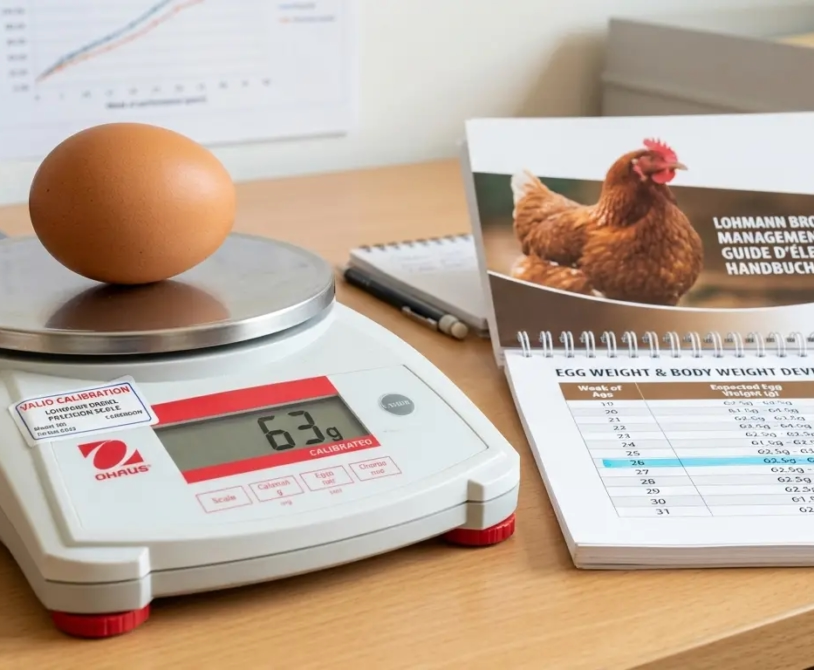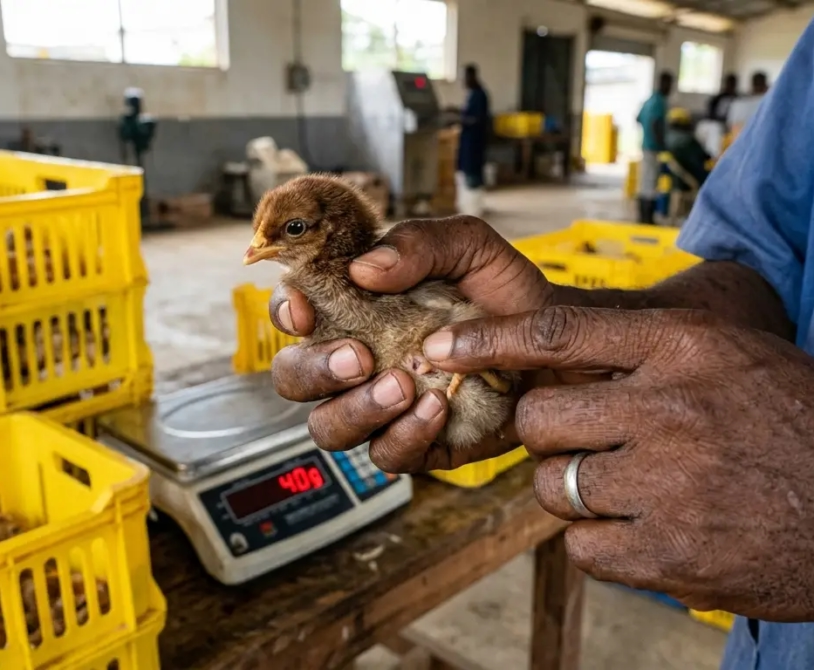

The dual-purpose breed is the chicken that sounds perfect in theory: one bird, two revenue streams, maximum resource utilization. The hen lays eggs. The cockerels become meat. The spent hens are heavier and worth more than commercial layer culls. The cost ratio is spread across two products. What’s not to like?
What’s not to like is the production arithmetic.
A dual-purpose hen does not lay as many eggs as a commercial layer. She does not convert feed to eggs as efficiently. She does not reach peak production as quickly. She does not maintain laying persistency as long. And in a market where egg price is the primary revenue driver and feed cost is the primary cost driver, every deviation from commercial layer performance benchmarks is a financial penalty paid daily, for every day of the 72-week cycle.
This does not mean dual-purpose breeds have no place in West African poultry production. It means their place is specific: defined by market conditions, production scale, management intensity, and the value placed on the non-egg outputs they generate. Understanding exactly where that place is — and where it is not — requires examining the production economics of dual-purpose breeding against commercial layer alternatives with specific numbers rather than general impressions.
What Is a Dual-Purpose Breed?
A dual-purpose breed is a poultry breed or cross selected for commercially acceptable performance in both egg production and meat production simultaneously. The breed represents a compromise between the two specialized genetic architectures — neither as efficient in egg production as a commercial layer cross nor as efficient in meat production as a commercial broiler cross, but performing acceptably at both.
The Genetic Trade-Off
Commercial layer genetics have been selected for 60+ years specifically for maximum eggs per unit of feed, with body weight deliberately minimized because body maintenance requires feed that could otherwise go to egg production. The result: birds of 1,550–1,750g at peak lay, extraordinarily efficient at converting feed to eggs, but producing minimal meat value at depopulation.
Commercial broiler genetics have been selected for maximum daily weight gain and feed conversion to body mass, with no selection pressure for egg production. The result: birds that reach 2.0 kg in 35 days but whose egg production when kept beyond slaughter age is marginal.
Dual-purpose breeds occupy the genetic middle ground — larger body frames than commercial layers (1,800–2,500g at point of lay) with moderate egg production (180–250 eggs per year under commercial conditions) and acceptable carcass quality at slaughter.
Common Dual-Purpose Breeds Available in Cameroon and West Africa
Imported or introduced breeds:
- Sussex (Light Sussex): English origin; moderate egg production (180–220 eggs/year); good carcass quality; available through some agricultural stations
- New Hampshire Red: American breed; 200–240 eggs/year; good meat yield; available through NGO and government breeding programs
- Black Australorp: Australian origin; documented record of 364 eggs in one year under exceptional management; typical commercial performance 200–250 eggs/year; good carcass weight
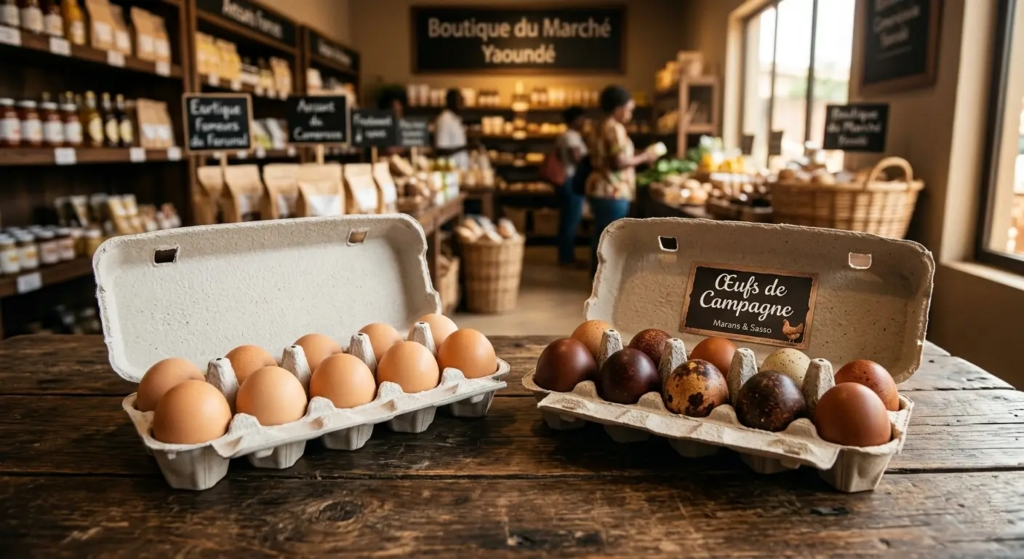
- Marans: French origin; known for dark-shelled eggs; 180–210 eggs/year; good meat yield; small presence in Cameroon premium market
- Plymouth Rock (Barred Rock): American origin; 200–230 eggs/year; good carcass yield; available through some agricultural stations
- Sasso (Red JA / T451): French-developed slow-growing broiler line widely used in Africa as dual-purpose; 180–220 eggs/year; good carcass quality at 120–140 days; widely used in rural Cameroon and Nigeria
Local and improved local breeds:
- Cameroon local ecotype (village chicken): Extremely low egg production (50–80 eggs/year); high disease resistance; exceptional market value as “poulet bicyclette” at XAF 3,500–8,000 (USD 5.83–13.33) per bird live
- IRAD improved local crosses (Cameroon): Local ecotype × Rhode Island Red or Sussex crosses; 120–160 eggs/year; moderate disease resistance; available through IRAD breeding programs
- Sasso × local cross: Increasingly common in peri-urban Cameroon; 160–190 eggs/year; above-average carcass weight; marketed as semi-village chicken with premium pricing
The Production Economics: Dual-Purpose vs. Commercial Layer
The most important comparison in evaluating dual-purpose breed profitability is feed cost per egg — the metric that determines whether egg production from a given breed is economically viable against market price.
Egg Production Comparison
| Metric | Commercial Layer (ISA/LBB) | Black Australorp | Sasso T451 | Local Ecotype |
|---|---|---|---|---|
| Annual eggs per hen | 290–320 | 200–250 | 180–220 | 50–80 |
| Peak laying rate (%) | 92–96% | 65–80% | 55–70% | 30–45% |
| Age at first egg (weeks) | 17–19 | 22–26 | 24–28 | 28–36 |
| Egg weight (g) | 60–65g | 55–65g | 50–60g | 40–52g |
| FCR (kg feed/kg egg mass) | 2.00–2.15 | 2.80–3.40 | 3.20–3.80 | 5.50–7.00+ |
| Daily feed intake | 110–120g | 130–155g | 140–165g | 60–90g |
| Point of lay body weight | 1,600–1,700g | 1,900–2,300g | 2,000–2,400g | 1,200–1,600g |
The Feed Cost Per Egg Calculation
This is the definitive economic comparison. It answers: how much does feed cost to produce one egg from each breed?
Formula: Daily feed cost per egg = (Daily feed intake × Feed cost per kg) ÷ Daily laying rate
At peak production with XAF 350/kg feed (USD 0.58/kg):
| Breed | Feed Intake (g/day) | Laying Rate | Feed Cost/Day | Eggs/Day | Feed Cost Per Egg (XAF) | Feed Cost Per Egg (USD) |
|---|---|---|---|---|---|---|
| ISA Brown | 115g | 93% | XAF 40.25 | 0.93 | XAF 43.3 | USD 0.072 |
| Lohmann Brown Classic | 116g | 92% | XAF 40.60 | 0.92 | XAF 44.1 | USD 0.074 |
| Black Australorp | 142g | 72% | XAF 49.70 | 0.72 | XAF 69.0 | USD 0.115 |
| Sasso T451 | 152g | 62% | XAF 53.20 | 0.62 | XAF 85.8 | USD 0.143 |
| Local ecotype | 75g | 38% | XAF 26.25 | 0.38 | XAF 69.1 | USD 0.115 |
The feed cost per egg from a Black Australorp (XAF 69.0 / USD 0.115) is 59% higher than from an ISA Brown (XAF 43.3 / USD 0.072) at equivalent feed prices. For a Sasso, the feed cost per egg (XAF 85.8 / USD 0.143) is 98% higher than ISA Brown — nearly double.
What this means at a commercial scale:
At a 1,000-bird farm, the additional feed cost of producing eggs with Black Australorp vs. ISA Brown:
- ISA Brown feed cost per egg: XAF 43.3 (USD 0.072)
- Black Australorp feed cost per egg: XAF 69.0 (USD 0.115)
- Additional cost per egg: XAF 25.7 (USD 0.043)
- Additional cost over 300,000 eggs (approximate cycle production from each breed): XAF 7,710,000 (USD 12,850) in additional feed cost per cycle
The dual-purpose hen’s eggs cost XAF 7.7 million (USD 12,850) more in feed to produce than the equivalent volume from a commercial layer — before accounting for the reduced total egg count (250,000 eggs from Black Australorp vs. 310,000+ from ISA Brown at equivalent flock size).
The Revenue Side: Can Dual-Purpose Advantages Compensate?
Dual-purpose breeds generate additional revenue from sources that commercial layers do not — cockerel sales at culling, heavier spent hen prices, and premium market positioning for “traditional” or “free-range” branded products. Can these advantages close the XAF 7.7 million (USD 12,850) feed cost gap?
Cockerel Revenue
In hatching dual-purpose breeds, 50% of chicks are male. Cockerels are not useful for egg production and must be either:
- Raised to slaughter weight and sold as meat (additional feed cost + revenue)
- Sold as day-old cockerels to farmers who will raise them (low per-unit value)
- Culled at hatch (no revenue, no cost beyond disposal)
Cockerel meat revenue calculation (raising to slaughter at 20 weeks):
For a Black Australorp cockerel:
- Feed to 20 weeks: approximately 8 kg total
- Slaughter weight: 1.8–2.2 kg live (approximately 1.3–1.6 kg dressed)
- Feed cost: 8 kg × XAF 320/kg (grower ration) = XAF 2,560 (USD 4.27) per cockerel
- Sale price: XAF 2,500–4,000 (USD 4.17–6.67) per live bird or XAF 3,500–6,000 (USD 5.83–10.00) dressed
At best: XAF 4,000 sale − XAF 2,560 feed cost = XAF 1,440 (USD 2.40) net cockerel revenue
For 500 cockerels from a 1,000-bird hatch: 500 × XAF 1,440 = XAF 720,000 (USD 1,200) total cockerel net revenue
This is meaningful but represents only 9% of the XAF 7.7 million (USD 12,850) feed cost gap created by dual-purpose breed egg production inefficiency.
Premium Pricing for Dual-Purpose Eggs
Dual-purpose breeds are marketed in some Cameroonian market segments as “country eggs” (œufs de campagne) — perceived as more natural, more nutritious, and of higher quality than industrial layer eggs. In urban markets with consumer awareness of food origins, this premium exists:
- Standard commercial layer egg: XAF 120–140 (USD 0.20–0.23) per egg
- “Country egg” / dual-purpose premium: XAF 160–220 (USD 0.27–0.37) per egg
- Premium per egg: XAF 40–80 (USD 0.07–0.13)
Revenue gap from premium pricing:
- 250,000 eggs (Black Australorp production) × XAF 60 premium average = XAF 15,000,000 (USD 25,000) additional revenue
This is larger than the feed cost gap (XAF 7.7 million / USD 12,850). At XAF 60 per egg premium, dual-purpose breed egg production from a Black Australorp is more profitable per egg than commercial layer production — despite the higher feed cost per egg.
The critical condition: This conclusion holds only if the premium market channel actually exists and is accessible. A farm selling “country eggs” at open-air markets where the premium is not recognized — because consumers cannot distinguish dual-purpose eggs from commercial layer eggs by appearance alone — captures none of the premium and pays the full feed cost penalty.
Spent Hen Premium
Dual-purpose breed spent hens are significantly heavier than commercial layer culls and command premium prices in the “traditional chicken” market:
| Breed | Spent Hen Weight (72 weeks) | Wholesale Price/kg | Per-Bird Revenue | Commercial Layer Comparison |
|---|---|---|---|---|
| ISA Brown / LBB | 1,900–2,100g | XAF 1,100/kg (USD 1.83) | XAF 2,090–2,310 (USD 3.48–3.85) | Baseline |
| Black Australorp | 2,800–3,200g | XAF 1,400/kg (USD 2.33) | XAF 3,920–4,480 (USD 6.53–7.47) | +XAF 1,830–2,170 (USD 3.05–3.62) per bird |
| Sasso T451 | 2,500–3,000g | XAF 1,600/kg (USD 2.67) | XAF 4,000–4,800 (USD 6.67–8.00) | +XAF 1,910–2,490 (USD 3.18–4.15) per bird |
Spent hen revenue advantage (1,000 birds, Black Australorp vs. ISA Brown):
- Additional per-bird revenue: approximately XAF 2,000 (USD 3.33)
- Total additional spent hen revenue: 900 birds × XAF 2,000 = XAF 1,800,000 (USD 3,000)
The Complete Profitability Model: Does Dual-Purpose Pay?
Comparing a 1,000-bird ISA Brown operation vs. a 1,000-bird Black Australorp operation over one production cycle:
| Item | ISA Brown (XAF) | ISA Brown (USD) | Black Australorp (XAF) | Black Australorp (USD) |
|---|---|---|---|---|
| Revenue | ||||
| Egg sales (standard price XAF 130 avg) | 40,300,000 | 67,167 | 32,500,000 | 54,167 |
| Egg sales (premium market +XAF 60) | — | — | 15,000,000 | 25,000 |
| Spent hen revenue | 2,000,000 | 3,333 | 3,800,000 | 6,333 |
| Cockerel revenue (net) | — | — | 720,000 | 1,200 |
| Total Revenue | 42,300,000 | 70,500 | 52,020,000 | 86,700 |
| Operating Costs | ||||
| Feed (ISA Brown 310,000 eggs, FCR 2.1) | 17,100,000 | 28,500 | — | — |
| Feed (Australorp 250,000 eggs, FCR 3.2) | — | — | 24,800,000 | 41,333 |
| Health, labor, utilities (comparable) | 3,800,000 | 6,333 | 3,800,000 | 6,333 |
| Total Operating Costs | 20,900,000 | 34,833 | 28,600,000 | 47,667 |
| Net Operating Profit | 21,400,000 | 35,667 | 23,420,000 | 39,033 |
The result is counterintuitive: A well-managed Black Australorp operation selling at a XAF 60 premium per egg generates higher net operating profit (XAF 23.4 million / USD 39,033) than a well-managed ISA Brown operation selling at standard price (XAF 21.4 million / USD 35,667) — despite significantly higher feed cost and lower egg volume.
But this conclusion depends entirely on realizing the egg price premium.
If the dual-purpose eggs are sold at standard commercial prices (no premium):
| Item | ISA Brown (XAF) | ISA Brown (USD) | Black Australorp (no premium) (XAF) | Black Australorp (no premium) (USD) |
|---|---|---|---|---|
| Total Revenue | 42,300,000 | 70,500 | 37,020,000 | 61,700 |
| Total Operating Costs | 20,900,000 | 34,833 | 28,600,000 | 47,667 |
| Net Operating Profit | 21,400,000 | 35,667 | 8,420,000 | 14,033 |
Without the premium, Black Australorp profitability collapses to XAF 8.4 million (USD 14,033) — 61% below ISA Brown.
This is the fundamental economics of dual-purpose breed egg production: It is profitable above commercial layer production only when the premium market channel is real, accessible, and consistently priced at XAF 50–80 (USD 0.08–0.13) above commodity eggs. It is significantly less profitable when that channel is absent or inconsistent.
The Market Conditions That Make Dual-Purpose Viable
Condition 1: Verifiable Premium Market Access
Before stocking a dual-purpose breed for egg production, the farm must have:
- A committed buyer for “country eggs” at a confirmed premium price
- Volume requirements confirmed in writing or verbal commitment
- Evidence that the buyer can distinguish dual-purpose eggs from commercial layer eggs by shell color, egg size, or farm certification
Selling dual-purpose eggs to an open-air wholesale trader who blends them with commercial layer eggs and pays XAF 120 per egg, regardless of breed, captures zero premium. The distinction between “country eggs” and commercial eggs must be verifiable to the end consumer or institutional buyer — through distinctive shell color (dark brown or speckled), egg size variation (dual-purpose eggs are often more variable in size), farm branding, or direct farm-to-consumer sale.
Condition 2: Small Production Scale with Direct Sales
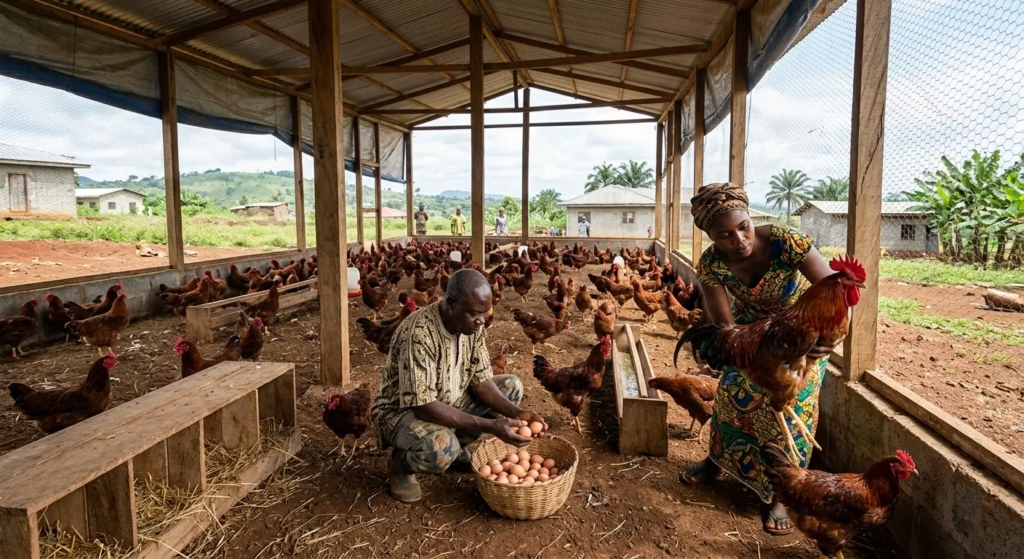
The premium market channel for dual-purpose eggs is primarily urban direct retail — farmers’ markets, household delivery, restaurant relationships — rather than wholesale. These channels are most accessible to small-scale operations (100–500 birds) selling directly to consumers who visit the farm or who have a relationship with the farmer.
At commercial scale (2,000+ birds), moving dual-purpose eggs through direct retail requires a distribution infrastructure that most layer farms in West Africa are not equipped to manage. The premium collapses toward the commodity price as volume exceeds the direct retail channel’s absorption capacity.
Condition 3: Integrated Meat and Egg Revenue Model
The dual-purpose breed is most economically rational in an integrated production system where both the egg output and the meat output are valued:
- Hens produce eggs through the laying period
- Spent hens are marketed as premium traditional chicken at XAF 4,000–5,500 (USD 6.67–9.17) per bird live
- Cockerels are raised to 14–20 weeks and sold as slow-grown chicken at XAF 2,500–4,500 (USD 4.17–7.50) per bird live
- The enterprise revenue is a blend of egg income and chicken income — neither dominating
In this model, the comparison is not “dual-purpose vs. commercial layer for egg production” but “integrated chicken enterprise vs. specialized egg enterprise” — a fundamentally different business model with different economics.
Condition 4: Rural and Peri-Rural Market Context
In rural areas where commercial layer chick supply chains are unreliable, feed quality is variable, and buyers prefer traditional-looking chickens, dual-purpose breeds are often the most practical choice regardless of the premium economics. A breed that survives on lower-quality feed, has higher disease resistance, and produces eggs that local buyers trust is more appropriate for this context than a commercial layer breed that requires precise management to avoid catastrophic performance failure.
The rural context inverts the economic argument: dual-purpose breeds are more resilient under rural management conditions. Commercial layer breeds, under the same conditions, often underperform so severely that they produce no economic advantage over their higher acquisition cost and management requirements.
The Verdict: When Dual-Purpose Is and Is Not the Answer
Dual-purpose breeds ARE the right choice when:
- You have confirmed access to a premium “country egg” channel paying XAF 50–80 (USD 0.08–0.13) above commodity prices
- You operate at a direct retail scale (100–500 birds), where the premium channel can absorb your production
- You are in a rural or peri-rural market where commercial layer supply chains are unreliable or management conditions are too variable for commercial layer performance
- You want an integrated meat + egg enterprise where both cockerel and spent hen meat revenue are part of the business model
- Your market specifically requests dark-shelled, speckled, or visually “traditional” eggs that differentiate your product from commercial production
Dual-purpose breeds are NOT the right choice when:
- You are selling through wholesale channels that pay a commodity price regardless of breed
- You are operating at a commercial scale (1,000+ birds), targeting volume throughput at a competitive price
- Your primary business goal is maximum eggs per franc of feed cost
- You do not have a marketing strategy that communicates the breed differentiation to end consumers
- You are comparing against a well-managed commercial layer operation and expecting equivalent egg volume
The Sasso Question: Why It Dominates Peri-Urban Markets in Cameroon
The Sasso T451 and related Sasso lines (Red JA, Sasso colored) occupy a unique market position in Cameroon and Nigeria that is not accurately described as either “commercial layer” or “traditional dual-purpose.” It is a slow-growing broiler line adapted for African market conditions — producing a colored, free-range-appearance bird that commands a significant premium as “poulet de chair fermier” (farm chicken) or “poulet bicyclette” equivalent while generating eggs as a secondary output.
Sasso’s market advantage in Cameroon:
- Live slaughter price: XAF 3,000–6,000 (USD 5.00–10.00) per bird at 14–20 weeks
- Eggs from Sasso hens kept beyond slaughter age: XAF 150–200 (USD 0.25–0.33) per egg in markets recognizing the “country egg” designation
- The bird’s colored feathering and slower growth pace visually differentiate it from commercial broiler or layer breeds — a critical market signal that commands a premium without requiring formal certification
Sasso is not an efficient egg producer (55–70% laying rate, XAF 85.8 / USD 0.143 feed cost per egg). It is an efficient premium chicken producer that also produces eggs. This distinction determines whether Sasso is the right choice: the primary revenue driver is meat, not eggs. The farm that evaluates Sasso as an egg production enterprise and finds it wanting has asked the wrong question.
Summary
Dual-purpose breeds are profitable for egg farming under a specific and non-universal set of conditions: premium market access at XAF 50–80 (USD 0.08–0.13) above commodity egg prices, direct retail scale, and an integrated meat revenue model that values the non-egg outputs.
Without those conditions, the feed cost penalty of dual-purpose egg production — XAF 25–42 (USD 0.04–0.07) more per egg than commercial layer production — creates a profitability gap that secondary revenues from heavier spent hens and cockerel sales cannot close.
The commercial layer breed — ISA Brown, Lohmann Brown, Hy-Line Brown — remains the most economically efficient choice for large-scale egg production in any market that prices eggs at commodity rates without breed-specific differentiation.
The dual-purpose breed is not a competitor to commercial layers in that context. It is an alternative enterprise model for a different market segment — one that values origin, tradition, and integrated production over maximum egg output per unit of feed.
Know which market you are selling into before choosing a breed. The economics follow from that decision.