Every management decision made across 72 weeks of layer production — every correctly timed vaccine, every precisely formulated ration, every litter management intervention — is built on one foundational input: the quality of the day-old chick that arrived on day one.
A chick from a well-managed hatchery — with verified parent flock health, correct Marek’s disease vaccination, low omphalitis incidence, and consistent maternal antibody transfer — arrives at the farm with passive immunity, a closed navel, a functional yolk sac, and the genetic potential of the breed intact. A chick from a poorly managed hatchery arrives with none of those assurances and several of those conditions compromised — and no amount of skilled rearing recovers what was already damaged before the chick left the hatchery.
The chick sourcing decision is therefore among the most consequential decisions in the production cycle, and simultaneously among the least systematically evaluated. Most layer farmers in West and Central Africa select a hatchery based on proximity, price, or word of mouth — none of which reliably predicts chick quality. The farm manager who visits a hatchery before committing to a supply relationship, asks specific quality verification questions, and establishes ongoing quality monitoring through per-cycle chick assessment is managing the single input that determines whether every subsequent investment in the production cycle is built on solid or compromised biological ground.
This article covers how to evaluate hatchery quality before purchase, how to assess chick quality at arrival, what Marek’s disease vaccine handling verification requires, and how to build a reliable long-term hatchery supply relationship.
What Makes a Day-Old Chick “Quality”
Before evaluating hatcheries, understand what quality means in the day-old chick — the specific biological attributes that predict production performance.
The Seven Quality Indicators of a Day-Old Chick
1. Navel closure: The navel — the opening through which the yolk sac was absorbed during incubation — should be fully closed, dry, and covered by a small patch of fluff. An open, moist, inflamed, or dark-colored navel indicates failure of the umbilical closure process, typically from bacterial contamination in the hatcher environment during the final 24 hours of incubation. Omphalitis (navel infection) rate above 1% in an arriving batch is a hatchery quality concern.
2. Yolk sac absorption: The yolk sac should be fully absorbed into the abdominal cavity before hatch. Chicks hatched prematurely — from eggs pulled too early from the hatcher — have a visible bulge at the navel from incompletely absorbed yolk. These chicks are fragile, prone to early mortality, and have compromised early nutritional status.
3. Eye brightness and alertness: A healthy day-old chick is responsive, alert, with bright, fully open eyes. Dull, sunken, or half-closed eyes indicate dehydration, temperature stress during transport, or illness. A chick that does not respond to sound or touch is compromised.
4. Physical weight and uniformity: Day-old chick weight correlates with hatch egg weight and reflects parent flock nutritional status and egg quality. Within-batch uniformity of chick weight (assessed by lifting a sample of chicks and comparing apparent weight) indicates consistent parent flock management and incubation conditions.
5. Leg conformation and movement: The chick should stand and move without difficulty. Splayed legs (spraddle leg), curled toes, or an inability to stand are indicators of incubation temperature problems. A batch with more than 2% leg conformation issues has a hatchery incubation management problem.
6. Vaccination evidence: Marek’s disease vaccination at day one should leave evidence — a subcutaneous injection site on the dorsal neck that can be felt as a small raised area or seen as a slight discoloration of the skin. No injection site = no Marek’s vaccination. Visual confirmation of vaccine administration is essential.
7. Activity level: Healthy chicks in a transport box are active — vocalizing, moving, pecking. Quiet, huddled, cold chicks have been temperature-stressed during transport. A box where chicks are piled in corners indicates cold stress; a box where chicks are spread flat and panting indicates heat stress.

Evaluating a Hatchery Before Committing to Purchase
The single most effective chick quality assurance measure is a pre-purchase hatchery visit. Most hatcheries that supply commercial layer chicks will allow a visit from a serious buyer — those that refuse to allow a farm visit should be treated with significant skepticism.
The Hatchery Visit Checklist
Biosecurity and hygiene:
- Is there a defined clean-dirty separation between the setters/hatchers and the chick handling area?
- Are staff who handle hatching eggs in a different area from staff who handle day-old chicks?
- What is the sanitation protocol between hatches — how are the hatchers cleaned and with what disinfectants?
- Is there a documented pest control program? Rodents and insects in a hatchery are vectors for Salmonella that contaminates hatching eggs and day-old chicks.
Parent flock health:
- Can you provide the parent flock’s vaccination record for the last 6 months? What diseases were vaccinated against, and what products were used?
- What is the current Salmonella testing status of your parent flocks? (EU-compliant hatcheries test parent flocks quarterly — ask for the most recent test result)
- How many parent flocks supply your hatchery? Single-parent-flock hatcheries are at higher operational risk than multi-parent-flock operations.
- What is the age range of your current parent flocks? Parent flock age affects hatchability and chick quality — flocks in the 30–50-week range produce the highest quality hatching eggs; very young (under 25 weeks) or very old (above 65 weeks) parent flocks produce lower-quality chicks.
Marek’s disease vaccine management:
- What Marek’s vaccine product do you use, and at what dose? (Acceptable: HVT alone, HVT + SB-1 bivalent, or Rispens CVI988 — the last being the gold standard for high-field-challenge environments)
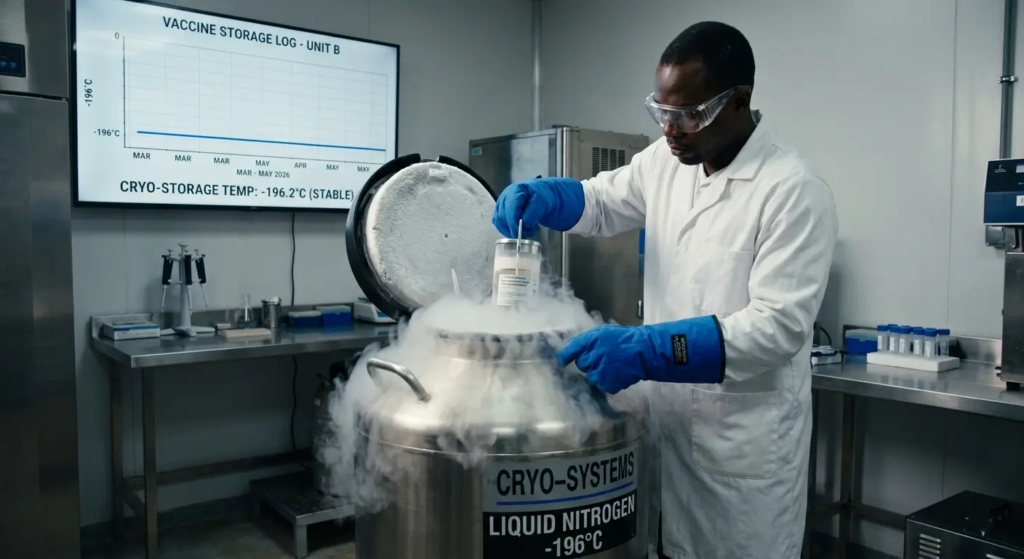
- How is the vaccine stored before use? (Required: liquid nitrogen dewar for cell-associated vaccines, or -70°C freezer for frozen ampule products)
- What is the time from vaccine thaw to administration? (Maximum: 2 hours — cell viability declines rapidly after thawing)
- How do you verify that every chick received the vaccine? (Acceptable answer: hand-spray + in-ovo injection, or individual subcutaneous injection with visible injection site confirmation)
Hatchability and performance data:
- What is your current hatchability rate from set eggs? (Target above 82%; below 78% indicates parent flock health or incubation management problems)
- What is your average first-week mortality rate in chicks from your hatchery? (Target below 1%; above 2% in farm feedback indicates hatchery quality problems)
- Can you provide contact details for 3–5 commercial layer farms currently supplied by your hatchery for a reference check?
A hatchery that answers all of these questions specifically and willingly is demonstrating transparency that correlates with quality. A hatchery that responds to technical questions vaguely, redirects to price discussions, or declines to provide references has not earned the purchase commitment.
The Marek’s Disease Vaccine: The Highest-Stakes Hatchery Quality Variable
Marek’s disease vaccine is the only vaccine that must be administered within the first 24 hours of life to be effective, because Marek’s disease virus in the field environment can infect chicks within days of hatch, and once infected, the chick is infected permanently. A chick that did not receive effective Marek’s vaccination at the hatchery is not protectable by any on-farm management decision.
This is why Marek’s vaccine handling is the highest-stakes quality variable in hatchery evaluation.
The Vaccine Types and Their Requirements
Herpesvirus of Turkeys (HVT) — cell-free freeze-dried or cell-associated:
- Freeze-dried (lyophilized): Stored at 2–8°C. More stable, easier to ship. Less protective than cell-associated forms in high-Marek ‘s-challenge environments.
- Cell-associated (liquid nitrogen): Stored at −196°C in liquid nitrogen dewars. Extremely temperature-sensitive — must be thawed in warm water (37°C) and used within 1–2 hours of thawing. Provides higher protection than freeze-dried forms.
Bivalent HVT + SB-1: Combination of two turkey herpesvirus serotypes. Provides broader immunity than HVT alone. Cell-associated, requiring liquid nitrogen storage.
Rispens CVI988: The most potently protective Marek’s vaccine available. A mildly pathogenic Marek’s disease virus serotype 1 strain. Cell-associated, liquid nitrogen storage. Recommended in areas with high velogenic Marek’s disease field challenge — including many parts of West Africa where commercial and backyard poultry mingle at high density.
The critical verification question for any Marek’s cell-associated vaccine: “Can you show me your liquid nitrogen storage facilities and your documented temperature log for vaccine storage?”
A hatchery claiming to use cell-associated Marek’s vaccines but unable to show liquid nitrogen storage is either not using cell-associated vaccines (using freeze-dried instead) or is not managing the cold chain correctly. Either scenario means the advertised Marek’s protection may not have been delivered.
On-Farm Marek’s Protection Follow-Up
Even with correct hatchery Marek’s vaccination, the field challenge environment in some West African locations is severe enough that additional protection measures are warranted:
- House disinfection before every new flock placement — Marek’s disease virus in feather dander can persist in poultry house environments for months
- A cleanout rest period of a minimum of 2 weeks between depopulation and restocking
- Isolation of new chicks from older birds during rearing — if older flocks are on the same farm, the Marek’s viral load from feather dust shedding by older birds can overwhelm vaccine-induced immunity in new chicks during the 2-week window before immunity fully establishes
Transportation Biosecurity: From Hatchery to Farm
Chick quality at arrival is determined by two separate events: hatchery production quality and transportation quality. A perfectly healthy chick from an excellent hatchery can arrive in compromised condition from a transport event that subjected it to heat stress, cold stress, dehydration, or mechanical injury.
The Standard Transportation Requirements
Temperature during transport:
- Target temperature in the chick transport box environment: 28–32°C
- Above 35°C: heat stress. Chicks will be panting, spread flat, potentially dehydrated.
- Below 22°C: cold stress. Chicks will huddle, yolk sac absorption slows, early mortality risk rises.
- A thermometer placed inside one box during transport and read immediately at delivery confirms the actual transport temperature.
Transport duration:
- Maximum recommended transport time from hatchery to placement at brooding: 24 hours
- Above 24 hours without access to water and supplemental feed significantly increases dehydration-related early mortality
- For farm locations more than 6 hours from the hatchery: negotiate delivery to arrive at farm by 06:00–08:00 so birds can be assessed, placed, and have access to water before the day heats up
Transport box condition:
- Standard commercial chick boxes hold 80–100 chicks per box and are ventilated through side perforations
- Stacked boxes during transport must not block ventilation holes — boxes should be transported in open-sided trucks or with positive air circulation, not enclosed containers
- Box temperature monitoring during delivery: ask the delivery driver whether any air conditioning or ventilation malfunction occurred during transport
Chick box examination at delivery:
- Examine boxes before signing the delivery documentation
- Count the number of dead-on-arrival (DOA) chicks per box — record this count separately and report to the hatchery
- DOA rate above 0.5% requires hatchery notification and investigation
- DOA rate above 1.5% is grounds for rejection of the batch or negotiation of replacement
Chick Assessment at Arrival: The 30-Minute Protocol
The 30 minutes between chick arrival and chick placement is the quality assessment window. Do not skip it — and do not allow the delivery driver’s presence to rush the assessment.
The 30-Minute Arrival Assessment
Step 1 — Box examination (5 minutes): Count DOA chicks in each box before removing chicks from boxes. Record DOA per box. Examine one box from the top of the delivery stack and one from the bottom (bottom boxes receive more stress from the weight above them in poorly loaded vehicles). If DOA rates differ significantly between top and bottom boxes, heat or cold stratification during transport is the likely cause.
Step 2 — Sample examination (15 minutes): Remove 30–50 chicks randomly from multiple boxes and assess against the seven quality indicators above. Record the percentage of chicks showing each quality concern:
| Quality Indicator | Acceptable Rate | Concern Threshold | Action Threshold |
|---|---|---|---|
| Open or abnormal navel | Below 1% | 1–3% | Above 3% |
| Eye condition (dull/sunken) | Below 0.5% | 0.5–2% | Above 2% |
| Leg/movement abnormality | Below 1% | 1–3% | Above 3% |
| Apparent dehydration (tacky skin over hock) | Below 1% | 1–2% | Above 2% |
| No visible Marek’s injection site | 0% | Any | Any |
If any indicator exceeds the action threshold, document it with photographs, notify the hatchery immediately by phone while the delivery driver is still present (to create a contemporaneous record), and request replacement or credit documentation.
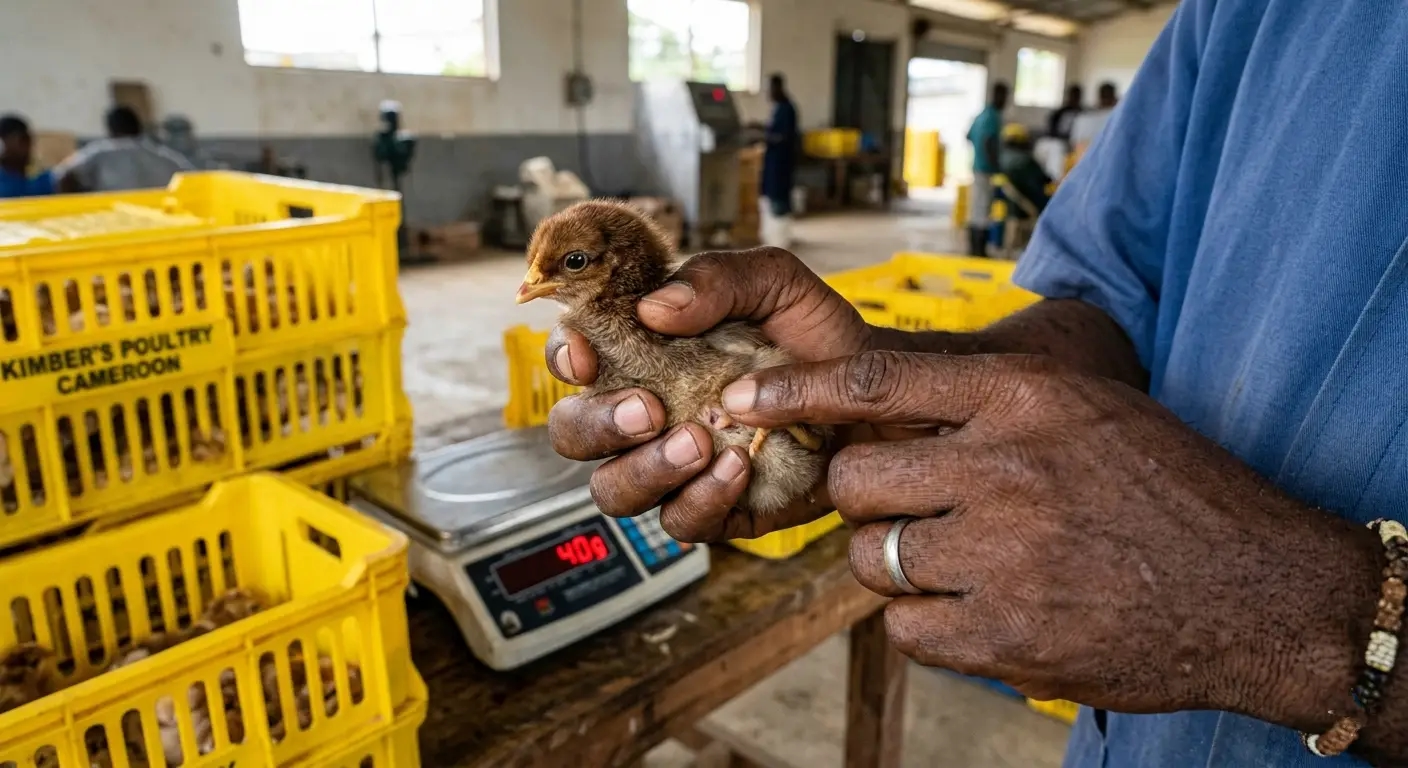
Step 3 — Weight sampling (5 minutes): Weigh 20 randomly selected chicks individually on a calibrated scale. Calculate the average weight and coefficient of variation (CV = standard deviation ÷ average × 100). Target average chick weight for commercial brown-egg layers: 36–42g. CV below 8% indicates uniform, well-managed parent flock and incubation conditions. CV above 12% indicates variability in parent flock management or incubation that will manifest as early rearing uniformity problems.
Step 4 — Documentation (5 minutes): Complete the arrival record:
- Hatchery name and contact
- Breed and hatch date
- Number of chicks ordered, number delivered, number DOA
- Box count and chicks per box
- Sample quality assessment results (per the table above)
- Chick weight sample average and CV
- Any transport concerns noted
- Farm manager’s signature confirming receipt
This record is the reference document for any quality dispute with the hatchery, for insurance claims in case of early mortality events, and for the post-cycle hatchery performance evaluation.
Building a Long-Term Hatchery Relationship
A single production cycle does not have enough data to evaluate hatchery quality. Chick quality varies within a hatchery from flock to flock and from season to season — parent flock age cycles, disease events, and incubation management variability all create batch-to-batch variation in a hatchery that supplies multiple farms simultaneously.
A reliable long-term hatchery relationship requires:
Feedback Loop Establishment
Provide the hatchery with your cycle performance data at the end of every production cycle:
- First-week mortality rate (a hatchery performance indicator, more than a farm management indicator)
- Rearing mortality rate (weeks 1–18)
- Marek’s disease incidence: any confirmed Marek’s cases during the cycle?
- Point-of-lay uniformity: was it above or below 80%?
This feedback gives the hatchery actionable data about how their chicks are performing in your specific conditions. Hatcheries that receive specific performance feedback can identify problems in their production that they cannot see from hatchery metrics alone. Hatcheries that do not receive feedback have no way to improve.
The Multi-Hatchery Trial
No farmer should source all chicks from a single hatchery on a long-term basis without having evaluated at least one alternative. Running one house with chicks from Hatchery A and one house with chicks from Hatchery B for a single cycle — under identical management — is the most direct comparison available. If the performance difference between the two houses exceeds 5 percentage points in laying rate at comparable ages, the hatchery whose chicks underperform should be investigated for the source of the gap before another cycle’s sourcing decision is made.
This side-by-side trial costs nothing beyond the modest administrative effort of tracking the two houses separately. It provides data that no amount of marketing or hatchery visit can substitute for.
Price vs. Quality: The Total Cost of Cheap Chicks
A XAF 200 (USD 0.33) price difference between two hatcheries’ day-old chicks — XAF 1,200 vs. XAF 1,400 per chick — is XAF 200,000 (USD 333) on a 1,000-bird order. This price difference feels significant at the time of purchase.
Evaluate it against the cost of the risk it accepts: a hatchery that cuts price through reduced Marek’s vaccine quality, lower parent flock management standards, or inadequate hatchery sanitation delivers those savings to the farm in the form of higher early mortality, lower rearing uniformity, compromised Marek’s protection, and reduced peak production rate.
The total cost of a 5% higher rearing mortality from poor hatchery quality:
- 50 additional dead birds × XAF 1,200 replacement cost + missed production = XAF 60,000 direct cost
- Plus: reduced flock uniformity at point of lay → 5% reduction in peak laying rate
- 5% laying rate reduction × 1,000 birds × 0.5 eggs/day × 300 peak days × XAF 140 = XAF 10,500,000 (USD 17,500) in reduced peak production revenue
The XAF 200,000 (USD 333) saved on chick price cost XAF 10,500,000 (USD 17,500) in production loss. That is a 52-fold return on the money saved — in the wrong direction.
Chick quality is not the place to save money. It is the place to invest it.
Key Hatcheries and Breed Availability in Cameroon (2026)
The commercial layer chick supply landscape in Cameroon is served by a small number of hatcheries with established parent flock operations, supplemented by importation from Nigeria, Côte d’Ivoire, and occasionally South Africa for breeds with limited local availability.
What to verify in any hatchery in Cameroon:
- MINEPIA (Ministry of Livestock, Fisheries and Animal Industries) sanitary certification — a registered hatchery must have this documentation available for inspection
- Parent flock species and breed documentation — ask for the parent flock’s import certificate or local production registration
- Marek’s vaccine purchase and cold chain documentation — request invoice records showing vaccine purchases and cold chain maintenance equipment
The specific hatchery landscape changes as new operations open and existing ones scale or close. Before each cycle, contact 3–4 regional hatcheries directly, ask the questions in this article’s evaluation checklist, and select the supplier who provides the most complete and transparent answers.
The best hatchery for your farm is not the cheapest or the closest. It is the one whose transparency, quality documentation, and reference farmer network give you the highest confidence that the chick placed on day one is the foundation the next 72 weeks deserve.
Summary
Day-old chick quality is the variable that determines whether every management input made across 72 weeks of layer production is building on a solid or compromised biological foundation. The best lighting program cannot compensate for Marek’s disease from inadequate hatchery vaccination. The most precisely formulated ration cannot recover the growth potential of a chick with chronic navel infection from hatchery contamination. The most disciplined biosecurity cannot protect a chick whose maternal antibody transfer was inconsistent from a poorly managed parent flock.
Sourcing quality day-old chicks requires visiting the hatchery before committing, asking specific quality verification questions, evaluating the transparency of the answers, verifying Marek’s vaccine cold chain management specifically, assessing chick quality at arrival through a structured 30-minute protocol, and establishing a feedback loop with the hatchery that makes your performance data their quality improvement data.
The chick sourcing decision is made in one morning. It defines the financial ceiling of the next 72 weeks.
Choose accordingly.