Site selection failures are the most expensive failures in commercial catfish farming because they are permanent. A wrong genetics decision can be corrected by restocking. A wrong feeding program can be corrected by reformulating. A wrong disease treatment can be corrected by changing the protocol. A wrong site — too far from a reliable water source, on soil that will not hold water, in a flood zone that inundates the farm during the first rainy season, or in a location that triggers regulatory action from neighboring residents — cannot be corrected without abandoning the infrastructure investment entirely and starting elsewhere.
The site evaluation process that prevents these permanent mistakes is not complex, but it is specific. It requires answering a defined set of questions with field measurements and tests rather than assumptions, and it requires understanding why each criterion matters in terms of the production biology it affects. A site that passes all evaluations is not guaranteed to succeed — management quality determines that. But a site that fails a key evaluation will produce problems that management quality cannot overcome.
This guide covers every site evaluation criterion for a commercial catfish farm in West and Central Africa, with the specific assessment methods, acceptable threshold values, and the consequences of proceeding on a site that does not meet each criterion.
Water Source — The Non-Negotiable First Criterion
Why Water Is the First Evaluation
A catfish farm without adequate water is not a farm — it is an expensive concrete and earthwork structure. Water supply must be evaluated first because it is the only site criterion that is entirely non-negotiable: every other criterion has workarounds of varying cost and complexity. Inadequate water supply has no workaround at reasonable cost.
Water Volume Requirement
Calculate the total water volume requirement before evaluating any source:
The daily water requirement for a commercial catfish operation has two components:
Evaporation and seepage replacement: Earthen ponds lose water through evaporation from the surface (typically 5–10 mm per day in West African conditions during the dry season) and seepage through the pond base and walls. A 1-hectare pond may require 50,000–100,000 liters per day simply to maintain water level.
Water exchange for quality management: Commercial catfish production at high stocking densities generates ammonia, nitrite, and other metabolic wastes that accumulate in pond water. Maintaining acceptable water quality through partial water exchange — typically 10–20% of pond volume per day in intensively managed systems — requires substantial daily water volume.
Reference calculation for a 10-pond earthen pond operation (each pond 0.5 ha, 1.2 m average depth):
- Total water volume: 10 × 5,000 m² × 1.2 m = 60,000 m³ initial fill
- Daily replacement requirement (evaporation + seepage + 15% exchange): approximately 200,000–300,000 liters (200–300 m³) per day
- Annual water requirement: approximately 73,000–110,000 m³
For concrete tank operations, water volume per unit area is lower, but exchange rates are typically higher (20–30% per day for intensively stocked systems), producing similar or higher total daily water demand per unit of fish production.
Water Source Types and Evaluation
Rivers and streams:
Running water sources provide a continuously replenished supply — the river continues flowing regardless of seasonal variation (subject to the seasonal flow variation of the specific waterway). Rivers provide high-volume supply suitable for large-scale operations.
Evaluation requirements:
- Minimum dry-season flow measurement (not wet season measurement — the dry season low flow is the binding constraint)
- Water quality analysis upstream and at the intake point (rivers receive runoff from upstream activities — agricultural chemical runoff, industrial discharge, upstream aquaculture operations — that may compromise water quality)
- Flood risk assessment — intake structures positioned in a river system must be protected from flood damage
- Legal water rights — confirm the right to abstract water from the waterway, which in most jurisdictions requires a permit
Boreholes (groundwater):
Borehole water offers advantages of consistent year-round availability and typically superior water quality (low turbidity, low bacterial load, consistent temperature) compared to surface water. Groundwater temperature in West Africa (typically 24–28°C from moderate-depth boreholes) is within or near the optimal range for African catfish production.
Evaluation requirements:
- Hydrogeological assessment before drilling — establish whether the local geology supports productive aquifers
- Pump test after drilling — sustained yield test measuring the maximum flow rate the borehole can sustain over extended pumping (not the short-term flow rate immediately after pump start)
- Water quality analysis (pH, hardness, iron content, conductivity, absence of toxic compounds)
- Cost of pumping to the required head (height above the borehole pump) — high head requirements mean high energy costs that affect operating economics
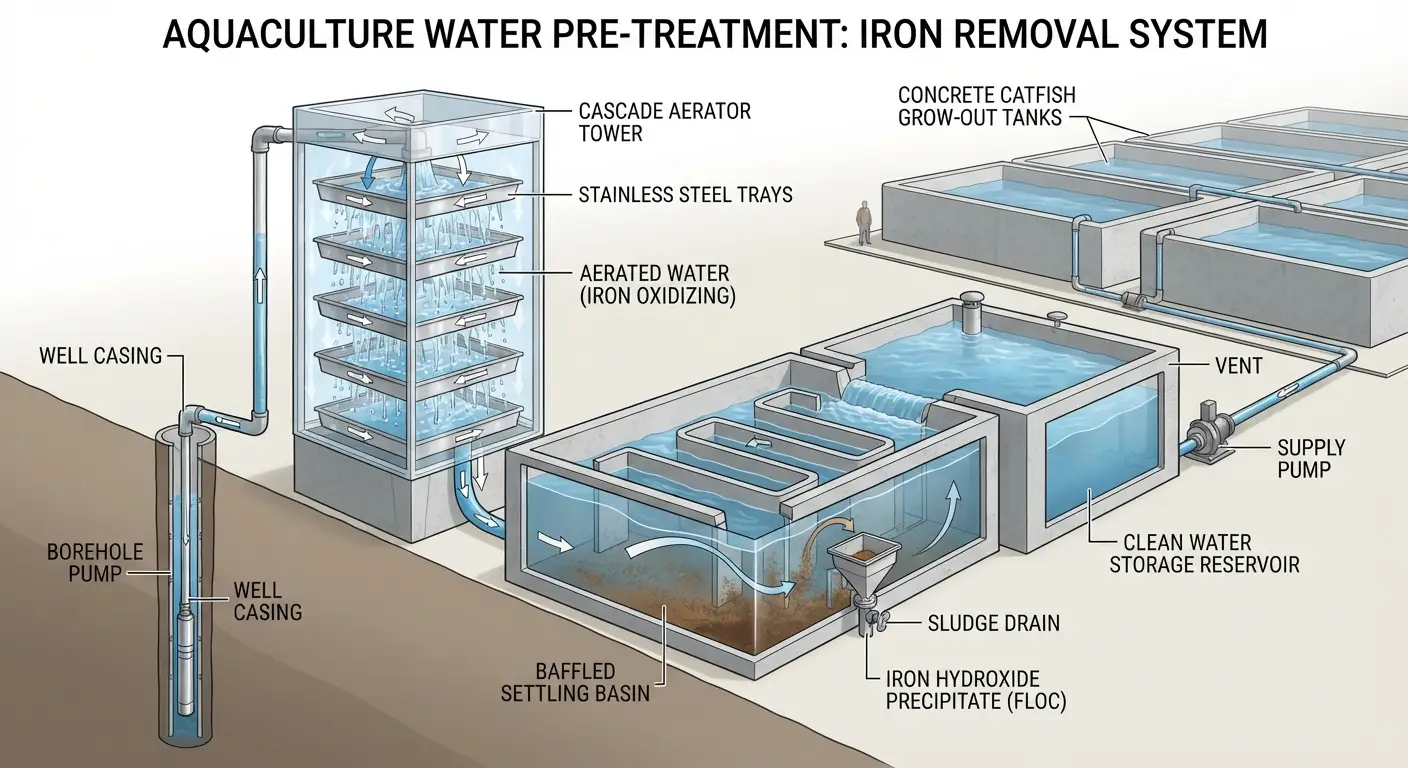
Note on borehole iron content: Many West African groundwater sources have elevated iron concentrations. Water with iron above 0.5 mg/L can precipitate as iron hydroxide on fish gills, causing respiratory irritation and inflammation. High-iron borehole water should be treated by aeration and settling before use.
Ponds and reservoirs:
Existing water bodies (farm ponds, reservoirs, irrigation canals) may provide water supply. Evaluation requires water quality testing and assessment of the body’s ability to sustain abstraction without depleting to unusable levels during the dry season.
Rainwater harvesting:
In high-rainfall areas, designed catchment systems can capture and store sufficient rainfall for aquaculture supply. This approach has high upfront storage infrastructure cost and is subject to seasonal supply variability — viable for supplementary supply or modest-scale operations in high-rainfall zones, generally insufficient as sole supply for large commercial operations.
Water Quality Assessment at the Source
Before committing to any water source, laboratory analysis of a representative sample should confirm:
| Parameter | Acceptable Range | Notes |
|---|---|---|
| pH | 6.5–8.5 | Outside this range requires treatment before use |
| Dissolved oxygen | Above 5 mg/L | Surface water; below this level indicates organic loading upstream |
| Temperature | 24–30°C (ideal) | Groundwater typically stable; surface water varies seasonally |
| Total ammonia nitrogen | Below 0.1 mg/L | Elevated ammonia at intake indicates upstream organic pollution |
| Nitrite | Below 0.1 mg/L | — |
| Iron | Below 0.5 mg/L | Higher levels may require treatment |
| Total dissolved solids | Below 1,000 mg/L | Very high TDS may indicate saline intrusion or mineral contamination |
| Turbidity | Below 50 NTU ideally | High turbidity reduces light penetration, affects pond productivity |
| Coliform bacteria | Below 100 CFU/100 mL | High coliform levels indicate fecal contamination from upstream sources |
Soil Evaluation — The Foundation of Pond Construction
Soil evaluation matters primarily for earthen pond construction — for farms using only concrete tanks or RAS systems, soil serves primarily as a foundation material, and its water-retention properties are less critical. Most commercial catfish operations in West Africa use at least some earthen pond infrastructure, making soil evaluation a relevant assessment for the majority of sites.
The Clay Content Requirement
Earthen ponds hold water because the soil’s clay particles form a low-permeability layer at the base and walls of the pond. Clay minerals have layered crystalline structures with negative surface charges that strongly bind water molecules and resist water flow — a sufficiently clayey soil creates an effective barrier that limits seepage to acceptable rates.
The target: A minimum clay content of 20–30% in the pond base and walls is generally required for acceptable seepage rates. Below 20% clay, seepage is typically excessive and the pond will either drain unacceptably fast or require expensive lining to function.
The field texture test (quick assessment without laboratory analysis):
Take a soil sample from the proposed pond base area, moisten it to a workable consistency, and roll it into a ribbon between the thumb and forefinger:
- Ribbon length above 5 cm, smooth texture, soil remains plastic without crumbling: Clay content is likely above 25% — acceptable for pond construction without lining
- Ribbon length 2–5 cm, slightly gritty texture: Borderline clay content — laboratory analysis warranted before committing to earthen pond construction
- Ribbon length below 2 cm, gritty texture, soil crumbles readily: Low clay content — earthen ponds will require lining or the production system should use concrete tanks or lined pond systems
Laboratory confirmation: The field test provides a quick screen but should be confirmed by particle size analysis (hydrometer method or laser diffraction) for any major earthen pond investment.
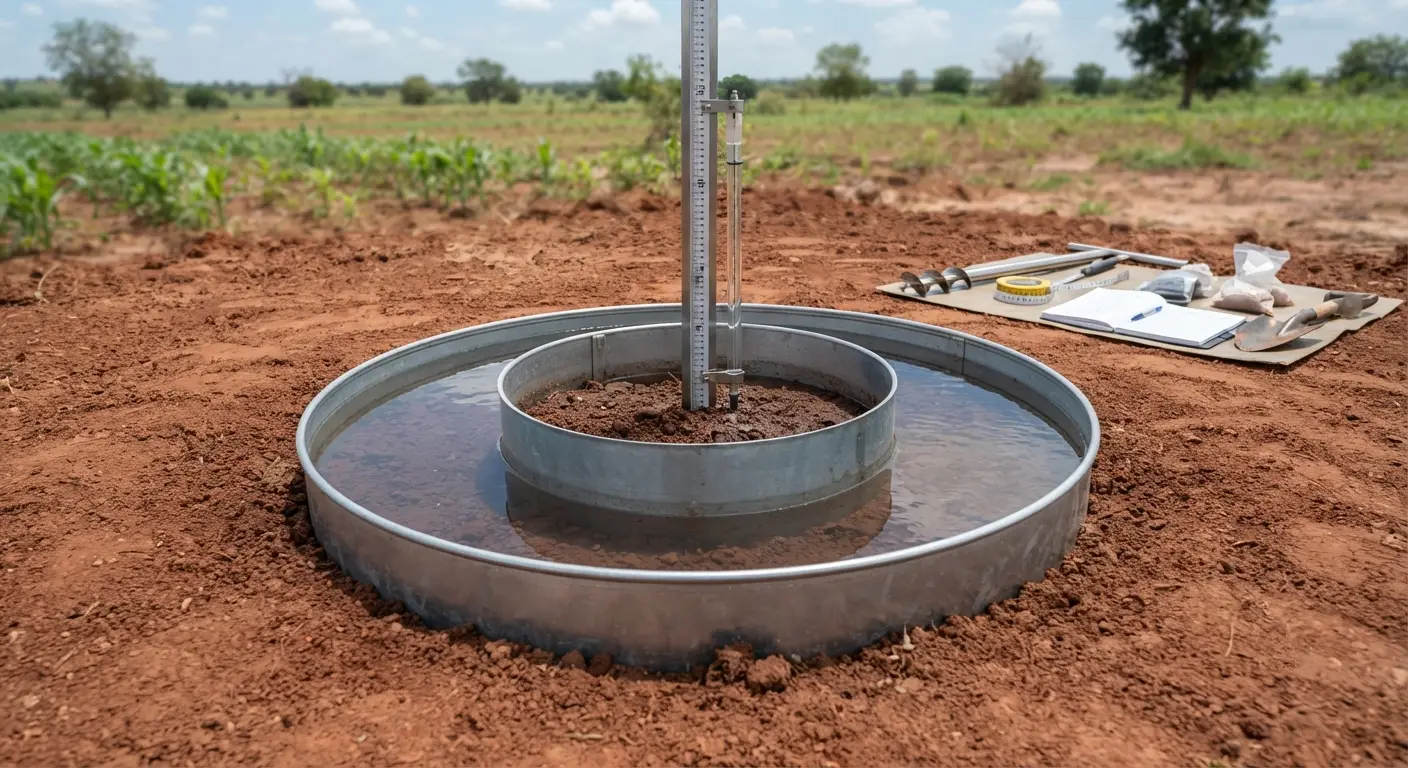
The Double Ring Infiltrometer Test (Field Seepage Assessment)
The most reliable field method for estimating pond seepage rate at a proposed site — more specific than clay content estimation because it measures the actual hydraulic conductivity of the soil in place, which reflects both clay content and soil structure.
Method:
- Drive two concentric metal rings (inner ring 30 cm diameter, outer ring 60 cm diameter) into the soil to a depth of 10 cm
- Fill both rings with water to the same level
- Measure the rate at which the water level in the inner ring drops over time (the outer ring creates a buffer that prevents lateral flow from the inner ring measurement)
- After the initial rapid drainage phase (typically the first 30–60 minutes), the steady-state infiltration rate represents the soil’s hydraulic conductivity
Acceptable infiltration rates for earthen pond construction:
- Below 1 mm/hour: Excellent — minimal seepage; earthen pond construction appropriate without lining
- 1–5 mm/hour: Acceptable — seepage within manageable range; pond compaction during construction will reduce further
- 5–25 mm/hour: Marginal — seepage will be high; consider bentonite treatment during construction or lining
- Above 25 mm/hour: Not acceptable for unlined earthen ponds — use concrete, lined pond, or tarpaulin systems
Soil pH and Acidity
Pond productivity (natural food production from phytoplankton and zooplankton) depends on appropriate soil pH in the base material. Highly acidic soils (pH below 5.0) release aluminum and iron ions that are toxic to fish and also limit the productivity of natural food organisms. Highly alkaline soils (pH above 9.0) can release harmful levels of sodium and other ions.
Target soil pH: 6.0–8.0 is optimal for catfish pond construction. Acidic soils (pH 4.5–6.0) can be amended with agricultural lime (calcium carbonate) before and during pond construction — the liming rates required to achieve target pH should be calculated from laboratory analysis and factored into construction cost.
Topsoil Removal
Organic matter in topsoil decomposes under anaerobic conditions in a new pond, consuming dissolved oxygen and releasing hydrogen sulfide and other toxic compounds. During pond construction, the top 15–20 cm of organic topsoil should be stripped from the pond base area and stockpiled for use as bund material or removed from the site — it should not form the pond base material.
Topography and Drainage — Engineering the Water Flow
Slope Requirements
The ideal site for earthen pond construction has a gentle, consistent slope — enough to allow gravity drainage of ponds (for harvest and cleanout) but not so steep that pond bund construction requires excessive earthmoving.
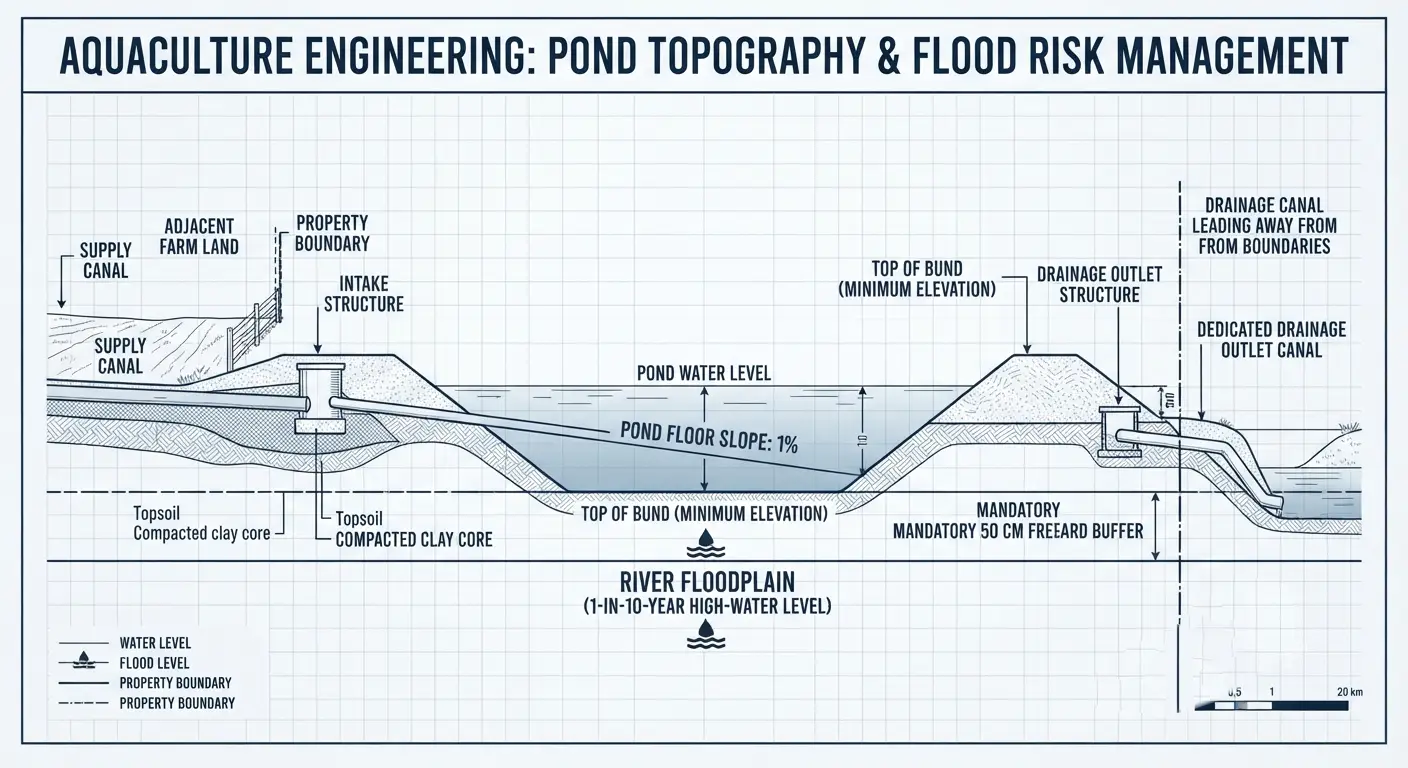
Target slope: 0.5–2.0% gradient (5–20 mm per meter) is ideal for catfish pond construction in most West African contexts. This slope allows:
- Gravity drainage of ponds to a lower-elevation outlet without requiring pumped drainage
- Pond bunds (walls) of reasonable height that do not require excessive earthmoving
- Natural drainage of rainfall away from pond bunds, reducing erosion risk
Slope above 3–5%: Requires terracing to create level pond beds — significantly increases construction cost and complexity. On steeper slopes, tank-based or RAS systems positioned on a constructed level platform may be more cost-effective than earthen pond construction.
Flat sites (slope below 0.5%): Earthen ponds can be constructed on flat terrain but require either pumped drainage (additional operating cost and equipment requirement) or completely raised bund construction (enclosing ponds within bunds rather than excavating them into the terrain).
Flood Risk Assessment
A catfish farm in a flood zone faces catastrophic risk: a single flood event that overflows pond bunds releases all fish (immediate production loss), introduces wild fish and pathogens into the production system, damages earthwork and infrastructure, and potentially deposits silt that reduces pond depth and volume.
Flood risk assessment methods:
Local community knowledge: Ask landowners and farmers adjacent to the proposed site whether the area has flooded in recent years and at what intervals. Seasonal flooding that occurs in most years represents an unacceptable risk; occasional flooding from extreme events requires assessment of whether bund design can provide protection.
Topographic map analysis: Maps showing contour intervals allow identification of the proposed site’s elevation relative to the nearest watercourse. Sites within 1–2 m elevation of the adjacent river or stream floodplain face significant flood risk.
Historical satellite imagery: Google Earth’s historical imagery function shows land surface condition at different dates — evidence of inundation visible in wet season images indicates flood risk.
Minimum bund freeboard: Where some flood risk is accepted but manageable, pond bunds should be constructed to provide at least 50 cm of freeboard above the estimated 1-in-10-year flood water level at the site.
Drainage Outlet Availability
All water that leaves the catfish farm (through pond drainage for harvest, through water exchange discharge, and through overflow during flood events) must go somewhere. Evaluate:
- Is there a natural drainage outlet (stream, drainage channel, low-lying area) that can receive farm drainage without creating flooding or environmental problems for downstream neighbors?
- Does the drainage route require any infrastructure (culverts, drainage channels) that adds to construction cost?
- Are there regulatory requirements for water quality treatment before discharge? In some jurisdictions, effluent from aquaculture operations must meet discharge standards for ammonia and suspended solids before release to waterways.
Location, Access, and Market Proximity
Road Access — A Critical Operational Requirement
Commercial catfish farming requires reliable all-weather road access for three operational dependencies that cannot be interrupted:
Feed delivery: Feed is delivered in large volumes — a 1,000 m² concrete tank operation producing 10 tonnes of fish per cycle consumes approximately 14,000 kg of feed (FCR 1.4 × 10,000 kg) per production cycle. This requires multiple truck deliveries that cannot be delayed by impassable roads without causing feed inventory gaps that directly impact fish growth.
Market delivery: Live catfish or fresh-processed fish must reach market in the shortest possible time after harvest. Delayed delivery of live fish (which requires oxygenated transport) or fresh fish (which requires cold storage absent continuous transport) causes mortality or quality deterioration that reduces sale value or makes the product unsaleable.
Emergency access: Veterinary support, emergency equipment, and key inputs (aerators, oxygen, medications) must be accessible on short notice. A farm with access that becomes impassable for weeks during the rainy season has no emergency response capability during those periods.
Minimum access standard: All-weather road capable of carrying a fully loaded 5-tonne truck from the nearest tarred road to the farm gate. Seasonal dirt tracks that become impassable during the rainy season are not acceptable for commercial operations without alternative access infrastructure.
Distance from Market
Market distance determines the logistics cost and feasibility of different marketing approaches:
Live fish transport: African catfish survive well in live haul transport with adequate oxygenation, but transport duration should be minimized — typically below 6–8 hours for commercial volumes. Transport beyond this duration requires greater oxygenation investment and increases mortality risk. Operations more than 100–150 km from their primary market face elevated live transport costs and mortality risk.
Processed/smoked fish: Higher value-adding justifies longer transport distances and reduces the time-sensitivity of delivery. Operations more than 2 hours from live fish markets may find processing and smoking on-farm a more viable market approach than live transport — but this requires on-farm processing infrastructure as an additional capital cost.
The urban proximity advantage: Peri-urban sites within 30–50 km of a major city (Lagos, Abuja, Douala, Yaoundé, Accra) combine reliable access to inputs (feed, fingerlings, equipment), proximity to the largest consumer markets for live and fresh fish, and access to institutional buyers (hotels, restaurants, supermarkets) who pay premium prices for consistent supply. These sites command higher land values but typically generate superior financial returns from the market access premium.
Distance from Neighbors and Sensitive Receptors
Catfish farming generates operational characteristics that require adequate buffer distance from neighbors:
Odor: Decomposing feed waste, pond sediment disturbance during harvest, and waste management infrastructure (biogas digesters, composting areas) generate odors that are detectable at distance in wind direction. Minimum 200–300 m from residential areas is standard; 500 m provides a comfortable buffer.
Noise: Aerators, generators, and pump motors operate continuously and generate noise. Night operation (required for continuous aeration) in proximity to residential areas creates neighbor conflict risk.
Effluent: Drainage from catfish ponds contains elevated nutrients (ammonia, phosphate) and organic matter. Discharge pathways that flow toward neighboring properties or water supply sources can create legal and community relations issues.
Regulatory and Legal Assessment
Land Tenure Security
A commercial catfish farm requires capital investment that can only be recovered over multiple production cycles — typically 5–10 years or longer. This recovery period requires secure land tenure throughout. Evaluate:
Land ownership documentation: Is the land properly titled? In West Africa, land disputes on customary land (held under traditional tenure systems without formal title) are common and can result in farm closure regardless of investment made. Formal title (certificate of occupancy or equivalent legal documentation in the relevant national system) is strongly preferred over customary tenure for commercial investment.
Lease security (if land is not owned): If the site is leased, the lease term must be sufficient for the investment recovery period — a minimum 10-year lease with renewal options is advisable. Shorter leases create the risk of displacement before capital investment is recovered.
Multiple claimant risk: In areas with contested customary land rights, a site that appears to have a clear owner may generate competing claims once significant investment is visible. Community consultation before investment — engaging with local leaders and documenting the land negotiation — reduces this risk.
Water Rights
The right to abstract water from a natural source is regulated in most jurisdictions — using river water for agricultural purposes without a permit can result in operations shutdown and fines. Research the specific requirements in the relevant state or national regulatory framework before committing to a river or stream water source.
Environmental Permits
Aquaculture operations above a certain scale typically require environmental impact assessment (EIA) and permits from national or state environmental agencies. The specific threshold and process vary by country and state — in Nigeria, the Federal Ministry of Environment sets requirements for operations of national significance, while State Environmental Protection Agencies regulate smaller operations; in Cameroon, MINEPDED sets environmental permitting requirements for aquaculture.
Engaging the regulatory process before construction (rather than building and seeking retroactive approval) is strongly advisable — construction without required permits can result in mandatory demolition orders.
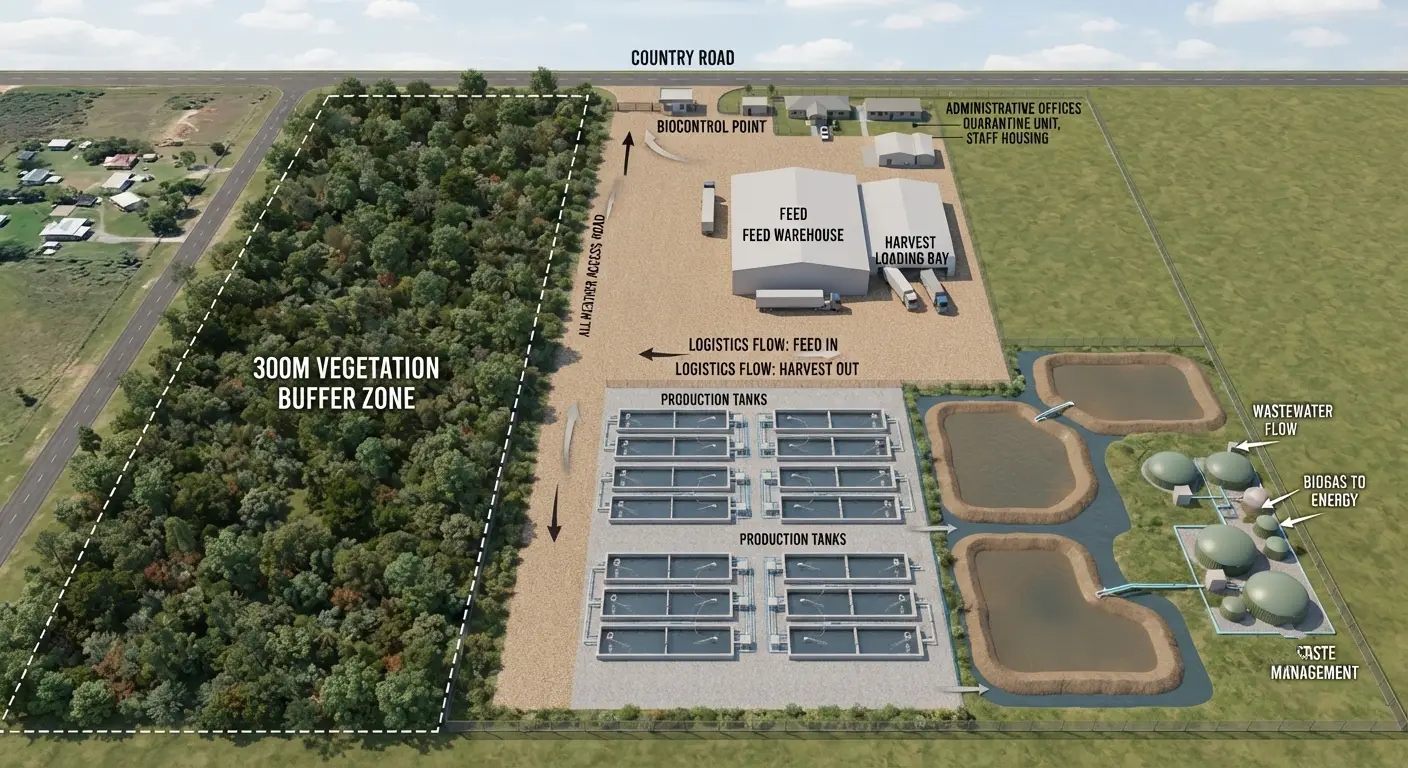
The Site Evaluation Scorecard
Before making a final site commitment, score the proposed site against every criterion in this guide:
| Criterion | Assessment Required | Pass/Fail Threshold | Weight |
|---|---|---|---|
| Water volume (year-round) | Flow measurement or pump test | Sufficient for calculated daily demand | Critical — fail = reject site |
| Water quality at source | Laboratory analysis | Within acceptable parameter ranges | Critical — major exceedances = reject |
| Soil clay content | Field test + laboratory if marginal | Above 20% for earthen ponds | High — below threshold = switch to concrete/lined |
| Seepage rate | Double ring test | Below 5 mm/hour for earthen ponds | High — above threshold = modify design or reject |
| Topographic slope | Survey or GPS measurement | 0.5–2.0% ideal | Moderate — higher slopes increase construction cost |
| Flood risk | Community consultation + map analysis | No annual flooding; 1-in-10-year flood manageable by bund design | Critical — regular flooding = reject |
| All-weather road access | Physical inspection in wet season | 5-tonne truck passable year-round | Critical — inadequate access = reject |
| Market distance | Map measurement + transport time | Live fish: below 150 km; fresh: below 200 km | High |
| Distance from neighbors | Physical measurement | 200 m minimum residential buffer | High — regulatory and community risk |
| Land tenure security | Legal documentation review | Clear title or long-term lease | Critical |
| Regulatory status | Government agency consultation | Permits obtainable at reasonable cost and time | High |
Decision rule: Any criterion marked “Critical” that does not pass is a site rejection — these criteria have no cost-effective workaround. High-weight criteria that fail indicate high additional cost or risk that must be explicitly accounted for in the financial model before proceeding.
Summary
Site selection is the most consequential infrastructure decision in catfish farming — more consequential than the design of the ponds themselves, because the site constraints are permanent while the pond design can be modified. The evaluation process in this guide — water source volume and quality testing, soil clay content and seepage assessment, topographic and flood risk analysis, access and market proximity assessment, and regulatory due diligence — generates the factual basis for a site decision that is defensible, not assumed.
The field tests described — the soil ribbon test, the double ring infiltrometer, the dry-season water source flow measurement — are accessible to any producer with basic equipment and a clear understanding of what they are measuring and why. They take days to complete. They cost a small fraction of the infrastructure investment they protect. And they generate the specific information that distinguishes a site that will support profitable production from one that will absorb investment and produce preventable problems for the life of the farm.
Evaluate before you build. The site will constrain everything that follows.