Species selection is the first and most permanent decision in commercial catfish farming. Every subsequent decision — pond design, stocking density, feed formulation, water quality targets, harvest timing, and market positioning — flows from the biology of the species you choose to farm. A species poorly matched to your climate requires expensive environmental control. A species poorly matched to your market requires finding buyers willing to accept what you produce rather than what they want. A species poorly matched to your production system underperforms regardless of how well every other management decision is executed.
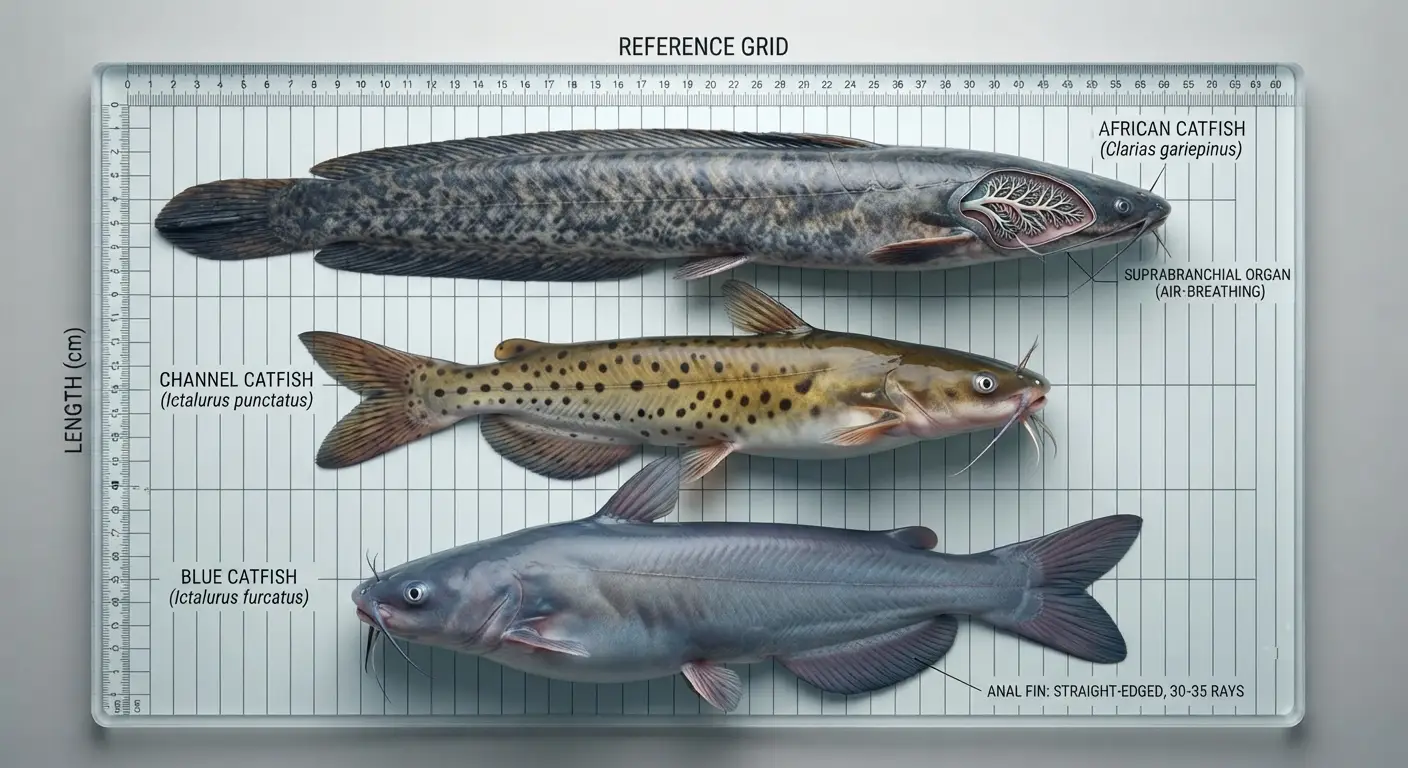
Three species dominate commercial catfish aquaculture globally: the channel catfish (Ictalurus punctatus), the blue catfish (Ictalurus furcatus), and the African catfish (Clarias gariepinus). Each has a distinct biological profile, a distinct performance envelope under commercial production conditions, and a distinct market positioning. Understanding these differences — not in general terms, but in the specific parameters that determine production economics — is the prerequisite for a species decision that supports rather than undermines the entire farming enterprise.
This guide compares all three species across the dimensions that matter for commercial farming: growth rate, temperature tolerance, feed conversion, stocking density tolerance, disease susceptibility, market demand, and regional appropriateness. The comparison is honest about trade-offs. Every species has genuine advantages and genuine limitations, and the correct choice depends on which combination of factors is most aligned with your specific production context.
Channel Catfish (Ictalurus punctatus) — The North American Commercial Standard
Biological Profile
Channel catfish is the dominant commercial aquaculture species in the United States, representing approximately 50% of all U.S. aquaculture production by volume and generating over USD 300 million in farm-gate revenue annually. Its position as the commercial standard in North American production is based on a combination of biological characteristics that are well-suited to the pond-based production systems dominant in that region.
Size and growth rate: Channel catfish grow to a harvest weight of 500–700 g in approximately 18 months under optimal conditions in outdoor earthen pond systems, and to 1.0–1.5 kg at 24 months. Maximum size reaches 20+ kg in wild populations, but commercial production targets are set at 500 g–1.2 kg for market presentation. Growth rate under commercial conditions (28°C water temperature, formulated feed at 35% crude protein, stocking density of 7,500–10,000 fish per hectare) averages approximately 1.5–2.0 g per day.
Temperature tolerance: Channel catfish are moderately cold-tolerant — they survive temperatures down to 4°C and can be maintained in temperate climates through winter in reduced-feeding or no-feeding management. The optimal growth temperature range is 24–29°C. Above 32°C, feed intake and growth rate decline, and above 35°C, mortality risk increases significantly.
Oxygen requirements: Channel catfish are moderately sensitive to dissolved oxygen (DO) — they require a minimum of 4–5 mg/L DO for normal activity and growth, and show significant stress responses below 3 mg/L. At high stocking densities in warm weather, supplemental aeration is typically required to maintain adequate DO.
Feeding behavior: Channel catfish are omnivorous bottom feeders in natural conditions but adapt readily to commercial pellet feeding. They can be trained to surface feed on floating pellets — a management advantage that allows visual observation of feeding behavior as a health and appetite indicator.
Advantages for Commercial Production
Established feed industry: The extensive history of commercial channel catfish production in the United States has produced a mature, well-researched commercial feed industry with formulations specifically optimized for this species at every production stage. Nutritional requirements are among the most thoroughly documented of any farmed fish species.
Processing infrastructure: In established channel catfish production regions, a fully developed processing infrastructure — live haul transport, processing plants, cold chain distribution — is available. Farmers have access to established marketing channels with known price mechanisms.
Disease research base: Decades of commercial production have produced extensive research on channel catfish disease, treatment protocols, and management responses. Veterinary and extension support is well-developed in production regions.
Limitations
Temperature sensitivity at high end: In tropical and subtropical climates where water temperatures regularly exceed 30–32°C during summer periods, channel catfish show reduced growth rate and increased disease susceptibility — a significant limitation for year-round production in equatorial regions.
Slower growth than African catfish: Under tropical production conditions, channel catfish grow significantly more slowly than Clarias gariepinus — a production efficiency disadvantage in regions where both species can be farmed.
Market specificity: Channel catfish has a strong established market in North America but limited market development in West and Central Africa, where consumer preference is for the species they know — principally Clarias in sub-Saharan Africa.
Blue Catfish (Ictalurus furcatus) — The Hybrid Parent and Trophy Species
Biological Profile
Blue catfish is the largest North American catfish species — wild individuals exceeding 50 kg have been recorded, and commercial-scale fish commonly reach 2–5 kg. Its biology overlaps substantially with channel catfish but differs in several commercially important characteristics.
Size and growth rate: Blue catfish grow faster than channel catfish under commercial conditions, reaching larger ultimate sizes and showing higher daily growth rates particularly in the 1–5 kg range. This growth advantage is most pronounced at warmer temperatures within the tolerable range.
Temperature tolerance: Similar to channel catfish — optimal range 24–29°C, tolerates cold water down to 4–5°C, shows heat stress above 32–34°C.
Feed behavior: Blue catfish are more predominantly piscivorous (fish-eating) in their natural feeding behavior than channel catfish, though they adapt to formulated feeds in commercial production. They show somewhat less consistent adoption of floating feed presentation than channel catfish.
The Blue Catfish Hybrid — The Primary Commercial Relevance
The most commercially significant aspect of blue catfish in current aquaculture is not its own direct production but its role as the paternal parent in the channel catfish × blue catfish hybrid (“channel-blue hybrid” or “sunshine catfish”). This hybrid — produced by crossing female channel catfish with male blue catfish — is increasingly dominant in U.S. commercial catfish production because it combines several commercially superior characteristics:
Hybrid vigor (heterosis): The channel-blue hybrid shows 20–30% faster growth than pure channel catfish under the same production conditions — a significant production efficiency gain that directly improves economic returns.
Feed conversion: Hybrid fish typically show 10–15% better FCR than channel catfish — a meaningful cost reduction given feed’s 40–60% share of total operating costs.
Disease resistance: Hybrids show improved resistance to Enteric Septicemia of Catfish (ESC), the most economically significant bacterial disease in North American catfish production, reducing mortality losses and antibiotic treatment costs.
Processing yield: Hybrid catfish produce higher fillet yield from the same body weight than channel catfish — typically 40–42% fillet yield vs. 36–38% for channel catfish at equivalent harvest weight.
Limitations of Blue Catfish and Channel-Blue Hybrids
Hybrid seed availability: Producing channel-blue hybrid fingerlings requires artificial propagation (stripping and fertilizing eggs) because the two species do not spawn spontaneously in ponds. This limits hybrid fingerling availability to hatcheries with specific breeding capability.
Limited tropical adaptation: Like channel catfish, blue catfish and their hybrids are North American temperate-zone species poorly adapted to the sustained high water temperatures of tropical production environments.
Market limitation outside North America: Blue catfish and its hybrids have essentially no established market in West or Central Africa, making them irrelevant to producers in those markets regardless of their production performance characteristics.
African Catfish (Clarias gariepinus) — The Tropical Commercial Standard
Biological Profile
African catfish (Clarias gariepinus), known locally as “mud fish,” “sharp tooth catfish,” and “catfish” in Nigeria/Cameroon, and by various vernacular names across sub-Saharan Africa, is the dominant commercial aquaculture species in West, East, and Central Africa. Its biological characteristics are specifically adapted to tropical environmental conditions — making it the natural choice for commercial production in the region where this series is primarily directed.
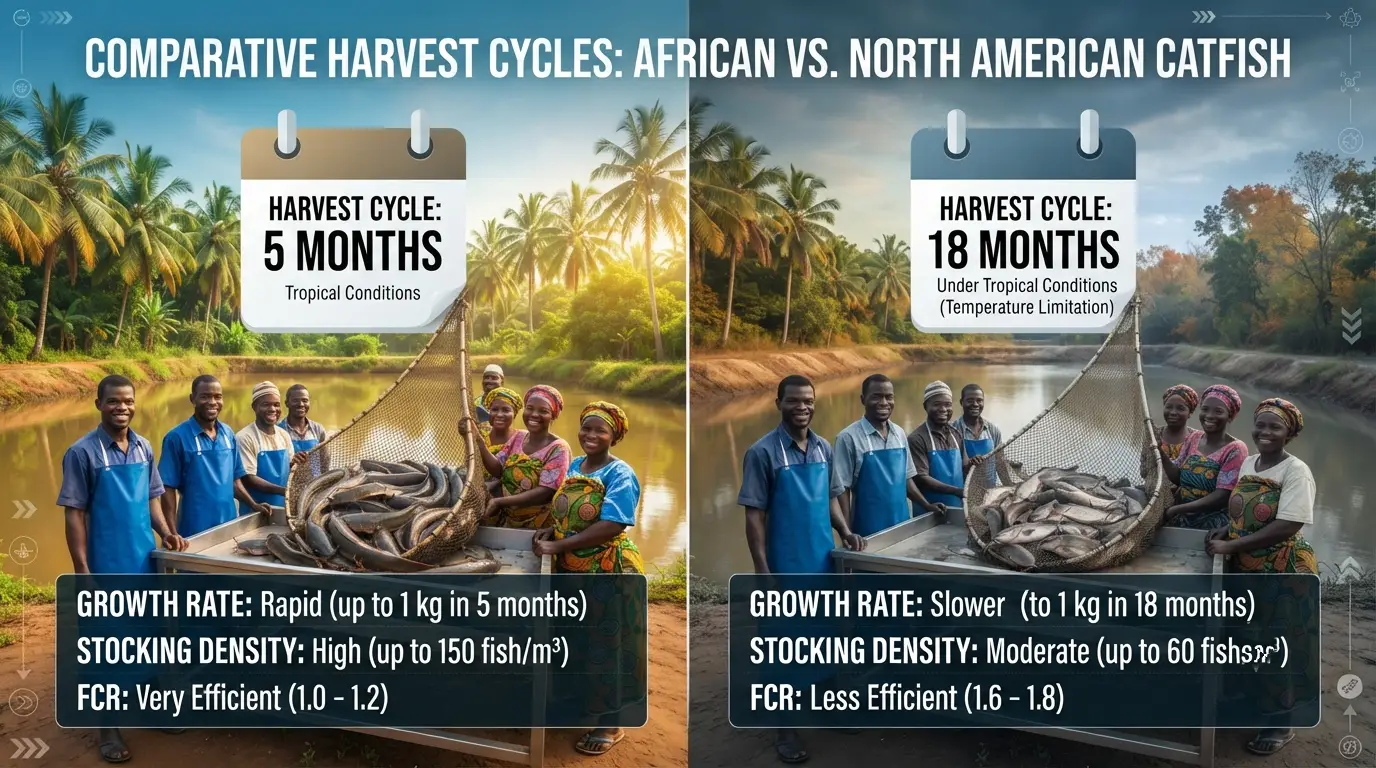
Size and growth rate: African catfish are among the fastest-growing freshwater fish in aquaculture — under optimal conditions (28–30°C water temperature, high-protein formulated feed, adequate density management), they can reach 1.0 kg in 4–5 months and 1.5–2.0 kg in 6–7 months. This growth rate is substantially faster than either channel or blue catfish under comparable tropical conditions and is the primary driver of the species’ dominance in West and Central African commercial production.
Temperature tolerance: The optimal temperature range for African catfish is 25–30°C — precisely the temperature range prevailing year-round in most West and Central African lowland water bodies. Unlike North American species, African catfish do not require winter management and maintain active growth through conditions that would stress or kill channel catfish. The upper thermal tolerance extends to approximately 35–38°C, with a lower tolerance limit around 14–15°C (below which feeding stops and mortality risk increases).
Air breathing capability: Clarias gariepinus possesses a suprabranchial respiratory organ — an arborescent organ that allows the fish to breathe atmospheric air directly. This adaptation allows African catfish to survive in severely oxygen-depleted water that would be lethal to most other commercial fish species, including channel catfish. The practical production implication is significant: African catfish can be stocked at substantially higher densities than species without air-breathing capability, because they are not entirely dependent on dissolved oxygen in the water for their oxygen supply.
Behavioral characteristics: African catfish are primarily nocturnal, showing peak feeding activity at night. They are highly aggressive feeders — competitive and active at the feed surface — and adapt quickly to pellet feeding. They are also cannibalistic, particularly at early developmental stages (larvae and fingerlings), which requires careful size-grading during the hatchery and nursery phases to prevent significant losses.
Natural habitat: In the wild, Clarias gariepinus inhabits warm, slow-moving, often oxygen-depleted freshwater bodies — swamps, floodplains, rivers, and lakes across sub-Saharan Africa. This natural habitat profile explains its tolerance for the challenging water quality conditions that might occur in less intensively managed pond or tank systems.
Why African Catfish Dominates West and Central African Commercial Production
Growth rate advantage: The most commercially compelling characteristic. A Nigerian or Cameroonian catfish farmer who stocks Clarias fingerlings in April can harvest 1 kg fish by August–September — a 4–5 month production cycle that generates positive cash flow within the same calendar year as stocking. The same farmer producing channel catfish would wait 18 months for equivalent market weight — nearly four times the capital tied up in the production cycle.
Established market: In Nigeria, Cameroon, Ghana, Côte d’Ivoire, and across the region, Clarias gariepinus is the culturally familiar catfish. Consumers know it, prefer it, and pay premium prices for fresh or smoked product. The market infrastructure — local fish markets, smoked fish traders, restaurant buyers, household consumers — is built around this species. No market development investment is required.
Climate alignment: West and Central African water temperatures year-round fall within or close to the African catfish’s optimal growth range. No heating systems are required. No winter mortality management is required. The species and the climate are matched.
Feed industry development: Nigeria in particular has developed a significant commercial aquafeed industry — including floating and sinking pellet manufacturers — producing feeds specifically formulated for Clarias gariepinus nutritional requirements. Feed is commercially available at the scale required for commercial production.
High stocking density tolerance: The air-breathing capability allows stocking densities in concrete tanks of 100–200 fish per cubic meter and in earthen ponds of 2–3 fish per square meter — densities that would produce catastrophic oxygen-related mortality in channel catfish. This density advantage is central to the economics of concrete tank production systems widely used in urban and peri-urban areas of West Africa.
Limitations of African Catfish
Cannibalism requirement for active management: The strong cannibalistic tendency in juvenile African catfish requires regular size-grading of fingerlings and juveniles — fish of significantly different sizes in the same tank will produce high mortality from larger fish eating smaller ones. This management requirement adds labor cost and handling stress compared to less cannibalistic species.
Off-flavor susceptibility: Like all catfish species, Clarias gariepinus is susceptible to off-flavor from geosmin and 2-methylisoborneol (MIB) produced by certain cyanobacteria and actinobacteria in pond environments. Off-flavor fish are rejected by quality-sensitive buyers — managing this risk requires water quality and pond management discipline.
Market outside Africa: African catfish has essentially no established export market to North American or European consumers, where it is unknown. Operations targeting export markets must work with other species or invest in new market development from scratch.
Head-to-Head Comparison — The Decision Matrix
Production Performance Comparison
| Parameter | Channel Catfish | Blue Catfish / Hybrid | African Catfish |
|---|---|---|---|
| Growth rate to 1 kg (optimal conditions) | 18–24 months | 14–18 months | 4–5 months |
| Optimal water temperature | 24–29°C | 24–29°C | 25–30°C |
| Upper thermal tolerance | 32–34°C | 33–35°C | 35–38°C |
| Minimum DO requirement | 4–5 mg/L | 4–5 mg/L | 1–2 mg/L (air-breather) |
| Maximum stocking density (tanks) | 30–50 kg/m³ | 30–50 kg/m³ | 80–200 kg/m³ |
| Feed conversion ratio (FCR) | 1.8–2.2 | 1.5–1.9 | 1.2–1.6 |
| Fillet yield | 36–38% | 40–42% | 35–38% |
| Cannibalism risk | Low | Low | High (juveniles) |
| Disease susceptibility | Moderate | Lower (hybrid) | Moderate |
Regional Appropriateness
| Region | Recommended Species | Rationale |
|---|---|---|
| Nigeria, Cameroon, Ghana, West Africa | African catfish (Clarias gariepinus) | Market demand, climate match, growth rate advantage |
| Central Africa (DRC, Congo, CAR) | African catfish (Clarias gariepinus) | Same rationale as West Africa |
| East Africa (Kenya, Uganda, Tanzania) | African catfish, with Nile tilapia as alternative | Clarias established but tilapia dominant in some markets |
| Southern United States | Channel catfish or channel-blue hybrid | Established industry, market, and infrastructure |
| North America (outside traditional catfish belt) | Channel-blue hybrid | Growth efficiency advantage compensates for smaller market |
The Financial Comparison That Determines the Choice
For a West or Central African producer evaluating species selection, the financial comparison is definitive:
African catfish at 1,000 fish stocked:
- Time to 1 kg market weight: 5 months
- Cycles per year: 2 (with a 1-month turnover and cleaning period between cycles)
- Market pigs produced per year: 1,600–1,800 kg (allowing for mortality)
- Revenue at XAF 2,500/kg: approximately XAF 4,250,000 per year
- Feed cost (FCR 1.4, feed price XAF 600/kg): approximately XAF 1,344,000 per year
Channel catfish at 1,000 fish stocked (same production area):
- Time to 1 kg market weight: 18–20 months
- Cycles per year: 0.6 (well under one complete cycle per year)
- Revenue from partial harvest: a fraction of the African catfish system’s output
- Same or higher feed cost due to worse FCR and longer holding period
The financial comparison — even before considering market demand differences — makes the species selection decision straightforward for producers in West and Central Africa.
Summary
Species selection in commercial catfish farming is the foundational decision on which every subsequent operational and financial decision depends. For producers in West and Central Africa, this decision is unambiguous: Clarias gariepinus (African catfish) is the species for which the region’s climate, market demand, established feed industry, and cultural food preferences are aligned. Its growth rate advantage alone — 4–5 months to market weight vs. 18+ months for North American species — makes any comparison of production economics decisively in its favor for the regional context.
Channel catfish and blue catfish (and their hybrids) are excellent commercial species in the specific contexts for which they are matched — temperate North American climates with established processing and market infrastructure. Outside that context, producing them requires fighting against both the biology (suboptimal climate, poorer growth performance) and the market (no established consumer demand) simultaneously.
The subsequent articles in this series are written with Clarias gariepinus production as the primary reference species, with appropriate reference to North American species characteristics where comparisons are useful for producers with access to those markets. For West and Central African producers, the species decision is made: the biology, the market, and the economics all point in the same direction.