Of all the water quality parameters that commercial catfish farmers must manage — pH, ammonia, nitrite, temperature, turbidity — dissolved oxygen is the one that kills fastest. A pond or tank that develops acute oxygen depletion at 2 AM on a hot August night can transition from normal production to mass mortality within 2–4 hours. No other water quality parameter has a comparable emergency timeline. pH changes slowly. Ammonia accumulates over days. Temperature shifts gradually. Dissolved oxygen can crash from adequate to lethal within a single nighttime period under the wrong combination of stocking density, temperature, cloud cover, and biological oxygen demand.
For Clarias gariepinus — African catfish — the situation is partially moderated by the suprabranchial air-breathing organ described in the biology article. Fish can access atmospheric oxygen when water DO falls below the critical threshold, allowing them to survive in conditions that would otherwise kill most other farmed fish species. But the air-breathing adaptation does not eliminate the management requirement — it extends the survival window, not indefinitely, and fish that are chronically stressed by low dissolved oxygen show suppressed growth rates, compromised immune function, and increased disease susceptibility even when they are not in acute danger of death.
Dissolved oxygen management is therefore a two-level problem: preventing the acute events that kill fish in hours, and maintaining chronic DO levels that support optimal growth rather than merely survival. Both levels require the same foundation — understanding oxygen dynamics, measuring DO accurately and frequently, and having the management infrastructure in place to respond before the critical threshold is crossed.
The Biology of Oxygen Demand in Catfish Production
Sources of Oxygen in Production Systems
Atmospheric diffusion: Oxygen transfers from the atmosphere into water at the water surface. The rate of transfer depends on the concentration gradient (the difference between DO in the water and the saturation concentration at that temperature), the surface area, and the degree of surface turbulence. In a still pond, atmospheric diffusion is very slow — entirely inadequate to supply oxygen for anything beyond a very lightly stocked system. Any production-scale catfish farm requires active aeration to supplement atmospheric diffusion.
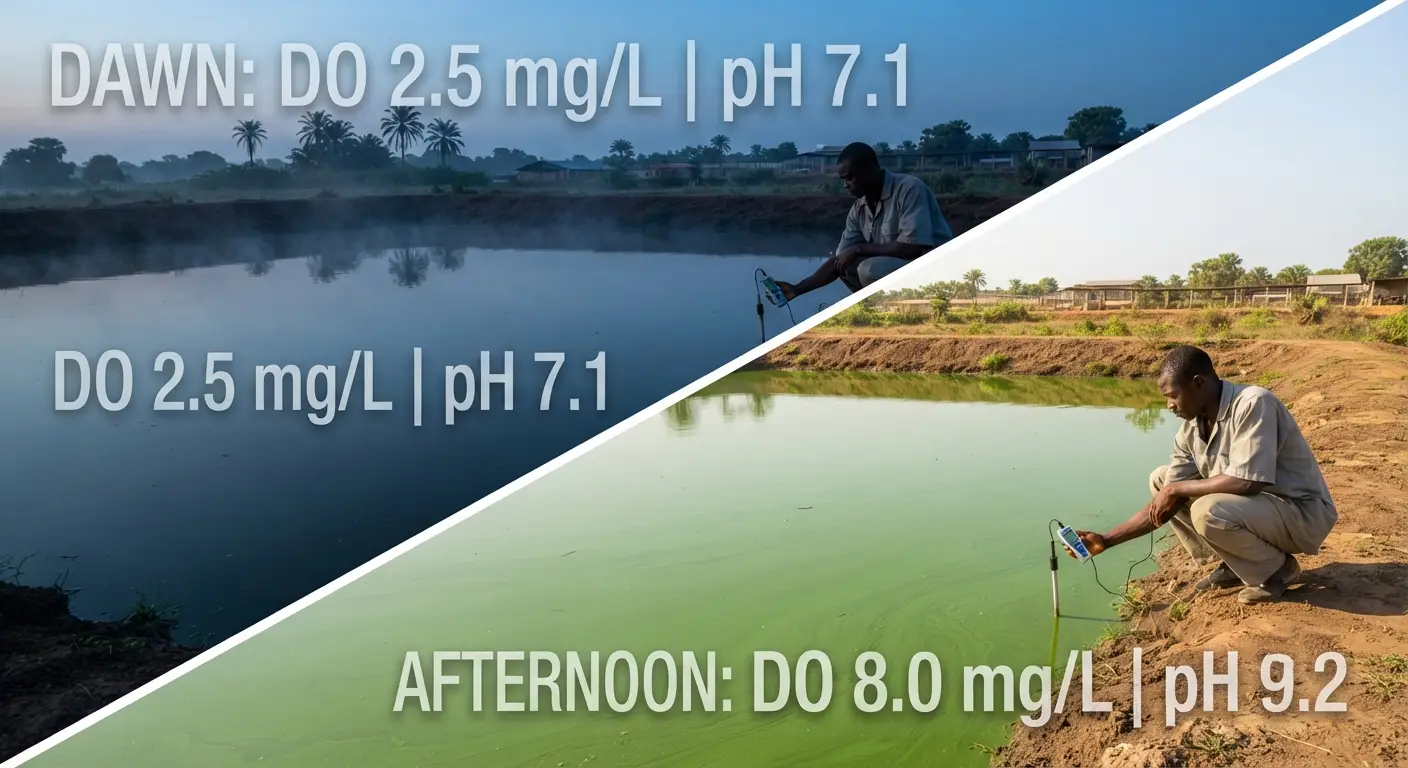
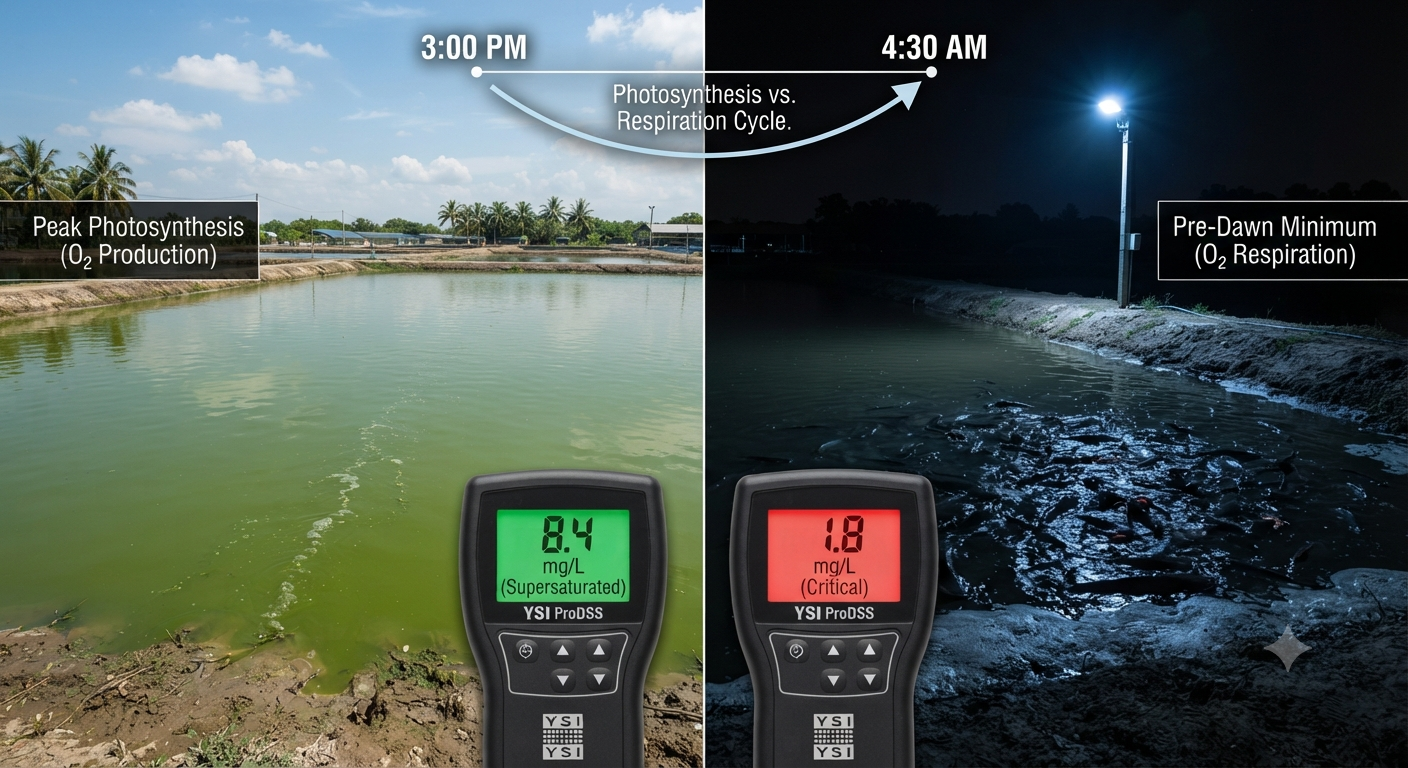
Photosynthesis (pond systems only): Phytoplankton and submerged aquatic plants in earthen ponds produce oxygen as a byproduct of photosynthesis during daylight hours — contributing substantially to the daytime oxygen budget in well-managed pond systems. A dense phytoplankton population can produce more oxygen than the fish biomass consumes during peak photosynthesis hours, driving DO above saturation in the afternoon. The same phytoplankton community then consumes oxygen through respiration at night — creating the diurnal DO cycle that is the defining water quality management challenge in earthen pond systems.
Mechanical aeration: Paddles, diffusers, venturis, and other aeration devices transfer oxygen from the atmosphere into the water mechanically — this is the primary managed oxygen source in both pond and tank systems, and the one over which the farm manager has direct control.
Sources of Oxygen Consumption
Fish respiration: The dominant oxygen consumer in any production system — fish extract oxygen from water (or air) through gill and suprabranchial respiration to support metabolic processes. Oxygen consumption rate per kilogram of fish body weight increases with water temperature and increases after feeding (the specific dynamic action of digestion). It decreases at lower temperatures or during periods of reduced activity.
Reference values for African catfish oxygen consumption:
| Water Temperature | Oxygen Consumption Rate |
|---|---|
| 20°C | 150–200 mg O₂/kg fish/hour |
| 25°C | 200–280 mg O₂/kg fish/hour |
| 28°C | 250–350 mg O₂/kg fish/hour |
| 30°C | 300–400 mg O₂/kg fish/hour |
| 32°C | 380–480 mg O₂/kg fish/hour |
The significant increase in oxygen demand with temperature — approximately doubling from 20°C to 32°C — explains why oxygen crises are most common during hot periods and why the dawn DO minimum is most severe in hot weather.
Bacterial decomposition: Bacteria decomposing organic matter (uneaten feed, feces, dead algae, leaf litter entering ponds) consume substantial oxygen. In heavily loaded systems with poor feed management (excessive uneaten feed accumulating in sediment), bacterial oxygen demand can approach or exceed fish oxygen demand — creating a situation where even adequate aeration is overwhelmed by the combined fish and bacterial demand.
Phytoplankton and zooplankton respiration (pond systems): The living organisms in the pond biological community — phytoplankton, zooplankton, bacteria, insects — consume oxygen for their own metabolic processes. At night, when photosynthesis has stopped, but respiration continues, the entire pond biological community is consuming oxygen from the pool in the water. Dense algal blooms that produce abundant oxygen during the day create equally large nighttime oxygen demands — a double-edged relationship that requires careful pond productivity management.
The Oxygen Saturation Concept
Water can only hold a finite amount of dissolved oxygen — the saturation concentration, above which oxygen escapes from the water to the atmosphere. Saturation concentration decreases as temperature increases and decreases as altitude and atmospheric pressure decrease:
| Temperature | DO Saturation at Sea Level |
|---|---|
| 20°C | 9.1 mg/L |
| 24°C | 8.3 mg/L |
| 26°C | 8.1 mg/L |
| 28°C | 7.8 mg/L |
| 30°C | 7.5 mg/L |
| 32°C | 7.2 mg/L |
The practical implication: As West African water temperatures approach 30–32°C during the hot dry season, the maximum possible DO in the water decreases. The gap between the maximum achievable DO (7.2–7.5 mg/L at these temperatures) and the critical minimum threshold (4–5 mg/L for sustained growth) narrows — leaving a smaller safety margin between optimal conditions and crisis. This thermodynamic constraint is why hot weather is the highest-risk period for oxygen depletion events regardless of aeration capacity.
Dissolved Oxygen Targets and Thresholds
DO Targets for African Catfish Production
| DO Level | Status | Fish Response | Management Action |
|---|---|---|---|
| Above 6 mg/L | Optimal | Full growth rate, normal behavior, immune function optimal | Maintain — no action required |
| 5–6 mg/L | Acceptable | Slightly reduced growth, normal behavior | Monitor closely; ensure aeration functioning |
| 4–5 mg/L | Marginal | Reduced feed intake and growth; some surface breathing behavior begins | Increase aeration; reduce feeding temporarily |
| 3–4 mg/L | Stress | Significant growth suppression; frequent surface breathing; increased disease susceptibility | Emergency aeration increase; suspend feeding; investigate cause |
| 2–3 mg/L | Severe stress (tanks); tolerated by air-breathing in ponds | Significant mortality risk in tanks; African catfish tolerate through air-breathing but health compromised | Emergency response: maximum aeration, emergency water exchange; fish observation every 30 minutes |
| Below 2 mg/L | Critical | Acute mortality risk; fish gasping at surface continuously | Emergency: all available aeration, emergency fresh water addition, consider partial harvest to reduce biomass |
| Below 1 mg/L | Lethal (even air-breathers at sustained exposure) | Mass mortality imminent | All emergency resources activated; contact for emergency intervention |
The Chronic vs. Acute Distinction
The thresholds above describe acute responses. Chronic exposure to borderline DO levels — maintaining the pond or tank at 4–5 mg/L consistently rather than allowing the occasional dip below 4 mg/L with rapid recovery — produces less visible but financially significant effects:
Chronic low DO effects:
- 10–20% reduction in feed conversion efficiency (fish consuming more feed per unit of growth)
- 15–25% reduction in average daily growth rate
- Elevated cortisol (chronic stress hormone) that suppresses immune function over time
- Increased susceptibility to opportunistic bacterial infections
- Reduced willingness to school and compete for feed — increasing size disparity within the group
A farm that maintains DO at 4.5 mg/L consistently, measuring above the acute mortality threshold but below the optimal growth range, may attribute its poor FCR and slow growth to feed quality or genetics without recognizing that chronic mild hypoxia is the actual constraint.
Measuring Dissolved Oxygen — Equipment and Protocols
DO Measurement Equipment
Electrochemical DO meters (polarographic or galvanic probes):
The standard instrument for DO measurement in aquaculture — a probe containing an oxygen-permeable membrane and electrochemical cell that measures the partial pressure of oxygen in the water, converted to mg/L by the instrument electronics.
Requirements for accurate measurement:
- Membrane condition: the oxygen-permeable membrane must be clean and undamaged; fouled or torn membranes give erroneously low readings
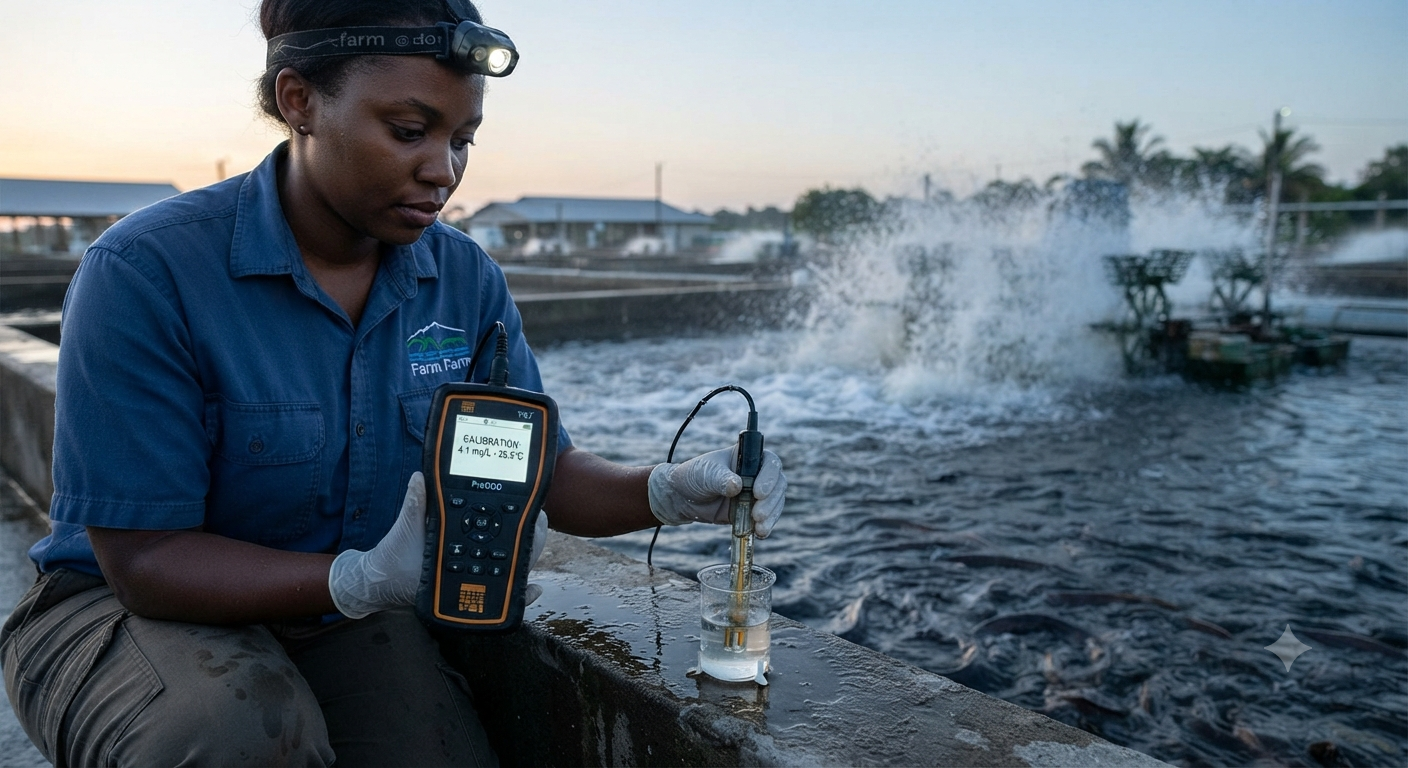
- Calibration: calibrate daily using the air-saturation method (hold the probe in humid air above water and allow the reading to stabilize at the expected saturation value for the current temperature and altitude) or using a zero-DO solution
- Temperature compensation: most modern meters automatically compensate DO readings for temperature — verify this function is enabled
- Stirring: water must be moving past the probe during measurement — either the probe is stirred, a flow-through cell is used, or the probe is placed in a location with water movement; stagnant water gives falsely low readings as the probe depletes oxygen locally
Expected accuracy: ±0.3 mg/L when correctly maintained and calibrated.
Optical (luminescent) DO sensors:
More expensive than electrochemical probes but significantly more reliable in continuous monitoring applications — optical sensors measure DO by the quenching effect of oxygen on a luminescent dye in the probe’s sensing cap rather than consuming oxygen electrochemically. The sensing cap requires replacement periodically (typically every 1–2 years) but the sensor requires no membrane changes and is less sensitive to biofouling than electrochemical probes.
Best application: continuous monitoring installations (permanent sensors in tanks or ponds connected to data loggers or alarm systems).
DO test kits (colorimetric / Winkler titration):
Chemical methods that measure DO by reaction rather than electrochemically. The Winkler method is highly accurate (±0.1 mg/L) and is used as the reference method for calibrating meters but requires laboratory bench chemistry that is impractical for routine farm-side monitoring. Colorimetric test kits (where sample color is compared to a reference chart) provide approximate DO indication sufficient for emergency field assessment but not for precise management decisions.
Practical recommendation for most West African commercial catfish farms:
One properly maintained electrochemical DO meter per farm as the primary measurement instrument, supplemented by colorimetric emergency test kits for backup situations when the meter is unavailable. Keep spare membranes, electrolyte solution, and calibration equipment on-farm at all times.
DO Monitoring Protocol
Daily monitoring minimum (pond systems):
| Time | Measurement Point | Purpose |
|---|---|---|
| 5:00–6:00 AM (pre-dawn) | All production ponds | Captures the daily DO minimum — the most critical measurement |
| 10:00–11:00 AM | Spot check 25% of ponds | Confirms morning recovery from the pre-dawn minimum |
| 3:00–4:00 PM | Spot check 25% of ponds | Captures daily maximum; verifies photosynthesis activity |
If any pond measures below 5 mg/L at the pre-dawn check: Immediately run all available aeration, suspend morning feeding, and check every 30 minutes until DO recovers above 5 mg/L.
Daily monitoring minimum (concrete tank systems):
| Time | Measurement Point |
|---|---|
| 6:00–7:00 AM | All production tanks |
| 12:00–1:00 PM | Spot check 50% of tanks (particularly highest biomass tanks) |
| 6:00–7:00 PM | All production tanks |
Continuous monitoring (higher-specification operations):
Installing continuous DO monitoring with data logging and alarm functions — where a sensor in each tank or pond transmits DO readings to a central display and triggers an alarm when DO falls below a set threshold — represents the highest standard of DO management. The alarm capability is particularly valuable at night when staff are not continuously present; a low-DO alarm that wakes a farm manager at 2 AM allows emergency intervention that prevents the mass mortality that would otherwise be discovered at the 6 AM morning check.
Commercial continuous DO monitoring systems are available from aquaculture equipment suppliers; simpler DIY systems using low-cost optical DO sensors connected to programmable alarms are increasingly accessible for smaller operations.
Causes of DO Depletion Events — Diagnosis and Prevention
Cause 1: Algal Bloom Crash (Most Common in Earthen Ponds)
What happens: A dense phytoplankton bloom — productive for oxygen during the day — crashes when a triggering event (overcast weather, heavy rainfall dilution, chemical shock, bloom senescence) causes the mass death of the algal population. Dead algae decompose rapidly, consuming massive amounts of oxygen and driving DO from supersaturation (8–10 mg/L in a healthy bloom) to near-zero within 24–48 hours.
The warning signs:
- Sudden change in pond water color from green/brown to grayish or clearing (dying algae losing pigment)
- Unusual foam or scum on the pond surface (aggregated dead algal cells)
- Strong odor from the pond (hydrogen sulfide from decomposing organic matter)
- Reduction in the afternoon DO peak that normally characterizes a healthy bloom
Prevention:
- Prevent excessively dense blooms by limiting nutrient loading (correct feeding rates, removing excess feed, not over-fertilizing ponds)
- Monitor Secchi disk depth (water clarity) weekly — a Secchi depth below 25 cm indicates an excessively dense bloom that creates crash risk
- Avoid sudden large water exchanges (more than 30% at once) that can shock the phytoplankton community
- Maintain adequate circulation and aeration to prevent thermal stratification that can trigger bloom crashes
Response when crash is detected: Immediately run all aeration, perform emergency water exchange to dilute decomposing organic matter, and monitor every hour until bloom has either recovered or the farm has confirmed a complete crash requiring full algal re-establishment.
Cause 2: Feeding Overload
What happens: Uneaten feed accumulates in the pond or tank sediment. Feed that was not consumed has a high biological oxygen demand as bacteria decompose it — consuming oxygen in the water column above the sediment, particularly at night when no photosynthesis is occurring to compensate.
The warning signs:
- Reduced feed intake over several days (fish not consuming full ration)
- Observation of uneaten pellets in the tank or pond after feeding
- DO drop more severe than expected for the current biomass and temperature
Prevention: Accurate feed rate management (never feeding more than fish can consume in 20–30 minutes at the current consumption rate), adjusting feed quantity downward immediately when consumption drops rather than maintaining the same ration, removing uneaten feed from tanks during water exchange.
Cause 3: Overcrowding Without Adequate Aeration
What happens: Fish biomass has grown beyond the carrying capacity of the aeration system — the oxygen demand of the fish population exceeds the oxygen delivery capacity of the aerators, resulting in progressive DO decline that eventually drops below the critical threshold.
The warning signs:
- Gradual increase in surface breathing frequency over days to weeks as biomass increases
- Declining morning DO readings over successive weeks despite consistent aeration
- Increased feed refusal behavior
Prevention: Calculate carrying capacity for each pond or tank based on the aeration capacity (kg oxygen delivered per day by the aeration system) and the oxygen demand per unit fish biomass at current temperature. Harvest or transfer fish before the biomass reaches carrying capacity, not after.
Cause 4: Aeration Equipment Failure
What happens: Paddlewheel motor failure, diffuser blockage, air line disconnection, or power failure removes aeration at a critical period — typically at night, when fish and bacterial oxygen demand is uncompensated by photosynthesis and the water is already at or near the daily DO minimum.
The warning signs:
- Sound change or cessation of aeration equipment (regular equipment sound monitoring is the primary detection method)
- Motor overheating indicator lights
- Tripped circuit breakers or blown fuses in the electrical distribution
Prevention: Daily equipment inspection; immediate repair or replacement of malfunctioning aerators; backup equipment on standby (at minimum one spare aerator per four operational units); backup power supply for critical aeration during grid power failures.
Cause 5: Hot Weather and Reduced Photosynthesis Combination
What happens: During overcast, humid hot weather — common at the onset of the West African rainy season — water temperatures are high (increasing oxygen demand) while overcast skies reduce photosynthesis (reducing oxygen supply). This combination can drive pond DO below critical thresholds during the night without any equipment failure or management error.
The warning signs:
- Extended periods of overcast weather with high temperatures
- Reduced afternoon DO maximum compared to clear-weather performance
- Behavioral indicators of oxygen stress in the early morning
Prevention: Increase aeration duration and intensity during overcast periods; reduce feed rate (feeding increases oxygen demand from digestion); monitor more frequently than usual.
Emergency Response to Acute DO Depletion
The Emergency Response Protocol
When DO is observed at or below 3 mg/L (or when behavioral indicators — continuous surface breathing, fish milling — indicate acute oxygen stress regardless of instrument reading):
Immediate actions (first 5 minutes):
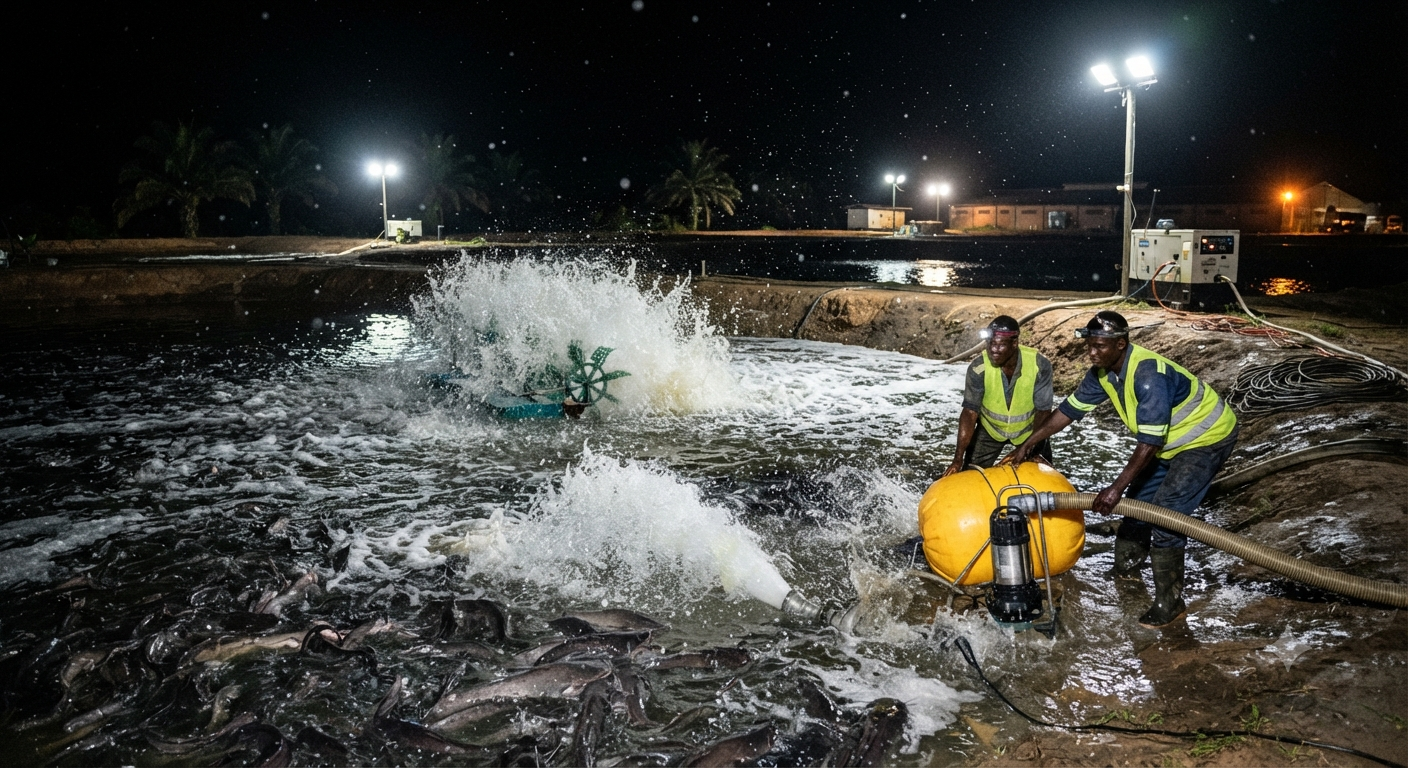
- Activate all available aeration equipment — paddlewheels, air blowers, emergency aerators — to maximum capacity
- Open all fresh water supply valves to maximum flow — adding oxygenated supply water dilutes the low-DO water and brings in fresh dissolved oxygen
- Suspend all feeding — digestion consumes oxygen that cannot be spared during an oxygen crisis
- Alert all available farm staff
Assessment (5–15 minutes after initial response): 5. Measure DO at multiple points in the pond or tank — is it the same throughout, or are there low-DO zones? 6. Identify any aeration equipment that is not functioning and repair or replace it immediately 7. Assess fish behavior — are fish beginning to recover (moving away from surface) or are they worsening (more fish at surface, visible distress)?
Extended emergency response (15 minutes to several hours): 8. If DO is not recovering toward 4 mg/L within 30 minutes of maximum aeration: consider emergency partial harvest (removing 20–30% of fish biomass immediately to reduce oxygen demand below the current supply capacity). 9. Where liquid oxygen or pressurized oxygen cylinders are available on-farm: inject oxygen directly into the tank or pond — this is the most rapid and effective emergency intervention available 10. Continue monitoring every 15–30 minutes until DO has recovered above 5 mg/L and remained there for at least 1 hour
Post-event assessment: 11. Once the emergency is resolved, investigate the cause using the diagnostic framework in Part 4 12. Document the event: date, time, lowest DO recorded, fish behavior, actions taken, fish mortality (if any) 13. Implement specific preventive measures to prevent recurrence
Emergency Equipment That Should Always Be Available
A commercial catfish farm must have immediately accessible emergency DO response equipment:
Emergency aerator (portable paddlewheel or motor-driven pump): A portable unit that can be deployed in any pond in the farm within 10 minutes — not wired into the fixed electrical system but independently operable, capable of running from a generator or vehicle battery.
Generator for power backup: All aeration systems must be capable of operating from a backup generator during power failures. Power failures during hot nights are a common cause of mass mortality events — a generator with an automatic transfer switch that immediately takes over aeration when grid power fails is the most reliable protection.
Oxygen supply (where available): Compressed oxygen cylinders or liquid oxygen supply — one hour of oxygen injection into an acutely hypoxic tank can prevent a mass mortality event that would take weeks of production to replace. The cost of maintaining oxygen supply on-farm is justified by the mortality risk it prevents.
Integrating DO Management Into Daily Farm Operations
The DO Management Mindset
DO management is not reactive — a farm that manages DO by responding to crises after they occur will regularly experience mortality events. The farms that avoid acute DO emergencies manage oxygen proactively — they know their system’s oxygen budget at the current biomass and temperature, they monitor at the times when DO is at its daily minimum, and they act on behavioral and instrument early warning signs before the critical threshold is crossed.
Building the DO management calendar:
Daily: Pre-dawn DO measurement of all ponds and high-biomass tanks; observation of fish behavior at feeding time (surface breathing frequency is a DO stress indicator that requires no instrument); verification that all aeration equipment is operational.
Weekly: Calculation of current biomass estimate (from growth rate and initial stocking data) and comparison against aeration carrying capacity — flagging tanks or ponds approaching the biomass ceiling.
Monthly: Assessment of whether seasonal temperature changes require adjustment to aeration schedules or stocking densities — as temperatures rise into the hottest months, the DO safety margin decreases and management intensity must increase correspondingly.
DO Management and FCR
The connection between dissolved oxygen management and feed conversion ratio is direct and financially significant. Fish chronically maintained below the optimal DO range (5–7 mg/L) show:
- Reduced voluntary feed intake (feed refusal at sub-optimal DO reduces actual daily feed consumption below the designed ration)
- Poorer feed conversion of what is consumed (metabolic efficiency declines under hypoxic stress)
- Longer time to reach market weight (slower growth from both reduced intake and poorer conversion)
A farm that maintains optimal DO achieves FCR 1.3–1.5 in well-managed African catfish production. A farm that chronically operates at marginal DO may observe FCR 1.8–2.2 for the same genetics, feed quality, and stocking density — with higher feed cost per kilogram of fish produced directly attributable to avoidable oxygen management deficit.
At XAF 600/kg feed cost and an FCR difference of 0.5 kg feed per kg fish, the cost of marginal DO management is XAF 300 per kilogram of fish produced — the equivalent of the farm’s entire net margin at commodity pricing. This is not an abstract relationship. It is the financial consequence of insufficient aeration investment or poor DO monitoring discipline, expressed in feed cost on every kilogram the farm produces.
Summary
Dissolved oxygen management is the most operationally urgent water quality responsibility in catfish farming — the parameter with the shortest time from normal to lethal, and the one whose chronic mismanagement most consistently degrades FCR and growth performance without producing obvious clinical signs. Both the acute crisis dimension and the chronic marginal performance dimension require the same foundational discipline: accurate measurement at the right times, understanding of the causes of depletion, and infrastructure (aeration capacity, emergency equipment, backup power) sized for the maximum oxygen demand the system will experience.
For African catfish specifically, the air-breathing adaptation provides a buffer that prevents many situations from progressing to acute mortality — but that buffer is not a management substitute. Fish that are continuously cycling to the surface to breathe air are fish under physiological stress, fish not focused on feeding, fish with compromised immune systems. The target is not avoiding mortality — it is maintaining the dissolved oxygen conditions under which the fish can express their full growth potential with the minimum feed input.
The next article in this cluster addresses the other key water quality parameters — pH, ammonia, nitrite, and temperature — that operate on longer time scales but with equally significant production consequences when they move outside the acceptable management range.