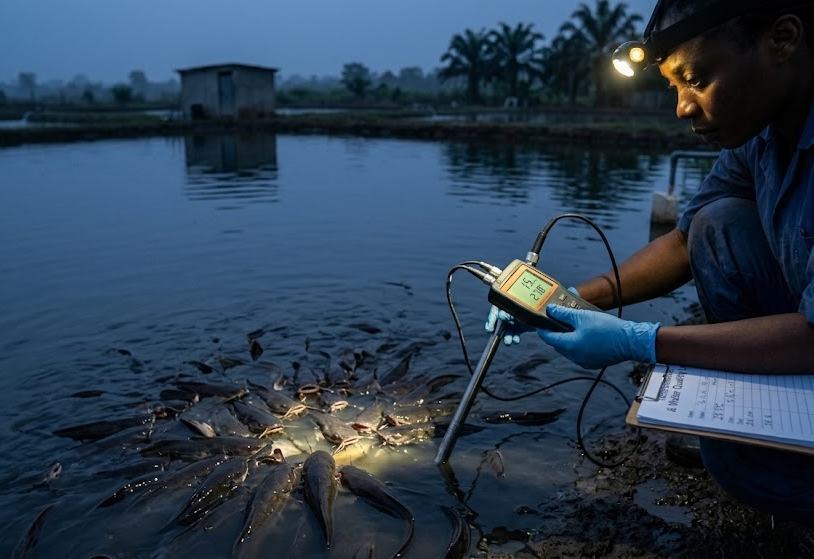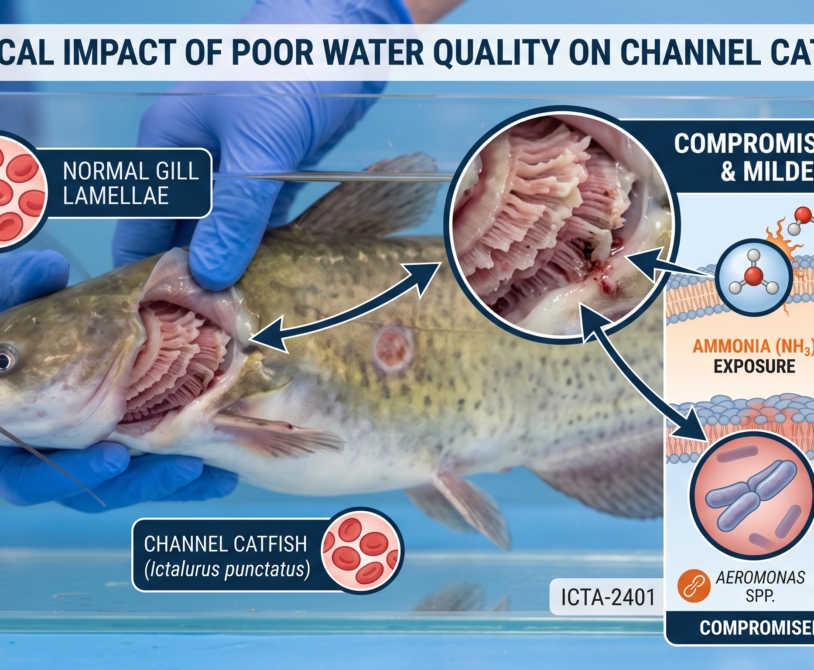
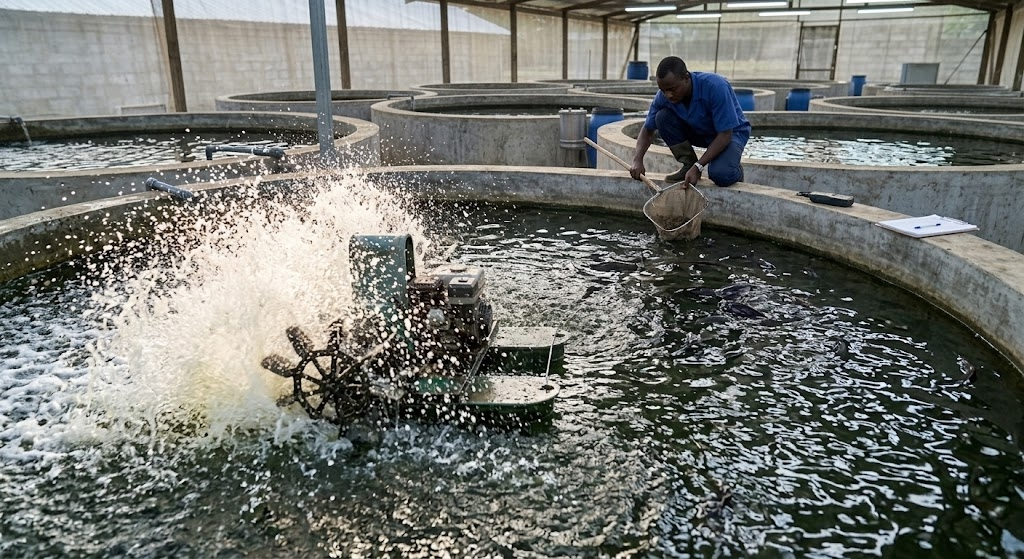
Water quality is one of the most important factors affecting catfish health, growth and survival. In African catfish farming, poor water conditions can reduce feeding, slow growth, damage gills and contribute to sudden mortality.
Monitoring key catfish pond water quality parameters helps farmers identify problems early and maintain conditions suitable for production. The most important measurements include dissolved oxygen, ammonia, nitrite, pH, temperature and alkalinity.
1. Dissolved Oxygen
Dissolved oxygen (DO) is the oxygen available in water for fish and other aquatic organisms. It is essential for normal metabolism and healthy growth.
Low dissolved oxygen can cause catfish to gasp at the surface, gather near water inlets, reduce feeding or become weak.
A commonly used aquaculture management target is approximately 5 mg/L or higher, although requirements depend on the farming system and conditions.
Factors that affect dissolved oxygen:
- High stocking density.
- Excessive feeding and organic waste.
- Warm water temperatures.
- Decomposition of organic matter.
- Inadequate aeration and water circulation.
Management: Monitor oxygen regularly, maintain suitable aeration and reduce excess organic waste. In ponds, early-morning testing can help detect overnight oxygen depletion.
2. Ammonia
Ammonia enters pond water through fish excretion, uneaten feed and decomposing organic matter. Excessive ammonia can damage gills and interfere with normal physiological functions.
Ammonia toxicity depends on total ammonia concentration, pH and temperature. The un-ionized form, NH₃, is particularly toxic to fish.
Common causes of ammonia accumulation:
- Overfeeding.
- High stocking density.
- Accumulated fish waste.
- Inadequate water exchange.
- Poor biological filtration in tank-based systems.
Management: Control feeding, remove waste, maintain effective filtration and test ammonia alongside pH and temperature.
3. Nitrite
Nitrite forms during the biological conversion of ammonia into nitrate. It can accumulate when the processes responsible for nitrogen removal are unable to keep up with the waste load.
Nitrite interferes with the blood’s ability to transport oxygen. Affected catfish may show respiratory distress, weakness, reduced appetite or abnormal swimming.
Factors that contribute to elevated nitrite:
- Immature or poorly functioning biological filters.
- Excessive organic waste.
- High stocking density.
- Overfeeding.
- Disrupted biological filtration.
Management: Test nitrite regularly, maintain the biological filter, control waste and investigate the source of repeated increases.
4. Water pH
pH measures how acidic or alkaline water is.
A practical management range commonly used in freshwater aquaculture is approximately 6.5–8.5, although the suitable range depends on the species, life stage and farming conditions.
Sudden pH changes can stress catfish. High pH is particularly important to monitor because it can increase the proportion of toxic un-ionized ammonia.
Factors affecting pH include:
- Water source and soil characteristics.
- Photosynthesis and respiration.
- Organic matter decomposition.
- Alkalinity.
- Chemical additions and water treatments.
Management: Test pH consistently, monitor alkalinity when fluctuations occur and avoid making sudden chemical adjustments without confirming the underlying cause.
5. Water Temperature
Temperature affects feeding, metabolism, growth and dissolved oxygen availability.
For African catfish (Clarias gariepinus), approximately 26–30°C is a practical warm-water management range for many grow-out systems. Actual requirements depend on fish size, production conditions and other water quality factors.
High temperatures can reduce the amount of oxygen water holds and increase ammonia toxicity when pH is also elevated.
Management: Measure water temperature directly, maintain suitable conditions and avoid abrupt temperature changes during transfers or water exchange.
6. Alkalinity
Alkalinity describes water’s capacity to resist changes in pH. It helps explain why some ponds experience large pH fluctuations while others remain more stable.
Low alkalinity can make water more susceptible to changes caused by photosynthesis, respiration and other processes.
Management: Test alkalinity when pH changes frequently. Select corrective measures according to water chemistry and, where relevant, pond soil conditions.
7. Water Clarity and Turbidity
Water clarity affects how much light penetrates a pond and can provide clues about suspended particles, algae and organic material.
Cloudy water may result from suspended soil, plankton, waste or other materials. Clear water is not automatically safe, and green water does not automatically indicate a problem.
Management: Investigate sudden changes in water colour or clarity, observe fish behaviour and test key water quality parameters before taking corrective action.
8. Organic Waste
Uneaten feed, faeces, dead fish and other decomposing materials contribute to the organic waste load.
Excess organic matter can increase microbial oxygen demand and contribute to deteriorating water conditions. It may also indicate that feeding or waste management needs improvement.
Management:
- Avoid feeding more than the fish can consume.
- Remove dead fish promptly.
- Remove accessible accumulated waste where appropriate.
- Maintain suitable water circulation and filtration.
- Review stocking density and feeding practices when waste repeatedly accumulates.
Catfish Pond Water Quality Parameters at a Glance
| Parameter | Practical monitoring guide | Why it matters |
|---|---|---|
| Dissolved oxygen | Around 5 mg/L or higher is a common management target | Supports respiration and normal activity |
| pH | Approximately 6.5–8.5 is a commonly used range | Affects fish physiology and ammonia toxicity |
| Temperature | Approximately 26–30°C for many African catfish grow-out systems | Influences metabolism, feeding and oxygen availability |
| Ammonia | Keep at a low, suitable level; interpret with pH and temperature | Excess can damage gills and cause toxicity |
| Nitrite | Keep at a low, suitable level | Excess interferes with oxygen transport in blood |
| Alkalinity | Assess according to the system and pH stability | Helps buffer pH changes |
| Water clarity | Interpret changes in context | Can indicate changes in suspended matter or plankton |
| Organic waste | Prevent excessive accumulation | Decomposition can increase oxygen demand and affect water quality |
These are general management guides, not universal limits for every catfish farm. Ammonia and nitrite results must be interpreted using the test units, fish conditions, and farming system.
How to Monitor Water Quality Effectively
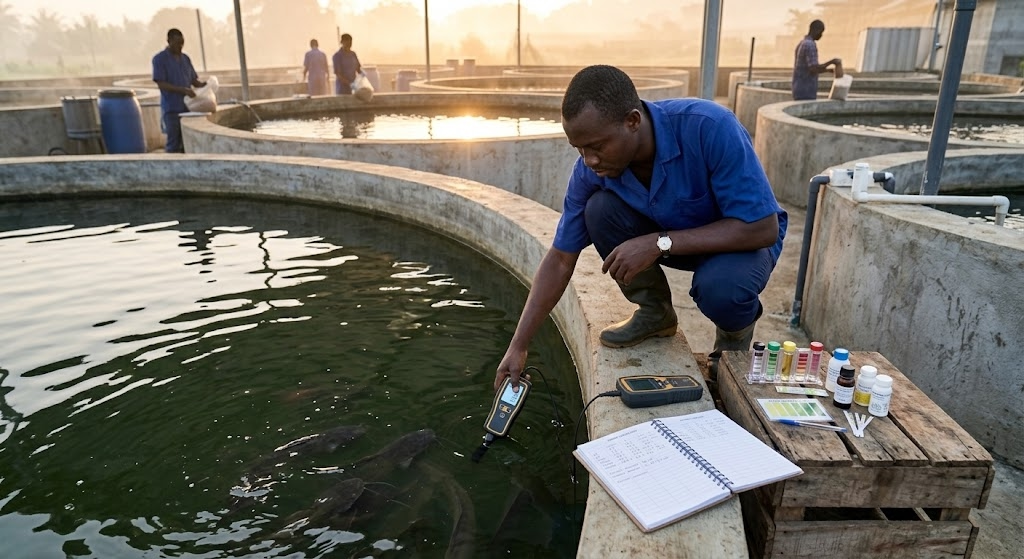
A consistent testing routine is more useful than testing only when fish become sick.
- Measure dissolved oxygen and temperature. Pay particular attention during hot weather and in intensive systems.
- Test pH regularly. Record the time to identify daily fluctuations.
- Monitor ammonia and nitrite. Increase testing when fish show signs of stress or the system experiences a heavy waste load.
- Check alkalinity when pH is unstable. This helps explain whether the water has sufficient buffering capacity.
- Observe fish behaviour. Record appetite, swimming patterns, surface congregation and mortality.
- Maintain records. Link water readings to feeding, weather, stocking density and water exchange.
- Investigate abnormal readings. Confirm the result and identify the underlying cause before applying corrective measures.
Common Water Quality Management Mistakes
Testing only when fish are sick
Some problems develop before visible symptoms appear. Routine monitoring helps detect changes earlier.
Ignoring the relationship between parameters
High pH and high temperature can increase ammonia toxicity. Warm water can also hold less dissolved oxygen. Parameters should therefore be interpreted together.
Overfeeding
Excess feed increases waste production and can contribute to ammonia accumulation and oxygen depletion.
Making sudden chemical corrections
Uncontrolled chemical additions can create abrupt changes in pH or other water conditions. Test first and correct conditions carefully.
Assuming clear water is healthy water
Dissolved pollutants may be present even when water looks clean. Use appropriate tests rather than relying on appearance alone.
Frequently Asked Questions
What is the most important water quality parameter in catfish farming?
Dissolved oxygen is an immediate priority when fish show respiratory distress. However, successful management also requires monitoring ammonia, nitrite, pH and temperature.
Can catfish survive poor water quality?
Catfish may tolerate some challenging conditions, but tolerance does not mean that poor water quality is safe. Persistent stress can reduce growth and increase mortality risk.
How often should catfish pond water be tested?
Testing frequency depends on stocking density, feeding rate, system design and water stability. Intensive farms generally require closer monitoring than lightly stocked systems.
Why can fish die when the water looks normal?
Water may contain excessive ammonia or nitrite, or have insufficient dissolved oxygen, without obvious visual signs. Accurate testing is needed to identify these problems.
Conclusion
Managing catfish pond water quality requires monitoring several connected parameters rather than relying on a single measurement. Dissolved oxygen, ammonia, nitrite, pH, temperature and alkalinity all contribute to the conditions experienced by the fish.
Consistent testing, appropriate feeding, effective waste management and suitable aeration help farmers identify risks early and maintain better production conditions.