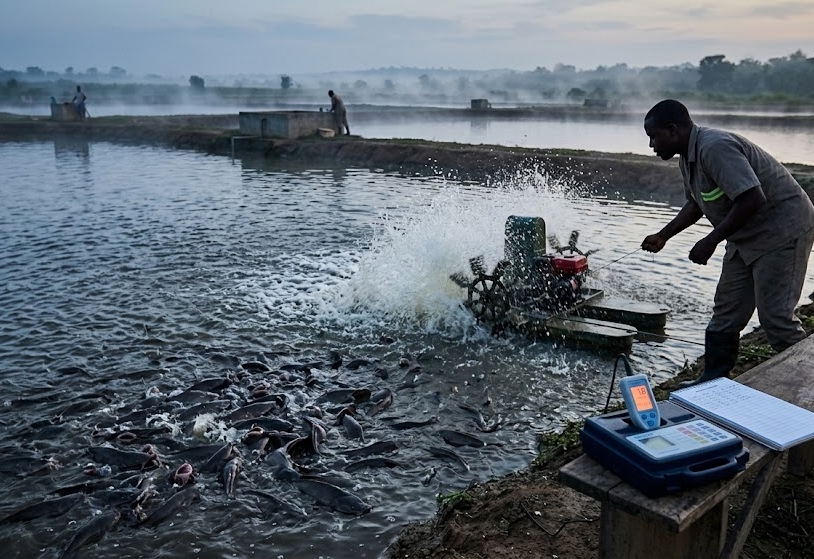
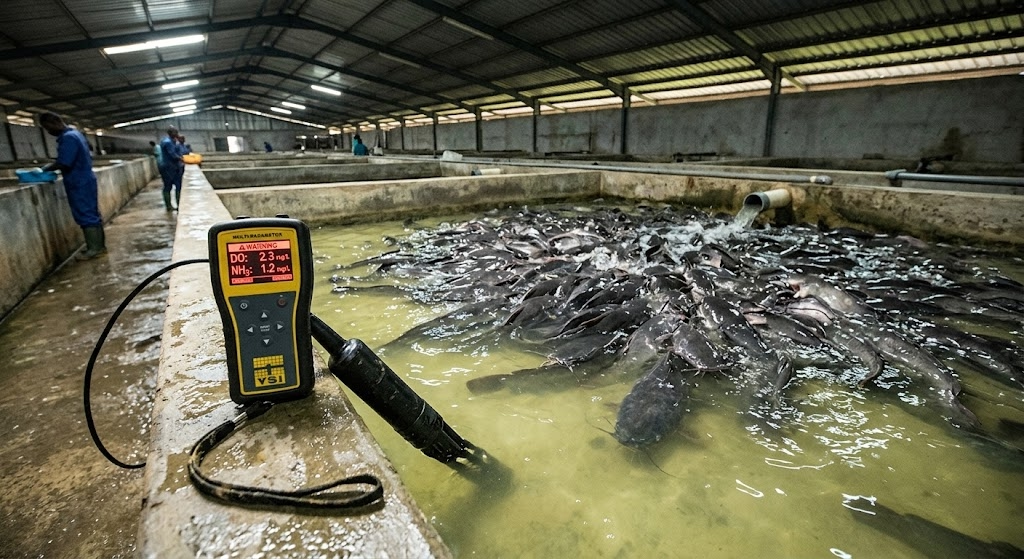
Overstocking is a common management problem in catfish farming. It occurs when too many fish are kept in a pond, tank, or production unit relative to its water volume, oxygen supply, filtration capacity, and waste-removal system. When stocking density exceeds what the system can support, water quality can deteriorate, fish become stressed, and the risk of disease and mortality increases.
In African catfish (Clarias gariepinus) farming, stocking density must be managed alongside feeding, aeration, water exchange, fish size, and the effectiveness of the production system. A stocking density that works in a well-aerated tank with effective waste removal may be unsuitable for a pond with limited water circulation.
What Happens When Catfish Are Overstocked?
Overstocking affects water quality through several connected processes. More fish consume more oxygen, produce more waste, and require more feed. If the farming system cannot handle these demands, harmful conditions may develop.
1. Dissolved oxygen decreases
Catfish consume oxygen through respiration. As the number and biomass of fish increase, total oxygen demand also increases. Microorganisms breaking down uneaten feed, faeces, and other organic matter consume additional oxygen.
When oxygen supply cannot meet demand, dissolved oxygen may fall, especially at night or early in the morning in ponds.
Possible signs include:
- Catfish gathering near the water surface.
- Rapid gill movements.
- Reduced feeding activity.
- Unusual swimming or weakness.
- Sudden deaths during severe oxygen depletion.
Maintaining adequate aeration and monitoring dissolved oxygen are essential, particularly when fish biomass is high.
2. Ammonia accumulates
Catfish excrete nitrogenous waste, including ammonia, while uneaten feed and faeces contribute additional nitrogen as they decompose.
In an overstocked system, waste production can exceed the capacity of biological filtration, water exchange, or natural microbial processes to remove or transform it. Ammonia may then accumulate and damage fish gills and other tissues.
The toxicity of ammonia depends partly on water pH and temperature. A higher pH generally increases the proportion of ammonia present in its more toxic un-ionized form.
Farmers should test ammonia rather than relying only on water appearance or fish behaviour.
3. Nitrite levels may increase
Nitrite can accumulate when the biological processes responsible for converting ammonia into less harmful nitrate cannot keep up with waste production. This may occur in heavily stocked systems with immature, damaged, or overloaded biological filtration.
Nitrite interferes with the blood’s ability to transport oxygen efficiently. Affected fish may show respiratory distress, reduced activity, poor feeding, or increased mortality.
Testing nitrite is particularly important in intensive systems that depend on biological filtration.
4. Organic waste builds up
More fish generally produce more faeces. Higher feeding rates also increase the amount of uneaten feed when feeding is poorly managed.
Organic waste can:
- Increase microbial activity and oxygen consumption.
- Accumulate at the bottom of ponds and tanks.
- Contribute to unpleasant odours.
- Encourage deterioration of water quality.
- Increase the likelihood of harmful conditions developing around waste deposits.
Routine removal of settled solids, appropriate feeding, and effective water management help control this problem.
5. Water quality becomes less stable
An overstocked system has less capacity to absorb sudden changes in oxygen demand, waste production, or feeding activity.
For example, a system may appear normal after water exchange but deteriorate rapidly after heavy feeding, during hot weather, or overnight when oxygen production by aquatic plants stops.
High stocking density therefore requires more frequent monitoring and more reliable water-quality management.
How Overstocking Increases the Risk of Catfish Disease
Poor water quality can weaken fish and make them more susceptible to disease. Crowding may also increase contact between fish and allow infectious agents to spread more readily under some conditions.
Potential consequences include:
- Gill damage: Low oxygen, ammonia, and nitrite can impair normal gill function.
- Skin injuries: Frequent contact and competition may contribute to physical damage.
- Reduced immunity: Persistent environmental stress can compromise the fish’s ability to cope with infections.
- Faster disease transmission: Some infectious diseases can spread more easily when infected and healthy fish are kept in close contact.
- Higher mortality: Multiple stressors can act together, especially when poor water quality is not corrected promptly.
Overstocking does not automatically mean that fish will develop a specific disease. Symptoms such as gasping, poor feeding, or sudden deaths can have several causes and require investigation.
Signs That Your Catfish Stocking Density May Be Too High
Watch for the following warning signs:
| Observation | Possible explanation |
|---|---|
| Fish gasp at the surface | Low dissolved oxygen or gill problems |
| Fish feed poorly | Stress, poor water quality, disease, or unsuitable feeding practices |
| Ammonia readings increase | Waste production exceeds removal or treatment capacity |
| Nitrite readings increase | Biological filtration or nitrogen processing is inadequate |
| Water develops a bad smell | Organic waste accumulation or anaerobic decomposition |
| Fish grow unevenly | Competition, variation in fish size, feeding access, or health problems |
| Repeated mortality occurs | Severe water-quality problems, disease, or other environmental stressors |
These signs are indicators for investigation, not proof of overstocking on their own.
How to Prevent Overstocking in Catfish Farming
1. Calculate stocking density before introducing fish
Stocking density should be based on the production system’s actual capacity, not simply the number of fish that can fit into a pond or tank.
Consider:
- Water volume and usable culture area.
- Expected harvest weight and total fish biomass.
- Aeration capacity and backup equipment.
- Water supply and exchange rate.
- Filtration and waste-removal capacity.
- Feeding rate and the farmer’s ability to monitor water quality.
Fish biomass is especially important because a system containing many small fingerlings can have a very different oxygen and waste demand from the same number of large market-size fish.
2. Monitor dissolved oxygen regularly
Measure dissolved oxygen with a suitable meter, especially before sunrise, after heavy feeding, and during periods of high temperature or cloudy weather.
For many grow-out systems, approximately 5 mg/L or higher is a useful general management target, although requirements depend on system conditions and production stage. Respond promptly when readings fall toward unsafe levels.
3. Test ammonia and nitrite
Use appropriate water-test kits or meters to check ammonia and nitrite. Test more frequently when fish biomass increases, after changes in feeding, or when fish show signs of stress.
If concentrations rise, investigate feeding, solids accumulation, water exchange, and biological filtration rather than treating the symptoms alone.
4. Feed according to fish biomass
Calculate feeding rates using estimated fish biomass, fish size, feed quality, and observed feeding response. Remove uneaten feed when practical and avoid feeding more than the fish can consume.
Overfeeding adds to the same waste burden that makes overstocking dangerous.
5. Maintain aeration and water circulation
Ensure that aeration equipment can meet oxygen demand during peak biomass and feeding periods. In intensive systems, consider backup aeration or power arrangements because equipment failure can cause rapid oxygen depletion.
Aeration helps maintain oxygen levels but does not, by itself, remove accumulated solids or solve every ammonia and nitrite problem.
6. Remove waste and maintain the production system
Clean tanks and remove accumulated solids as appropriate for the system. Maintain filters and inspect water inlets, outlets, pumps, and aeration equipment.
In ponds, manage organic loading carefully and avoid making sudden changes that could create additional stress.
7. Reduce stocking density when necessary
If the system repeatedly fails to maintain acceptable water quality despite appropriate feeding, aeration, and waste management, the fish biomass may exceed its capacity.
Depending on the circumstances, options may include grading fish, harvesting market-size fish, transferring fish to a suitable prepared unit, or reducing the number stocked in future production cycles.
Any transfer should be planned to avoid introducing new stress or spreading disease.
Can Overstocked Catfish Recover?
Catfish may recover when poor water quality is corrected early and permanent damage has not occurred. Recovery depends on the severity and duration of the problem, the fish’s condition, and whether disease or other complications are present.
When signs of stress appear:
- Check dissolved oxygen immediately.
- Test ammonia and nitrite.
- Inspect aeration, pumps, filters, and water flow.
- Remove uneaten feed and address accumulated waste.
- Adjust feeding while investigating the cause.
- Consider reducing biomass if the system cannot maintain suitable conditions.
- Seek qualified fish-health advice if mortality continues or disease is suspected.
Avoid adding medicines or chemicals without identifying the underlying problem. Treating a disease will not correct an unresolved oxygen shortage or excessive waste load.
Frequently Asked Questions
What happens if too many catfish are kept in one tank?
The tank may experience increased oxygen demand, ammonia and nitrite accumulation, organic waste buildup, competition, and greater stress. If filtration, aeration, and water exchange cannot handle the biomass, fish health and survival can deteriorate.
Does overstocking cause low oxygen in catfish ponds?
It can. More fish consume more oxygen, while the decomposition of additional organic waste also uses oxygen. The severity depends on aeration, pond productivity, temperature, water movement, and organic loading.
Can overstocking cause sudden catfish deaths?
Yes, overstocking can contribute to sudden mortality when it leads to severe oxygen depletion or toxic water conditions. However, sudden deaths can also result from infectious disease, contamination, temperature changes, or other causes. Test the water and investigate promptly.
How can I know the correct stocking density for African catfish?
There is no single stocking density suitable for every farm. It depends on the system type, water volume, expected harvest size, aeration, filtration, water exchange, feeding rate, and management capacity. Use stocking guidance developed for comparable systems and monitor water quality as biomass increases.
Is changing the water enough to solve overstocking?
Not necessarily. Water exchange may improve some water-quality problems, but it does not eliminate excessive stocking pressure. If the fish biomass remains too high for the system, the problems may return.
Conclusion
Overstocking affects catfish water quality by increasing oxygen demand, waste production, and pressure on filtration and water-management systems. These effects can create stress, damage gills, increase disease risk, and contribute to mortality.
Successful African catfish farming requires matching stocking density to the system’s actual capacity, monitoring dissolved oxygen and nitrogen compounds, controlling feeding, and removing waste. If water quality repeatedly deteriorates, reducing fish biomass may be necessary.