Dissolved oxygen is one of the most important water quality factors in catfish farming. It affects fish respiration, feeding activity, growth, stress levels, and survival. When oxygen levels fall too low, catfish may become distressed, eat less, grow slowly, or die.
African catfish (Clarias gariepinus) can tolerate some low-oxygen conditions better than many other cultured fish because they can breathe atmospheric air. However, this adaptation does not eliminate the need for suitable dissolved oxygen in ponds and tanks.
What Is Dissolved Oxygen in Catfish Farming?
Dissolved oxygen (DO) is the amount of oxygen present in water that fish and other aquatic organisms can use for respiration. It is usually measured in milligrams per litre (mg/L).
In catfish ponds and tanks, oxygen enters the water through:
- Exchange between air and water at the surface
- Photosynthesis by algae and aquatic plants
- Mechanical aeration
- Water movement, splashing, and circulation
- Incoming water that contains oxygen
Oxygen is consumed by fish, microorganisms, and the decomposition of organic waste. When oxygen consumption exceeds oxygen replenishment, dissolved oxygen levels decline.
This imbalance is a common cause of water-quality problems in intensive catfish production.
What Is the Ideal Dissolved Oxygen Level for Catfish?
The appropriate dissolved oxygen level depends on fish size, stocking density, water temperature, feeding rate, and the type of production system.
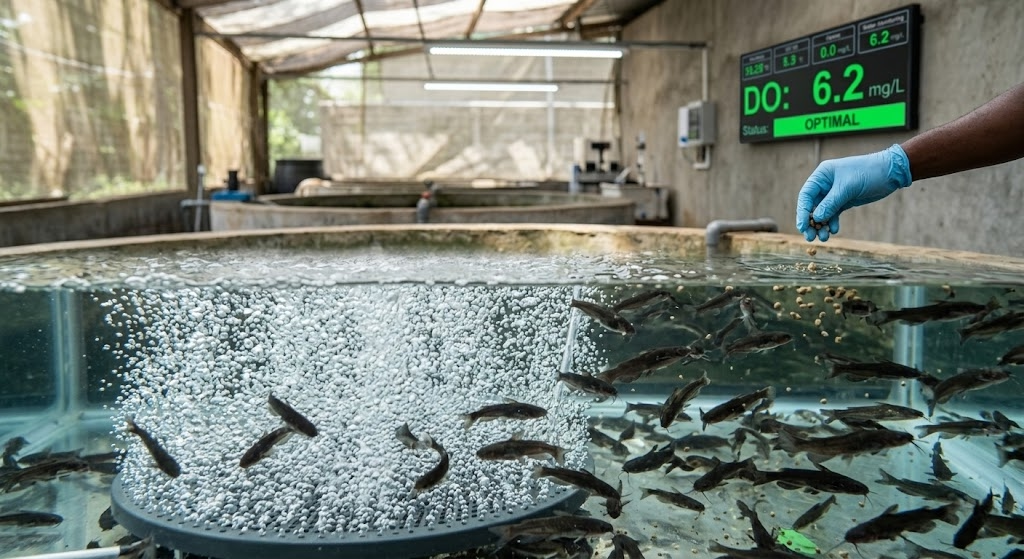
As a general management guide, maintaining dissolved oxygen around 5 mg/L or higher is a useful target for many catfish farming systems, where practical. Lower concentrations may cause stress, especially when exposure is prolonged or fish are heavily stocked.
Do not use a single oxygen reading as the only measure of water quality. The duration of exposure, changes throughout the day, and the condition of the fish also matter.
Why Dissolved Oxygen Falls in Catfish Ponds
1. Overstocking
When too many catfish are kept in a pond or tank, total oxygen demand increases. High stocking density also produces more faeces and waste, which can increase oxygen consumption during decomposition.
Management: Match stocking density to the system’s oxygen supply, aeration capacity, filtration, and waste-removal capability.
2. Overfeeding
Uneaten feed decomposes in the water, encouraging microbial activity that consumes oxygen. Excessive feeding also increases waste production and can contribute to ammonia accumulation.
Management: Feed according to fish size, biomass, appetite, and water conditions. Remove uneaten feed where practical.
3. Organic Waste Accumulation
Faeces, dead organisms, leftover feed, and sludge can increase biological oxygen demand. This can lead to oxygen depletion, particularly in ponds with substantial organic matter.
Management: Manage sludge, remove dead fish promptly, control feeding, and prevent excessive waste accumulation.
4. High Water Temperature
Warmer water holds less dissolved oxygen than cooler water under comparable conditions. At the same time, fish metabolism and oxygen demand may increase as temperature rises.
This combination can make hot weather particularly challenging for heavily stocked catfish ponds.
Management: Monitor both temperature and dissolved oxygen, especially during warm periods, and ensure that aeration can meet the system’s oxygen demand.
5. Heavy Algal Growth
Algae produce oxygen through photosynthesis during daylight. However, algae and other organisms also consume oxygen through respiration, including at night.
Ponds with dense algal growth can experience large daily oxygen fluctuations. Dissolved oxygen may become dangerously low before sunrise.
Management: Monitor oxygen at vulnerable times and avoid sudden, uncontrolled changes to algal populations.
6. Equipment Failure
In intensive tank systems, a failed aerator, pump, or circulation system can cause oxygen levels to fall rapidly.
Management: Inspect equipment regularly, maintain backup aeration where possible, and prepare an emergency response for power or equipment failures.
Symptoms of Low Dissolved Oxygen in Catfish
Recognising oxygen stress early can help prevent serious losses.
Common warning signs include:
- Catfish gathering at the water surface
- Rapid gill movement
- Increased surfacing or air-gulping behaviour
- Reduced appetite
- Unusual inactivity
- Crowding near water inlets or aerators
- Loss of balance or abnormal swimming in severe cases
- Sudden mortality
African catfish naturally gulp atmospheric air, so occasional surfacing alone does not prove that dissolved oxygen is too low. Look for changes in behaviour and confirm the situation with a dissolved oxygen measurement.
How to Measure Dissolved Oxygen in Catfish Ponds
Reliable measurement is more useful than judging oxygen levels from water appearance.
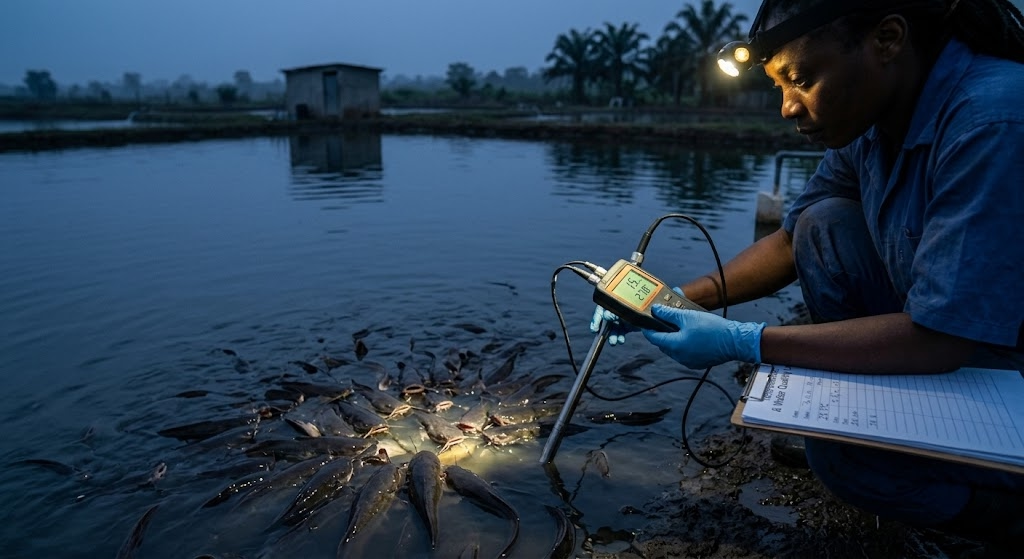
Using a dissolved oxygen meter
A dissolved oxygen meter provides a direct measurement of oxygen concentration.
- Check that the meter is calibrated and maintained according to its instructions.
- Measure water in representative areas of the pond or tank.
- Record the reading, time, and water temperature.
- Repeat measurements at different times when oxygen fluctuations are suspected.
- Compare the results with fish behaviour and other water-quality measurements.
In ponds, measurements near the end of the night or early morning can be particularly informative because oxygen may have been consumed throughout the night without photosynthetic replenishment.
Using fish behaviour as an early warning
Observe the fish during feeding and routine inspections. Sudden changes in surfacing, swimming, or appetite should trigger water-quality checks.
Behavioural observation is useful for early warning but cannot replace direct measurement.
How to Increase Dissolved Oxygen in Catfish Farming
1. Start or increase aeration
Mechanical aerators introduce oxygen into the water and improve gas exchange. In tank systems, appropriate aeration and circulation are essential.
During an oxygen emergency, activate available aeration immediately and ensure that it is distributing oxygen effectively.
2. Reduce feeding temporarily when necessary
If oxygen is low, feeding adds to the system’s oxygen demand through fish metabolism and the decomposition of uneaten feed.
Temporarily reduce or suspend feeding as appropriate while correcting the problem. Resume normal feeding only after conditions improve and fish behaviour returns towards normal.
3. Improve water circulation
Poor circulation can create areas where oxygen is depleted. Suitable water movement helps distribute oxygen and can reduce stagnant zones.
However, circulation must be appropriate for the system and should not unnecessarily disturb fish or resuspend excessive bottom waste.
4. Remove excessive organic waste
Manage accumulated sludge, uneaten feed, and dead organisms. Reducing unnecessary organic matter helps limit oxygen consumption caused by decomposition.
5. Manage stocking density
If oxygen problems recur despite adequate equipment maintenance, assess whether fish biomass exceeds the system’s capacity.
Possible long-term solutions include reducing stocking density, improving aeration capacity, upgrading filtration, or improving waste management.
6. Prepare for emergencies
Catfish farmers using intensive systems should have a clear response plan for power failures, aerator breakdowns, and unexpected oxygen depletion.
Where feasible, backup power, spare equipment, and alarms can help reduce losses.
Dissolved Oxygen and Other Water Quality Problems
Low oxygen often occurs alongside other water-quality issues.
Ammonia: Poor waste management can increase ammonia concentrations. Low oxygen may also disrupt biological filtration, worsening the problem.
Nitrite: Nitrite interferes with oxygen transport in fish blood. Consequently, fish may show oxygen-stress symptoms even when dissolved oxygen in the water is adequate.
Temperature: Warm water holds less oxygen, so temperature and dissolved oxygen should be assessed together.
Organic waste: Decomposition consumes oxygen and can contribute to ammonia accumulation.
When catfish are gasping or dying, do not assume oxygen is the only problem. Measure dissolved oxygen and investigate ammonia, nitrite, temperature, and other relevant conditions.
Common Mistakes in Dissolved Oxygen Management
Assuming African catfish do not need dissolved oxygen
African catfish can use atmospheric air, but they still depend on suitable aquatic conditions for healthy production.
Checking oxygen only during the day
Daytime measurements may miss overnight oxygen depletion. Monitoring should include periods when oxygen is most likely to be low.
Waiting until fish are dying
Gasping and sudden mortality can indicate that an oxygen emergency is already severe. Routine measurements help detect declining oxygen before obvious distress develops.
Increasing aeration without investigating the cause
Aeration may correct an immediate oxygen shortage, but recurring problems may also involve overstocking, excessive feeding, organic waste, or inadequate system design.
Treating low oxygen with chemicals without diagnosis
The first response should focus on measuring oxygen, improving aeration, and identifying the cause. Chemical interventions should not replace appropriate oxygen management.
Frequently Asked Questions
Can African catfish survive low dissolved oxygen?
African catfish have adaptations that allow them to breathe atmospheric air. However, prolonged low dissolved oxygen can still impair production and contribute to stress and mortality. Their tolerance should not be used as a reason to neglect aeration or monitoring.
Why are my catfish coming to the surface in the morning?
One possible cause is low dissolved oxygen after a night of respiration by fish, algae, and microorganisms. Check dissolved oxygen promptly, especially before sunrise. Also consider ammonia, nitrite, and other causes of respiratory distress.
Does aeration improve catfish growth?
Adequate oxygen supports normal feeding, metabolism, and growth. Aeration can improve production when oxygen availability is limiting, but growth also depends on feed quality, stocking density, temperature, genetics, and overall water quality.
Is clear pond water a sign of high dissolved oxygen?
No. Water clarity does not reliably indicate dissolved oxygen concentration. Use a dissolved oxygen meter or another appropriate measurement method.
When should dissolved oxygen be measured?
Measure it routinely and whenever fish behaviour changes. In ponds, early morning is an important monitoring period because oxygen can fall overnight. In intensive tank systems, frequent or continuous monitoring may be necessary.
Conclusion
Dissolved oxygen management is essential for healthy and productive catfish farming. Low oxygen can reduce feeding, increase stress, disrupt normal behaviour, and cause severe losses, particularly in heavily stocked systems.
Monitor oxygen directly, pay attention to early-morning conditions in ponds, maintain reliable aeration, control feeding and waste, and match stocking density to system capacity. When fish show signs of distress, respond immediately and investigate other water-quality problems as well