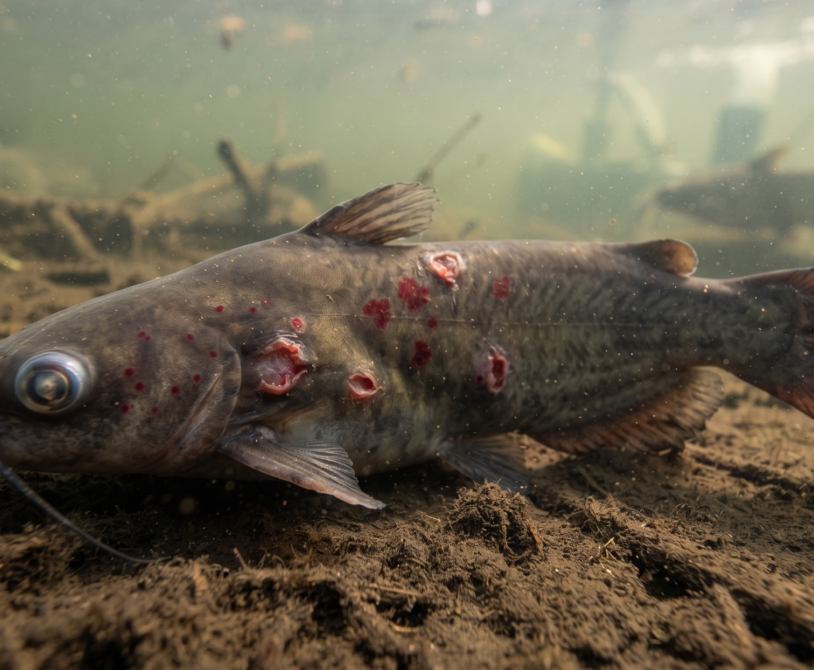
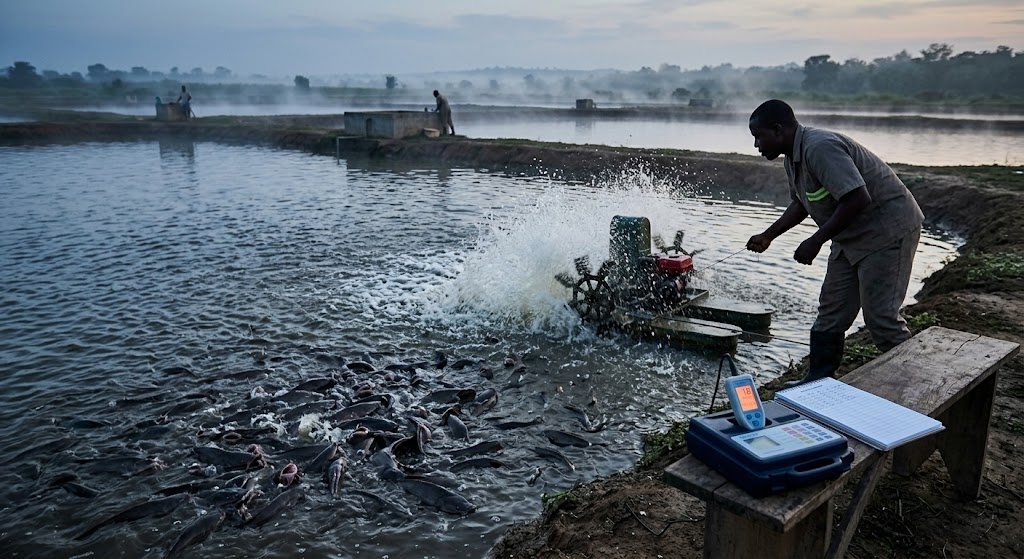
Low dissolved oxygen is a major water quality problem in catfish farming. When oxygen levels fall below what fish need, catfish may gather at the water surface, breathe more frequently, reduce feeding, and become stressed. Severe oxygen depletion can cause mass mortality, especially in heavily stocked ponds.
African catfish (Clarias gariepinus) can breathe atmospheric air, but this adaptation does not make them immune to the effects of poor water quality. Effective oxygen management remains essential for healthy growth and reliable production.
What Causes Low Oxygen in Catfish Ponds?
Dissolved oxygen changes throughout the day as oxygen enters the water and is consumed by fish, microorganisms, and other aquatic organisms.
1. Oxygen depletion overnight
During daylight, algae and aquatic plants produce oxygen through photosynthesis. At night, photosynthesis stops, but fish, plants, algae, and microorganisms continue to consume oxygen through respiration.
This can cause dissolved oxygen to reach its lowest levels shortly before sunrise.
2. Overstocking
High stocking density increases the total oxygen demand of a pond. More fish also produce more waste, which can increase oxygen consumption during decomposition.
Farmers should match stocking density to pond conditions, water exchange capacity, and available aeration.
3. Excessive feeding
Uneaten feed decomposes and increases the amount of organic matter in the pond. Microorganisms breaking down this material consume dissolved oxygen.
Overfeeding can therefore contribute to oxygen depletion while also increasing ammonia and other waste-related problems.
4. Accumulation of organic waste
Fish faeces, leftover feed, dead organisms, and bottom sludge contribute to biological oxygen demand.
Ponds with excessive organic matter may experience severe oxygen depletion, particularly when water circulation is poor or temperatures are high.
5. High water temperature
Warm water holds less dissolved oxygen than cooler water under comparable conditions. Fish may also consume oxygen more rapidly as their metabolism increases.
This makes monitoring particularly important during hot weather.
6. Sudden changes in pond conditions
Heavy rainfall, algal population changes, cloudy weather, and other environmental changes can alter oxygen production and consumption. In ponds with dense algal growth, sudden changes can contribute to oxygen depletion.
Symptoms of Low Oxygen in Catfish Ponds
Recognising the warning signs early can help farmers act before serious losses occur.
Common symptoms include:
- Catfish gathering at the surface more frequently than usual
- Increased air-gulping or unusual surfacing behaviour
- Rapid gill movement
- Reduced appetite or refusal to feed
- Unusual swimming or inactivity
- Fish congregating near water inlets or areas with better circulation
- Loss of balance in severe cases
- Sudden or widespread mortality
African catfish naturally gulp air, so surfacing alone does not confirm oxygen deficiency. A noticeable change in behaviour, especially when several fish are affected, should trigger immediate water-quality checks.
How to Confirm Low Dissolved Oxygen
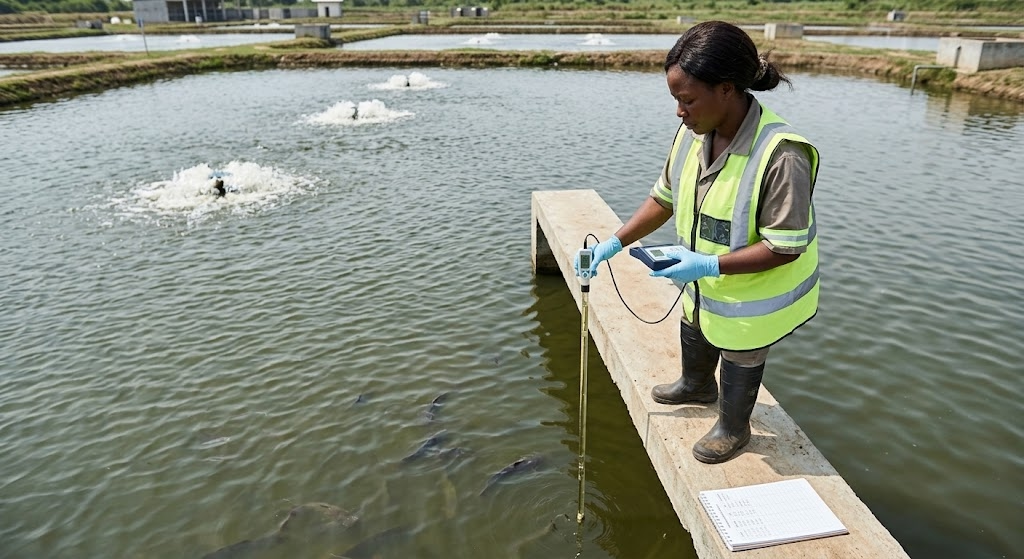
A dissolved oxygen meter is the most reliable practical tool for measuring oxygen concentration in pond water. Results are generally reported in milligrams per litre (mg/L).
To assess oxygen conditions:
- Measure dissolved oxygen as soon as fish show signs of distress.
- Record the water temperature and time of measurement.
- Check more than one location if oxygen distribution may be uneven.
- In ponds, pay particular attention to early morning, when oxygen may be lowest.
- Compare readings with fish behaviour and other water-quality results.
As a general management guide, many catfish farming systems aim to maintain dissolved oxygen around 5 mg/L or higher, where practical. The appropriate target depends on the production system, fish biomass, temperature, and other conditions.
Do not delay emergency action while waiting for a measurement if fish are clearly distressed.
How to Fix Low Oxygen in Catfish Ponds
1. Increase aeration immediately
If oxygen is low, activate available aeration equipment and ensure it is working effectively.
Suitable aerators increase contact between water and air, helping oxygen enter the pond. Their effectiveness depends on pond size, depth, equipment capacity, and water circulation.
For intensive catfish production, farmers should plan aeration capacity around peak oxygen demand rather than average conditions.
2. Temporarily reduce or stop feeding
Feeding during an oxygen emergency can add to the system’s oxygen demand. Uneaten feed can also increase organic waste.
Temporarily reduce or suspend feeding as appropriate while correcting the problem. Resume normal feeding gradually once oxygen conditions stabilise and fish behaviour improves.
3. Check water circulation
Inspect pumps, aerators, and water inlets. Poor circulation can leave areas with inadequate oxygen.
Improve water movement where necessary, but avoid disturbing excessive bottom sludge, which can worsen water quality.
4. Remove excessive organic waste
Remove dead fish promptly and manage accumulated sludge and uneaten feed using methods suitable for the pond.
Reducing organic waste helps lower the oxygen consumed by decomposition.
5. Evaluate water exchange
Water exchange may help in some situations, provided the incoming water is suitable and contains adequate oxygen.
Check its temperature and other relevant parameters before introducing large volumes. Sudden changes in water conditions may create additional stress.
6. Investigate recurring oxygen shortages
If oxygen repeatedly falls to unsafe levels, investigate the underlying cause rather than relying only on emergency aeration.
Possible corrective measures include:
- Reducing stocking density
- Improving aeration capacity
- Adjusting feeding practices
- Improving waste management
- Reviewing pond depth and circulation
- Monitoring dissolved oxygen more frequently
How to Prevent Low Oxygen in Catfish Ponds
Prevention begins with understanding when and why oxygen falls.
Monitor oxygen before sunrise
Early-morning measurements can reveal overnight oxygen depletion that daytime readings miss. Record results consistently to identify recurring patterns.
Maintain suitable stocking density
Avoid keeping more fish than the pond’s oxygen supply and waste-management capacity can support.
Control feeding
Feed according to fish biomass, size, appetite, and water conditions. Avoid feeding excessive quantities that remain uneaten.
Maintain aeration equipment
Inspect aerators, pumps, power supplies, and other equipment regularly. Where feasible, prepare backup aeration or power for emergencies.
Manage algae and organic matter
Avoid sudden, uncontrolled changes in algal populations. Remove excessive organic waste and monitor ponds with dense algal growth more closely.
Keep water-quality records
Record dissolved oxygen, temperature, feeding, stocking density, mortality, and corrective actions. These records can help identify the conditions that precede oxygen problems.
Low Oxygen or Another Catfish Disease?
Low oxygen can cause symptoms that resemble other health problems. Gasping, rapid gill movement, poor appetite, and lethargy may also occur with ammonia poisoning, nitrite poisoning, gill parasites, or bacterial disease.
Use the following approach:
| Observation | What to check |
|---|---|
| Many fish suddenly gather at the surface | Dissolved oxygen immediately |
| Fish remain distressed despite adequate oxygen | Ammonia, nitrite, temperature, and gill health |
| Oxygen repeatedly falls before sunrise | Overnight oxygen trends, algae, and organic waste |
| Oxygen problems follow heavy feeding | Feeding rate and waste accumulation |
| Mortality continues after oxygen improves | Other water-quality problems and possible disease |
These observations help guide investigation, but they do not establish a diagnosis by themselves.
Common Mistakes When Managing Low Oxygen
Relying on catfish air-breathing ability: African catfish can breathe atmospheric air, but poor water quality can still damage health and reduce production.
Checking oxygen only during the afternoon: Oxygen may be adequate during daylight and critically low before sunrise.
Increasing feed to compensate for poor growth: Excessive feeding can worsen oxygen depletion and waste accumulation.
Using aeration without correcting the underlying problem: Aeration addresses oxygen availability, but recurring shortages may require changes to stocking, feeding, and waste management.
Assuming oxygen is the only cause of mortality: If fish continue dying after oxygen levels improve, investigate additional water-quality problems and seek qualified fish-health advice.
Frequently Asked Questions
Why do catfish come to the surface in the morning?
Overnight oxygen consumption can cause dissolved oxygen to fall, particularly in ponds with heavy algal growth or substantial organic waste. Measure oxygen as soon as possible and compare morning readings with measurements taken later in the day.
Can low oxygen kill catfish overnight?
Yes. Severe oxygen depletion can cause substantial fish losses over a short period. Risk increases when oxygen demand is high and replenishment is inadequate.
Does changing pond water solve low oxygen?
Not always. Water exchange may help if the incoming water is suitable, but it does not necessarily solve problems caused by excessive stocking, feeding, organic waste, or insufficient aeration.
Should I feed catfish when oxygen is low?
Reduce or suspend feeding as appropriate while addressing the oxygen problem. Feeding decisions should be based on oxygen conditions, fish behaviour, and the severity of the situation.
How can I prevent oxygen problems during hot weather?
Monitor water temperature and dissolved oxygen more closely, maintain functioning aeration, control organic waste, and avoid excessive feeding or stocking beyond the system’s capacity.
Conclusion
Low oxygen in catfish ponds can lead to feeding problems, stress, poor growth, and sudden mortality. The most effective response combines early detection, immediate aeration when needed, responsible feeding, waste management, and appropriate stocking density.
For African catfish farmers, measuring dissolved oxygen before sunrise and during periods of distress can reveal problems that visual inspection alone may miss. If fish remain sick or continue dying after oxygen improves, investigate ammonia, nitrite, and other possible causes.