In the world of aquaculture, your harvest is only as good as your preservation. For years, fish farmers across Africa have struggled with post-harvest losses, often losing up to 40% of their stock due to inadequate processing.
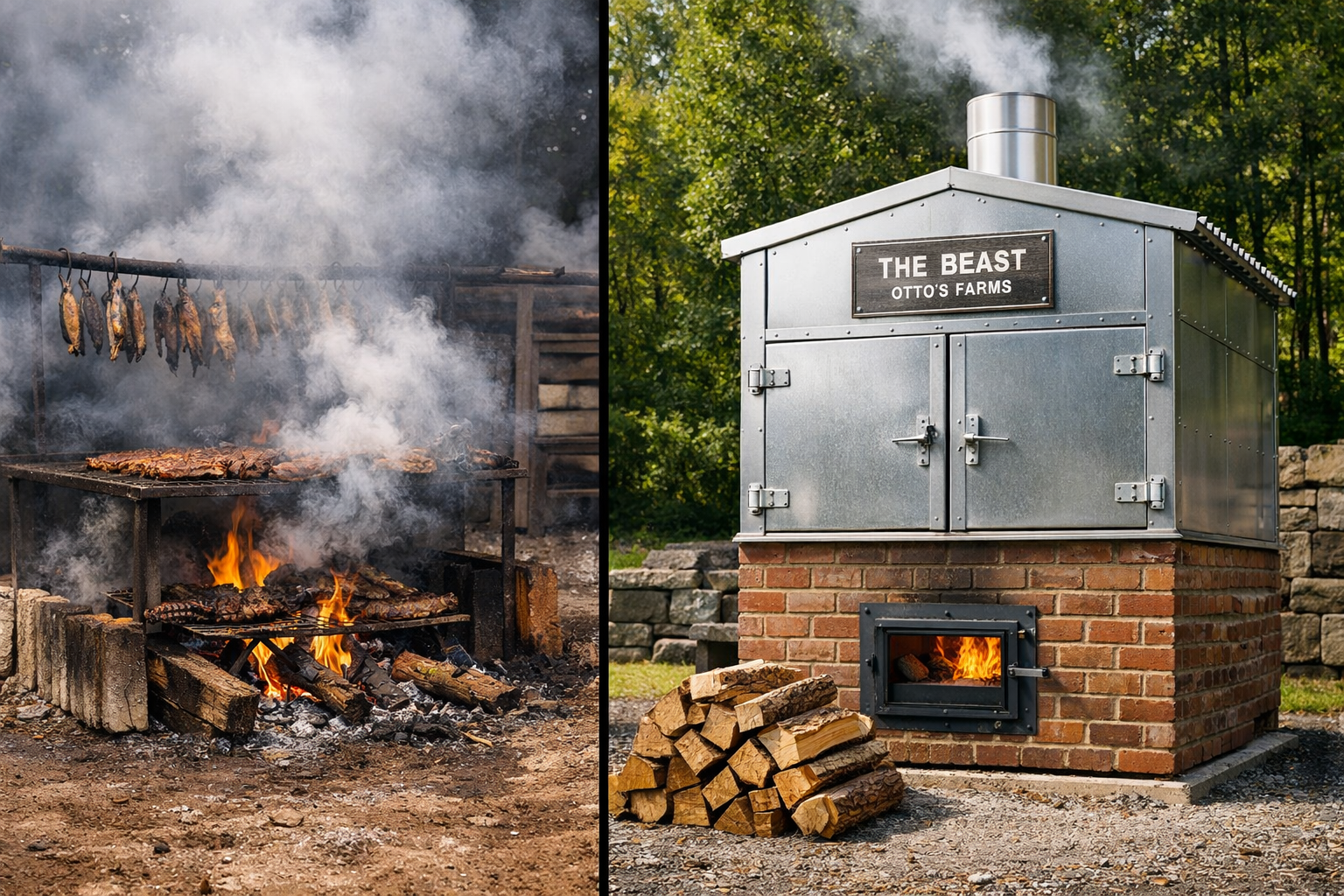
At Otto’s Farms, the solution wasn’t just to work harder, but to build smarter. Enter “The Beast”—a custom-built, high-capacity smoking kiln that is shifting the paradigm of catfish processing from a backyard chore to an industrial powerhouse.
The Engineering Gap: Traditional vs. Modern Kilns
To understand why custom kilns are the future, we must look at the past. Traditional open-fire drying—while culturally significant—is plagued by engineering inefficiencies that limit a farm’s growth.
Proper kiln design is the first step in [African Catfish Processing], ensuring that the fish doesn’t just “dry,” but transforms into a premium asset.
Firewood Efficiency: The Sustainability Angle
One of the highest hidden costs in fish smoking is fuel. Traditional methods are “heat-leaky,” meaning most of the energy produced by burning wood escapes into the atmosphere.
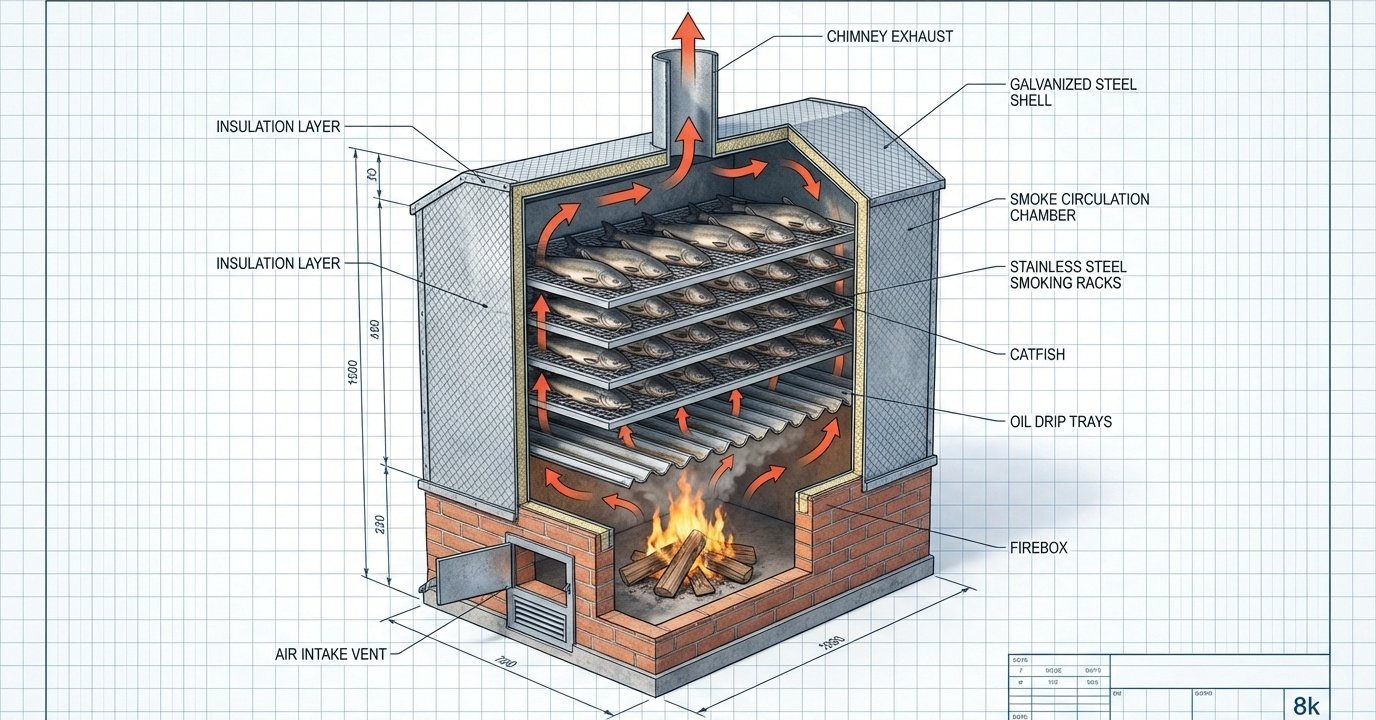
“The Beast” is engineered with thermal retention in mind. By using thick-walled brickwork and controlled ventilation, the kiln traps heat and smoke, circulating it evenly across multiple layers of fish.
-
The Result: We process nearly 10 times the amount of fish using only a fraction more wood than a standard open fire.
-
The Impact: This reduces the carbon footprint of the farm and protects local forests, making the agribusiness more environmentally sustainable and economically profitable.
Food Safety: The War on PAHs
In 2026, international export standards will never be stricter. The primary concern for health regulators in the EU and North America is Polycyclic Aromatic Hydrocarbons (PAHs)—carcinogenic compounds formed when fish fat drips directly onto open flames.
Traditional smoking often results in high PAH levels because the fish is too close to the fire. Our custom kiln solves this through indirect heat engineering:
-
Drip Trays: Prevent oils from hitting the embers.
-
Smoke Filters: Allow the “clean” aromatic smoke to flavor the fish while filtering out heavy soot.
-
Distance Regulation: The height between the heat source and the smoking racks is mathematically calculated to ensure dehydration without charring.
By reducing PAHs, we aren’t just making the fish taste better; we are making it safe for the global dinner table.
Consistency: The Key to Branding
Buyers—especially international distributors—demand consistency. They need every fish in a 1,000kg order to have the same color, moisture content, and texture.
Traditional fires produce “hot spots” where some fish burn while others remain raw. The Beast’s multi-tier racking system ensures that every fish, from the bottom rack to the top, undergoes the same 5-day transformation. This engineering precision allows Otto’s Farms to build a brand that buyers can trust.
Conclusion: Investing in the Beast
For the modern fish farmer, a custom smoking kiln isn’t a luxury; it’s a necessity. It is the bridge between a local pond and a global market. By focusing on firewood efficiency, food safety, and massive capacity, we are proving that the future of African fish farming is built on solid engineering.
Are you ready to scale your farm? If you’re interested in the blueprints or technical specifications of high-capacity kilns, let’s discuss how custom engineering can protect your harvest.
Next Step: Learn more about the biology behind the beast in our next post: [Why Clarias Gariepinus? Understanding the Biology of African Catfish.
Frequently Asked Questions (FAQ)
Q: What makes a kiln “custom” compared to a standard oven? A: A custom kiln like the one at Otto’s Farms is engineered specifically for the dimensions of the African Catfish. It features precise airflow vents, multi-tier racking heights to prevent charring, and thermal-efficient brickwork designed to hold heat for a 5-day cycle.
Q: How does a modern kiln reduce firewood costs? A: Traditional fires lose up to 70% of their heat to the open air. Custom kilns use “thermal mass” (bricks and insulation) to trap heat inside. This allows us to smoke up to 10x more fish with nearly the same amount of fuel.
Q: Are PAHs really a concern for exporters? A: Absolutely. International regulators, especially in the EU, have strict limits on Polycyclic Aromatic Hydrocarbons. Modern kilns use indirect heat and drip trays to ensure fish oils don’t hit the fire, keeping the product within safe, exportable limits.
Q: Can a smaller farm benefit from a high-capacity kiln? A: While the “Beast” is built for 400kg+, the engineering principles (insulation and airflow) can be scaled down. Investing in a smaller, well-engineered kiln is better than using an inefficient open-fire pit.