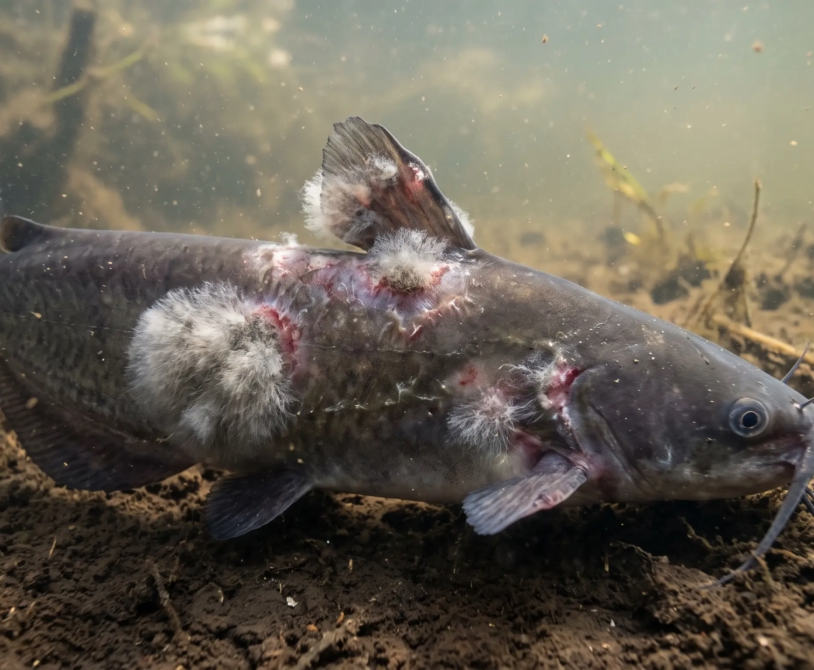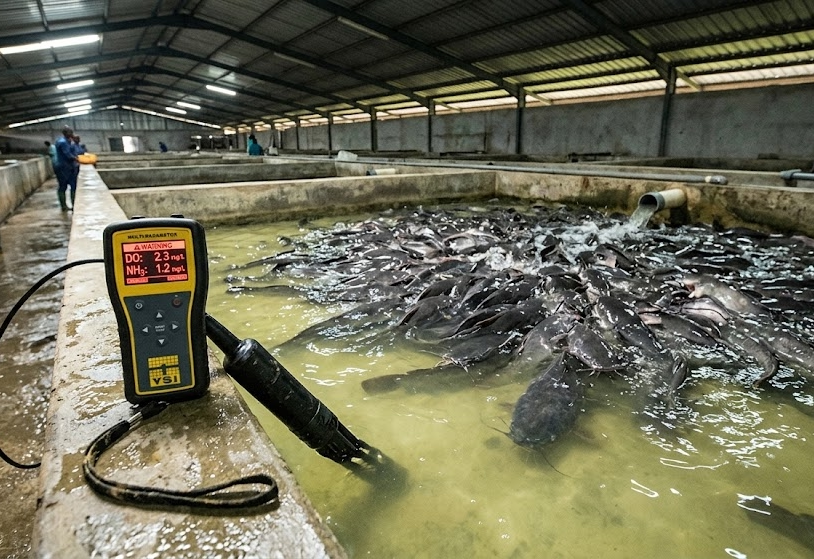
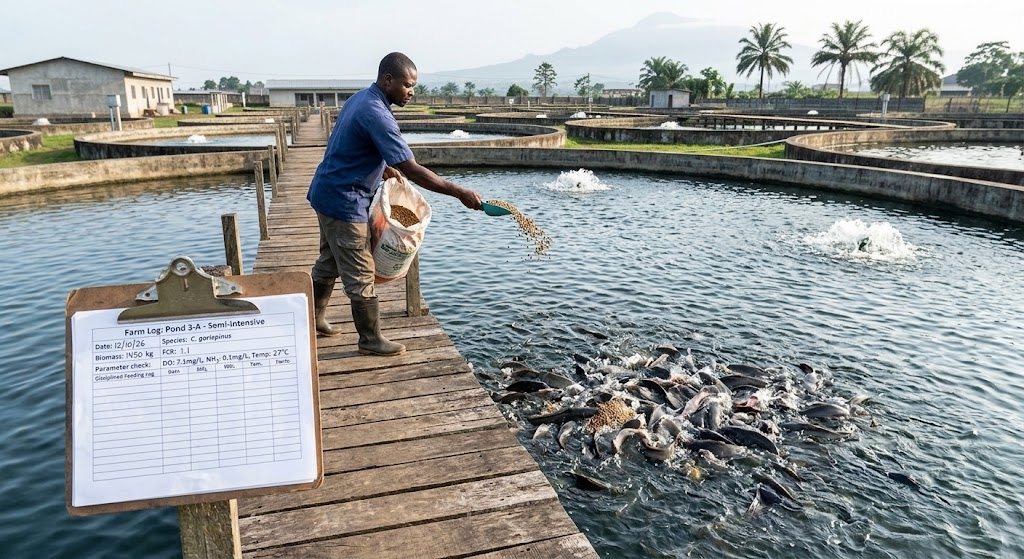
Overfeeding is a common water quality management problem in catfish farming. When farmers provide more feed than fish can consume and utilise, uneaten feed and additional waste can accumulate in the pond or tank. This increases the organic load and can contribute to ammonia accumulation, oxygen depletion, and unstable water conditions.
For African catfish (Clarias gariepinus), controlling feed quantity is important for maintaining water quality, supporting growth and reducing avoidable production losses.
What Happens When Catfish Are Overfed?
Overfeeding affects water quality through uneaten feed, fish waste, and the biological processes involved in decomposition.
When excess feed remains in the water, microorganisms begin breaking it down. This process consumes oxygen and releases nutrients and nitrogenous compounds into the system.
The resulting changes can affect several important water quality parameters, including dissolved oxygen, ammonia, and, in some systems, nitrite.
Overfeeding can also increase operating costs because feed is wasted rather than converted efficiently into fish growth.
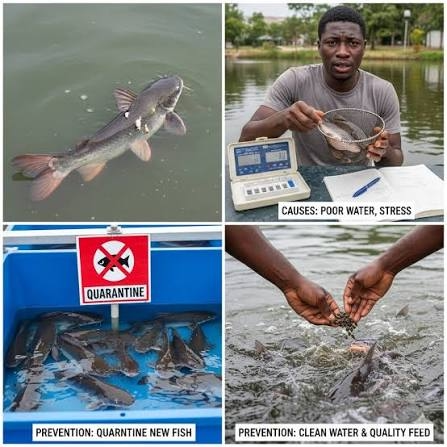
1. Overfeeding Increases Ammonia Levels
Fish release nitrogenous waste through their normal metabolic processes. Uneaten feed and decomposing organic material add to the nitrogen load in the water.
When waste production exceeds the system’s ability to process it, ammonia may accumulate.
Elevated ammonia can damage gills, interfere with normal physiological functions and contribute to poor feeding and mortality.
The toxicity of ammonia depends on total ammonia concentration, pH and temperature. High pH and temperature can increase the proportion present as toxic un-ionized ammonia.
How to reduce the risk:
- Provide feed according to fish size, biomass and appetite.
- Remove uneaten feed where practical.
- Monitor ammonia regularly.
- Maintain effective biological filtration in tank systems.
- Review feeding practices when ammonia repeatedly rises.
2. Overfeeding Contributes to Low Dissolved Oxygen
Decomposing feed and organic waste support microbial activity. The breakdown of this material can increase biological oxygen demand, reducing the oxygen available in the water.
This is particularly concerning in heavily stocked ponds and tanks where fish already place a substantial demand on available oxygen.
Possible warning signs include:
- Catfish gasping at the water surface.
- Fish gathering near water inlets.
- Reduced feeding activity.
- Unusual swimming behaviour.
- Weakness or sudden mortality.
Low oxygen can develop alongside other water quality problems, so testing is essential.
How to reduce the risk:
- Avoid excessive feeding.
- Remove accumulated organic waste.
- Maintain appropriate aeration and circulation.
- Monitor dissolved oxygen, particularly during hot weather and early morning in ponds.
3. Overfeeding Can Contribute to Nitrite Accumulation
Nitrite forms during the biological conversion of ammonia into nitrate.
When excessive feeding increases the nitrogen load, biological filtration may struggle to process the waste effectively. If the system cannot convert nitrogen compounds efficiently, nitrite may accumulate.
Nitrite interferes with oxygen transport in the blood and can cause respiratory distress, weakness and mortality.
This risk is particularly important in tank-based systems with immature or poorly functioning biological filters.
How to reduce the risk:
- Control feed quantities.
- Maintain biological filtration.
- Test ammonia and nitrite together.
- Avoid disrupting established biofilters.
- Investigate recurring nitrogen-compound spikes.
4. Overfeeding Increases Organic Waste
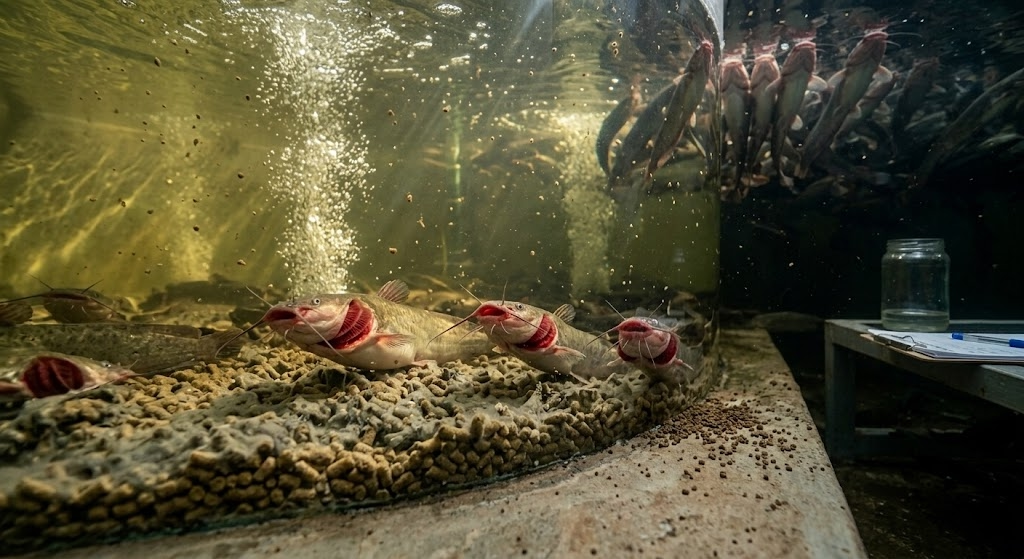
Uneaten pellets, faeces and other organic materials can accumulate at the bottom of ponds and tanks.
Excess organic waste may cause:
- Increased oxygen consumption during decomposition.
- Deteriorating water quality.
- Greater difficulty maintaining stable conditions.
- Sludge accumulation.
- Unpleasant odours.
- Additional demands on filtration and waste-removal systems.
The effects depend on the amount of waste, water circulation, stocking density and the system’s ability to remove or process organic material.
How to reduce the risk: Remove dead fish and accessible waste promptly, clean tanks appropriately and manage pond sludge according to the farming system.
5. Overfeeding Can Cause Cloudy or Foamy Water
Excess feed and organic matter can contribute to visible changes in water quality.
Cloudiness may result from suspended particles, microbial activity or plankton changes. Foam can form when organic compounds and water movement interact.
However, cloudy or foamy water does not prove that overfeeding is the cause. Soil particles, algae, water treatments and other factors can produce similar conditions.
When water appearance changes, inspect feeding practices and test dissolved oxygen, ammonia and other relevant parameters before choosing corrective measures.
6. Overfeeding Increases Production Costs
The effects of overfeeding extend beyond water quality.
Excess feed increases expenses without necessarily producing additional fish growth. It may also increase labour requirements, water treatment costs and the risk of mortality.
Better feed management helps farmers use feed more efficiently while reducing unnecessary waste.
Signs That You May Be Overfeeding Your Catfish
Look for a combination of feeding behaviour, waste accumulation, and water quality changes.
- Feed remains uneaten after the normal feeding period.
- Fish appetite becomes inconsistent.
- Organic waste accumulates on the bottom.
- Ammonia or nitrite readings increase.
- Dissolved oxygen declines.
- Water develops unusual cloudiness or odours.
- Fish show respiratory distress or abnormal behaviour.
No single sign confirms overfeeding. Review the amount of feed provided, fish response, and measured water conditions together.
How to Feed Catfish Without Damaging Water Quality
1. Estimate fish biomass
Feeding requirements depend on the number of fish, their average weight, size, and production stage. Periodically estimate biomass so that feed quantities reflect the current stock.
2. Observe feeding response
Watch how quickly and consistently fish consume feed. Persistent leftovers may indicate excessive feeding, unsuitable pellets, poor appetite or a water quality problem.
3. Adjust feeding to fish condition
Do not continue increasing feed when fish are eating poorly. Check temperature, dissolved oxygen, ammonia and other conditions that may affect appetite.
4. Use suitable feed
Feed should be appropriate for the fish’s size and nutritional requirements. Poor-quality or unsuitable feed may contribute to inefficient feeding and additional waste.
5. Distribute feed appropriately
Distribute feed in a way that allows fish access without creating excessive localised accumulation. The correct method depends on pond or tank design and fish behaviour.
6. Remove uneaten feed
Where practical, remove uneaten feed before it decomposes. Review the cause of repeated leftovers instead of relying on removal alone.
7. Monitor water quality
Test dissolved oxygen, ammonia, nitrite, pH, and temperature according to the intensity and stability of the farming system.
What to Do If Overfeeding Has Already Affected Water Quality
If fish are showing signs of distress or water quality readings have deteriorated, act promptly.
- Assess the fish: Check appetite, swimming behaviour, and whether fish are gasping.
- Measure dissolved oxygen: Improve aeration promptly if oxygen is low or fish show respiratory distress.
- Test ammonia and nitrite: Identify whether nitrogenous waste has accumulated.
- Reduce or temporarily suspend feeding: Avoid adding more waste while fish are stressed and water conditions are being corrected.
- Remove excess feed and waste: Clean accessible waste without unnecessarily disturbing pond sediments.
- Check filtration: In tank systems, confirm that biological and mechanical filtration are working correctly.
- Consider suitable water exchange: Use only replacement water with appropriate quality and manage changes carefully.
- Retest the water: Continue monitoring until conditions stabilise.
Do not apply chemicals or medication simply because the water looks dirty. Identify the actual water quality problem and choose a response appropriate to the system.
Overfeeding and Other Catfish Water Quality Problems
| Water quality problem | How overfeeding may contribute |
|---|---|
| Ammonia accumulation | Adds nitrogen through fish waste and decomposing feed |
| Low dissolved oxygen | Decomposition increases oxygen demand |
| Nitrite accumulation | Increases the nitrogen load that biological filtration must process |
| Organic waste buildup | Leaves more uneaten feed and waste in the system |
| Cloudy water | Can contribute suspended particles and microbial activity |
| Unpleasant odours | May accompany excessive organic waste and decomposition |
These relationships are not automatic. Their severity depends on feeding levels, stocking density, water circulation, filtration and waste-management practices.
Frequently Asked Questions
Can overfeeding kill catfish?
Yes. Overfeeding can contribute to deteriorating water quality, including oxygen depletion and ammonia accumulation. These conditions can cause serious stress and mortality.
Does uneaten feed increase ammonia?
Uneaten feed can contribute to ammonia accumulation as it decomposes. Fish waste also contributes to the ammonia load.
How do I know if I am feeding too much?
Persistent uneaten feed, increasing organic waste and deteriorating water quality may indicate excessive feeding. Compare these observations with fish appetite, biomass and the feeding requirements of the production stage.
Should I stop feeding when catfish are gasping?
Gasping requires immediate attention to water quality, especially dissolved oxygen. Temporarily withholding feed while investigating the problem can prevent additional waste from entering the system, but it does not replace the need to identify and correct the underlying cause.
Can good aeration prevent all problems caused by overfeeding?
No. Aeration helps maintain oxygen availability, but it does not eliminate accumulated feed, directly remove ammonia or guarantee effective nitrogen processing. Feeding control and waste management remain essential.
Conclusion
Overfeeding can undermine catfish pond water quality by increasing organic waste, ammonia production and oxygen demand. These changes can also contribute to nitrite accumulation and other management problems.
Farmers can reduce these risks by estimating fish biomass, observing feeding behaviour, removing uneaten feed, maintaining effective filtration and monitoring water quality consistently.
The goal is not simply to provide more feed, but to supply the right amount while maintaining conditions that allow catfish to use it efficiently