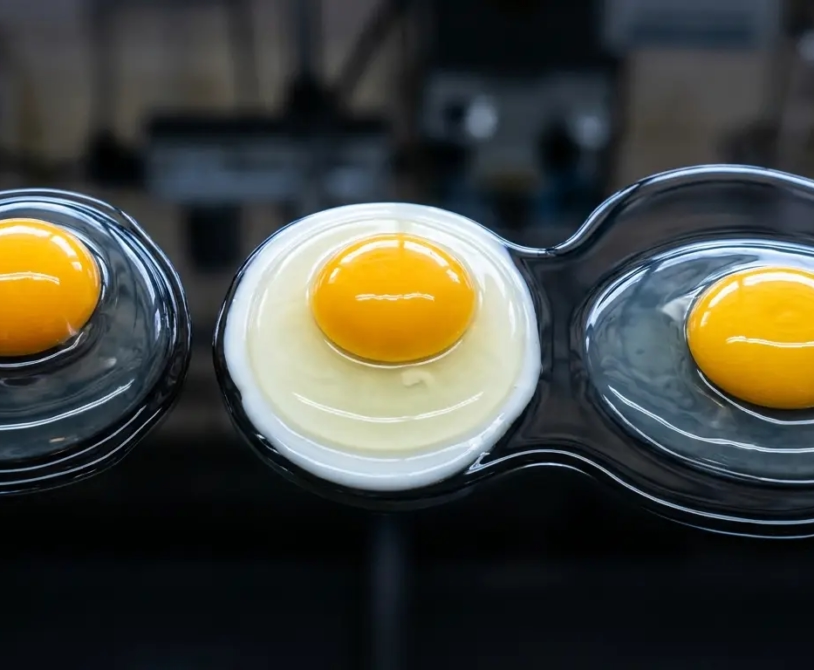

A cracked egg is not a minor inconvenience. It is a revenue event that went wrong — a potential XAF 140 (USD 0.23) sale that became a disposal problem, a bacterial contamination risk, and a daily metric that, when tracked carefully, reveals specific failures in the collection system, the housing infrastructure, or the nutritional program.
The industry benchmark for acceptable cracked egg rates in commercial layer production is below 2%. Well-managed operations consistently achieve below 1%. The difference between a 4% cracked egg rate and a 1% cracked egg rate at a 1,000-bird farm producing 850 saleable eggs per day is:
- At 4%: 34 cracked eggs per day
- At 1%: 8.5 cracked eggs per day
- Daily revenue recovered by closing the gap: 25.5 eggs × XAF 140 (USD 0.23) = XAF 3,570 (USD 5.95) per day
- Annual revenue impact: XAF 3,570 × 365 = XAF 1,303,050 (USD 2,172) per year
From a single management quality metric — cracked egg rate — the improvement from poor to excellent costs nothing beyond the correct knowledge and its consistent application. This article provides that knowledge across the full egg handling chain: from nest box or cage tray to storage facility to delivery.
Understanding Where Eggs Break: The Breakage Audit
Before implementing any improvement, identify exactly where the breakage is occurring. Cracked eggs are not all produced at the same point in the egg handling chain. Identifying the primary breakage source determines which intervention produces the largest improvement.
The Six Breakage Points
Breakage Point 1 — At laying (nest box or cage impact): The egg impacts the nest box floor or cage tray surface at the moment of laying. Hard surfaces, insufficient substrate depth in nest boxes, or damaged/corroded egg trays in cage systems cause breakage at the instant of egg production. Characteristic evidence: cracks with a distinct radial pattern from a single impact point, typically found on the blunt end where the egg lands first.
Breakage Point 2 — Hen stepping on eggs (nest box systems): In community nest boxes or floor systems where eggs are not immediately separated from hens by a roll-away mechanism, hens standing on or kicking eggs after laying cause characteristic star-shaped cracks from point compression. Characteristic evidence: multiple cracked eggs in the same nest area, crack patterns inconsistent with single-impact breakage.
Breakage Point 3 — Collection handling: Eggs dropped, placed with excessive force, or collected into containers that are too full cause breakage during the manual collection process. Characteristic evidence: breakage concentrated in the last eggs placed in a tray (overfilling) or variable-pattern cracks consistent with impact from different directions.
Breakage Point 4 — Tray stacking and transport: Egg trays stacked more than 5–6 high, or transported on rough surfaces without cushioning, cause compression breakage from the weight of upper trays or vibration fracturing. Characteristic evidence: breakage concentrated in the lower trays of a stack, hairline cracks without a clear impact point.
Breakage Point 5 — Temperature shock: Moving eggs from a hot collection environment (32–35°C in a tropical layer house) directly into a cold storage room (4–10°C) causes rapid contraction of the egg’s contents. This creates internal pressure that can crack the shell microscopically — not visible immediately but detectable as a higher proportion of hairline cracks and “leakers” after cold storage.
Breakage Point 6 — Shell quality deficiency: Some eggs crack not because of handling damage but because the shell is too thin or structurally weak to survive normal handling. Thin-shelled eggs from calcium or vitamin D₃ deficiency will crack at a fraction of the mechanical stress that a correctly formed shell would withstand. Characteristic evidence: breakage distributed throughout the batch with consistent thin shell appearance, occurring across all collection rounds rather than concentrated at specific handling points.
Conducting the breakage audit: For two weeks, record the condition (cracked/intact), time of collection, and cage row or floor zone location of every cracked egg at each collection round. This data reveals whether breakage is:
- Uniform across all collection rounds (shell quality issue or transport issue)
- Higher in the first collection round (overnight accumulation and hen-stepping)
- Higher in a specific zone of the house (cage tray damage, ventilation deficiency affecting shell quality in that area)
- Rising over time (progressive shell quality decline from late-lay calcium deficiency)
The audit takes 15 minutes per day for two weeks. The diagnosis it produces saves XAF 1,300,000+ (USD 2,167+) per year.
Collection Frequency: The Most Impactful Single Intervention
The single most effective way to reduce cracked egg rates in commercial layer operations is to collect eggs more frequently. This is also the most consistently underimplemented recommendation in most layer farms — because it requires additional labor rounds.
Why Frequency Matters
Every egg that remains in a cage tray, on a nest box floor, or on a roll-away collection belt after laying is exposed to:
- Additional hen traffic (hens continuing to lay, walk, or perch after the first collection)
- Accumulation pressure from additional eggs laid in the same space
- Temperature fluctuation that weakens the shell membrane over time
- The risk of an older egg being struck by a newly laid one falling onto it
An egg collected 20 minutes after laying has been exposed to one risk event — the impact of laying. An egg collected 6 hours after laying has been exposed to 360 minutes of subsequent hen activity, accumulation pressure, and temperature cycling.
Collection frequency targets:
- Cage systems with egg belt or roll-away collection: collect every 2–4 hours during the active laying period (typically 07:00–14:00)
- Cage systems without belts (manual collection from cage trays): minimum 3 collection rounds per day — 08:00, 11:00, 15:00
- Nest box systems (colony cages or floor housing): minimum 3–4 collection rounds, with emphasis on the 09:00–10:00 collection immediately after peak laying
The improvement from moving from one daily collection to three daily collections in a cage system reduces cracked egg rates by 0.5–1.5 percentage points in most operations — without any other change.
Handling Technique: The Human Variable
Breakage from handling error is entirely preventable — but preventing it requires training, not just instruction. A farm worker who has been told “handle eggs gently” but has never been shown specifically what gentle handling looks like in a cage system collection round will continue handling eggs in ways that cause breakage.
The Correct Collection Sequence
For cage systems (manual collection from trays):
- Approach the cage with the collection tray held level and stable — not tilted, not swinging
- Use a cupped grip — four fingers beneath the egg, thumb above, never squeezing
- Place the egg in the collection tray with a controlled placement — not dropped, not tossed
- Do not fill collection trays more than 30 eggs (one standard layer) — overfilled trays cause compression breakage on the bottom eggs
- Do not stack collection trays while carrying along the cage row — carry a maximum of two trays stacked, and only after the lower tray is covered by the upper tray’s base
- Set trays down on a flat, stable surface — never on an uneven edge or corner
For nest box systems (floor or colony cage):
- Begin collection by removing eggs from nest boxes before hens are disturbed — a hen flushed from a nest box as the collector approaches will step on eggs in her exit
- Check the nest box floor for eggs before inserting the hand — reaching into a dark nest box and pressing down on an egg before feeling it is the most common collection-phase breakage cause
- Roll-away nest boxes: check collection troughs every 2 hours and clear them before accumulation causes pressure cracking of lower eggs
Collection Tray Management
Collection trays are the most abused equipment on the farm and the most overlooked source of egg breakage. Cracked, warped, or broken plastic trays have sharp or uneven surfaces that crack eggs on contact. Missing or compressed paper pulp dimples in paper egg trays fail to cushion eggs from tray-to-tray contact.
Inspection protocol:
- Inspect every collection tray weekly
- Discard any tray with cracked ribs, warped base, broken dimples, or any sharp surface
- Never stack paper pulp trays when wet — wet paper trays compress and lose their cushioning structure
Paper pulp vs. plastic trays:
- Paper pulp trays: better initial cushioning, biodegradable, but degrade rapidly in humid tropical conditions — replace monthly or whenever visibly compressed
- Plastic trays with foam or rubber dimples: more durable, washable, maintain cushioning longer — the superior choice for tropical layer operations despite higher initial cost
The Role of Shell Quality in Breakage Rates
As discussed in the breakage audit section, some cracked eggs represent shell quality failure rather than handling failure. Distinguishing the two requires understanding what structural shell weakness looks like.
Signs of Shell Quality-Driven Breakage
Thin shell (insufficient calcium or vitamin D₃):
- Shell is visibly thinner than normal — appears almost translucent when held to light
- Breaks easily with light finger pressure
- Breakage distributed across all collection rounds, not concentrated at specific handling points
- Coincides with a decline in average shell weight (measure shell weight from 10 eggs weekly: peel the membranes, dry the shells, weigh — should average 5.5–6.5g for a 63g brown-egg commercial layer)
Rough or porous shell (calcium carbonate crystal structure abnormality):
- Shells with irregular surface texture, visible pitting, or chalky patches
- Weaker structural integrity despite adequate thickness — crystal structure defects reduce breaking strength
- Often associated with manganese deficiency, early Infectious Bronchitis viral damage to the shell gland, or vitamin A deficiency
Misshapen or wrinkled shell (oviduct dysfunction):
- Wrinkled, corrugated, or irregular shape — egg formed while the oviduct was contracting irregularly
- Structurally weak at wrinkle points — cracks preferentially along the wrinkle
- Associated with the history of Infectious Bronchitis, Egg Drop Syndrome 76, or chronic oviduct stress
The correction pathway:
- Calcium deficiency → increase calcium to 4.0–4.2% with 50% coarse limestone for overnight release
- Vitamin D₃ inadequacy → increase to 3,500–4,000 IU/kg; check feed freshness and storage
- Manganese deficiency → increase to 80–100 mg/kg organic manganese chelate
- IB history causing oviduct damage → no correction available; manage shell quality nutritionally through the remainder of the cycle
Egg Collection Infrastructure: The Hardware That Prevents Breakage
Nest Box Substrate Management
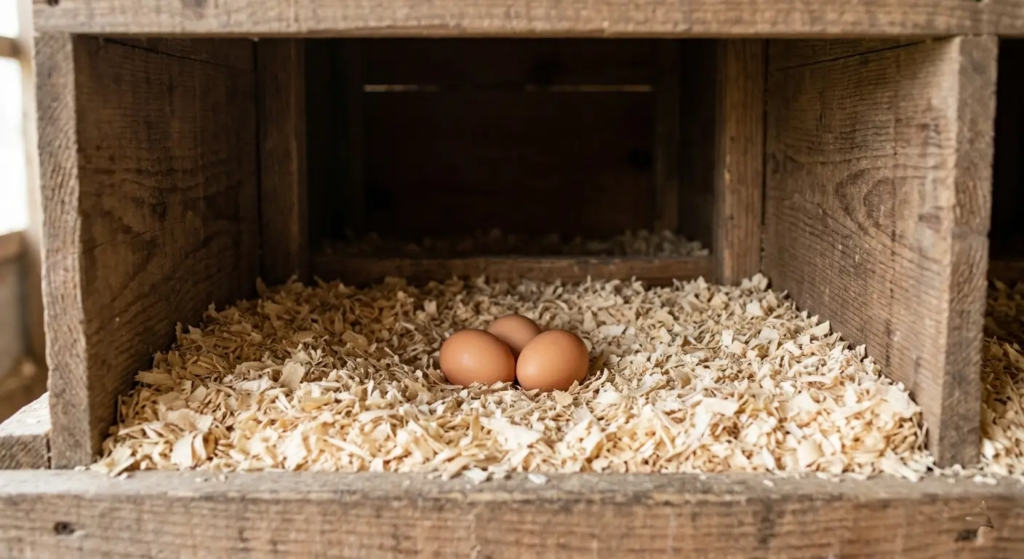
In nest box systems (floor systems, colony cages, aviary systems), the substrate on the nest box floor is the first shock absorber between the laying hen and the egg impact.
Substrate depth for shock absorption:
- Target depth: 5–8 cm
- Below 3 cm: insufficient cushioning; eggs may contact the hard floor beneath
- Above 10 cm: substrate becomes unstable; eggs roll and collide on the soft substrate surface
Material choice:
- Wood shavings (5–8 cm depth): standard choice; replace or top up every 2–3 weeks as shavings compress
- Rubber nest pads: consistent cushioning regardless of management frequency; washable; replace when surface texture deteriorates
- Artificial turf: acceptable but degrades faster than rubber in humid tropical conditions
Roll-away nest floor angle: 8–12°. Below 8°, eggs do not roll away from the nest area consistently. Above 14°, eggs roll at speed and impact the collection trough wall, causing the breakage roll-away floors are designed to prevent.
Cage Tray Surface Condition
In battery cage or colony cage systems, the wire mesh or PVC-coated cage floor that holds eggs before collection is the primary impact and resting surface for the egg.
Wire mesh egg trays:
- Inspect monthly for bent wire tips that can puncture or crack eggs resting on them
- Correct any wires that have migrated out of the flat plane — a single protruding wire end beneath 50 eggs creates breakage every collection round until corrected
- PVC coating on cage wire: extends useful life and prevents rust and sharp edges that degrade uncoated wire; inspect PVC integrity annually
Egg tray padding (foam or rubber strip): In some cage systems, a rubber or foam strip runs along the front edge of the egg collection tray to cushion eggs as they roll forward after laying. Degraded or missing padding is a common overlooked breakage source.
Temperature Management: Preventing Thermal Shock Breakage
Eggs collected at 32–35°C (the ambient temperature of a tropical layer house during peak dry season) and immediately moved into a cold storage room at 8–12°C experience a temperature differential of 20–27°C. Rapid cooling causes the egg’s contents to contract faster than the shell can accommodate, creating internal stress that produces hairline cracks — “cold shock” breakage that is not visible immediately but manifests as cracked or leaking eggs during or after cold storage.
Managing the Temperature Transition
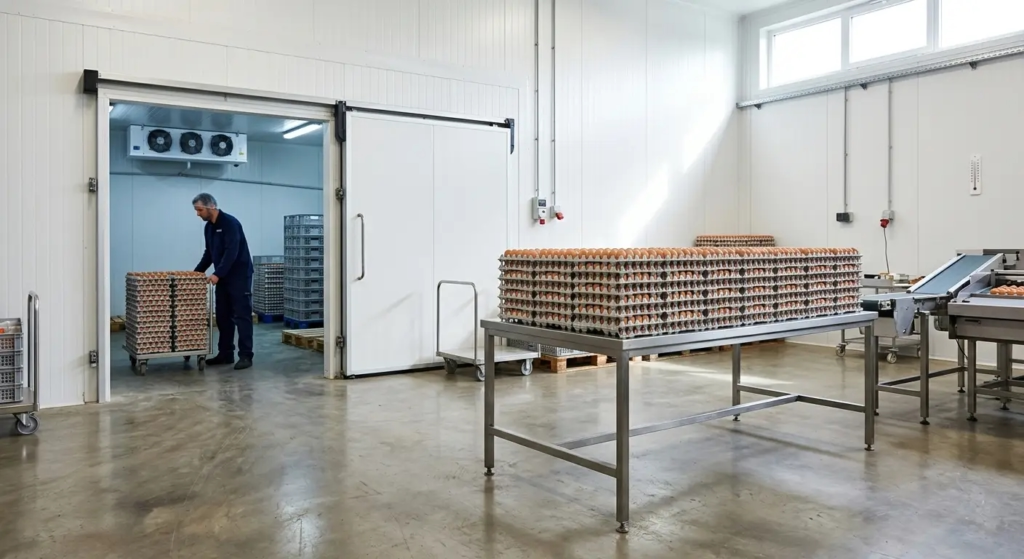
Pre-cooling room (grading area temperature): Maintain the egg grading and sorting area at an intermediate temperature of 20–25°C rather than the cold storage temperature. Eggs should spend 2–4 hours in the grading area before moving to cold storage, allowing the shell to adjust gradually.
Cold storage target temperature: 10–15°C for short-term storage (up to 2 weeks). This temperature range is below the bacterial multiplication threshold for Salmonella and E. coli while avoiding the most severe thermal shock from the tropical collection environment. Temperature below 8°C is recommended for export or longer-term storage but requires careful pre-cooling management.
Avoid condensation: When eggs move from cold storage back to a warm environment, water condenses on the shell surface (sweating). This condensation creates a moisture layer that facilitates bacterial penetration through shell pores. Never move chilled eggs directly to a warm market environment — allow them to come to room temperature in a clean, enclosed space before exposure to open-air market conditions where bacterial challenge is high.
Grading and Sorting: The Quality Gate Before Market
Egg grading — the sorting of eggs by weight class and quality — is the quality control step that separates market-ready eggs from eggs that would damage the farm’s reputation if sold.
Grade Definitions for Commercial Brown-Egg Layers in West Africa
| Grade | Weight Range | Shell Quality | Market Channel |
|---|---|---|---|
| Extra Large (XL) | Above 68g | Clean, intact | Hotel/supermarket premium |
| Large (L) | 63–68g | Clean, intact | Standard retail and wholesale |
| Medium (M) | 55–62g | Clean, intact | Standard retail and wholesale |
| Small (S) | 48–54g | Clean, intact | Budget retail, institutional cooking |
| Cracked (hair crack) | Any weight | Hairline crack, contents intact | Immediate use or cooking processing |
| Dirty | Any weight | Fecal contamination | Wash and grade, or discard |
| Broken | Any weight | Contents compromised | Discard |
Why grading matters beyond quality: In weight-graded markets — supermarkets, hotel supply, some wholesale buyers — eggs sold outside the specified weight range damage the supply relationship. A hotel buyer who receives Medium-grade eggs when Large was specified will renegotiate the price downward or find a new supplier. Consistent grading protects the market relationship.
Manual vs. Machine Grading
Manual grading (hand sorting by weight using a scale): Appropriate for farms up to 2,000–3,000 birds. A trained worker can grade 500–600 eggs per hour by weighing individual eggs and placing them in labeled trays. Cost: zero capital; higher per-egg labor cost.
Semi-automated grading (weight-based tray filler): Appropriate at 2,000–5,000 birds. Eggs roll along a conveyor and drop into grade trays when their weight triggers the drop mechanism. Cost: XAF 3,500,000–9,000,000 (USD 5,833–15,000) depending on capacity. Reduces labor cost significantly; pays back in 18–24 months at commercial volumes.
Automated grading with candling (full-line): Appropriate at 5,000+ birds. Includes weight grading, candling (light inspection for internal quality — blood spots, hairline cracks, air cell position), and automated tray filling. Cost: XAF 25,000,000+ (USD 41,667+). Justified at a very large commercial scale.
For most farms in the 500–2,000 bird range in Cameroon and Nigeria, manual grading with a calibrated digital scale (accurate to ±1g) is the appropriate and affordable method.
Egg Washing: The Controversy and the Correct Position
Egg washing is a topic on which regulatory standards differ between markets. EU standards prohibit washing commercially sold eggs (it removes the protective bloom — the cuticle — that seals shell pores); US standards require washing. West African regulatory standards are not uniformly defined.
The Biology of the Cuticle
The cuticle (bloom) is a thin protein layer deposited on the shell surface during the final moments of egg formation in the uterus. It seals the 7,000–17,000 microscopic pores in the eggshell that would otherwise allow rapid bacterial penetration. An intact cuticle extends shelf life and reduces the probability of Salmonella contamination through the shell by 10–100-fold compared to a washed shell.
The correct West African practice:
- Do not wash eggs unless necessary for sale in a context where consumers specifically demand clean-washed eggs
- If washing is performed: use water at 5–10°C warmer than the egg (not colder — cold water creates suction that draws bacteria into shell pores), with food-grade egg wash solution, and dry eggs immediately after washing to prevent bacterial colonization of the wet shell surface
- Do not use a detergent not approved for food contact surfaces
- Washed eggs must be refrigerated — the bloom removal that makes washing problematic also removes the natural protection that allows unwashed eggs to be safely stored at room temperature for up to 2–3 weeks under West African ambient conditions
The practical recommendation: Keep eggs clean at production by managing nest box hygiene, floor egg rates, and collection frequency — so washing is rarely needed. Clean production eggs handled correctly from collection through sale do not require washing and benefit from intact cuticle protection.
Packaging and Market Presentation: The Final Handling Stage
Egg Tray Selection
Paper pulp trays (30-egg standard, 15-egg retail) are the most common packaging format in West African egg markets. Their dimpled construction provides inter-egg cushioning that prevents lateral movement during transport.
Tray quality verification: Press firmly on the center of an empty tray with one finger — it should resist compression without cracking. A tray that deforms easily under finger pressure will fail to protect eggs from lateral compression during stacking and transport.
Tray labeling: A labeled tray — with the farm name, contact number, egg grade, and collection date — commands premium pricing in formal retail channels (supermarkets, hotels). An unlabeled tray is a commodity product competing on price alone. The cost of printing and applying a paper label: XAF 20–50 (USD 0.03–0.08) per tray. The premium commanded by a recognizable farm brand: XAF 50–150 (USD 0.08–0.25) per tray. Return on the labeling investment: 2–6× the labeling cost in recovered margin.
Transport from Farm to Market
The last handling stage before the buyer receives eggs is transport, and it is the stage where the most breakage occurs in operations without dedicated egg transport infrastructure.
Common transport-caused breakage sources:
- Loose trays sliding on metal truck bed surfaces: line truck beds with foam padding or rubber matting
- Tray stacks exceeding 8 high without restraint: limit to 6 high maximum; use netting or rope restraint for stacks above 4
- Unpaved road vibration: reduce vehicle speed on unpaved surfaces; use shock-absorbing packing material under the bottom layer of trays
- Direct sunlight on trays during transport: cover tray loads with breathable fabric — not plastic sheeting, which creates heat buildup — to prevent thermal shock from solar radiation
Target transport breakage rate: Below 0.3% of eggs transported. Above 0.5% transport breakage requires an investigation of vehicle loading, road surface, or packaging integrity.
The Weekly Cracked Egg Dashboard
Tracking cracked egg rates weekly — by breakage point, by collection round, and by zone of the house — converts breakage reduction from a management aspiration into a managed, measurable process.
Weekly cracked egg dashboard:
| Metric | Week 1 | Week 2 | Week 3 | Target |
|---|---|---|---|---|
| Total eggs collected | 5,950 | 5,980 | 6,012 | — |
| Cracked at collection (round 1) | 28 | 24 | 19 | Below 15 |
| Cracked at collection (round 2) | 18 | 15 | 14 | Below 12 |
| Cracked at collection (round 3) | 14 | 11 | 10 | Below 10 |
| Cracked in storage/transport | 8 | 7 | 6 | Below 5 |
| Total cracked (weekly) | 68 | 57 | 49 | Below 40 |
| Cracked egg rate | 1.14% | 0.95% | 0.81% | Below 0.8% |
| Revenue lost (XAF at 140/egg) | 9,520 | 7,980 | 6,860 | Below 5,600 |
| Revenue lost (USD at 0.23/egg) | 15.87 | 13.30 | 11.43 | Below 9.33 |
This dashboard tracks improvement across three weeks without needing to change the production system — only the handling and collection management. The trajectory from 1.14% to 0.81% across three weeks, and the corresponding revenue recovery, represents the return on the management attention invested in applying this article’s recommendations.
Summary
Egg breakage is not a fixed cost of layer production. It is a variable that responds to collection frequency, handling technique, tray quality, substrate depth in nest boxes, temperature management during storage, and the nutritional program that determines shell integrity before the egg is even laid.
The cracked egg rate is one of the clearest diagnostic signals available in a layer operation — it reveals whether the problem is in the collection system (handling, frequency), the housing infrastructure (cage tray condition, nest box substrate), the storage and transport chain (temperature management, tray stacking), or the nutritional program (calcium, vitamin D₃, manganese).
At XAF 1,303,050 (USD 2,172) per year in recoverable revenue at 1,000 birds from closing the gap between 4% and 1% cracked egg rates — achieved through management improvement with zero capital expenditure — the cracked egg rate is the most undervalued performance metric on most layer farms.
Measure it weekly. Audit the breakage source. Correct the primary cause first. Let the revenue recovery pay for the time invested.