Most piggery failures during expansion do not happen because the operator ran out of pigs to sell — they happen because the business scaled the herd faster than it scaled the systems underneath it. A 10-sow operation run on memory and a notebook can work. A 100-sow operation run the same way cannot, because the volume of daily decisions, the cost exposure of a single management error, and the capital tied up in inventory all grow non-linearly with scale. Scalability in pig farming is not a growth curve for sow numbers — it is a sequence of infrastructure, staffing, and market-access thresholds that have to be crossed in the right order.
Defining the Scale Tiers
| Tier | Sow Herd Size | Annual Market Pigs (approx.) | Typical Operator Profile |
|---|---|---|---|
| Backyard/subsistence | 1–5 | 15–90 | Household enterprise, part-time labor, local sale only |
| Small-scale commercial | 6–25 | 100–450 | Owner-operator, 1–2 hired staff, local and regional markets |
| Medium-scale commercial | 26–75 | 470–1,400 | Dedicated management structure, formal staffing, mixed market channels |
| Large-scale commercial | 76–300+ | 1,450–5,800+ | Multi-tier management, specialized staff roles, processor/export contracts |
This guide focuses on the transition between small-scale (6–25 sows) and large-scale (76+ sows) operations, since this is the range where most operators attempt to scale and where most scaling failures occur.
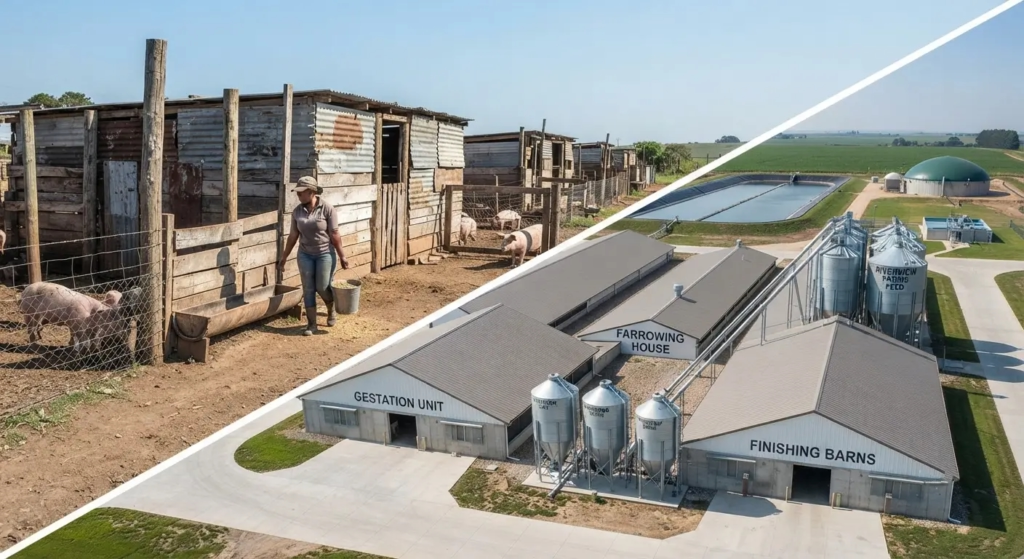
Structural Differences Between Small-Scale and Large-Scale Operations
Capital and Infrastructure
| Factor | Small-Scale (15 sows) | Large-Scale (150 sows) |
|---|---|---|
| Infrastructure CapEx | XAF 45,000,000–60,000,000 | XAF 450,000,000–550,000,000 |
| Housing design | Often adapted/incremental construction | Purpose-built, phase-separated (AIAO by design) |
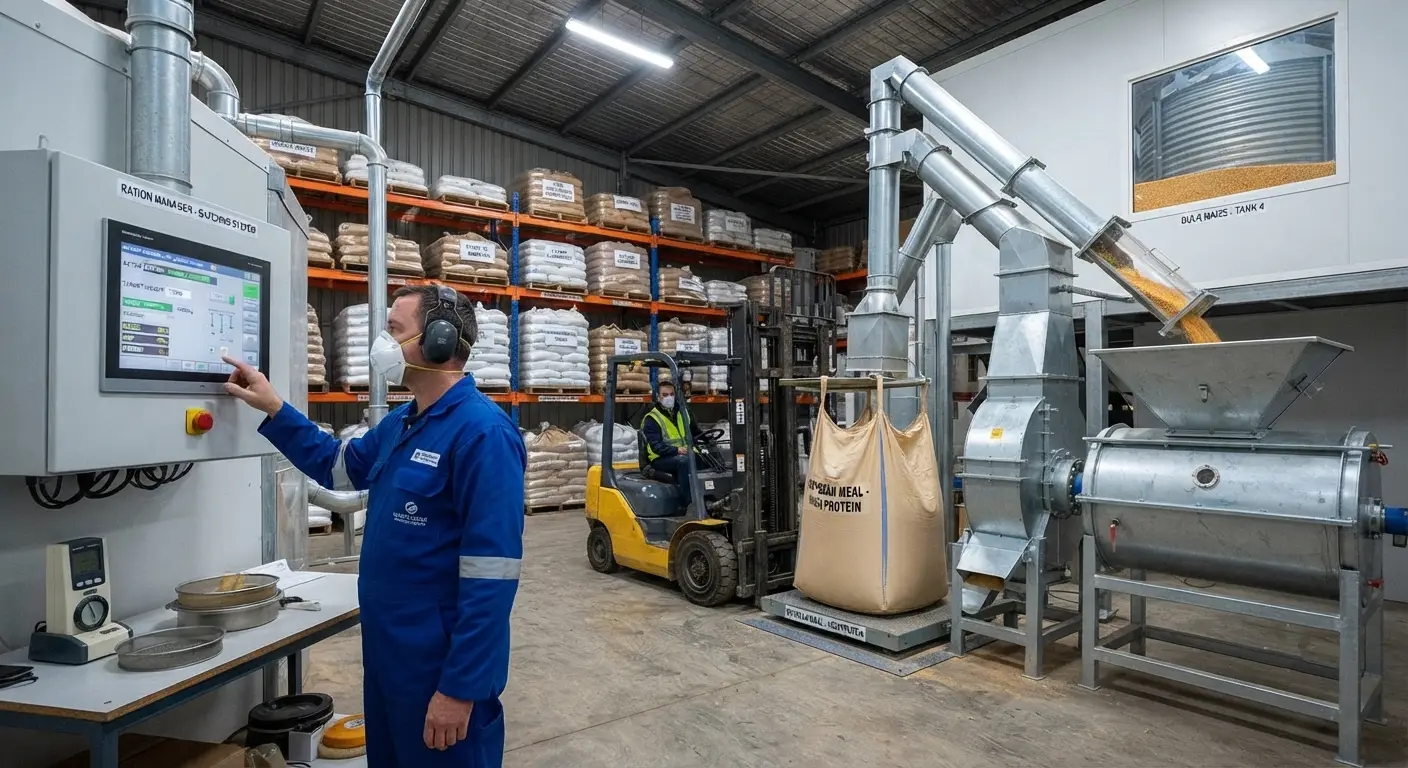
| Feed system | Manual feeding, purchased complete feed | Mechanized feeding, on-farm mixing standard |
| Water system | Basic borehole or municipal connection | Redundant water supply, high-volume distribution |
| Waste management | Basic pit or manual composting | Biogas digester, engineered lagoon, compost systems |
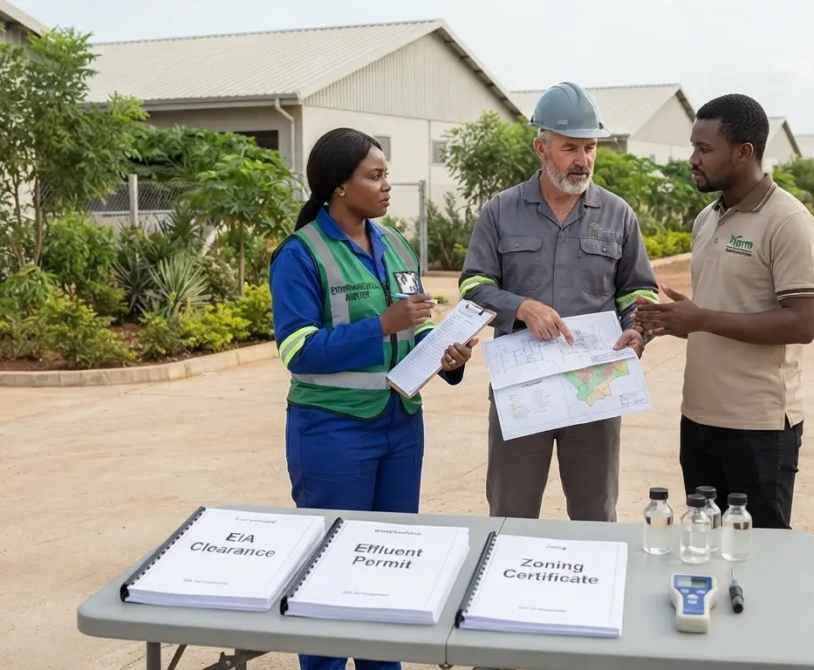
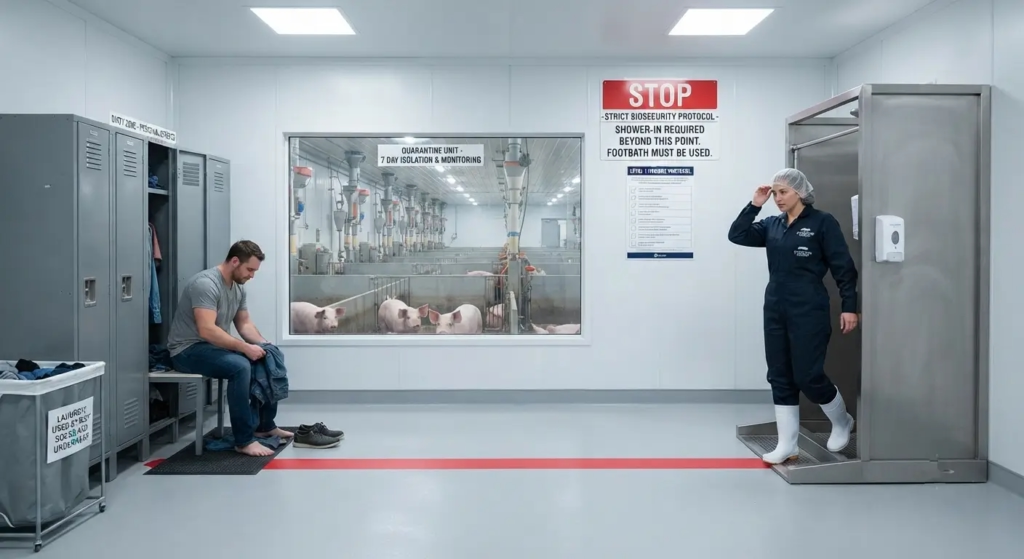
| Biosecurity infrastructure | Minimal — perimeter fencing, informal visitor control | Formal zoning, quarantine facility, shower-in/shower-out protocols |
Labor and Management
| Factor | Small-Scale | Large-Scale |
|---|---|---|
| Staffing model | Owner + 1–2 general laborers, tasks shared informally | Farm manager + specialized stockpersons by section |
| Decision-making | Owner makes all decisions directly, often reactively | Structured protocols, delegated authority with reporting lines |
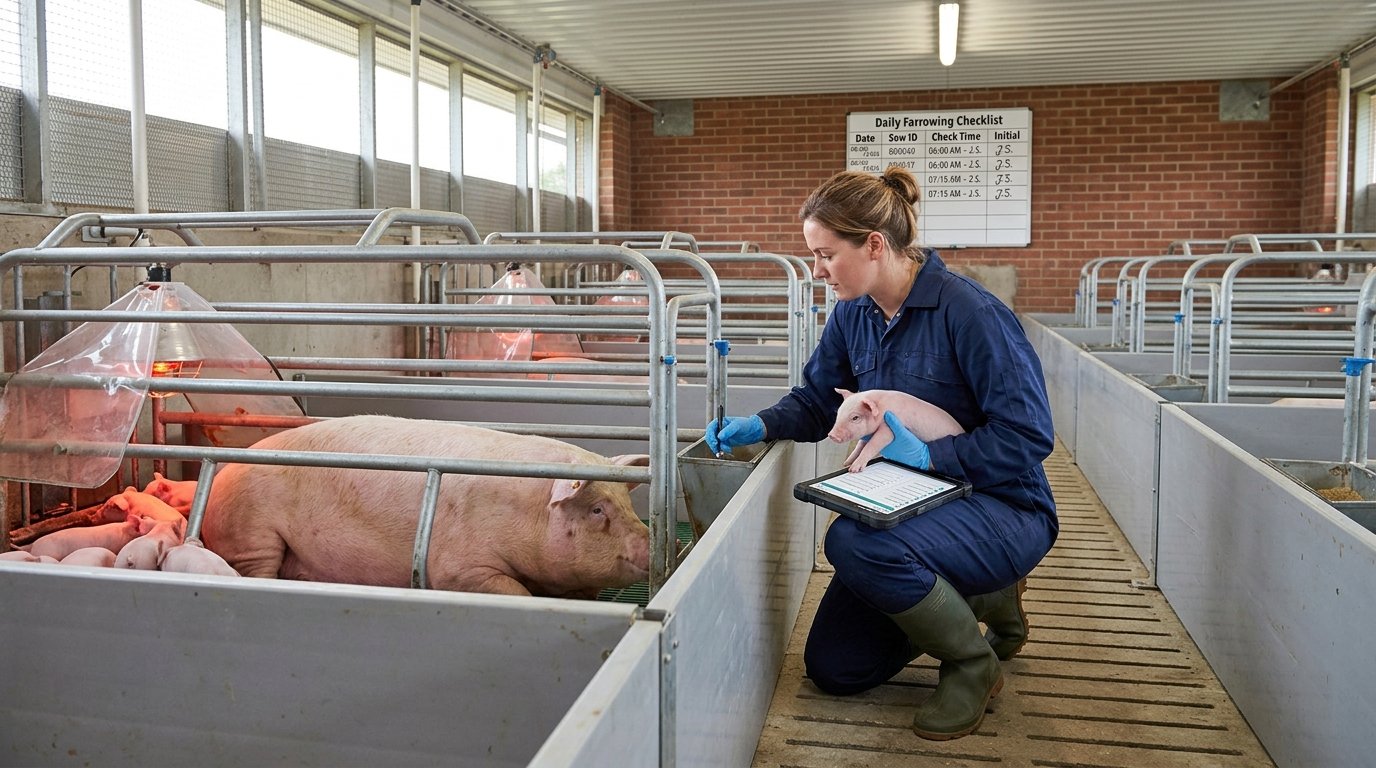
| Record-keeping | Informal, memory-based or simple notebook | Formal daily/weekly/monthly systems, digital tracking common |
| Veterinary relationship | Ad hoc, called when problems appear | Scheduled monthly visits, preventive health calendar |
Feed and Nutrition
| Factor | Small-Scale | Large-Scale |
|---|---|---|
| Feed sourcing | Purchased complete commercial feed | On-farm mixing from bulk ingredients (typically 15–20% cost saving) |
| Ration precision | Often single ration across life stages | Phase-fed by production stage |
| Feed cost as % of OpEx | 55–65% (higher due to purchased feed premium) | 65–75% (higher volume but lower per-unit cost) |
| Purchasing power | Retail pricing, no volume discount | Bulk ingredient contracts, volume discounts |
Market Access
| Factor | Small-Scale | Large-Scale |
|---|---|---|
| Primary channel | Local live pig sales, local butchers | Mixed: wholesale, processor contracts, hotel/restaurant supply, potential export |
| Price negotiation | Price-taker, limited leverage | Price-negotiating position, contract stability |
| Volume commitments | Rarely required | Often required to secure premium channel access |
| Price volatility exposure | High — small volume means no hedge against local price swings | Moderated — diversified channels reduce exposure to any single market |
The Economics of Scale — Where the Numbers Actually Shift
Per-Pig Cost Comparison
| Cost Component | Small-Scale (15 sows) | Large-Scale (150 sows) |
|---|---|---|
| Feed cost per pig | XAF 195,000–210,000 | XAF 165,000–180,000 |
| Labor cost per pig | XAF 35,000–45,000 | XAF 18,000–24,000 |
| Veterinary cost per pig | XAF 12,000–15,000 | XAF 7,000–9,000 |
| Fixed cost allocation per pig (utilities, admin, maintenance) | XAF 20,000–28,000 | XAF 9,000–12,000 |
| Total cost per pig | XAF 262,000–298,000 | XAF 199,000–225,000 |
This is the central economic argument for scale: a large-scale operation produces pigs at roughly 20–25% lower cost per unit than a small-scale operation, driven primarily by bulk feed purchasing/on-farm mixing, labor specialization spreading fixed staff costs across more animals, and fixed overhead (utilities, administration, base veterinary contract) being absorbed by a much larger production volume.
Where Scale Does NOT Automatically Help
Scale is not a guaranteed advantage — it is conditional on execution. Three factors work against naive scale assumptions:
Disease risk scales faster than production. A disease outbreak in a 15-sow herd affects 15 breeding units. The same outbreak in a 150-sow herd, without proportionally stronger biosecurity, can spread through shared airspace, staff movement, and equipment far more efficiently, because more animals mean more contact points. Biosecurity investment must scale ahead of herd size, not behind it — the CapEx tables in Part 2 already reflect this, which is why large-scale biosecurity infrastructure costs are disproportionately higher than a simple multiple of the small-scale figure.
Management complexity scales non-linearly. A 15-sow operation has perhaps 30–40 active decisions per week that matter (feeding adjustments, breeding timing, health observations). A 150-sow operation does not have 10 times that — it has considerably more, because interactions between sections (farrowing scheduling against weaner room capacity, feed batch timing against multiple pen groups) create coordination overhead that does not exist at small scale. This is why large-scale operations require the formal management structure and record-keeping systems described in Part 2 — informal, memory-based management that works at 15 sows fails at 150.
Market absorption is not automatic. Producing 1,400+ market pigs per year at large scale requires market channels capable of absorbing that volume at acceptable prices. An operation that scales production without first securing the wholesale contracts, processor relationships, or premium channel commitments to move that volume will simply depress its own local market price — the same failure mode described in the piggery business plan analysis in this series, where premium channel access is identified as existential to profitability at scale.
The Phased Scalability Strategy
Scaling a piggery is best executed in defined phases, each with its own completion criteria before advancing to the next. Attempting to skip phases — most commonly, expanding herd size before infrastructure, staffing, or market access are ready — is the single most common cause of scaling failure.
Phase 1: Stabilize at Small Scale (6–25 Sows)
Objective: Prove consistent production performance and cash flow before committing capital to expansion.
Completion criteria before advancing:
- Farrowing rate consistently above 80% for at least 3 consecutive breeding cycles
- Pre-weaning mortality consistently below 15%
- Positive operating cash flow for at least 2 consecutive quarters
- Basic biosecurity and record-keeping systems functioning and consistently followed
Phase 2: Infrastructure and Systems Build-Out (Pre-Expansion)
Objective: Build the infrastructure and management systems for the target scale before the herd grows into them — not after.
Key actions:
- Construct phase-separated housing (distinct farrowing, gestation, weaner, and finisher facilities) sized for the target herd, not the current herd
- Install on-farm feed mixing capability ahead of the volume that justifies it, so the cost-saving is available from the first expanded batch
- Formalize record-keeping and task checklist systems (as detailed in the labor management guidance in this series) before staff headcount increases, so new hires join a functioning system rather than helping build one
- Secure at minimum verbal or preliminary commitments from premium market channels for the increased volume
Phase 3: Herd Expansion (Medium Scale, 26–75 Sows)
Objective: Grow the breeding herd into the infrastructure built in Phase 2, in controlled increments rather than a single large purchase.
Key actions:
- Expand breeding stock in batches of 10–15 sows, allowing each batch to reach productive maturity and be evaluated before the next batch is added
- Hire and train specialized stockpersons ahead of the herd reaching the point where a single generalist can no longer cover a section adequately
- Formalize the veterinary relationship into a scheduled preventive program rather than reactive calls
- Begin negotiating formal supply agreements with wholesale or processor buyers as volume approaches contract-worthy levels
Phase 4: Scale Consolidation (Large Scale, 76+ Sows)
Objective: Operate at full target scale with the cost efficiencies of scale realized and risk systems mature enough to protect the larger capital base.
Key actions:
- Complete transition to formal management structure with defined section ownership (as detailed in labor management guidance)
- Lock in bulk ingredient purchasing agreements to realize the on-farm mixing cost advantage at full volume
- Diversify market channels so no single buyer represents more than 30–40% of sales volume, protecting against relationship or contract loss
- Build financial reserves proportional to the larger cost base — a disease event or price shock at 150 sows requires a substantially larger cash buffer than the same relative event at 15 sows
Risk Profile Comparison
| Risk Factor | Small-Scale | Large-Scale |
|---|---|---|
| Disease outbreak impact | Limited absolute loss, but often no reserve to absorb it | Larger absolute loss, but typically better positioned to absorb it with reserves |
| Market price volatility | High exposure — single channel, no negotiating power | Lower exposure — diversified channels, contract pricing |
| Management error impact | Contained to a small herd, easier to correct quickly | Can propagate across sections before detection without formal systems |
| Capital loss exposure | Lower absolute capital at risk | Higher absolute capital at risk, requiring proportionally stronger risk controls |
| Financing dependency | Often self-financed or small loans | Typically requires formal debt financing, adding repayment obligation risk |
The risk profile does not simply get worse with scale — it changes in kind. Small-scale operations are vulnerable to being unable to absorb any shock at all. Large-scale operations are vulnerable to shocks propagating faster and further if the management systems have not scaled alongside the herd. Neither profile is inherently safer; each requires a different risk mitigation approach.
Decision Framework — Should You Scale Now?
Before committing to Phase 2 infrastructure investment, an operator should be able to answer yes to each of the following:
- Has the current operation demonstrated consistent production performance (farrowing rate, mortality, FCR) for at least two full breeding cycles, not just one favorable quarter?
- Is there a specific, identified market channel — not a general assumption of “the market will absorb it” — capable of purchasing the increased volume at acceptable prices?
- Can the business fund Phase 2 infrastructure without depleting the working capital reserve needed to operate the current herd through a normal disease or price-volatility event?
- Is there a credible plan for the management and staffing structure the larger herd will require, including specific people or a hiring plan — not just a headcount number in a spreadsheet?
- Does the expansion timeline allow each phase to reach stability before the next begins, rather than compressing all phases to meet an external deadline (investor expectation, loan term, etc.)?
A “no” answer to any of these questions indicates the operation is not yet ready to scale, regardless of how attractive the per-pig cost economics of large-scale production appear on paper.
Summary
Small-scale and large-scale pig farming are not the same business at different sizes — they are structurally different businesses with different cost drivers, market relationships, labor models, and risk exposures. Large-scale operations achieve genuinely lower per-pig production costs, typically 20–25% below small-scale figures, but only when infrastructure, management systems, and market access are built ahead of herd expansion rather than in response to it. The operators who scale successfully treat growth as a sequence of phases with defined completion criteria, not a continuous line on a sow-count chart — and they resist the temptation to expand the herd before the systems that make a larger herd profitable are actually in place.