A commercial layer hen carries the genetic potential for 320–330 eggs in a 72-week laying cycle. Most flocks produce 270–290. The gap between genetic potential and actual production has many contributors nutrition, health, environment, but the lighting program is the one variable that, when wrong, suppresses production regardless of how well every other input is managed.
Light is not simply illumination in poultry production. It is a hormonal signal — the primary environmental driver of the hypothalamic-pituitary-ovarian axis that controls ovulation frequency. The duration, intensity, and consistency of that signal determine how often the axis fires, how strongly it responds, and whether it sustains peak output for the 30–40 weeks of peak production that determine whether a flock crosses the 300-egg threshold.
A flock that receives 16 hours of light at the correct intensity, consistently and without interruption across 72 weeks, will produce close to its genetic ceiling. A flock that receives 14.5 hours on some days, 15.5 on others, gets a power cut at 11 pm twice a week, and runs at 8 lux instead of 25 lux, will not, regardless of the breed, the feed, or the house design.
This guide covers the complete lighting program for 300+ eggs per year: the biology behind each decision, the schedule construction from rearing through late lay, the lux targets that separate adequate stimulation from optimal stimulation, the timer and equipment requirements that make consistency achievable, and the seasonal adjustments that protect production when ambient conditions change.
The Photostimulation Biology Behind 300 Eggs
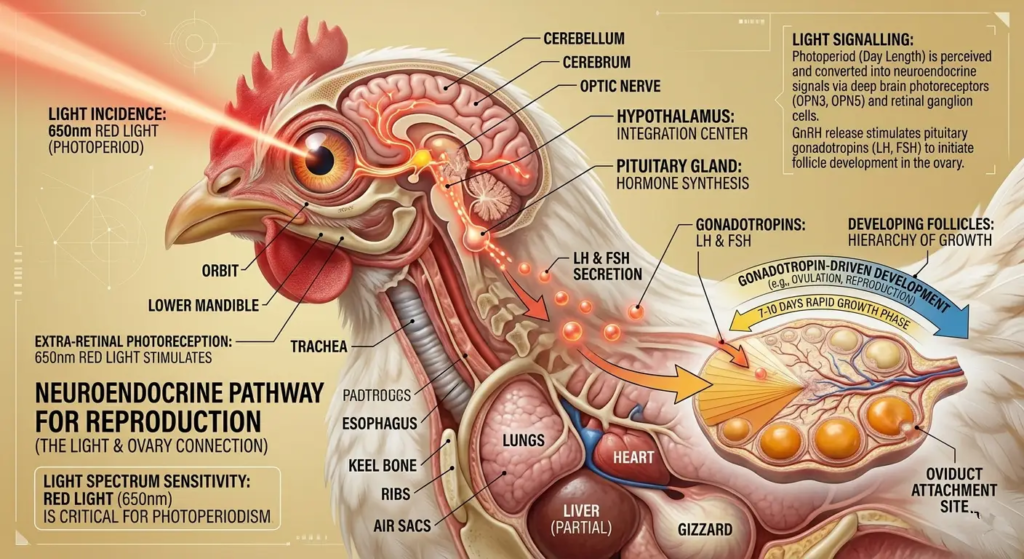
Every element of the lighting program traces back to a single biological pathway: light detected by the retina and by extra-retinal photoreceptors in the hypothalamus stimulates the suprachiasmatic nucleus to release gonadotropin-releasing hormone (GnRH). GnRH reaches the anterior pituitary, triggering follicle-stimulating hormone (FSH) and luteinizing hormone (LH) release. LH drives ovulation of the mature follicle. FSH stimulates the next follicular cohort into development.
The frequency of this cycle — one ovulation approximately every 24–26 hours — is what determines annual egg output. A hen ovulating every 24 hours and maintaining that rhythm for 72 weeks without interruption produces 365 × (72/52) eggs — well above 300. A hen whose ovulatory cycle is disrupted by light inconsistency, interrupted dark periods, or sub-threshold stimulation loses days from her clutch sequence, extends inter-clutch intervals, and falls short of her genetic ceiling.
Three lighting variables directly regulate this pathway:
Photoperiod (duration): The number of continuous hours of light per 24-hour cycle. Below 14 hours, the hypothalamic response is sub-threshold in most commercial brown-egg breeds. At 16 hours, the response is at or near maximum. Above 17 hours, there is no further production benefit, and shell quality may be compromised by disrupted calcium deposition timing.
Illuminance (intensity): The amount of light energy reaching the bird’s retina, measured in lux at bird level. Below 5 lux, the photoperiod signal is too weak to drive full GnRH release regardless of duration. Between 10 and 30 lux, stimulation is adequate to sufficient. Above 60 lux, behavioral problems (feather pecking, aggression) increase without production benefit.
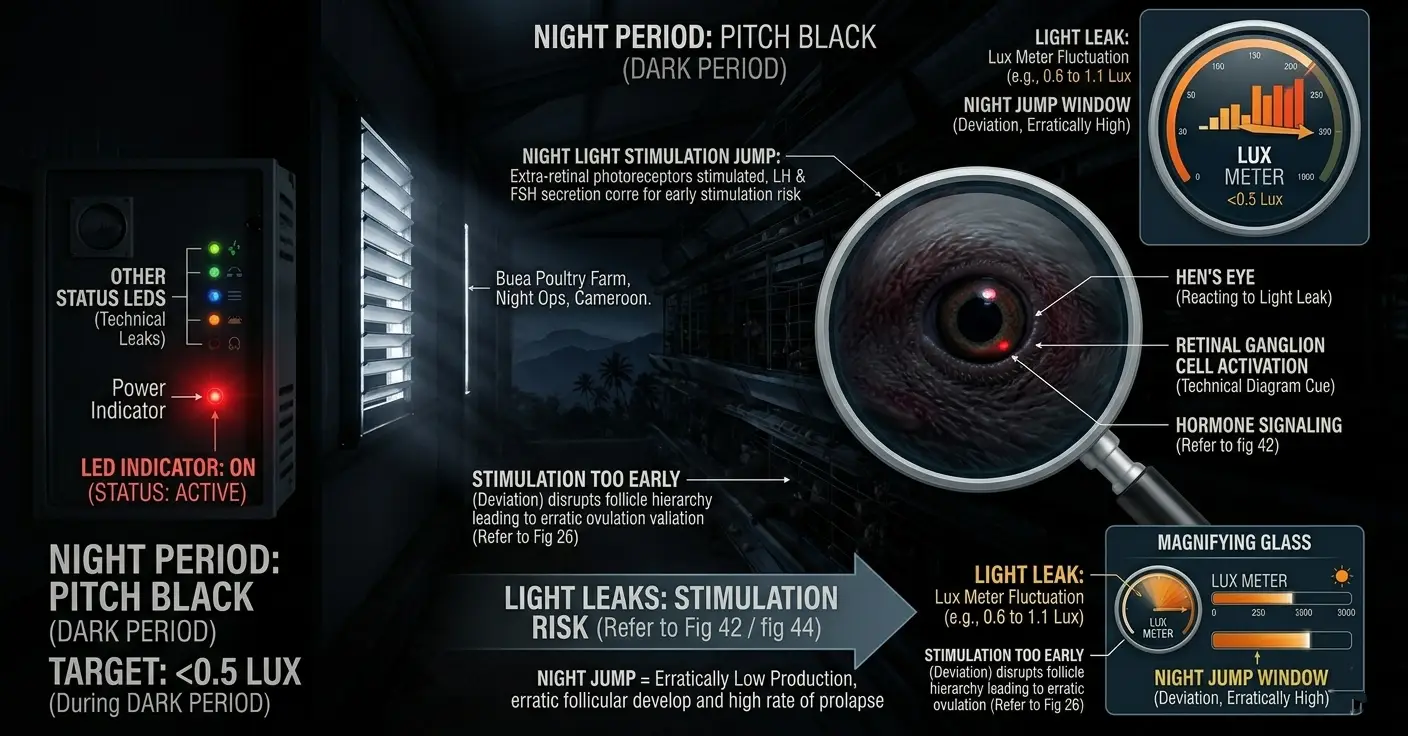
Dark period continuity: The 8-hour dark period is not the absence of stimulation — it is an active biological signal that resets the circadian rhythm and allows calcium mobilization for shell formation. A single light intrusion of more than 0.5 lux during the dark period can reset the biological clock mid-cycle, disrupt the LH surge timing, and cause a soft-shelled or shell-less egg the following day.
All three variables must be managed simultaneously. A correct photoperiod at the wrong intensity fails. A correct intensity at a correct photoperiod with an interrupted dark period fails. The 300-egg outcome requires all three to be correct, consistently, for 72 weeks.
The Complete Lighting Schedule: Rearing Through Late Lay
Phase 1 — Early Brooding (Day 1–7): High Intensity, Long Duration
Day-old chicks need light primarily to find feed and water, not for reproductive stimulation. The photoperiod during the first week is set long — 23 hours of light and 1 hour of darkness — at high intensity (20–30 lux) to ensure chicks locate feeders and drinkers and establish feed intake in the critical first 48 hours.
The 1 hour of darkness is not optional. Chicks raised under continuous 24-hour light never develop a circadian rhythm — they become unable to adapt to the light reduction that comes later in rearing, which causes a production-suppressing stress response at the transition. One hour of darkness from day 1 establishes the light-dark rhythm that the bird’s biological clock will depend on for the rest of its life.
Phase 2 — Rearing (Week 2–16): Deliberate Reduction and Restraint
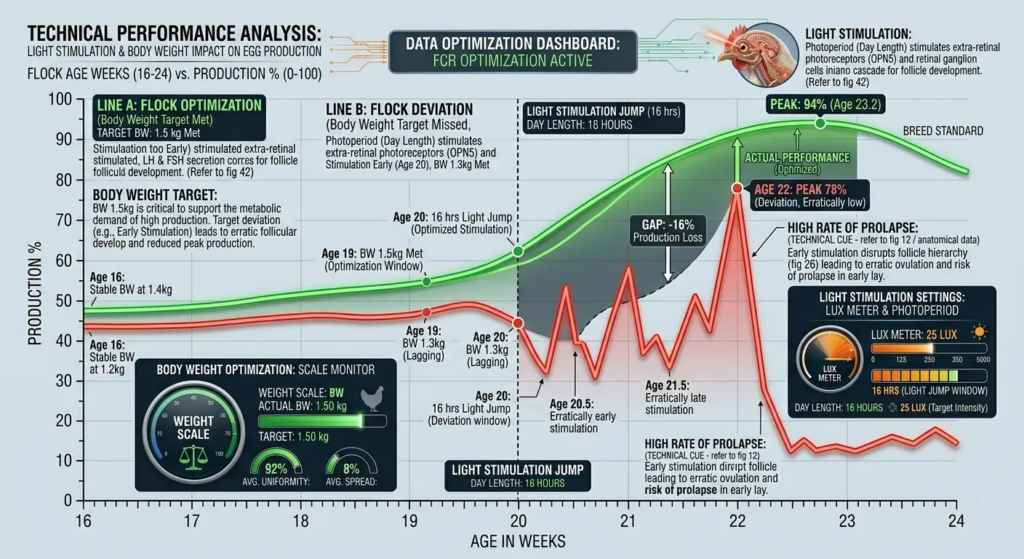
This is the phase most damaging to long-term production when managed incorrectly. The rearing photoperiod must be shorter than the laying photoperiod — and must not increase during rearing. The reason is fundamental: if a pullet receives an increasing photoperiod during rearing, she will reach sexual maturity early — before her skeleton, oviduct, and body weight are ready. She will produce small first eggs, show higher prolapse rates, and enter the laying cycle with a compressed productive life.
Target rearing photoperiod: 8–10 hours of continuous light for pullets reared in light-controlled enclosed houses.
Rearing lux target: 5–10 lux. This is intentionally low — sufficient to allow normal activity, feeding, and flock management, but below the threshold that strongly stimulates the hypothalamic-pituitary axis.
The step-down program for naturally lit houses: In open-sided houses where natural daylight cannot be fully excluded, the rearing photoperiod follows natural day length. In locations where natural day length exceeds 12 hours during the rearing period — common in equatorial West Africa, where day length stays close to 12 hours year-round — supplemental light must be kept minimal, and the house interior kept as dim as possible during the day to prevent premature stimulation.
At week 8, reduce artificial light to the minimum needed for flock management (5 lux, sufficient for feeding and observation). Maintain this through week 16. Do not add supplemental lighting during rearing in response to slow growth or poor uniformity — those are nutrition and management problems, not lighting problems.
Phase 3 — Light Stimulation (Week 17–18): Triggering the Reproductive Axis
Light stimulation is the intentional increase in photoperiod that triggers the reproductive hormonal cascade and initiates laying. It is the most consequential lighting decision in the production cycle — get the timing right and the flock peaks cleanly; get it wrong, and the entire 72-week curve is compressed.
Prerequisites before stimulation (all must be met):
- Average flock body weight within 5% of breed target at week 16–17
- Uniformity above 80% (≥80% of birds within ±10% of average weight)
- Comb development: ≥70% of sampled birds showing bright red, falling combs
- Pelvic width: ≥60% of sampled birds showing 2+ finger gap
If any prerequisite is not met, delay stimulation by one week and recheck. Do not apply light stimulation to an unready flock on the basis of calendar date alone.
The stimulation step-up:
| Week | Photoperiod | Intensity at Bird Level |
|---|---|---|
| Week 17 | Increase to 12 hours | Increase to 20–25 lux |
| Week 18 | Increase to 14 hours | Maintain 20–25 lux |
| Week 19 | Increase to 15 hours | Maintain 25–30 lux |
| Week 20 onward | 16 hours | 25–30 lux (maintain through lay) |
The gradual step-up — 2 hours added per week — is preferred over a single jump to 16 hours at week 17. The gradual increase gives the reproductive axis time to activate progressively, produces more uniform lay onset across the flock, and reduces the proportion of birds that respond to an abrupt stimulation with reproductive regression (a stress-driven suppression of the LH response).
In practice, the week 18–20 transition period is when the first eggs appear. The target is 5% production at week 18–19, 50% production by week 20–21, and 90%+ production (peak) by week 24–26.
Phase 4 — Peak Lay (Week 20–50): Holding 16 Hours Precisely
Once the flock has reached 16 hours of light, this photoperiod must be maintained without reduction for the remainder of the laying cycle. Any reduction in photoperiod — even 30 minutes — signals to the hen’s biological clock that day length is shortening, which in the natural seasonal cycle signals approaching winter and triggers reproductive regression.
This is the most commonly violated rule in commercial layer lighting programs. Timer failures, power outages, equipment changes, and seasonal shifts in natural daylight (in open-sided houses) all create unintended photoperiod reductions that suppress production without any visible cause. The production dip that appears 2–3 weeks after a lighting disruption is frequently attributed to disease, feed change, or flock stress, and the lighting record is not examined.
What 16 hours at peak lay requires:
- A digital timer verified weekly against actual switch times
- A backup power supply (UPS or generator transfer switch) for the lighting circuit
- In open-sided houses: a monitoring log of natural day length vs. total photoperiod, with supplemental lighting adjusted to maintain the 16-hour total as seasons change
- Light intensity checks with a lux meter at bird level every 8 weeks — bulb output declines with age and dust accumulation, and the 25 lux that was measured at installation may be 14 lux after 6 months of operation.
Phase 5 — Late Lay (Week 50–72): Maintaining Stimulation Through Declining Response
As the flock ages, the ovarian response to the same photoperiod stimulus declines. Follicular reserve decreases. The interval between ovulations lengthens. Some operations attempt to compensate by increasing photoperiod beyond 16 hours — adding 17 or 18 hours of light in late lay to restore production rate.
The evidence for this practice is mixed, and the risks are real: extending photoperiod beyond 16 hours in late lay increases the proportion of double-yolk eggs, may disrupt the dark period calcium mobilization timing, and can accelerate reproductive exhaustion in birds that are already in the declining phase of their cycle.
The more reliably effective intervention in late lay is maintaining intensity rather than extending duration. Birds whose retinal sensitivity declines with age — a normal aging process — require slightly higher lux levels to receive the same effective stimulation. Increasing lux from 25 to 35–40 lux at bird level in weeks 50–72 sustains the hypothalamic response more reliably than extending photoperiod.
Simultaneously, a late-lay ration review — increasing calcium percentage and maintaining vitamin D₃ at 4,000 IU/kg to support declining absorption efficiency — keeps shell quality from undermining the eggs that are still being produced.
Lux Targets That Actually Drive 300 Eggs
Lux (lumens per square meter) is not a lighting design specification. It is a biological input. The 25 lux on the design drawing is irrelevant if what reaches the bird at cage level — after distance attenuation, dust accumulation, bulb aging, and reflector fouling — is 9 lux.
How to Measure Lux Correctly
Use a calibrated digital photometer (lux meter). Measure at bird level — the height at which the bird’s eye is located — not at the floor, not at the ceiling, not near the bulb. In cage systems, measure inside the cage at the location where the hen spends most of her time. In floor or aviary systems, measure at standing height across the full floor area.
Take readings at:
- The center of the house
- 1 meter from each sidewall
- 1 meter from each end wall
- Directly under each bulb and at the midpoint between bulbs
The lowest reading in the house is the effective lux level for the birds in the worst-lit zone. The average reading is irrelevant if one zone is below the stimulation threshold.
Acceptable lux variation: The maximum reading should not exceed 3× the minimum reading within the same house section. If the center reads 45 lux and the corners read 8 lux, the house has a lighting problem that cannot be solved by timer management — it requires additional bulbs or repositioned reflectors.
Lux Targets by Phase
| Phase | Target Lux at Bird Level | Notes |
|---|---|---|
| Brooding (Day 1–7) | 20–30 lux | High: guides chicks to feed and water |
| Rearing (Week 2–16) | 5–10 lux | Low: prevents premature stimulation |
| Stimulation (Week 17–20) | 20–25 lux | Increase with photoperiod step-up |
| Peak lay (Week 20–50) | 25–30 lux | Maintain; measure every 8 weeks |
| Late lay (Week 50–72) | 30–40 lux | Increase slightly to compensate retinal sensitivity decline |
LED Bulb Selection for Layer Houses
LED technology is the current standard for commercial layer house lighting. The selection criteria that matter for 300-egg performance:
Color temperature: 2,700–3,000K (warm white). This color temperature delivers a higher proportion of red wavelengths (600–700 nm) — the spectrum most stimulatory to the avian hypothalamic photoreceptors. Cool-white LEDs (5,000K+) skew toward blue wavelengths that are calming rather than stimulatory. Use warm white throughout the laying period.
CRI (Color Rendering Index): CRI above 80. Higher CRI means the light spectrum more closely matches daylight across wavelengths — including those the bird detects through extra-retinal photoreceptors — producing a more complete photostimulatory signal.
Agricultural-grade sealing: Standard consumer LEDs fail within 12–18 months in poultry house conditions; ammonia, dust, and humidity degrade the driver circuit. Agricultural-grade LEDs sealed against these conditions last 25,000–50,000 hours. At 16 hours of daily operation, that is 4–8 years of service life.
Dimmability: Dimmable LEDs allow gradual dawn and dusk simulation (15–30 minute ramp-up and ramp-down) rather than abrupt on-off switching. Dawn and dusk simulation reduces stress-related behaviors, prevents panic responses at sudden darkness, and allows hens on perches or in nest boxes to settle safely before full darkness. Specify dimmable LEDs and a compatible dimmer at installation.
Timer Systems: The Infrastructure That Makes Consistency Possible
The biology is straightforward: 16 hours of light, 8 hours of uninterrupted darkness, consistent every day for 72 weeks. The management challenge is making that happen reliably in an environment with power outages, dust, equipment aging, and the human tendency to “just check something quickly” with a flashlight during the dark period.
Minimum Timer Requirements for 300-Egg Programs
Digital programmable timer with battery backup: The battery maintains programming memory and continues timing through power outages. Without battery backup, a 30-minute power cut resets the timer to default settings, which in most cases means lights on continuously. The flock receives a disrupted dark period. Production dips two to three weeks later.
Dedicated lighting circuit: The lighting circuit must be isolated from equipment circuits (feeders, fans, water pumps). A feeder motor fault that trips the breaker takes the lights with it if they share a circuit. A dedicated breaker for lighting is non-negotiable in a 300-egg program.
Timer verification protocol: Check actual switch times against programmed switch times weekly using a watch. Timers drift. Mechanical interval timers drift more than digital ones. Verify, not assume.
Light-tight door and penetration sealing: The dark period is 8 hours of dark, not 8 hours of dimness. A gap under a door, an unblocked ventilation inlet, or a translucent roof panel that admits 2 lux of moonlight or streetlight is sufficient to partially disrupt the circadian rhythm and LH surge timing. Walk through the house during the dark period with all lights off. Locate and seal every light leak before the production cycle begins.
Backup Power for Lighting
In West and Central Africa, where grid power reliability varies significantly by region and season, backup power for the lighting circuit is not a luxury — it is a production protection measure.
Options in order of cost and reliability:
- UPS (uninterruptible power supply): Suitable for small houses with low total lighting wattage. Switches to battery in milliseconds. LED lighting makes UPS-powered lighting practical at an affordable battery capacity. Calculate total lighting wattage and select a UPS rated for at least 8 hours of runtime.
- Generator with automatic transfer switch: For larger houses where UPS capacity is insufficient. The transfer switch activates the generator within 10–30 seconds of grid failure. Lights flicker briefly, but the dark period is not meaningfully interrupted.
- Solar-with-battery system for lighting circuit: In off-grid or unreliable-grid locations, a dedicated solar panel array charging a battery bank for the lighting circuit alone provides the most reliable dark-period protection. Lighting loads for LED-equipped layer houses are low enough (0.5–1.5 kW for a 5,000-bird house) that a 3–5 kW solar system covers the lighting circuit comfortably.
Seasonal Adjustments: Open-Sided Houses in Tropical Climates
Fully enclosed, light-controlled houses eliminate seasonal variability — the artificial lighting program runs independently of natural day length. For open-sided houses — the majority of commercial layer infrastructure in West and Central Africa — natural daylight contributes to the photoperiod and varies through the year, requiring active monitoring and adjustment.
Natural Day Length in Equatorial West Africa
Near the equator (latitudes 0–8°N, which includes southern Cameroon, Nigeria south of latitude 8°N, Ghana, Côte d’Ivoire), natural day length varies between approximately 11.5 and 12.5 hours across the year — a relatively small seasonal variation compared to higher latitudes.
This is both an advantage and a management requirement. The advantage: natural day length alone is close to the stimulation threshold, reducing the supplemental lighting load. The requirement: that supplemental lighting must be precisely calibrated to bring the total photoperiod to exactly 16 hours — and must be adjusted as natural day length shifts through the seasons.
The Monitoring and Adjustment Protocol
- Record local sunrise and sunset times monthly (available from timeanddate.com or a weather station app for your specific location)
- Calculate the natural day length for that month.
- Set supplemental lighting to close the gap: Supplemental Hours = 16 − Natural Day Length Hours.
- Split supplemental hours between early morning (pre-sunrise extension) and evening (post-sunset extension) to minimize total artificial lighting operating time
- Verify total photoperiod by monitoring: lights on + sunrise time and sunset time + lights off must equal exactly 16 hours.
If natural day length exceeds 16 hours at any point — which does not occur at equatorial latitudes but can occur at latitudes above 12°N during the northern hemisphere summer — supplemental lighting is unnecessary. In these conditions, light exclusion to maintain exactly 16 hours (rather than allowing 14+ hours of natural light plus supplemental) is the correct management response.
Measuring the Output: Production Data as Lighting Program Feedback
The 300-egg target is not monitored by counting eggs at the end of week 72. It is monitored week by week through the production data, which is the only reliable feedback signal for whether the lighting program is delivering what it was designed to deliver.
Key Production Metrics to Track Weekly
Hen-day production rate: The percentage of birds producing eggs on any given day. The target trajectory: 5% at week 18–19, 50% at week 20–21, 90%+ by week 24–26, maintained above 80% through week 55–60, declining to 65–70% by week 72. A production rate that reaches 75% and plateaus — never achieving the 90% peak — indicates that 25% of the flock is not receiving adequate photostimulation. Check the lux levels in the areas where those birds are housed.
Production dip timing: A sudden production drop of 5–10% that appears 2–3 weeks after any operational event is a lightning disruption signature. The 2–3 week lag reflects the ovulatory cycle’s recovery time after a GnRH disruption. Investigate the lighting log for that period. Common culprits: power outage, timer reset, dark period intrusion during maintenance work, bulb failure in a key zone.
Shell quality trend: Progressive thinning of shells across the laying cycle is a late-lay calcium formulation issue, not a lighting issue. But shell-less eggs appearing in clusters — particularly in the first collection of the morning — indicate overnight calcium disruption, which in some cases traces back to dark period light intrusion disrupting the calcium mobilization cycle.
Cumulative eggs per hen housed: Calculate at week 30, 50, and 72. Compare against breed standard curves published by your breed supplier. A flock tracking below the breed curve at week 30 has a structural production problem — nutrition, lighting, health, or housing — that will not correct itself. Identify the cause and intervene.
The 300-Egg Calculation: What the Schedule Must Deliver
To produce 300 eggs per hen housed in 72 weeks, the flock must average a hen-day production rate of:
300 ÷ (72 × 7) = 59.5% average hen-day production across the full cycle
Achieving 59.5% average requires a peak well above that level — the production curve rises steeply, holds peak for 30–40 weeks, then declines. A flock that peaks at 90%, holds peak for 35 weeks at an average of 88%, and declines at a rate of 0.3% per week from week 55 through week 72 will deliver approximately 310–315 eggs per hen housed.
A flock that peaks at 82%, holds for 25 weeks at an average of 79%, and declines at 0.5% per week will deliver approximately 265–275 eggs — a 45-egg deficit per bird that, at 5,000 birds, is 225,000 fewer eggs per cycle. At prevailing commercial egg prices, that deficit defines whether the production cycle is profitable.
The lighting program cannot deliver those outcomes alone. But without a correctly executed lighting program, no amount of feed quality, health management, or housing investment will close the gap.
Summary
Three hundred eggs per hen per year is a lighting management outcome as much as it is a genetic one. The photoperiod must be long enough to fully stimulate the hypothalamic-pituitary-ovarian axis — 16 hours. The intensity must be high enough to produce that stimulation at bird level — 25–30 lux. The dark period must be complete and uninterrupted — 8 hours of genuine darkness every night for 72 weeks. The timer must deliver this with enough consistency that the biological clock never receives a conflicting signal.
None of these requirements is technically difficult. All of them require deliberate attention, the right equipment, a verification routine, and the discipline to treat the lighting program as the production-critical infrastructure it is — not an afterthought managed by a timer set once at the start of the cycle and assumed to be running correctly ever after.
Flocks that produce 300+ eggs are managed by farmers who check the lux meter, verify the timer, seal the light leaks, have backup power for the lighting circuit, and read the production data as a real-time feedback signal for whether the program is delivering what it was designed to deliver.
That is not complexity. That is consistency. And consistency is what 300 eggs require.