A finisher pig’s daily gain is not limited by how much feed it eats. In most commercial production contexts, pigs in the 60–110 kg weight range are fed ad libitum — they eat as much as they choose. Their daily weight gain is limited, instead, by the rate at which their genetically determined biological machinery can synthesize new lean tissue — and that rate is limited, in turn, by whether the correct amino acids are available in the correct proportions to supply that synthesis process at the moment it is occurring.
Of all the nutrients in a pig’s diet, amino acids are the most precisely constrained. Energy is stored and mobilized — a pig that receives more energy than it needs in a given day stores the surplus as fat, and a pig receiving slightly less than ideal can partially compensate by mobilizing body reserves. Amino acids cannot be stored in any meaningful quantity. They are either present when the cells of the muscle tissue require them for protein synthesis, or protein synthesis slows and the pig grows less lean tissue than its genetics would otherwise allow.
Lysine is the first of these limiting amino acids in the conventional maize-soybean meal rations that dominate West African commercial pig production. It is the amino acid whose supply most frequently constrains lean growth rate before any other amino acid becomes limiting. Understanding why lysine holds this position, how to ensure its supply precisely matches the finisher pig’s requirement, and how the broader ideal protein framework extends this precision across all the essential amino acids that collectively determine lean growth rate — this is the nutritional knowledge that separates a finisher operation performing close to its genetic ceiling from one operating significantly and unnecessarily below it.
Part 1: What Amino Acids Do in the Finisher Pig’s Body
Protein Synthesis: The Cellular Process That Creates Lean Tissue
Lean muscle tissue is primarily protein — approximately 22% protein, 75% water, and 3% lipid and mineral on a fresh weight basis. The protein in muscle tissue is continuously synthesized from amino acid precursors and simultaneously degraded (broken down) — the net balance between synthesis and degradation determines whether the pig’s muscle mass is growing (positive protein balance, synthesis exceeds degradation), maintaining (synthesis equals degradation), or declining (negative protein balance, degradation exceeds synthesis).
Finisher pig production depends on maintaining a strongly positive protein balance — maximizing synthesis rate and minimizing degradation rate simultaneously, so the maximum possible net lean tissue accretion occurs within each day of the finisher phase.
Every protein synthesis event in every cell requires the simultaneous availability of all 10 essential amino acids (those the pig cannot synthesize at an adequate rate from other precursors and must therefore obtain from dietary intake): lysine, methionine, cystine, threonine, tryptophan, isoleucine, leucine, valine, arginine, and phenylalanine + tyrosine. If any one of these amino acids is absent or present in quantities below the requirement for the current rate of synthesis, that specific synthesis reaction cannot complete — the ribosome stalls and the partially synthesized protein chain is degraded and its constituent amino acids recycled.
This is Liebig’s Law of the Minimum applied at the molecular level: the rate of protein synthesis is limited by the essential amino acid present in the lowest amount relative to its requirement — the first-limiting amino acid. Supply everything except enough of the most limiting amino acid, and the overall synthesis rate is constrained to what that deficient amino acid allows, regardless of how abundant all the others are.
Why Lysine Is Typically First Limiting in West African Pig Rations
The conventional West African finisher ration — maize as the primary energy source, soybean meal as the primary protein source, with regional byproduct ingredients where incorporated — has a specific amino acid profile that, relative to the finisher pig’s requirement pattern, is most deficient in lysine first. Several factors contribute to this:
Maize’s low lysine content relative to total protein: Maize contains approximately 0.25% lysine in its total crude protein fraction — significantly lower than the ideal protein ratio (which requires lysine to constitute approximately 6.8% of the ideal protein supply for the growing-finishing pig). Even though maize constitutes 50–65% of the total ration, its lysine contribution to the ration’s total amino acid pool is disproportionately small relative to its protein contribution.
Soybean meal’s lysine content — better, but constrained by processing and inclusion rate: Soybean meal has a much better lysine profile than maize (approximately 3.0% lysine in total crude protein vs. maize’s 0.25%), and its higher inclusion rate in pig rations compared to the actual pig requirement makes it the primary lysine source in most conventional rations. But even well-formulated conventional rations frequently approach but do not fully meet the finisher pig’s lysine requirement, particularly as the ration is pushed to reduce crude protein levels (and therefore soybean meal inclusion) to capture cost savings — the approach encouraged by the ideal protein/synthetic amino acid strategy described elsewhere in this series.
What Happens Below the Lysine Requirement
When dietary lysine supply falls below the finisher pig’s daily requirement, the rate of lean tissue protein synthesis is constrained — the pig’s muscle cells cannot synthesize new protein as rapidly as its genetics would allow, because the limiting amino acid is not present in adequate supply at the moment of synthesis.
The consequences of this constraint are directly measurable:
- Reduced average daily gain: Less lean tissue deposited per day means lower total weight gain per day (since lean tissue, water, and associated mineral deposition dominate total weight gain in the growing pig)
- Worsened feed conversion ratio: The pig continues eating and metabolizing energy at a rate appropriate for its body size, but less of that metabolic activity translates to lean tissue growth — effectively, the same (or similar) feed intake produces less weight gain
- Increased fat deposition relative to lean: When lysine availability limits lean tissue synthesis, energy that would have been directed toward supporting protein deposition is redirected toward fat deposition — the pig gets fatter relative to leaner at the same feed intake
- Depressed growth hormone and IGF-1 signaling: Amino acid deficiency, particularly lysine deficiency, directly downregulates the growth hormone signaling cascade that coordinates muscle protein synthesis — compounding the direct synthetic limitation with a systemic hormonal suppression of the anabolic drive
Part 2: Lysine Requirements by Stage and How They Are Expressed
Digestible Lysine vs. Total Lysine — Why the Distinction Matters
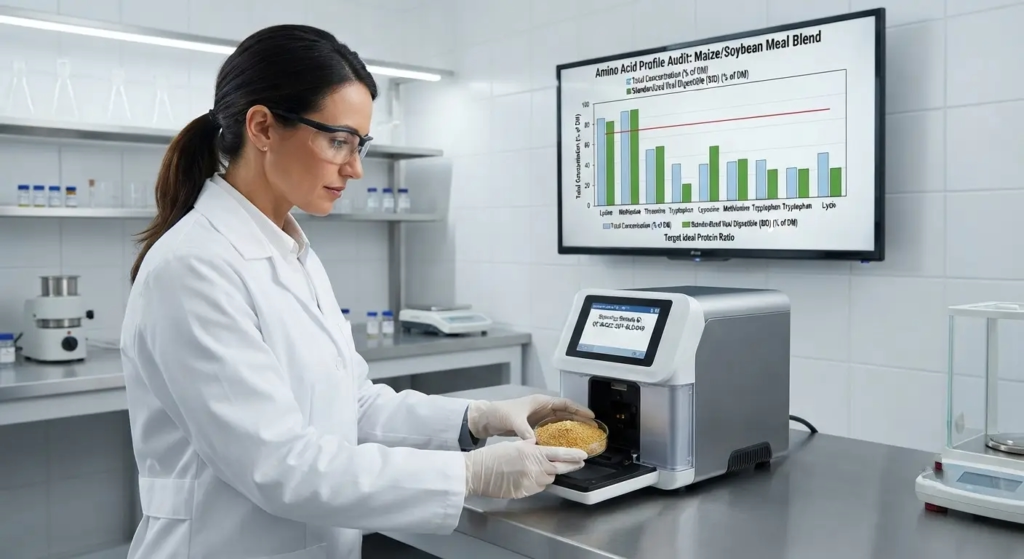
Feed ingredient databases and pig nutrient requirement tables can express lysine content either as total lysine (the total lysine present in the ingredient, measured by chemical analysis) or as standardized ileal digestible (SID) lysine (the portion of total lysine that is actually absorbed across the small intestine wall and made available for protein synthesis).
The distinction matters because different feed ingredients have different lysine digestibilities — the same total lysine content from two different protein sources does not necessarily mean the same biologically available lysine delivery. Heat-damaged soybean meal (Maillard reaction products formed during over-processing bind lysine to sugars, making it chemically detectable but biologically unavailable), certain fiber-containing ingredients that slow digestion and reduce the residence time available for lysine absorption, and animal-derived protein sources with high collagen content (which is extremely low in lysine despite contributing to total crude protein measurement) all illustrate why total lysine in the ration does not reliably predict biologically available lysine delivery.
Modern pig nutrition formulates to SID lysine targets rather than total lysine targets. When expressed in this way, the requirement figures in this article and in feed formulation specifications elsewhere in this series are SID lysine values unless explicitly noted otherwise.
SID Lysine Requirements for Finisher Pigs
| Weight Range | Daily SID Lysine Requirement (g/day) | SID Lysine as % of Diet (ad libitum feeding) |
|---|---|---|
| 60–75 kg | 17.5–19.5 g | 0.82–0.88% |
| 75–90 kg | 18.5–20.5 g | 0.78–0.84% |
| 90–110 kg | 18.0–20.0 g | 0.72–0.80% |
Why the percentage requirement declines across the finisher phase even while the absolute daily requirement changes less dramatically: As the pig grows heavier, its voluntary feed intake increases — it eats more feed per day. If the requirement is expressed as grams per day (absolute), it changes modestly across the finisher weight range as the pig’s maximum lean deposition rate plateaus. But as a percentage of the diet, the requirement declines because the denominator (total feed intake per day) increases, allowing the same or similar absolute gram requirement to be met at a lower dietary concentration.
This is why phase-specific lysine specification is important — holding the same dietary lysine percentage throughout the entire finisher phase would oversupply lysine (and therefore protein ingredient cost) in the later heavy finisher stage relative to the pig’s actual requirement, while undersupplying it in the early finisher stage where the requirement as a percentage of diet is highest.
Factors That Shift the Lysine Requirement
Genetics: Pigs with higher lean growth potential — Duroc crosses, high-genetic-merit commercial hybrids selected for lean deposition — have higher lysine requirements because their greater capacity for lean tissue synthesis demands more lysine per day to support that synthesis. The requirement figures above represent averages across commercial genetics; elite lines from high-selection-pressure programs may require 5–10% higher SID lysine to fully support their genetic potential.
Sex: Intact boars have higher lean growth capacity and therefore higher lysine requirements than gilts, which in turn have slightly higher requirements than barrows (castrated males). If feeding intact boars to slaughter (practiced in some commercial systems for FCR and growth rate advantages), formulation to the higher boar requirement rather than the average mixed-sex specification captures more of the boar’s growth potential.
Health status: As discussed in FCR management guidance, pigs mounting immune responses divert amino acids — including lysine — away from muscle protein synthesis toward acute-phase protein production (immune proteins). The effect is that pigs under disease challenge effectively have a higher “maintenance” lysine demand that reduces the net available for growth purposes, appearing to require higher dietary lysine to achieve the same growth rate as healthy pigs under identical formulation. This is one more mechanism by which poor health management degrades production performance even when feed formulation appears adequate on paper.
Feed intake level: At below-thermoneutral zone temperatures (cold stress, relevant in highland West African conditions during harmattan), pigs increase total feed intake to supply the additional energy needed for thermogenesis — which simultaneously increases total lysine intake for any given dietary lysine concentration. Conversely, heat stress reduces voluntary feed intake, meaning a dietary lysine percentage adequate at normal temperatures may deliver insufficient total daily lysine grams during periods of significant heat-stress-induced intake reduction — as discussed in FCR management guidance, where heat-adjusted formulation strategies are covered.
Part 3: The Ideal Protein Framework — Beyond Lysine
Why Lysine Alone Is Insufficient
Establishing adequate lysine supply is necessary but not sufficient for optimizing finisher lean growth. If lysine supply is brought up to requirement but one of the other essential amino acids is present at a level that constrains protein synthesis below the rate now possible with adequate lysine, that amino acid becomes the new first-limiting constraint. The biological limitation simply shifts to the next most deficient amino acid — growth rate remains below potential, now limited by the second amino acid rather than lysine.
The ideal protein concept addresses this by specifying the requirements for all essential amino acids relative to lysine — expressing each amino acid’s requirement as a ratio to the lysine requirement, so that a correctly balanced ration is not merely adequate in lysine but has all essential amino acids present at the correct ratios to collectively support the maximum achievable protein synthesis rate.
The Ideal Protein Ratios for Finisher Pigs (SID, Relative to Lysine = 100)
| Amino Acid | Ideal Ratio to Lysine | What Deficiency Specifically Impairs |
|---|---|---|
| Lysine | 100 | Lean tissue synthesis rate (primary rate-limiter) |
| Methionine + Cystine | 55–60 | Protein synthesis (sulfur amino acids), antioxidant defense (glutathione synthesis) |
| Threonine | 60–65 | Gut epithelial integrity and turnover, immune protein synthesis |
| Tryptophan | 18–20 | Feed intake regulation (serotonin precursor), growth hormone axis support |
| Isoleucine | 50–55 | Branched-chain amino acid contribution to muscle protein |
| Valine | 65–70 | Branched-chain amino acid contribution to muscle protein |
| Leucine | 100 | Branched-chain amino acid contribution, mTOR signaling (protein synthesis activation) |
| Phenylalanine + Tyrosine | 100–110 | Thyroid hormone synthesis, protein structural roles |
| Arginine | 35–40 | Nitric oxide synthesis, growth hormone secretion |
| Histidine | 30–35 | Protein structural roles |
The Cost Implications of the Ideal Protein Framework
The ideal protein framework generates direct formulation cost savings by allowing reduction in total crude protein (and therefore expensive protein ingredient inclusion) while maintaining or improving the effective amino acid balance available for lean growth.
The mechanism: A conventional crude-protein-specified ration meeting 17.5% CP using primarily maize and soybean meal provides lysine close to requirement — but also provides all other amino acids at levels that vary in how closely they match their ideal ratios. Threonine and methionine are often present at close to adequate levels in conventional soybean meal-based rations; tryptophan may be slightly marginal; isoleucine and valine may be over-supplied relative to their ideal ratios.
By explicitly formulating to the ideal protein ratio using synthetic amino acid supplementation where specific amino acids fall short of their ideal ratio targets, total dietary crude protein can be reduced — replacing a portion of soybean meal (high cost, high crude protein) with additional energy ingredients (lower cost, lower crude protein) while adding only the specific synthetic amino acids needed to bring each limiting amino acid up to its ideal ratio — without compromising and potentially improving the overall amino acid balance presented to the pig’s protein synthesis machinery.
Typical crude protein reduction achievable: 1.5–2.5 percentage points below conventional formulation (e.g., from 15% CP finisher to 12.5–13.5% CP finisher) when formulating to ideal protein ratios with synthetic amino acid support, at maintained or improved lean growth performance — capturing a feed cost reduction primarily from reduced soybean meal inclusion.
Part 4: Practical Second and Third Limiting Amino Acid Situations
When Threonine Becomes the Issue
Threonine is typically the second-limiting amino acid in maize-soybean meal rations, and the first to become limiting as rations are reformulated to reduce crude protein toward the ideal protein approach. The small intestine’s mucosal epithelium — the primary site of nutrient absorption — has particularly high threonine requirements for its rapid cell turnover and for the mucin proteins that protect the gut epithelial surface.
Practical sign of threonine deficiency: Loose feces or slightly elevated incidence of digestive disorder without other clear cause, in combination with below-target growth rate — reflecting the gut integrity function of threonine that complements its role in systemic protein synthesis. In reduced-protein rations formulated with added lysine but without adequate threonine correction, this pattern can emerge even while lysine supply appears adequate.
The synthetic solution: L-threonine is commercially available and inexpensive relative to the soybean meal inclusion it replaces when used to support protein reduction formulation strategies — typically the third most cost-effective synthetic amino acid addition after lysine and methionine in terms of cost relative to performance benefit delivered.
When Tryptophan Becomes the Issue
Tryptophan is the precursor for serotonin synthesis in the central nervous system — and serotonin, among its many functions, is an important signal for voluntary feed intake regulation. Tryptophan-deficient pigs can show reduced voluntary feed intake as a behavioral consequence of disrupted serotonin signaling, independently of other growth-limiting effects.
The practical pattern: Unexplained feed intake depression in finisher pigs on reduced-protein formulations, particularly those using alternative ingredients (palm kernel cake, cassava) that contribute relatively little to tryptophan supply, can reflect tryptophan limitation — a less commonly suspected cause than water access, heat stress, or disease, but worth including in the formulation review when these more obvious causes have been ruled out.
When Methionine + Cystine Balance Matters Most
Methionine is uniquely important among the essential amino acids because it participates in a metabolic role beyond protein synthesis alone — it is the universal methyl group donor (as S-adenosylmethionine) for a wide range of biochemical reactions, and it is the precursor for glutathione synthesis (the primary endogenous antioxidant). Cystine can be synthesized from methionine and partially satisfies the combined methionine + cystine requirement; the combined requirement is therefore typically expressed as total sulfur amino acids (TSAA), reflecting that cystine can spare methionine up to the proportion that can be synthesized endogenously.
Practical relevance for alternative ingredient formulations: Fish meal, which provides an excellent methionine profile, may be partially substituted in starter rations — but moving away from fish meal in formulations that do not compensate with DL-methionine supplementation risks making methionine the first or second limiting amino acid, particularly where palm kernel cake (relatively low in sulfur amino acids) makes up a significant proportion of the protein supply.
Part 5: Calculating the Cost of Amino Acid Deficiency
The Opportunity Cost Framework
The cost of amino acid deficiency is not the price of the deficient amino acid itself — it is the production value lost because the pig’s lean growth rate was constrained. Calculating this correctly requires expressing the deficiency’s effect in production terms first, then converting to financial terms.
A worked example — finisher pigs on a lysine-deficient ration:
Scenario: A farm mixes a finisher ration at 13% CP, 0.68% SID lysine — below the 0.78% SID lysine target for 75–90 kg pigs. The deficiency is 0.10 percentage points of SID lysine, representing approximately 12–13% below requirement.
Performance impact (from published literature on lysine dose-response curves for this weight range): At 12% below lysine requirement, average daily gain is reduced by approximately 4–5% and FCR worsened by approximately 3–4%.
Financial consequence at 1,000 finisher pigs per year, 75–90 kg phase:
- Daily gain reduction: 4.5% × 800 g/day target ADG = 36 g/day per pig
- Over the 75–90 kg phase (approximately 30 days): 36 g × 30 days = 1.08 kg additional days to gain the same weight per pig
- Feed cost of that additional time: 1.08 kg additional gain ÷ 2.9 FCR × XAF 310/kg feed = XAF 115 per pig
- Worsened FCR cost: 4% worse FCR for the remaining 75–90 kg phase: 15 kg gain × (3.01 – 2.9) = 1.65 kg additional feed × XAF 310 = XAF 512 per pig
- Total cost of 0.10% lysine deficiency per pig, for the 75–90 kg phase: approximately XAF 627 (USD 1.05) per pig
- At 1,000 pigs annually: approximately XAF 627,000 (USD 1,045) per year from a single phase’s lysine deficiency
Cost to correct: Adding sufficient L-lysine HCl (at a typical cost of approximately XAF 2,500–3,500/kg) to increase dietary SID lysine by 0.10 percentage points:
- L-lysine HCl inclusion increase: approximately 0.18% of ration weight
- Cost per tonne of feed: 1.8 kg × XAF 3,000 = XAF 5,400 per tonne of feed
- Feed consumed in 75–90 kg phase by 1,000 pigs: approximately 1,000 × 15 kg gain × 2.9 FCR = 43,500 kg feed
- Total correction cost: 43,500 kg × XAF 5.40/kg = XAF 234,900 (USD 392)
The deficiency costs XAF 627,000 per year. The correction costs XAF 234,900 per year. The net benefit of correcting this single lysine deficiency across a single phase: XAF 392,100 (USD 654) per year.
This is not an unusual scenario — it describes a real cost structure that many commercial operations in West Africa are carrying, invisible in the day-to-day management of pigs that appear to be growing normally, but measurable in FCR and days-to-market figures that remain persistently above what the genetics and overall nutrition level should be delivering.
Part 6: Practical Implementation — Getting Amino Acid Supply Right
Source L-Lysine as the Starting Point
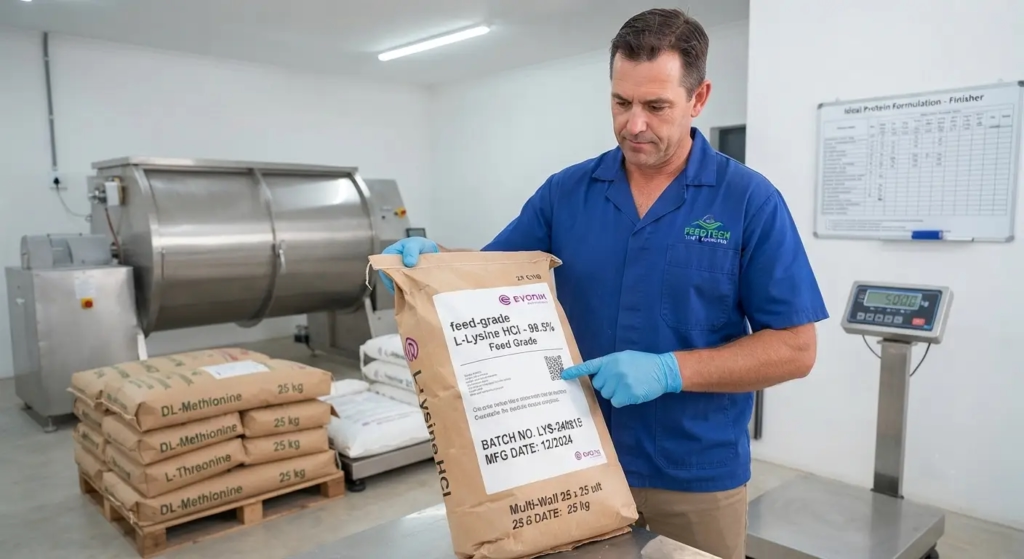
L-lysine monohydrochloride (L-Lys HCl, 78.8% lysine) is the standard commercial synthetic lysine form used in pig feed formulation globally. It is feed-grade, stable under normal storage conditions, and available through agricultural input importers and feed ingredient distributors across West and Central Africa.
Verify product specification on purchase: Confirm the product is L-lysine HCl (not lysine sulfate or other forms, which have different lysine content percentages requiring different inclusion rates to achieve the same dietary lysine concentration) and that the specification sheet confirms purity adequate for feed use.
The Calculation for Adding Synthetic Lysine
To increase dietary SID lysine by 0.10 percentage points using L-Lys HCl:
L-Lys HCl required = Target increase ÷ (L-Lys HCl lysine content × SID coefficient)
For most commercial L-Lys HCl products (78.8% total lysine, approximately 98–99% SID digestibility): 0.10% ÷ (0.788 × 0.99) ≈ 0.128% of total ration, or approximately 1.28 kg per tonne of feed
Add this quantity and simultaneously reduce a low-lysine ingredient (typically maize or another energy source) by the same quantity to maintain the total formulation at 100%.
Priority Order for Synthetic Amino Acid Investment
If budget or sourcing constraints limit the ability to supplement all amino acids simultaneously, prioritize in the order in which they are most likely to be limiting in a typical West African maize-soybean meal-based formulation:
- L-Lysine HCl — Almost always first limiting; highest return on supplementation investment
- DL-Methionine — Second most frequently limiting, particularly as protein levels are reduced
- L-Threonine — Third most frequently limiting, especially in lower-protein formulations
- L-Tryptophan — Fourth most frequently limiting, particularly relevant in formulations with high alternative ingredient inclusion (palm kernel cake, cassava) that contribute little tryptophan
Summary
Lysine is the primary biological rate-limiter for lean tissue deposition in finisher pigs — the essential amino acid whose supply most consistently constrains protein synthesis rate below the pig’s genetic ceiling in conventional West African formulations based on maize and soybean meal. Its deficiency costs more than its supplementation prevents: the production losses from amino acid deficiency (reduced daily gain, worsened FCR, increased fat deposition) consistently exceed the synthetic amino acid cost required to eliminate that deficiency, often by a factor of 2–3× at commercial production scale.
The ideal protein framework extends this precision beyond lysine to all essential amino acids — specifying each amino acid’s requirement relative to lysine and formulating rations that collectively provide the amino acid ratios the pig’s protein synthesis machinery requires, rather than approximating adequacy through crude protein targets that may satisfy some amino acids in excess while deficiencies persist in others.
For finisher pig producers in West and Central Africa, the practical starting point is simple: verify that the current ration’s SID lysine percentage matches the target for the specific weight range being fed, calculate the cost of any deficiency, and compare that cost to the price of the L-Lys HCl supplementation that would correct it. In virtually every realistic commercial scenario, the arithmetic will favor supplementation — not as a nutritional luxury, but as the correction of a specific, quantifiable, financially significant production constraint that disciplined amino acid nutrition is designed to prevent.