Harvest is the final conversion event in the catfish production cycle — the point at which months of feed investment, water quality management, health management, and growth monitoring are converted into revenue. Everything that happens in the 24 hours surrounding the harvest event either preserves that accumulated value or erodes it: fish that die during harvest represent lost revenue from already-absorbed costs; fish that arrive at market stressed, injured, or in poor condition receive lower prices than fish that arrive in optimal condition; and a harvest that occurs at the wrong time — before fish have reached market weight, or at a time when market prices are depressed, or without confirmed buyers — fails to convert production costs into the revenue that makes the production cycle financially viable.
The technical aspects of catfish harvesting — draining tanks, deploying nets, crowding fish, transferring to transport containers — are not complex. What makes harvesting a management decision rather than simply a physical activity is the combination of timing judgment, market knowledge, fish handling discipline, and transport management that together determine whether the harvest event recovers the full value of the production cycle or leaves a meaningful fraction of it uncaptured.
This guide covers harvest timing decisions (when to harvest), harvest methods for both concrete tank and earthen pond systems (how to harvest), grading at harvest (how to sort the catch for market presentation), and live transport management (how to get fish to buyers in optimal condition).
Harvest Timing Decisions
The Four Dimensions of Harvest Timing
Determining when to harvest requires simultaneously considering four factors that rarely align perfectly — requiring judgment about which factor is most constraining in any specific situation:
Dimension 1: Biological readiness (fish at target weight)
The most fundamental timing criterion — fish should have reached the target market weight before harvest. Harvesting below target weight produces smaller fish that may sell at lower per-kilogram prices (some markets price smaller fish at a discount), and wastes the growth potential that additional feeding time would have captured. Holding fish beyond target weight creates the opposite problem — diminishing returns on feed investment as FCR worsens in the late finishing phase.
The monthly growth monitoring system described in the previous articles provides the data for this assessment — the projected harvest date calculated from current weight and growth rate gives 4–6 weeks advance notice of the biological harvest window.
Dimension 2: Market timing (price and demand)
Catfish prices in West African markets are not constant — they follow seasonal patterns (higher prices during festive seasons — Christmas, Easter, Eid celebrations; lower prices during lean seasons when consumer spending declines) and shorter-term supply-and-demand fluctuations from other producers’ harvest scheduling. Harvesting into a price trough that occurs when multiple farms in the same supply area harvest simultaneously produces lower revenue per kilogram than scheduling harvest to avoid the peak supply periods.
Where possible, monitor prevailing market prices in the target sales channels (wholesale markets, direct institutional buyers, smoked fish traders) over the 4–6 week lead time that the biological harvest projection provides — using this window to confirm buyer commitments at acceptable prices before committing to the harvest date.
Dimension 3: Tank/pond availability for the next cycle
In operations where production facilities are fully utilized, the harvest date determines when the tank or pond is available for the next stocking cycle. Delaying harvest beyond biological readiness to capture a slightly better market price must be weighed against the cost of the delayed stocking — every day the tank is occupied by market-ready fish rather than new fingerlings is a day of productive capacity that the next production cycle does not have.
The financial comparison: additional revenue from an extra 2 weeks of waiting for better prices (estimated at 5% price improvement = XAF 125 per kg × 500 kg tank = XAF 62,500) versus the growth that could have been generated by the next cycle’s fingerlings in those same 2 weeks (approximately 2 weeks × 3 g/day ADG × 500 fish × XAF 2,500/kg = approximately XAF 52,500). The comparison is closer than intuition suggests — extended holding beyond biological readiness rarely generates large net benefit when the opportunity cost of production facility downtime is correctly accounted for.
Dimension 4: Logistics readiness
Harvest requires confirmed logistics: a buyer (or multiple buyers) with confirmed commitment and identified pickup time, transport containers and equipment in working order, adequate ice or oxygenation for live transport, and sufficient staff available for the harvest operations. Harvesting without confirmed buyer commitments creates the risk of completed harvest with no immediate market — live fish that have been harvested and placed in holding containers cannot be returned to grow-out conditions indefinitely, creating mortality pressure that erodes the catch value daily.
The Feed Withdrawal Period Before Harvest
Standard practice before any catfish harvest is a feed withdrawal period of 24–48 hours. The reasons:
Reduced gut content: Fish with full guts produce more fecal waste in transport containers, degrading water quality and increasing ammonia load in the confined transport space. Empty-gut fish produce significantly less waste and tolerate transport stress better.
Reduced oxygen demand: Digestion increases metabolic rate and therefore oxygen consumption. Fasted fish consume oxygen at a lower rate than recently fed fish, extending the safe transport duration and reducing the risk of oxygen depletion during transport.
Reduced mortality from handling: Fish with full guts are more susceptible to injury from crowding and netting during harvest — the full gut is under pressure and can rupture if the fish is physically compressed during crowding. Fasted fish handle more safely.
24 hours is sufficient in most cases. Extending the withdrawal period beyond 48 hours reduces fish weight (catabolism of stored fat and protein) and does not provide additional benefit.
Harvesting from Concrete Tanks
The Complete Drain-and-Net Method
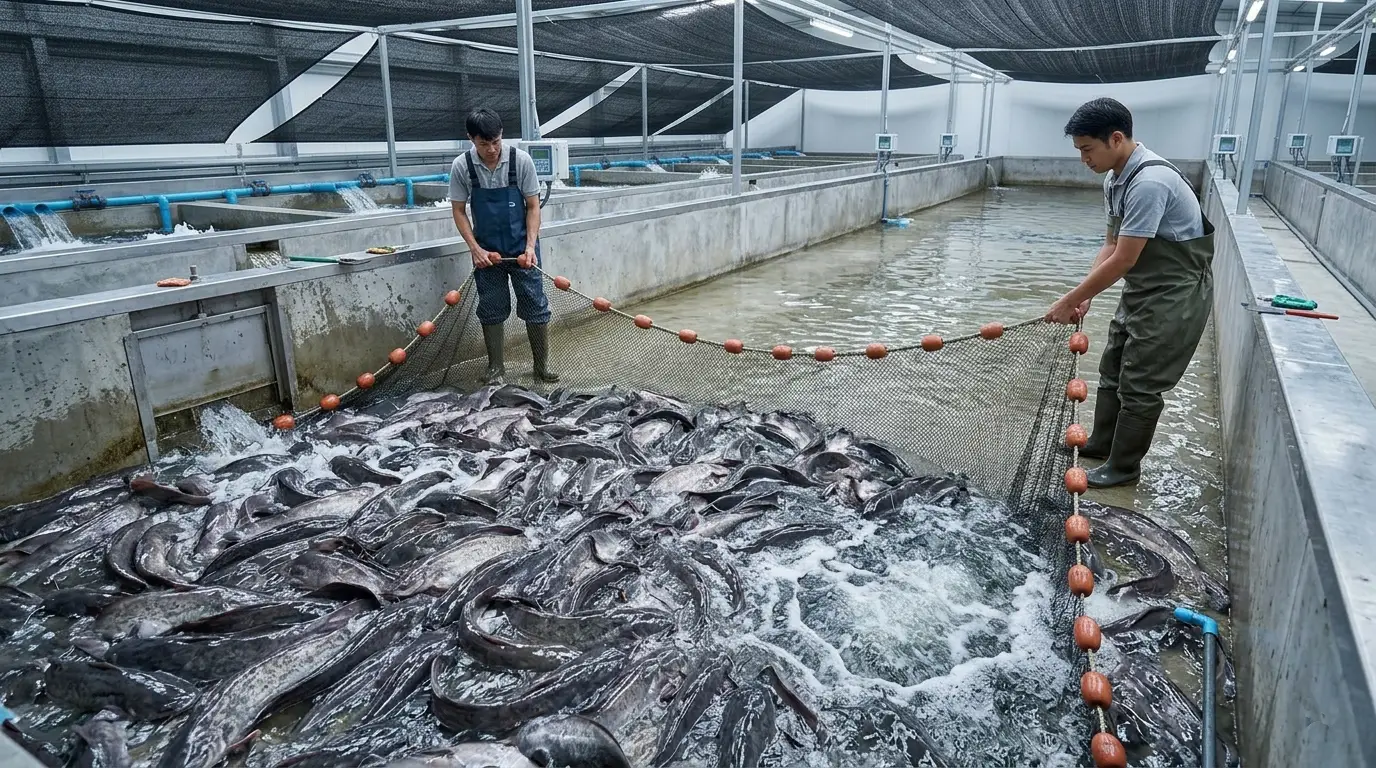
The most practical and most fish-welfare-appropriate harvest method for concrete tanks — draining the tank to a manageable water depth and then netting concentrated fish efficiently:
Step 1: Reduce water level (3–4 hours before harvest)
Begin draining the tank to approximately 20–30 cm water depth several hours before netting — giving fish time to adjust to the lower water level without the shock of very rapid depth reduction. At 20–30 cm depth:
- All fish are within reach of a seine net drawn across the tank
- Fish cannot escape to deep water zones inaccessible to netting
- Water quality remains adequate for fish welfare at this density for several hours
Maintain aeration throughout the drain: As water volume decreases and fish density per unit water volume increases, oxygen demand per unit water volume increases — additional aeration is essential during the drain period.
Step 2: Seine net across the tank
A seine net — a flat net hung vertically with a float line at the top and a lead line at the bottom — is drawn from one end of the tank to the other, concentrating all fish at the drain end of the tank:
- Net mesh size: 2–3 cm knotless mesh — small enough to prevent catfish from passing through, large enough to allow water to flow freely (reducing drag and allowing the net to be drawn smoothly)
- Knotless mesh: knots in traditional knotted nets abrade the fish’s skin and remove mucus — knotless mesh causes significantly less physical damage
- Two operators: one at each side of the tank pulling the net ends simultaneously toward the drain end
Step 3: Crowd and dip
Once fish are concentrated at the tank end by the seine net, use a dip net (a hand net mounted on a pole) to transfer fish from the tank to transport containers or a holding tank:
- Dip net size: 40–60 cm diameter — large enough for a substantial load but manageable for one person
- Transfer fish in small batches — do not overload the dip net to the point that fish are crushed by the weight of fish above them
- Transfer fish into transport containers or holding tanks containing water at the same temperature as the harvest tank — temperature shock from warm harvest tank water to cooler transport water adds harvest stress
Step 4: Complete drain and hand collection
After the main seine net pass has transferred the majority of the fish, lower the standpipe to drain the remaining water and collect the last fish by hand or dip net from the drained tank floor. Individual fish handling should be minimized — slide fish rather than gripping them, and wet hands before contact with any fish.
Step 5: Holding tank management
Where fish cannot be transported immediately after harvest, a holding tank maintains the harvest catch:
- Adequate volume: no more than 50–80 kg/m³ in the holding tank — overcrowding the holding tank causes the same oxygen and ammonia problems as overcrowding the grow-out tank
- Continuous aeration: all available aeration equipment directed to the holding tank during the holding period
- Ice addition: where fish transport is delayed more than 2–3 hours at temperatures above 28°C, controlled ice addition to bring holding temperature to 20–24°C reduces metabolic rate, extends survival, and maintains meat quality
The Live Weight vs. Processed Weight Distinction
At harvest, the farm’s decision about whether to sell live weight or processed weight has significant implications for revenue per fish:
Live weight sale: The most common sale method in West African catfish markets — fish are sold to buyers who handle their own slaughter and processing. Simplest for the farm (no processing infrastructure required); lowest price per kg (buyers incorporate processing cost and margin into their buying price).
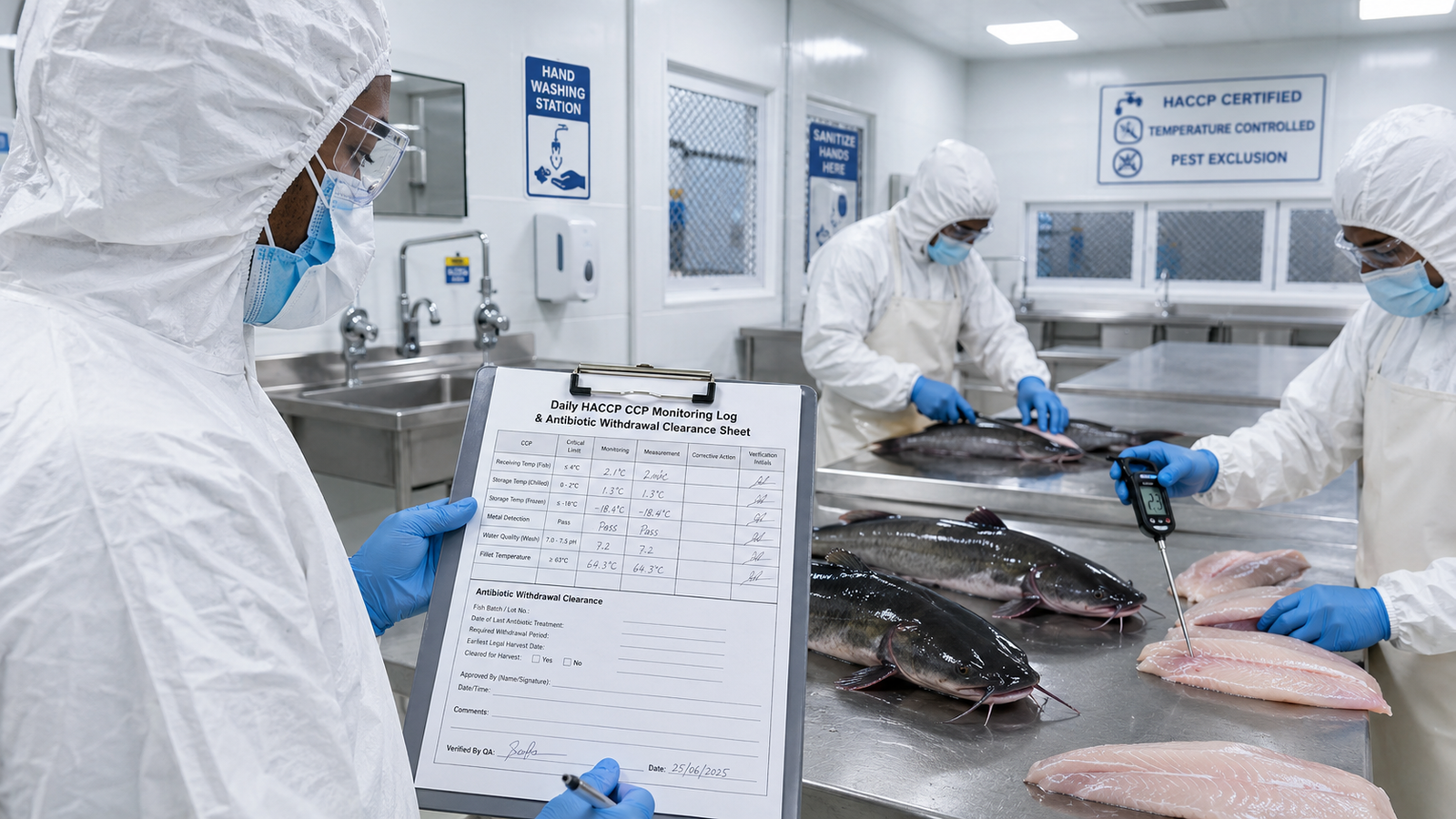
Processed (gutted, headed, or filleted): Higher price per kg received — typically XAF 500–1,500 per kg premium over live weight for gutted whole fish; XAF 2,000–4,000 per kg premium for fresh fillets. Requires on-farm processing capability (stainless steel work surfaces, water supply, ice or refrigeration, trained staff) and food safety management. Appropriate for farms with confirmed premium market relationships (hotels, supermarkets, food processors).
Harvesting from Earthen Ponds
The Drain-Seine-Complete Harvest Method
Earthen pond harvest is substantially more labor-intensive than concrete tank harvest — the larger water volume, variable pond bottom topography, and the fish’s ability to evade nets in larger spaces all make pond harvest more challenging.
Step 1: Begin pond drainage 24–48 hours before planned harvest
Open the monk outlet structure (remove boards from the monk frame as described in the plumbing article) and allow the pond to drain by gravity over 24–48 hours until the water level is sufficiently reduced for effective seining. A 0.5-hectare pond drained to 30–40 cm depth concentrates approximately 25,000 liters of water into a manageable area.
Drain timing: Begin drainage in the late afternoon of the day before planned harvest — allowing overnight drainage to bring the water level down substantially before the crew arrives in the morning. Avoid beginning drainage in the morning if harvest is planned for the same day — the partial drainage will leave water too deep for effective seining at the time the crew is ready.
Maintain aeration through the drain: As the pond level drops, the fish biomass per unit water volume increases — emergency aeration (portable paddlewheel aerators deployed as the water level drops) prevents the oxygen depletion that concentrating fish into shrinking water volume creates.
Step 2: Seine netting
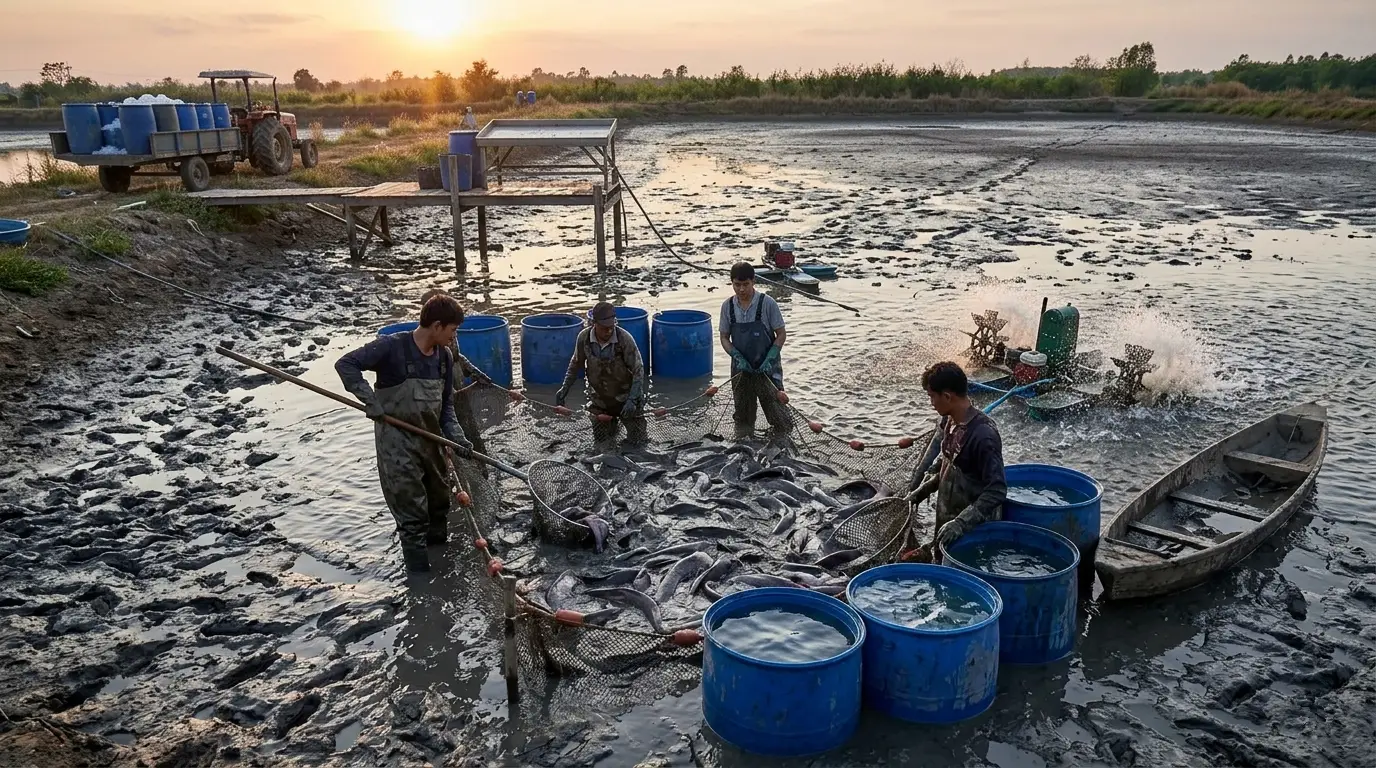
A pond seine net — typically 20–50 meters long for a 0.5-hectare pond, with lead line and float line — is pulled through the draining pond by a crew at each end:
- Drag seine: The net is pulled from one end of the pond toward the outlet end, sweeping fish toward the lowest point where they concentrate as water drains
- Multiple passes: A single seine pass will not capture all fish — repeat 3–5 passes until each additional pass is producing very few fish
- Bank seining: As water level drops below 20 cm, a bank seine (drawn along the shallow edge of the pond) captures fish that have moved to the margins to avoid the deep-water seine
Step 3: Harvest concentration and dip netting
As fish concentrate in the lowest remaining water area, dip net them into transport containers. Fish concentrated in very shallow water (below 10 cm) can be collected by hand (with smooth, wet hands) or with a small hand net.
Step 4: Dry harvest (final collection)
After all accessible water has drained, some fish will remain in pockets of water or soft mud in the pond base depressions. These are collected by hand or hand net. Harvesting in soft mud is physically demanding — rubber boots are essential, and careful footing prevents falls that could injure staff or fish.
Partial Harvest (Thinning) for Earthen Ponds
Where the production schedule or market timing makes complete harvest impractical, partial harvest (removing a portion of the fish biomass to reduce stocking density and allow continued growth of the remaining population) is an option for earthen ponds:
When to use partial harvest:
- Fish have reached market weight, but market demand or price does not support full harvest volume immediately
- Stocking density has reached the pond’s carrying capacity and growth rate is declining — harvesting the largest fish (those closest to or above target weight) reduces density and restores growth rate for the remaining smaller fish
Partial harvest technique:
- Seine net across the pond in 1–2 passes — capturing a portion of the fish
- Grade the catch: retain for sale all fish at or above target weight; return undersized fish to the pond
- Replace monk boards to restore water level after partial harvest
The trade-off: Partial harvest causes handling stress to the fish that are captured and returned — including the physical trauma of netting, crowding, and air exposure. This stress temporarily suppresses growth and immune function in the returned fish. Partial harvests should be planned to avoid the periods of highest disease pressure (peak hot season, recent disease event) when stress-induced immune suppression would be most consequential.
Grading at Harvest
Why Grading at Harvest Matters
Even a well-managed production cycle that maintained good size uniformity through regular grading during grow-out will produce some size variation at harvest — individual growth variation within any fish population is biological and irreducible, though manageable. Grading at harvest serves several functions:
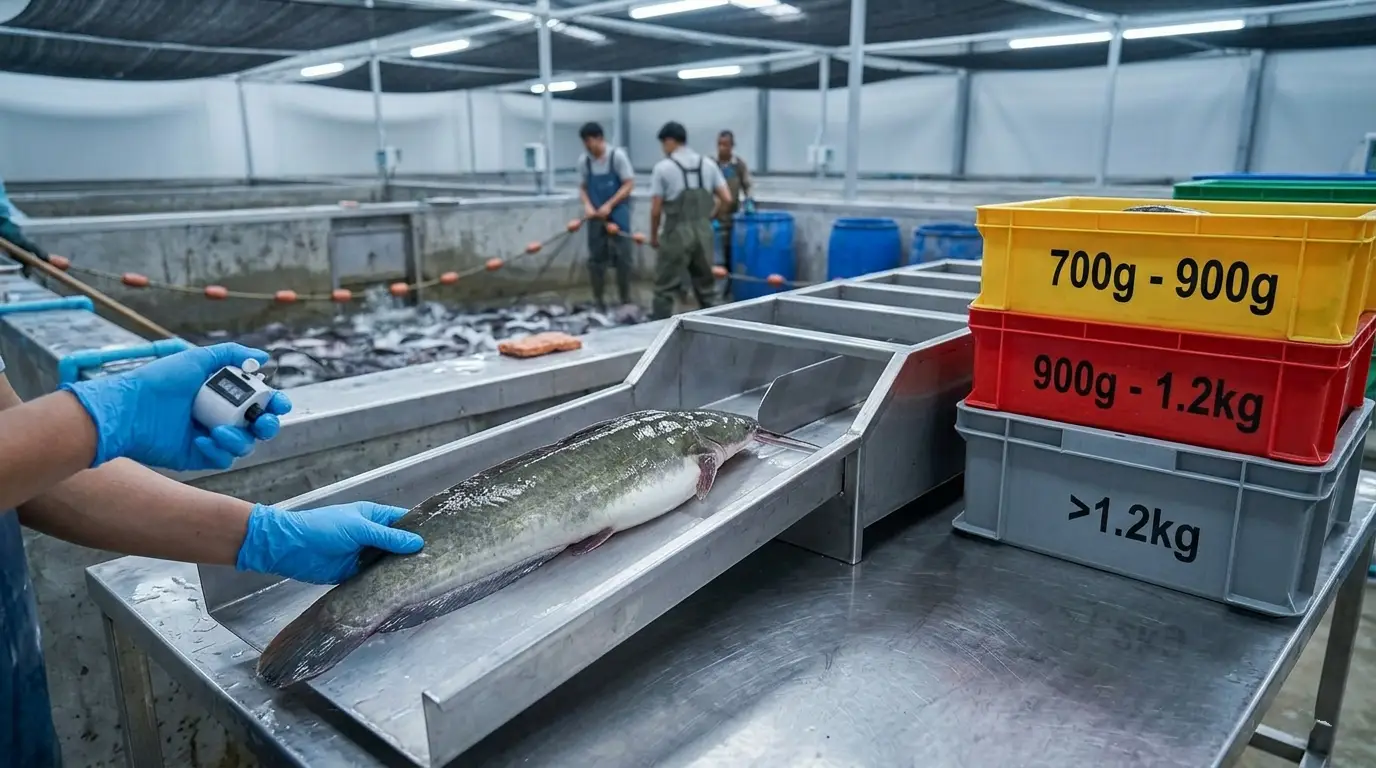
Premium market presentation: Hotel, restaurant, and supermarket buyers typically specify a weight range for the catfish they purchase (for example, 600 g–1,000 g for a restaurant that portions fish for individual serving plates). A catch that contains fish from 400 g to 1.5 kg cannot be uniformly priced at the premium channel rate — the non-conforming sizes must be sold into lower-priced channels. Grading separates the premium-eligible catch from the off-size catch, allowing each to be sold at the appropriate price.
Fair pricing for each size class: Some markets price catfish differently by size — large fish (above 1 kg) may command a per-kg premium over medium fish (600 g–1 kg) in markets where large whole catfish are preferred for specific preparations. Mixing size classes in a single sale at a blended average price captures neither the premium for large fish nor the volume advantage of the medium category.
Separate handling for off-size fish: Fish significantly below target weight at the time of the main harvest can be separated, returned to a grow-out tank or pond, and allowed to continue growing to the next harvest window — converting potential early-sale loss into full-value future sale. This requires a suitable holding facility and the operational judgment to determine which undersized fish are worth growing on versus which should be sold immediately at whatever price the smaller size commands.
Grading Equipment
Size-grading boxes: Rectangular frames with parallel bars at defined spacing — fish dropped into the box either pass between the bars (below that size grade) or remain on top (above that size grade). Multiple boxes with different bar spacings create size categories:
- Bar spacing 3 cm: separates fish below approximately 300 g (pass through) from above
- Bar spacing 4 cm: separates fish below approximately 600 g from above
- Bar spacing 5 cm: separates fish below approximately 900–1,000 g from above
Drum graders: Rotating cylindrical drums with apertures of defined size — fish fed into the rotating drum exit through the appropriately sized aperture based on their body diameter. More expensive than static grading boxes but faster and less labor-intensive for large harvest volumes.
Hand sorting: For small harvest volumes or when size variation is limited, hand sorting by experienced staff (who estimate fish weight visually and sort into two or three categories by eye) is practical. Experienced staff can sort fish into 300–500 g / 500–800 g / above 800 g categories at rates of 200–400 fish per hour per person.
Live Transport Management
The Biology of Live Fish Transport Survival
As established in the fingerling transport article, the primary stressors of fish transport — crowding, ammonia and CO₂ accumulation, oxygen depletion, and thermal shock — apply equally to market-size catfish transport. The management protocols that minimize these stressors for fingerlings apply directly to adult fish transport:
Oxygen management: At market harvest size (600–1,000 g), each fish consumes substantially more oxygen than a 10 g fingerling — requiring larger air or oxygen reservoirs per fish in transport. The loading density tables from the fingerling transport article must be scaled down significantly for larger fish:
Loading density for adult catfish live transport:
| Fish Size | Loading in Aerated Open Container | Loading in Oxygenated Sealed Bag |
|---|---|---|
| 300–500 g | 30–50 kg/m³ of water | Not practical at this size |
| 500–800 g | 25–40 kg/m³ of water | Not practical at this size |
| 800 g–1.2 kg | 20–35 kg/m³ of water | Not practical at this size |
Live transport of adult catfish uses open containers (plastic drums, purpose-built live haul tanks) with active aeration rather than sealed oxygen bags — the fish are too large and too active for bag transport to be feasible or humane.
Transport container options:
Plastic drums (100–200 liter): The most common transport container for small-volume catfish marketing in West Africa. A 200-liter drum filled one-third with water (approximately 65 liters) can carry approximately 15–20 kg of adult catfish (approximately 20–25 fish at 700 g average) with a battery-operated air pump running continuously. Multiple drums loaded onto a pickup truck or motorbike cargo carrier constitute the standard small-scale catfish transport system.
Purpose-built live haul tanks: Insulated rectangular tanks of 500–2,000 liter capacity, mounted on truck flatbeds or trailers. Equipped with battery-powered aeration, water level monitoring, and sometimes oxygen injection capability. Appropriate for farms harvesting and transporting several hundred kilograms per trip.
Temperature during transport:
Adding ice to the transport water to bring it to 20–24°C (from the typical 27–29°C of grow-out tanks) serves two purposes:
- Reduces fish metabolic rate and therefore oxygen consumption rate — extending safe transport duration
- Reduces the rate of ammonia accumulation from fish excretion — extending acceptable water quality duration
Ice addition should be gradual — lowering transport water temperature by no more than 2–3°C per 15 minutes to avoid thermal shock. Target 20–22°C in the transport water for optimal transport outcome.
Transport duration and mortality risk:
| Transport Duration | Expected Mortality (Good Management) | Expected Mortality (Poor Management) |
|---|---|---|
| Below 2 hours | Below 0.5% | 1–3% |
| 2–4 hours | 0.5–2% | 3–8% |
| 4–6 hours | 1–4% | 5–15% |
| 6–8 hours | 2–6% | 10–25% |
| Above 8 hours | 4–10% | 15–40%+ |
The dramatic difference between good and poor management outcomes at longer transport durations illustrates the financial value of correct loading density, oxygenation, temperature management, and fasting before transport — each management investment has a measurable mortality reduction return.
Post-Harvest Pond and Tank Management
The AIAO Cycle Completion Protocol
Harvest is not the end of the production cycle management — it is the beginning of the tank or pond preparation for the next cycle. The all-in/all-out cleaning protocol described in the biosecurity article must be completed before restocking:
For concrete tanks:
- Complete draining after harvest — remove all water
- Scrub walls and floor with brush and water to remove biofilm, algae, and fecal residue
- High-pressure wash all surfaces
- Apply disinfectant (sodium hypochlorite 200 mg/L, contact time 30 minutes; or potassium permanganate 200 mg/L)
- Rinse thoroughly with clean water — residual disinfectant causes fish mortality at these concentrations
- Rest period: minimum 5 days dry before refilling
- Refill and verify water quality before stocking
For earthen ponds:
- Allow complete drainage — remove all water
- Dry the pond base in sunlight for a minimum 7–14 days (longer in the rainy season when drying is slower) — sunlight and desiccation reduce pathogen load in the sediment
- Apply agricultural lime to the dry pond base and walls: 200–500 kg per 1,000 m² broadcast evenly and raked in — neutralizes acidity and kills remaining pathogens
- Check and repair any bund damage, erosion, or seepage points identified during the drain period
- Clear inlet screens of any debris accumulated during the production cycle
- Refill and allow the pond to stabilize for 5–7 days before fingerling stocking
Summary
Catfish harvest is the management event that converts the entire production investment into revenue — and the quality of that conversion is determined by the quality of the timing decisions, physical handling techniques, grading discipline, and transport management applied in the 24–72 hours surrounding the harvest event.
The biological harvest window (fish at or above target market weight), the market timing window (confirmed buyers at acceptable prices), and the logistics readiness (transport equipment and staff available) are the three conditions that must align for a harvest event to recover full production value. When all three align — schedule the harvest. When one is not ready — assess whether waiting for alignment is worth more than proceeding without it.
The physical harvest techniques — tank drain and seine for concrete systems, gravity drain and pond seine for earthen ponds — are straightforward in principle but physically demanding in practice. The key discipline in both cases is protecting the mucus coat and physical integrity of every fish from the moment of first contact to the moment of delivery to the buyer — because every fish that dies between harvest and market is revenue that has already been earned but cannot be collected.