Regulatory Framework Overview
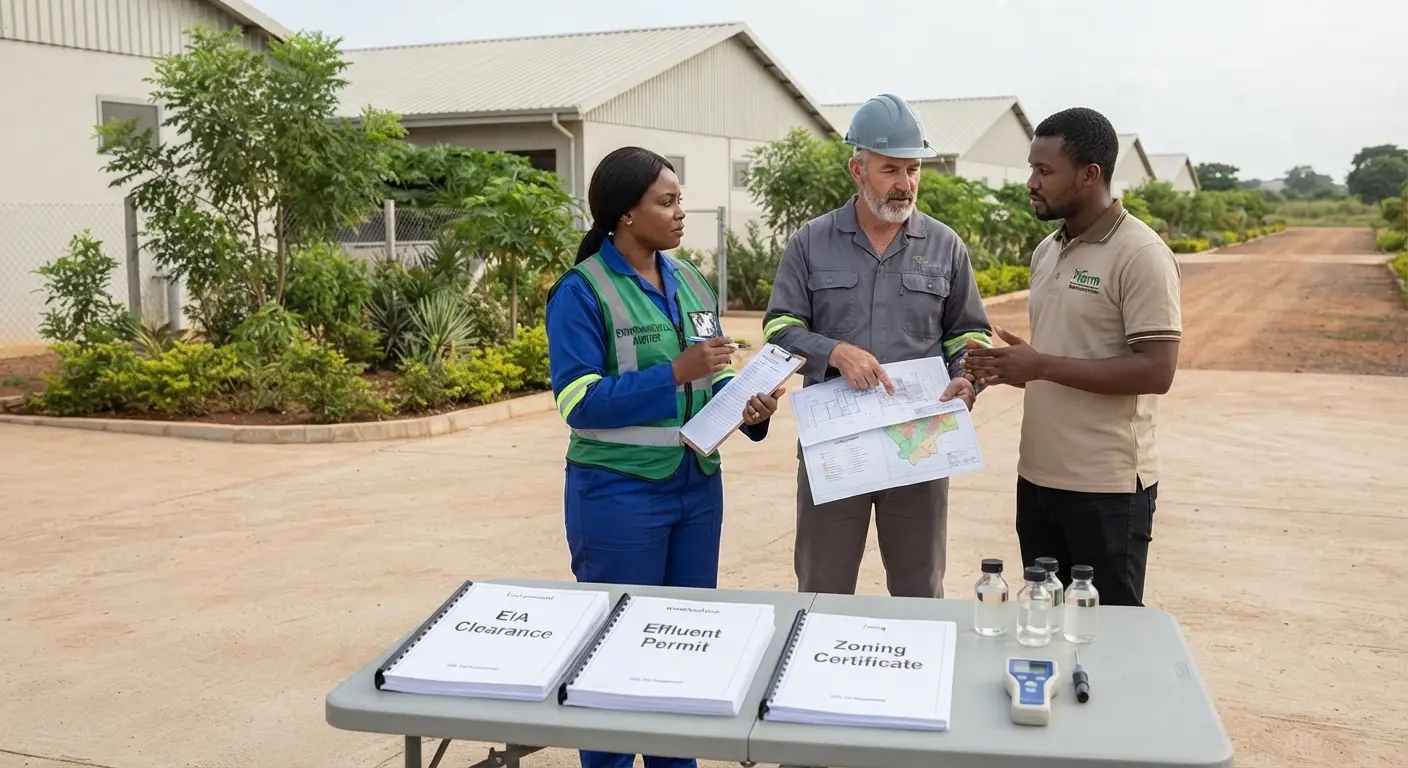
Commercial pig farming operations in West and Central Africa typically fall under three separate — and sometimes overlapping — regulatory regimes: environmental protection law, waste and sanitation regulation, and land use/agricultural zoning law. Each is usually administered by a different agency, which means a piggery can be fully compliant with one framework while in violation of another. Treating “getting licensed” as a single event misses this — compliance is three parallel tracks that must each be satisfied independently.
| Regulatory Track | Typical Administering Body | Primary Concern |
|---|---|---|
| Environmental protection | Ministry of Environment (national) or regional environmental agency | Impact assessment, pollution control, ecosystem protection |
| Waste and sanitation | Ministry of Health / local sanitation authority, sometimes water resources agency | Effluent discharge, manure management, water contamination |
| Land use and zoning | Local municipal or district planning authority, sometimes Ministry of Agriculture | Permitted land use, setback distances, neighboring land conflicts |
This guide provides a general operational framework. Specific permit names, thresholds, and fees vary by country and even by municipality — an operator should confirm exact requirements with the relevant local authority or a lawyer qualified in the specific jurisdiction before finalizing a farm site or CapEx budget.
Environmental Permits Typically Required
Environmental Impact Assessment (EIA)
Most jurisdictions in the region require an EIA — or a lighter-weight environmental screening report for smaller operations — before construction begins on a livestock facility above a defined herd size threshold. The threshold varies, but 50 sows or more commonly triggers at minimum a screening-level review; larger operations (100+ sows or facilities near water bodies or residential areas) more often require a full EIA.
| EIA Tier | Typical Trigger | Approximate Cost (XAF) | Typical Timeline |
|---|---|---|---|
| Screening/preliminary assessment | Small-to-medium operations, low environmental sensitivity site | 500,000–1,500,000 | 4–8 weeks |
| Full Environmental Impact Assessment | Large-scale operations, sites near water bodies, protected areas, or dense residential zones | 1,500,000–4,000,000 | 3–6 months |
What an EIA typically evaluates:
- Proximity to water bodies and groundwater vulnerability
- Odor and air quality impact on neighboring properties
- Waste management plan adequacy
- Noise and traffic impact from operations
- Cumulative impact if multiple livestock operations exist in the same watershed
Effluent and Discharge Permits
Separate from the EIA, most jurisdictions require a specific permit governing wastewater discharge — whether into a municipal system, a water body, or land application (irrigation of manure-treated water onto cropland). This permit typically sets numerical limits on nutrient load, biological oxygen demand (BOD), and pathogen indicators in any discharged effluent.
Air Quality / Odor Management
Some jurisdictions, particularly those with municipal zoning near residential development, require a documented odor management plan as a condition of operating permit renewal, especially for operations above 75–100 sows.
Waste Management Regulations and Compliance
Manure and wastewater management is the area where piggeries most frequently run into regulatory trouble, because the volume of waste a commercial herd produces is easy to underestimate at the planning stage.
Waste Volume Estimation
| Herd Component | Approximate Manure Output |
|---|---|
| Sow (gestating or lactating) | 4.5–6.0 kg/day |
| Grower-finisher pig | 2.0–3.5 kg/day |
| Boar | 4.0–5.0 kg/day |
A 50-sow farrow-to-finish operation at steady state (50 sows, 3 boars, roughly 350–450 growers/finishers on-site at any time) produces on the order of 2,000–2,800 kg of raw manure per day — a volume that, without engineered treatment, is capable of contaminating groundwater and surface water well beyond the farm boundary.
Compliance Requirements Commonly Applied
| Requirement | Typical Standard |
|---|---|
| Manure storage capacity | Minimum 90–180 days storage capacity to avoid forced land application during wet season |
| Setback distance — waste storage to water body | 50–100 meters minimum, varies by jurisdiction |
| Setback distance — waste storage to property boundary | 15–30 meters minimum |
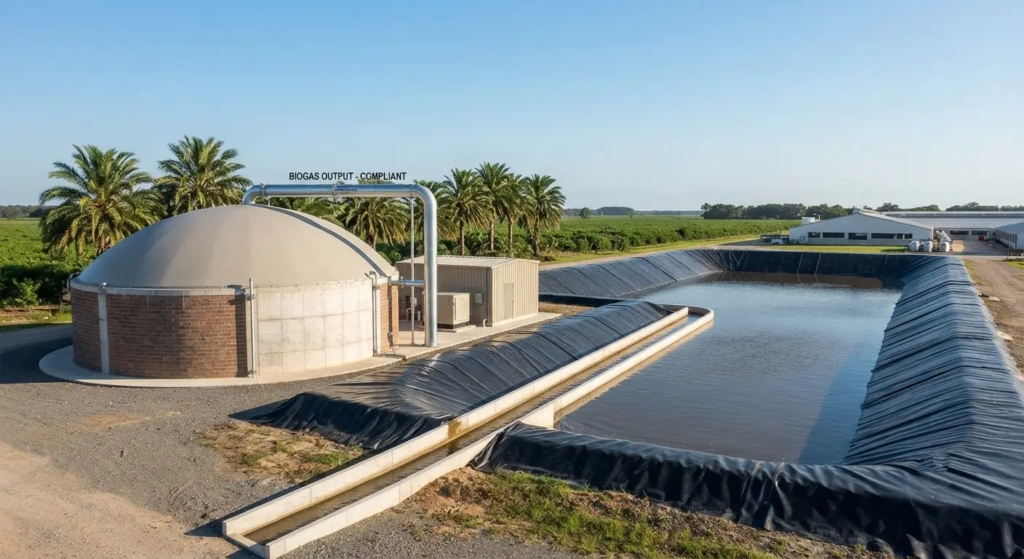
| Lagoon/storage lining requirement | Impermeable lining required above a defined herd size threshold to prevent groundwater seepage |
| Effluent nutrient limits (if land-applied) | Nitrogen and phosphorus loading limits per hectare, based on receiving soil capacity |
| Record-keeping | Waste application logs, volumes, and dates typically required for inspection |
Waste-to-Value Systems and Compliance
Biogas digesters and composting systems, beyond their value as secondary revenue sources (as detailed in the piggery business plan analysis in this series), are also frequently the most cost-effective route to regulatory compliance. A digester that processes raw manure into treated effluent and biogas typically reduces the pathogen load and nutrient concentration of the farm’s waste stream well below what raw manure land application would produce, which can mean the difference between meeting discharge limits and violating them.
Agricultural Zoning Laws
Land Use Classification
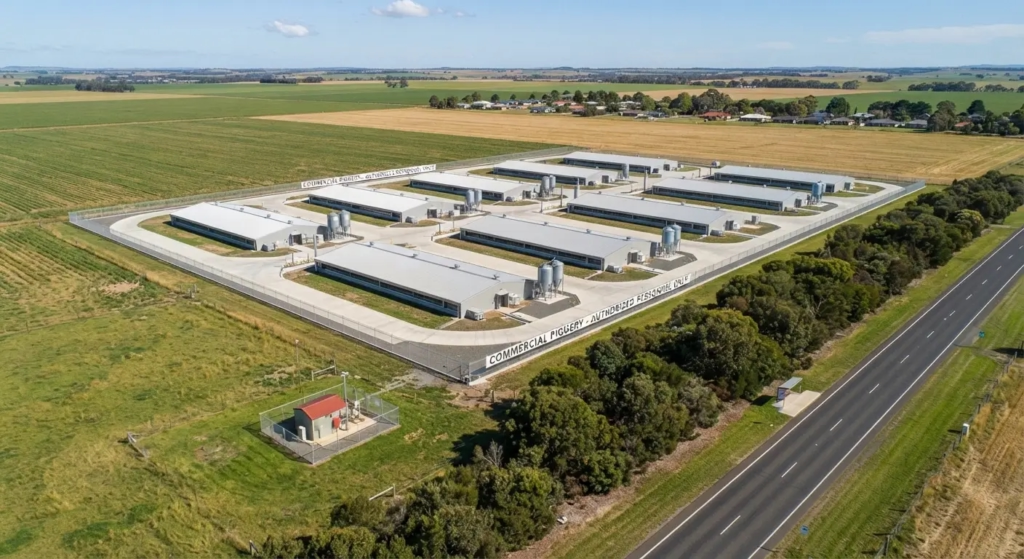
Land must typically be zoned for agricultural or specifically livestock use before a commercial piggery can be legally established. Operating on land zoned for general agricultural use but not specifically for livestock, or on land with residential or mixed-use zoning, is one of the most common compliance failures — often discovered only after significant CapEx has already been committed.
| Zoning Category | Typical Permitted Use | Piggery Compliance Status |
|---|---|---|
| Agricultural — general | Crop production, some livestock at small scale | Often requires additional livestock-specific permit |
| Agricultural — livestock designated | Commercial animal husbandry | Typically compliant, subject to setback rules |
| Peri-urban / mixed use | Residential and light commercial | Usually non-compliant for commercial-scale livestock; frequent source of neighbor complaints and permit denial |
| Protected / conservation | Restricted development | Non-compliant; permits will not be issued |
Setback and Buffer Requirements
Zoning law typically imposes minimum distances between livestock facilities and neighboring land uses, distinct from the environmental setback requirements in Part 3.
| Adjacent Land Use | Typical Minimum Setback |
|---|---|
| Residential dwelling | 200–500 meters |
| School, hospital, place of worship | 500–1,000 meters |
| Water source (well, borehole serving other properties) | 100–200 meters |
| Public road | 30–50 meters |
These figures vary substantially by jurisdiction and should be confirmed with the local planning authority before land is purchased or leased. A site that satisfies the environmental permit setback requirements in Part 3 does not automatically satisfy the separate zoning setback requirements in this section — the two regimes are administered independently, and a site must clear both.
Change-of-Use Applications
Where land is zoned for general agriculture but not specifically for livestock, an operator typically needs to file a change-of-use or conditional-use application with the local planning authority before construction. This process is frequently underestimated in project timelines — it can take longer than the EIA process itself in jurisdictions with limited planning department capacity.
Permit Application Sequence and Timeline
Permits are not independent of each other — most jurisdictions require certain approvals before others can be applied for, which makes sequencing a project timeline correctly essential to avoid costly delays.
| Step | Typical Sequence Position | Approximate Duration |
|---|---|---|
| 1. Land zoning verification / change-of-use application | Before any site work | 1–4 months |
| 2. Environmental screening or EIA | After zoning confirmed, before construction | 1–6 months |
| 3. Waste/effluent discharge permit | Often concurrent with or after EIA approval | 1–3 months |
| 4. Building/construction permit | After environmental approval | 2–6 weeks |
| 5. Operating license (livestock-specific) | After construction is complete, before animals arrive | 2–8 weeks |
Total realistic permitting timeline for a medium-to-large operation: 6–14 months from initial application to full operating clearance, depending on jurisdiction and site sensitivity. Project plans and financing timelines that assume permitting completes in under three months are a common source of construction-phase cash flow strain, since land, design, and pre-operating costs are often committed before permits are secured.
Compliance Costs Across the Permit Lifecycle
| Cost Category | Approximate Range (XAF) | Notes |
|---|---|---|
| Zoning/change-of-use application and fees | 300,000–800,000 | One-time |
| Environmental screening or EIA (see Part 2) | 500,000–4,000,000 | One-time, scales with facility size |
| Effluent discharge permit | 200,000–600,000 | One-time application, often renewable annually |
| Livestock operating license | 150,000–400,000 | Annual renewal typically required |
| Legal/consultancy fees for permit navigation | 1,000,000–2,500,000 | One-time, strongly recommended for first-time applicants |
| Ongoing compliance monitoring (water testing, waste audits) | 400,000–900,000/year | Recurring |
These figures are consistent with the pre-operating cost allowances used in the CapEx planning in this series, though operators in jurisdictions with more rigorous environmental review should budget toward the higher end of each range.
Common Compliance Failures and Their Consequences
| Failure | Typical Consequence |
|---|---|
| Constructing before zoning/change-of-use approval | Stop-work order, potential demolition requirement, forfeiture of construction investment |
| Operating without effluent discharge permit | Fines, mandatory waste system retrofit, potential closure pending compliance |
| Waste storage without adequate capacity or lining | Groundwater contamination liability, fines, neighbor litigation exposure |
| Insufficient setback from residential areas | Permit revocation risk following neighbor complaints, even after initial approval |
| Operating without EIA where required | Retroactive EIA requirement, operational suspension during review, reputational damage affecting premium market access |
The most financially damaging failures are those discovered after significant capital has already been committed — a stop-work order issued mid-construction, or a zoning challenge from neighbors after facilities are built, can force costly retrofits or relocation. This is why the permitting sequence in Part 5 places zoning and environmental approval before construction begins, not in parallel with it.
Compliance Checklist for Site Selection and Planning
Before finalizing land purchase or lease, an operator should verify:
- Land is zoned for livestock use, or a realistic change-of-use pathway exists with a confirmed timeline
- Site meets setback distances from residential areas, water sources, schools, and public roads under both environmental and zoning frameworks
- Groundwater and surface water proximity has been assessed for EIA and effluent permit feasibility
- Waste storage and treatment system design (lagoon, digester, composting) is sized to the planned herd from the outset, not retrofitted later
- A local legal or consultancy contact familiar with the specific municipal and national requirements has been engaged before land commitment
- Permitting timeline (6–14 months, per Part 5) is reflected in the project’s construction and financing schedule, not compressed to meet an external deadline
Summary
Environmental permits, waste regulations, and agricultural zoning law operate as three separate compliance tracks administered by different authorities, and a piggery must satisfy all three independently — passing one does not imply compliance with the others. The operators who avoid costly mid-construction stop-work orders and post-launch permit challenges are the ones who verify zoning and environmental feasibility before committing capital to land and design, size their waste management infrastructure to their target herd from the outset, and build a realistic 6–14 month permitting timeline into their project schedule rather than treating regulatory approval as a formality to be resolved in parallel with construction.