The value of a catfish harvest is not locked in at the moment the fish reaches target weight — it is preserved or eroded by every handling decision between harvest and sale. Fish that are harvested correctly, kept alive or chilled correctly, processed hygienically, and delivered to the buyer within the window that guarantees freshness maintain the full commercial value of the production cycle’s investment. Fish that are harvested and then held in overcrowded, poorly oxygenated containers, processed on contaminated surfaces, or allowed to warm above safe temperatures before delivery arrive at the buyer in a condition that commands lower prices, triggers rejection, or — in the worst case — poses a food safety risk.
In commercial catfish markets in West and Central Africa, the food safety standard expected varies significantly by market channel. Traditional wholesale and retail markets have limited formal food safety requirements — buyers evaluate fish primarily by sensory freshness (smell, gill color, eye clarity, skin condition) rather than by laboratory testing or documentation. Hotel, restaurant, export, and supermarket channels increasingly require formal food safety compliance — verified cold-chain management, processing-facility hygiene documentation, antibiotic-residue testing, and, in some cases, third-party food safety certification.
Understanding both sets of standards — the practical freshness assessment criteria used by the majority of catfish buyers, and the formal food safety documentation required by premium channels — allows a commercial catfish operation to manage product quality across the full range of market channels it serves, and to position itself for the premium channel access that the formal documentation standard enables.
This guide covers post-harvest fish handling, processing options, cold chain management, the HACCP framework applied to catfish operations, and the specific documentation systems that demonstrate food safety compliance to premium market buyers.
Freshness Biology — Why Time and Temperature Determine Value
The Post-Mortem Biochemistry of Fish Quality Deterioration
From the moment a fish dies, a cascade of biochemical and microbial processes begins that progressively reduces its quality and safety as a food product. Understanding these processes establishes why every post-harvest handling decision matters and what specific management interventions are most effective at slowing deterioration.
Rigor mortis: Within minutes to hours of death (depending on temperature and how the fish was killed), the fish musculature enters rigor mortis — the biochemical contraction of muscle proteins from ATP depletion. Fish in rigor are stiff and firm. Rigor resolution (post-rigor relaxation, typically 6–24 hours after rigor onset at 0–4°C) produces the soft texture of normal fresh fish muscle. Fish handled roughly during rigor are more susceptible to muscle gaping (separation of muscle flakes) that reduces fillet quality and presentation.
Autolysis (self-digestion): Enzymes naturally present in fish muscle and digestive tissue (cathepsins, collagenases, and enzymes from the intestinal contents) begin digesting the fish’s own tissues after death. Autolysis softens the texture, releases amino acids and peptides that serve as substrates for bacterial growth, and contributes to flavor deterioration. Temperature is the primary management lever — enzymatic activity is approximately halved for every 10°C reduction in temperature, making cold chain management the most effective autolysis retardation tool available.
Microbial spoilage: Bacteria present on the fish surface (skin, gills, gut) multiply in the nutrient-rich post-mortem environment. The bacterial species responsible for fish spoilage in tropical conditions — Pseudomonas, Shewanella, Aeromonas, and others — produce the characteristic “fishy” off-odors (trimethylamine and related compounds) and the slime layer that indicates advanced spoilage. At ambient tropical temperatures (28–35°C), microbial spoilage can render a fish organoleptically unacceptable within 6–12 hours of death. At 0–4°C, the same fish remains acceptable for 10–14 days.
Lipid oxidation: The omega-3 and omega-6 fatty acids in catfish fat are susceptible to oxidative rancidity — particularly in skin-on products where the subcutaneous fat is most exposed. Oxidation is accelerated by temperature, light exposure, and physical damage to cell membranes (from rough handling or freeze-thaw cycles). Rancid fat produces the characteristic stale, cardboard, or paint-like off-flavors that indicate advanced lipid oxidation.
The Freshness Assessment Criteria Used by Buyers
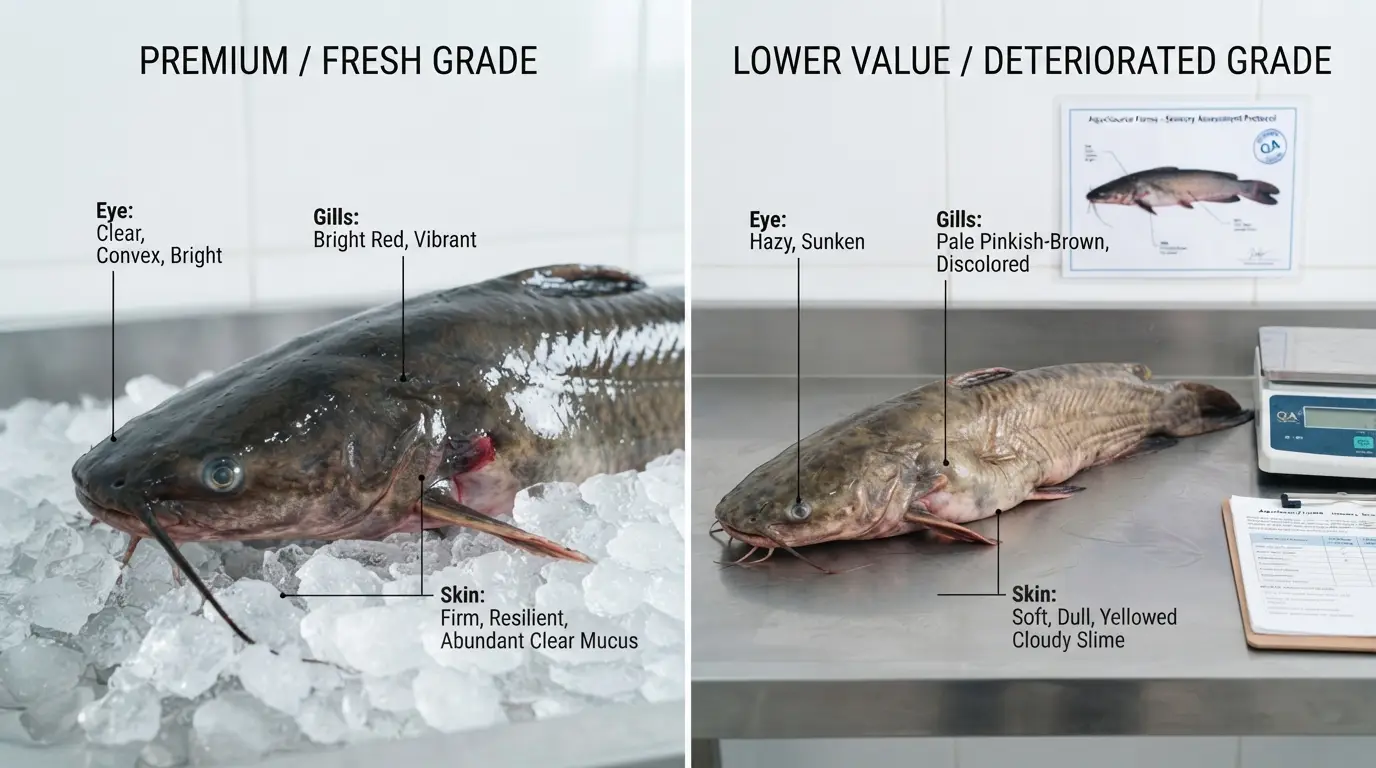
All catfish buyers assess freshness by sensory evaluation — the specific characteristics they look for are the direct observable consequences of the biochemical deterioration processes described above:
Eyes: Clear, bright, convex (slightly bulging) in fresh fish — hazy, sunken, or flat eyes indicate advancing spoilage as the aqueous humor protein degrades and the fluid behind the eye resorbs.
Gills: Bright red to dark red in fresh fish — pale pink, brown, or gray gills indicate spoilage as hemoglobin oxidizes and microbial activity in the gill tissue accelerates. Smell the gills directly — fresh gills smell of the sea or pond water; spoiled gills produce an ammonia or sulfur smell that is unmistakable.
Skin and mucus: The intact mucus coat of a fresh catfish is abundant, clear, and slightly slippery to the touch. As spoilage advances, the mucus becomes milky, then yellow, then acquires the characteristic slime and odor of advanced bacterial decomposition. Skin color should be uniform and natural — any unusual discoloration indicates quality problems.
Texture: Press the flesh firmly with one finger and release — fresh fish rebounds immediately (the muscle protein network is intact and elastic). Fish showing spoilage are soft, and finger pressure leaves a depression that does not immediately rebound.
Odor: The most sensitive and most reliable single freshness indicator. Fresh catfish should smell of the pond or clean water — neutral or very mildly “fishy” in a pleasant way. Any ammonia, sulfur, sour, or “off” odor indicates spoilage regardless of how visually acceptable the fish appears.
Live Fish Handling — Maintaining Value Through the Sale Event
Live Fish as the Premium Freshness Standard
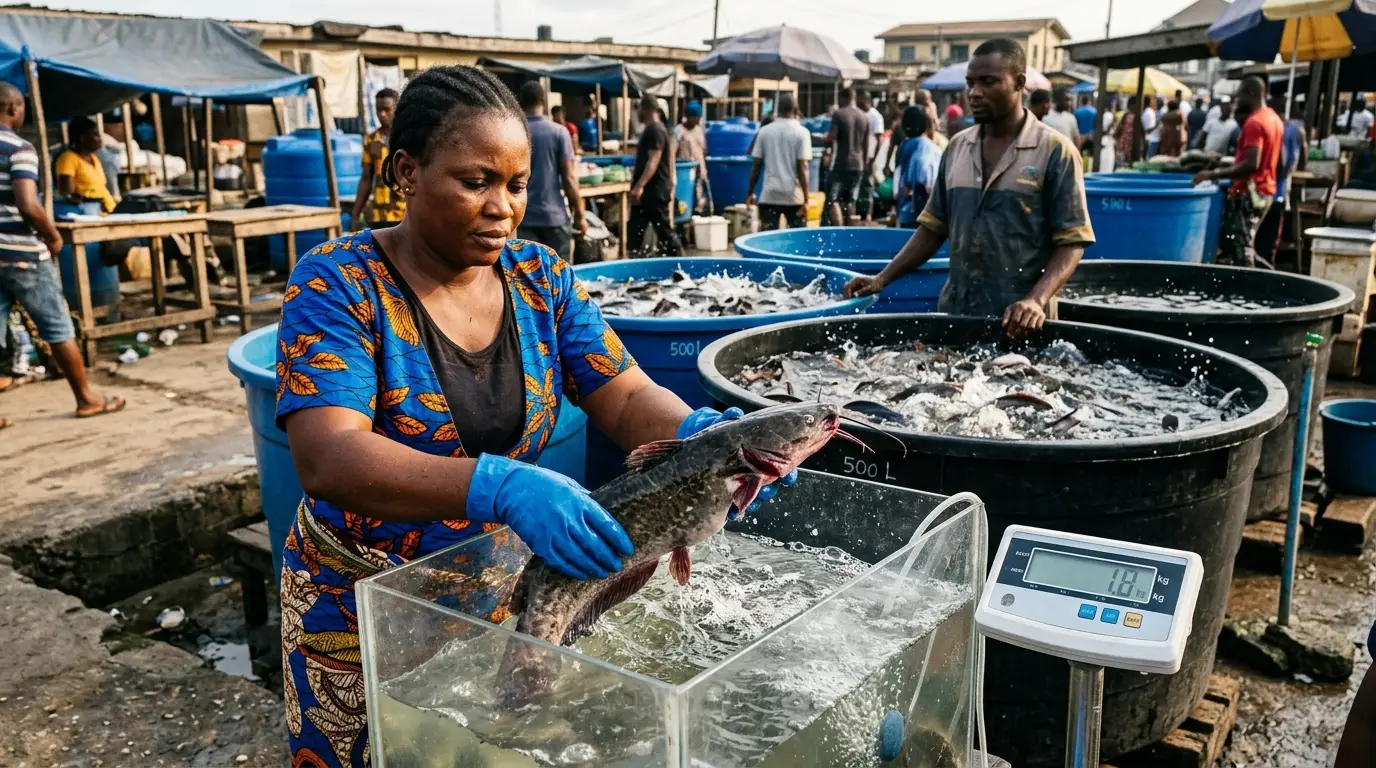
In West and Central African catfish markets, live fish command a price premium over killed fresh fish — typically XAF 200–500/kg above the price for equivalent quality killed fresh fish. The premium reflects the unambiguous freshness guarantee that a live fish provides — there is no doubt about when a live fish was harvested, no possibility that it has been in storage past its quality window, and no room for misrepresentation of condition.
For catfish operations with market access within 2–4 hours of the farm, live fish delivery is the highest-value marketing option and should be the default approach for premium channel buyers.
Live holding before sale:
When harvest timing and buyer collection timing do not align perfectly, live fish may need to be held for 12–24 hours between harvest and delivery. Live holding in aerated tanks is appropriate for these short periods:
- Stocking density in holding tanks: 30–50 kg/m³ maximum
- DO: above 5 mg/L continuously
- Temperature: 20–24°C (addition of ice to bring temperature below ambient reduces metabolic rate and extends safe holding duration)
- No feeding during the holding period — fasted fish produce less ammonia waste and tolerate crowding stress better
- Monitor water quality every 4 hours — ammonia accumulates rapidly in holding tanks and must be managed by water exchange
Live transport (reviewed in the harvesting article): The transport loading densities, oxygenation requirements, and temperature management for live transport were covered in the harvesting article. The key principle is that the live fish’s value depends entirely on it arriving at the buyer alive and in active, healthy condition — mortality in transport converts the premium live fish price to at best the killed fresh price, and typically produces a negotiation over partial compensation for the dead fish.
Killed Fresh Fish Handling
The Decision to Kill Fish Before Transport
For market distances above 2–3 hours, or for operations supplying buyers who prefer or require killed fresh fish (hotels and restaurants that have consistent delivery schedules and adequate cold storage to receive killed fresh product), on-farm killing and chilling before transport is the appropriate handling approach.
Killed fresh fish are commercially viable for:
- 24–36 hours at ambient tropical temperatures (28–35°C) — marginal, not recommended for premium markets
- 4–7 days at 0–4°C (ice chilling) — standard for premium fresh market supply
- 8–14 days at 0–4°C (modified atmosphere packaging + refrigeration) — appropriate for supermarket and food service supply with cold chain
Killing Methods and Their Quality Impact
Percussion stunning followed by cutting the gill arches (spiking):
The highest welfare and highest product quality killing method — the fish is rendered unconscious immediately by a firm blow to the cranium, then the gill arches are cut to allow rapid blood drainage. The rapid unconsciousness eliminates the stress of prolonged dying that degrades quality through cortisol release and ATP depletion from struggling, while the bleeding produces a cleaner fillet color (less blood discoloration in the muscle) and reduces the bacterial load in the tissue from residual gut circulation.
Suffocation by crowding (no aeration): The least welfare-appropriate killing method and one that produces the worst product quality — fish that struggle during suffocation deplete their muscle ATP reserves rapidly (accelerating rigor onset and texture deterioration), release stress hormones that cause muscle quality changes, and die with full guts that continue contaminating the tissue from the inside. Not appropriate for premium market supply.
Gill cutting without prior stunning: A common compromise in high-throughput commercial processing — faster than percussion stunning at scale, produces adequate product quality for most markets though not the highest quality achievable. Fish bleed out over 2–5 minutes.
CO₂ narcosis: Immersing fish in CO₂-saturated water renders them unconscious before killing — a welfare-acceptable alternative to percussion stunning at scales where individual percussion stunning is impractical. The CO₂ dissolved in the water acidifies the blood during the narcosis period — this slightly acidified blood environment has a mild preservation effect on the dressed fish.
Ice Application — The Most Critical Post-Kill Step
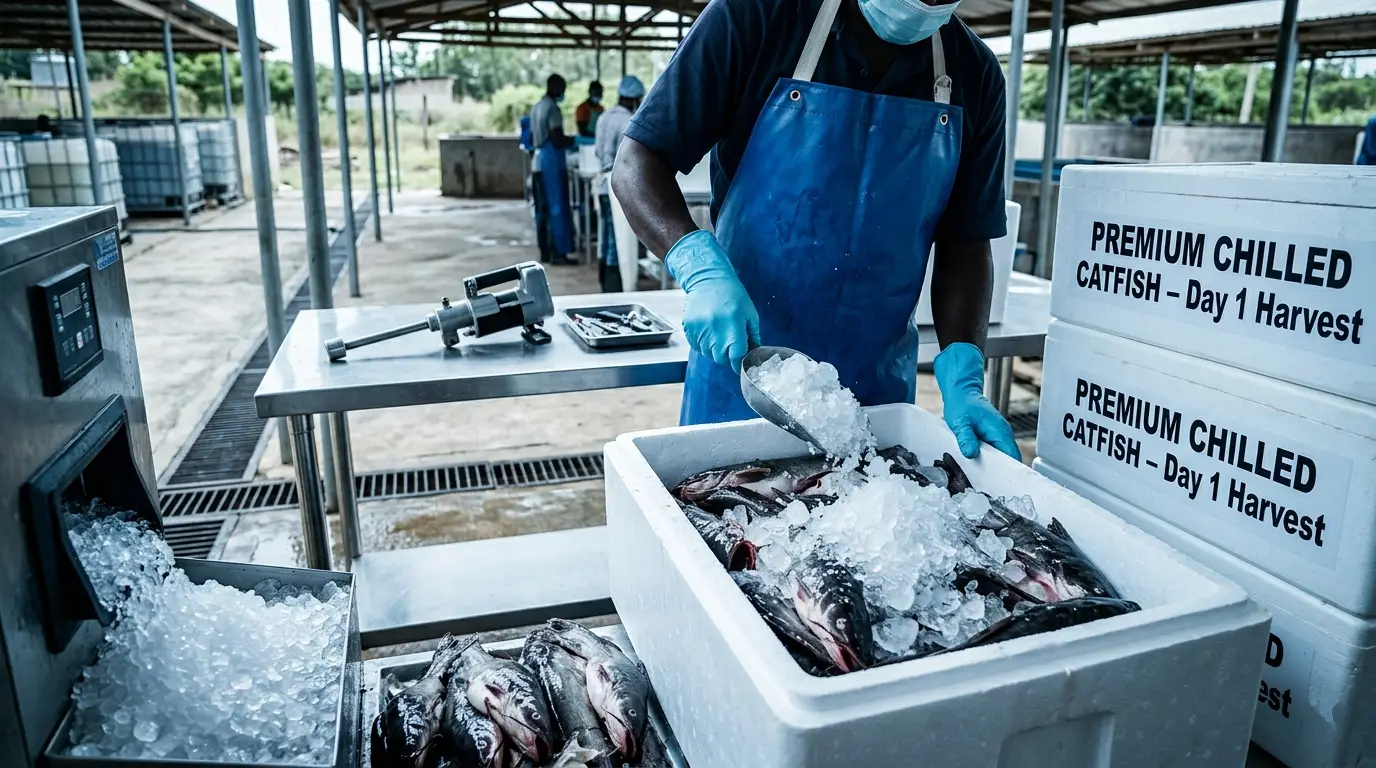
Immediately after killing, fish must be brought to near-zero temperature as rapidly as possible. Ice application is the most accessible and most effective chilling method for most West African catfish operations:
Ice-to-fish ratio: A minimum 1:1 ratio (1 kg ice per 1 kg of fish) maintains adequate chilling during transport and initial storage. In very hot ambient conditions (above 35°C), a 1.5:1 or 2:1 ice-to-fish ratio is required to maintain target temperature throughout the delivery period.
Slurry ice: A mixture of ice and water (slurry, typically 40% ice and 60% water by weight) provides better surface contact with the fish than solid ice cubes — the slurry surrounds the fish, conducting heat away from the entire body surface simultaneously rather than only at ice contact points. Slurry ice chills fish to near 0°C approximately 2–3× faster than equivalent-mass solid ice. Where ice-making equipment is available, slurry is preferred for initial chilling (the first 30–60 minutes after killing) followed by solid crushed ice for continued storage and transport.
Container insulation: Polystyrene foam boxes (styrofoam coolers) with fitting lids provide the insulation that maintains ice effectiveness through transport. A well-packed polystyrene box with 1:1 fish: ice ratio can maintain below-4°C internal temperature for 12–18 hours at 32°C ambient temperature — sufficient for same-day delivery within a 200 km radius.
Processing Options and Value Addition
Processing for Different Market Channels
Whole gutted: The minimal processing form — removing the viscera (intestines, swim bladder, and other abdominal organs) while leaving head, skin, and all other tissue intact. The most common processing form for catfish sold to hotels and upscale restaurants that prefer to butcher in-house. Removes the primary internal contamination source (gut microorganisms) and reduces the weight that must be transported (approximately 10–15% weight reduction). Shelf life 1–2 days longer than whole ungutted fish at the same temperature.
Headed and gutted (H&G): Removing both the head and the viscera. Further reduces transport weight (approximately 25–35% below round weight), removes the gills (a primary source of spoilage bacteria), and presents a form that some retail and food service buyers prefer. Shelf life similar to whole gutted when handled and iced correctly.
Fresh fillet: The highest-value processing form — removing the two boneless muscle portions from the skeleton, with or without skin. Produces the highest price per kilogram (XAF 3,500–5,000 in premium channels) at the cost of the lowest yield from live weight (35–40% yield of raw fillet from live weight). Requires the cleanest processing hygiene of any processing form — the exposed muscle surface is the highest-risk surface for contamination. Shelf life 3–5 days at 0–4°C for skin-on fillet; 2–3 days for skinless (skin removal exposes more muscle surface to contamination and desiccation).
Smoked catfish: The processing form that provides the longest shelf life (weeks to months), commands the highest total mass-equivalent price in the smoked fish market, and allows marketing at distances and through supply chains inaccessible to fresh fish. Smoking (hot smoking at 60–80°C, or cold smoking at 25–35°C combined with salt curing) reduces water activity in the fish tissue, inhibits microbial growth, and creates the characteristic flavor that has established smoked catfish as a premium dried fish product in West African food culture. Smoked catfish represents a significant value-addition opportunity for operations with access to reliable fuel for smoking and to the smoked fish market channels that are often geographically distinct from the fresh fish market.
HACCP for Commercial Catfish Operations
What HACCP Is and Why It Matters for Catfish Producers
HACCP (Hazard Analysis and Critical Control Points) is an internationally recognized food safety management system that identifies the specific points in the food production process where safety hazards can be controlled, and establishes monitoring and corrective action protocols for each control point. It is the basis for food safety certification required by most formal retail (supermarkets), export, and institutional (hotel chain, hospital, airline catering) buyers.
A catfish producer without HACCP documentation cannot supply these formal channels regardless of actual product quality — the documentation of systematic safety management is what these buyers require as evidence of food safety assurance, not simply the assertion that the fish is safe.
The Seven HACCP Principles Applied to Catfish
Principle 1: Conduct a Hazard Analysis
Identify all potential biological, chemical, and physical hazards that could cause harm at each step of the catfish production and processing chain:
Biological hazards:
- Bacterial pathogens in fish tissue: Salmonella, Aeromonas hydrophila, Vibrio species, Clostridium botulinum (in smoked products)
- Parasites: Gnathostoma species (larval roundworm, rare in Clarias but documented in some African freshwater fish)
- Viral pathogens: hepatitis A virus and norovirus from contaminated water sources or contaminated human handlers
Chemical hazards:
- Antibiotic residues: from treatment of fish with antibiotics without completing the withdrawal period
- Pesticide residues: from agricultural runoff into water sources
- Heavy metals: from industrial contamination of water sources
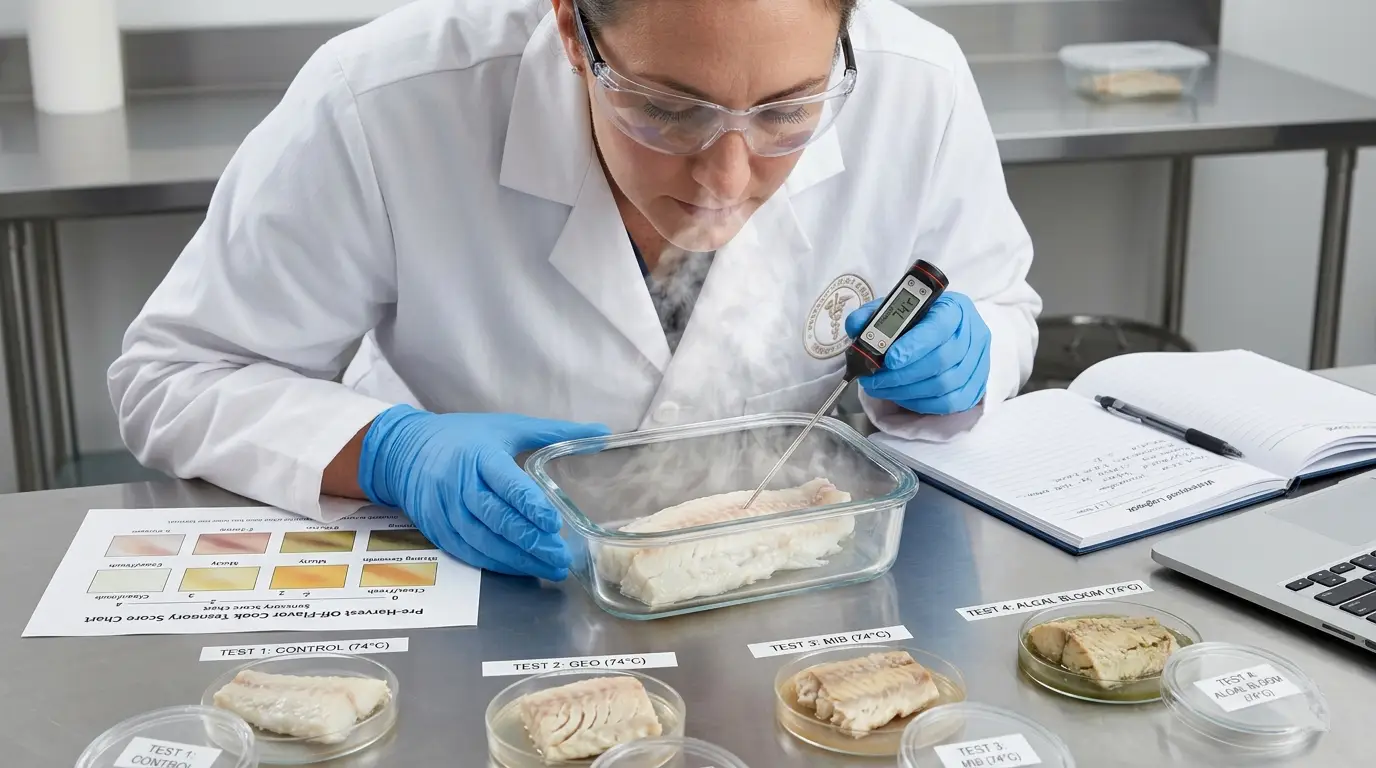
- Geosmin and MIB: not a food safety hazard (not toxic) but a quality/commercial hazard at detectable levels
- Cleaning chemical residues: from inadequate rinsing of processing surfaces after disinfection
Physical hazards:
- Metal fragments: from broken harvest or processing equipment
- Bone fragments: in filleted products
- Foreign objects: from poor processing facility management (pen caps, gloves, packaging materials)
Principle 2: Identify Critical Control Points (CCPs)
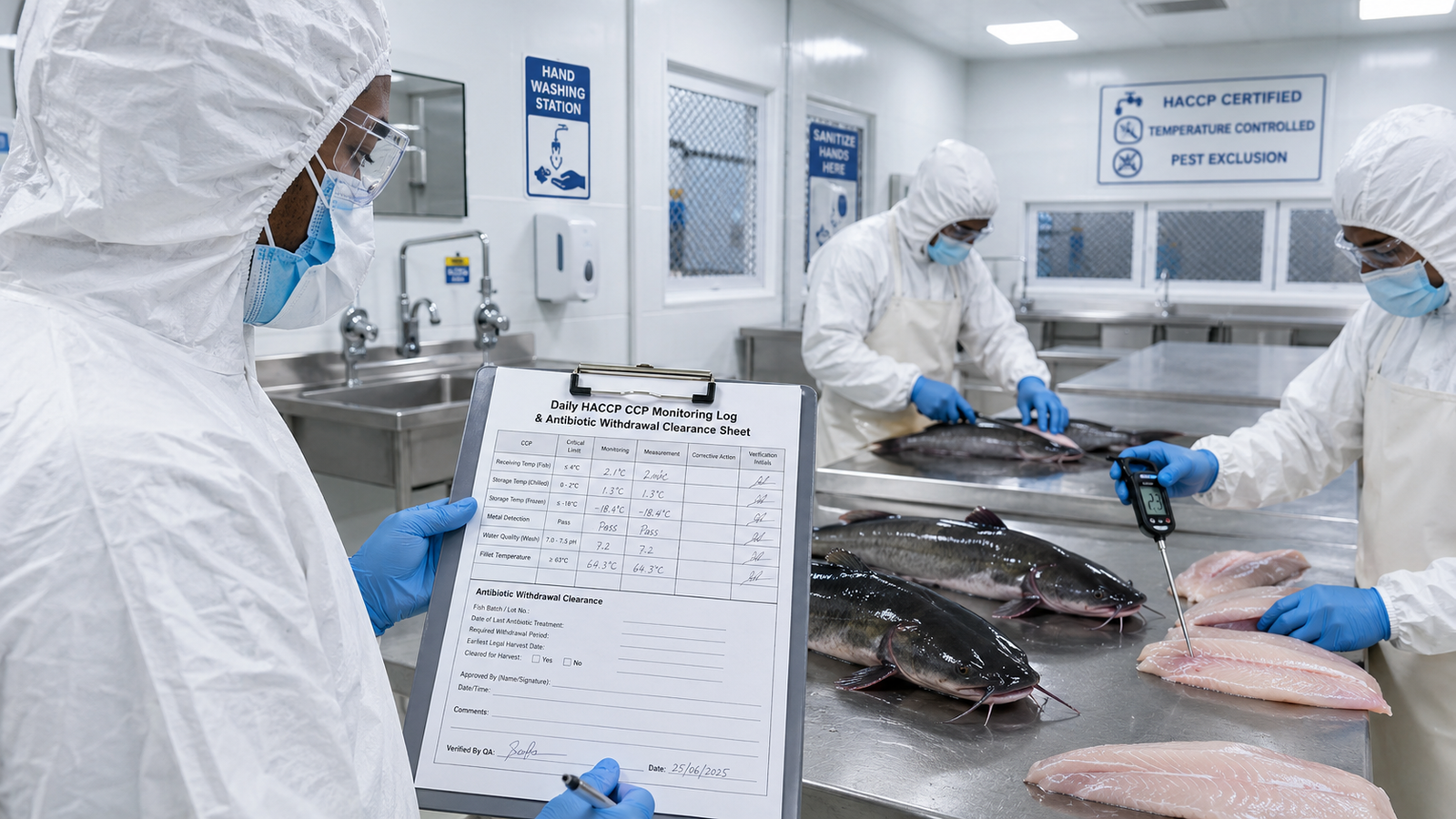
A Critical Control Point is a step in the process where a control measure can be applied and where failure to control the hazard could result in consumer harm. For a catfish farm and primary processing operation, the typical CCPs are:
| CCP Number | Process Step | Hazard Controlled | Critical Limit |
|---|---|---|---|
| CCP-1 | Antibiotic treatment and withdrawal | Antibiotic residues | Harvest only after withdrawal period complete; verified by record |
| CCP-2 | Chilling after harvest/killing | Bacterial growth | Fish temperature below 4°C within 2 hours of killing |
| CCP-3 | Processing facility hygiene | Bacterial contamination of product | All contact surfaces disinfected; verified before processing begins |
| CCP-4 | Cold chain during transport | Bacterial growth | Product temperature below 4°C throughout transport |
| CCP-5 (smoked product only) | Hot smoking temperature | Clostridium botulinum and other pathogens | Internal product temperature above 62°C maintained for minimum 30 minutes |
Principle 3: Establish Critical Limits
Critical limits are the specific measurable values that separate acceptable from unacceptable conditions at each CCP. The limits in the CCP table above represent critical limits — they are not aspirational targets but the minimum standards below which safety cannot be assured.
Principle 4: Establish Monitoring Procedures
For each CCP, specify who monitors, what is measured, how it is measured, and how often:
| CCP | Monitoring Method | Monitoring Frequency | Monitor Responsible |
|---|---|---|---|
| CCP-1 (withdrawal) | Review treatment log; verify harvest date vs. clearance date | Before every harvest | Farm manager |
| CCP-2 (chilling) | Thermometer measurement of fish temperature | At 30 min, 1 hour, and 2 hours after killing | Processing supervisor |
| CCP-3 (facility hygiene) | Visual inspection; ATP swab test if available | Before each processing session | Processing supervisor |
| CCP-4 (transport cold chain) | Thermometer check of transport container temperature | At loading and at delivery | Delivery driver + receiver |
| CCP-5 (smoking temperature) | Calibrated probe thermometer in product core | Continuous during hot smoking phase | Smoking operator |
Principle 5: Establish Corrective Actions
For each CCP, define the action taken when monitoring indicates the critical limit has been exceeded:
| CCP | Corrective Action |
|---|---|
| CCP-1 | Do not harvest; extend holding; recheck date; investigate cause of premature harvest plan |
| CCP-2 | Add additional ice immediately; investigate cause of slow chilling; assess product for safety if temperature exceedance was significant |
| CCP-3 | Shut down processing; re-clean and disinfect; reinspect before restarting; set aside product processed during unverified hygiene period for separate safety assessment |
| CCP-4 | Add ice; assess product safety; reject product if temperature above 10°C for more than 2 hours; investigate cold chain failure |
| CCP-5 | Continue smoking until temperature achieved; reject batch if target temperature cannot be achieved within reasonable smoking duration |
Principle 6: Establish Verification Procedures
Verification confirms that the HACCP system is working effectively — beyond the daily monitoring at each CCP:
- Weekly review of all CCP monitoring records to confirm measurements are being taken and documented at required frequency
- Monthly internal audit of the complete HACCP plan: are all CCPs being monitored? Are corrective actions being implemented and documented when critical limits are exceeded?
- Annual independent review of the HACCP plan by a food safety professional — confirming the hazard analysis remains current and that new hazards or process changes are incorporated
- Periodic microbiological testing of finished product (surface swabs, product samples for bacterial count) — confirming that the process controls are achieving the intended microbiological safety outcomes
Principle 7: Establish Record-Keeping and Documentation
HACCP is only as credible as its documentation — the monitoring records, corrective action records, and verification records that demonstrate the system is functioning:
Required records:
- Treatment log with withdrawal period clearance dates (evidence of CCP-1 compliance)
- Temperature log at each step of the cold chain (evidence of CCP-2 and CCP-4 compliance)
- Processing facility hygiene inspection log (evidence of CCP-3 compliance)
- Smoking temperature logs (evidence of CCP-5 compliance where applicable)
- Corrective action log: every instance where a critical limit was exceeded and the action taken
- Verification records: internal audit reports, review dates, third-party review reports where applicable
Processing Facility Hygiene Requirements
Facility Design for Food Safety
A processing facility that meets basic food safety requirements — appropriate whether or not formal HACCP certification is pursued — must provide:
Potable water supply: All water that contacts the fish during processing (washing, chilling, ice-making) must be potable — meeting the drinking water standards that ensure freedom from pathogenic bacteria and excessive chemical contamination. Borehole water used for processing should be tested annually for bacterial count, nitrates, and heavy metals (as described in the site selection article). Municipal water supply with residual chlorine is generally acceptable without additional treatment.
Smooth, washable, non-porous surfaces: All processing surfaces that contact fish (cutting boards, work tables, knives, tubs) must be made of smooth, non-porous materials that can be effectively cleaned and disinfected between uses. Stainless steel and food-grade polyethylene are the standard materials — wood surfaces are not acceptable because their porous structure harbors bacteria that are not removed by surface washing.
Temperature control: Where possible (and required for formal food safety certification), the processing area should be maintained at temperatures below 15°C during fish handling — either through an air-conditioned facility or by working during cooler hours of the day (early morning) and managing fish on ice throughout the processing session.
Hand hygiene facilities: Dedicated handwashing facilities with running water, soap, and single-use drying materials at the entrance to the processing area and at each work station — with a protocol requiring handwashing before starting work, after any contact with raw fish surfaces, after toilet use, and after any non-food contact activity.
Pest exclusion: Flies are the primary pest contamination risk in tropical fish processing — a fly in contact with a fish fillet deposits bacteria from whatever it previously contacted (feces, rotting organic matter, other food) onto the clean fish surface. Screens on windows and doors, positive air pressure in the processing room (air flowing outward when doors are opened, rather than inward), and fly light traps within the facility reduce fly contamination to acceptable levels.
Cleaning and Disinfection Protocol
Cleaning and disinfection sequence (before each processing session):
- Pre-rinse: Remove gross organic material (fish blood, scales, mucus) from all surfaces with cold water — hot water should not be used for pre-rinsing as it sets protein residues (blood and mucus) onto surfaces, making subsequent cleaning more difficult
- Detergent wash: Apply food-safe alkaline detergent at manufacturer-specified concentration; scrub all surfaces systematically; allow contact time as specified
- Rinse: Thorough water rinse to remove all detergent residue — detergent residue left on surfaces neutralizes the subsequently applied disinfectant
- Disinfection: Apply food-safe disinfectant (200 mg/L sodium hypochlorite, or peracetic acid at labeled concentration, or quaternary ammonium compound at labeled concentration); allow contact time as specified (typically 2–5 minutes)
- Final rinse (for non-porous surfaces): Remove disinfectant residue with potable water before processing begins — the residual concentrations of some disinfectants on surfaces can cause minor chemical burns on fish tissue
Post-processing cleaning: After each processing session, clean all equipment, surfaces, and drains with the same sequence — preventing the overnight accumulation of protein residues that provide substrate for overnight bacterial growth.
Antibiotic Residue Management — The Most Serious Food Safety Risk
Why Antibiotic Residues Are the Primary Regulatory Food Safety Issue
Of all the food safety hazards in catfish production, antibiotic residues in fish tissue from treatment without completed withdrawal periods represent the most significant current regulatory and market access risk for West African catfish producers:
- Major export markets (EU, USA) and some domestic premium channels require antibiotic residue testing before accepting fish products — positive tests result in immediate rejection and often a temporary ban on all products from the source farm
- Consumer awareness of antibiotic resistance is increasing — catfish with detectable antibiotic residues create both a food safety risk (contributing to antibiotic resistance in human gut bacteria) and a reputational crisis for the supplier
- Regulatory enforcement is increasing — while current enforcement capacity in West African markets varies considerably, the trend is toward stricter enforcement of antibiotic residue standards in formal market channels
The management solution is simple: Complete the withdrawal period before harvest. Every time. Without exception. The treatment log in the HACCP record system tracks every antibiotic treatment event and calculates the clearance date for each tank — the harvest scheduling system must incorporate withdrawal period compliance as a hard constraint that cannot be overridden by market pressure or production schedule convenience.
A farm that is known among premium buyers for strict withdrawal period compliance — that has demonstrated through antibiotic residue testing that its fish are consistently free of residues — has a differentiating quality attribute that supports premium pricing and buyer loyalty. A farm that has produced one positive residue test has a very long road back to that trust.
Summary
Post-harvest handling, HACCP, and food safety management are not bureaucratic requirements imposed on catfish production from outside — they are the management systems that preserve the value created during the production cycle and make it accessible through the highest-value market channels.
The freshness biology (bacterial spoilage accelerating exponentially with temperature above 4°C), the product quality implications of handling method (percussion stun vs. suffocation; slurry ice vs. solid ice vs. no ice), the HACCP framework (identifying the specific control points where safety failures occur and monitoring them systematically), and the antibiotic residue management discipline (completing every withdrawal period without exception) together constitute the post-harvest management system that determines whether catfish from a commercial production operation reaches consumers in the condition that its quality and value deserve.
The premium market channels — hotels, supermarkets, food service contracts, and export buyers — that pay the prices that make premium catfish production highly profitable are accessible only to operations that can demonstrate the food safety management discipline these channels require. HACCP documentation is not the barrier to entry — it is the evidence of the management quality that premium buyers are already paying a premium for.
The catfish farming series is now complete — covering the complete production cycle from species selection and biology through site selection, production systems, water quality management, hatchery operations, fingerling management, nutrition, health management, farm operations, and now post-harvest handling and food safety. The full cluster provides the integrated knowledge base that commercial catfish production in West and Central Africa requires to be consistently profitable.