Every reproductive failure that begins with “she didn’t conceive” or “she returned to service” traces back, more often than any other single cause, to a heat detection error — insemination or natural service that occurred too early, too late, or not at all because the signs of standing heat were missed, misread, or never properly checked for. Heat detection is not a peripheral skill in pig breeding management. It is the gateway through which every other investment in genetics, semen quality, and insemination technique either produces a pregnancy or fails to.
The financial stakes of heat detection accuracy are substantial and frequently underappreciated. A sow that is not bred during her fertile window does not simply lose that reproductive cycle — she loses 21 days (the full cycle length) before another breeding opportunity arises, extending her farrowing interval and directly reducing her PSY (pigs per sow per year) for the remainder of her productive life in the herd. At scale, across a 20-sow or 100-sow herd, the cumulative cost of inconsistent heat detection is measured in millions of XAF annually — not from any failure of genetics, nutrition, or insemination technique, but from simply not recognizing when a sow was ready to breed.
This guide provides the complete, practical framework for accurate heat detection: every visible sign, every behavioral indicator, how they sequence through the estrus cycle, how to distinguish reliable signs from misleading ones, and the detection protocols and schedules that catch standing heat reliably enough to support an 85%+ farrowing rate breeding program.
Part 1: The Estrus Cycle — What Detection Is Actually Tracking
The Cycle Timeline
The sow’s estrous cycle averages 21 days (range 18–24 days), divided into four phases, each with distinct hormonal drivers and distinct external signs:
Proestrus (approximately 2 days): Follicle-stimulating hormone (FSH) drives follicular development on the ovaries. Estrogen production from the developing follicles begins to rise. External signs become visible, but the sow does not yet show standing heat behavior.
Estrus / standing heat (40–70 hours, averaging 50–60 hours): Estrogen reaches peak concentration, triggering the behavioral and physical changes that define standing heat — most importantly, the lordosis (standing) reflex in response to mounting pressure. Ovulation occurs during this phase, typically 24–48 hours after standing heat onset (closer to two-thirds of the way through the standing heat duration).
Metestrus (approximately 2–3 days): The ruptured follicles form corpora lutea, beginning progesterone production. Estrogen-driven signs (vulva swelling, standing reflex) subside rapidly.
Diestrus (approximately 13–15 days): Progesterone dominates, maintaining either early pregnancy (if conception occurred) or simply maintaining the cycle until the corpora lutea regress (if no pregnancy occurred), restarting the cycle at proestrus.
Why Accurate Detection Within This Timeline Matters
Insemination must occur in the window before ovulation — sperm need to be present and viable in the reproductive tract when the egg is released, because the egg’s fertile window after ovulation is only 8–12 hours, while sperm remain viable for up to 24 hours. Since ovulation occurs at a variable point within the standing heat period (and the standing heat period itself varies in duration from 40–70 hours between individual sows), accurate detection of the onset of standing heat is the critical reference point from which the entire insemination schedule is calculated.
A heat detection error of even 12 hours — missing the actual onset and detecting standing heat half a day late — shifts the entire insemination schedule later, potentially causing insemination to occur after ovulation has already happened, when conception is no longer possible for that cycle.
Part 2: The Visible and Physical Signs of Approaching Estrus
Vulva Changes — The Most Commonly Relied-Upon Visual Sign
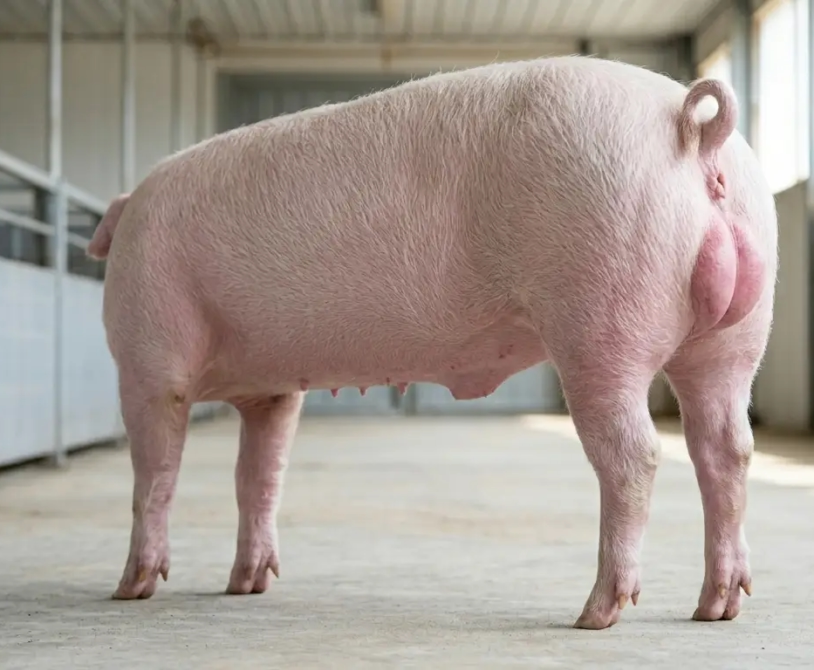
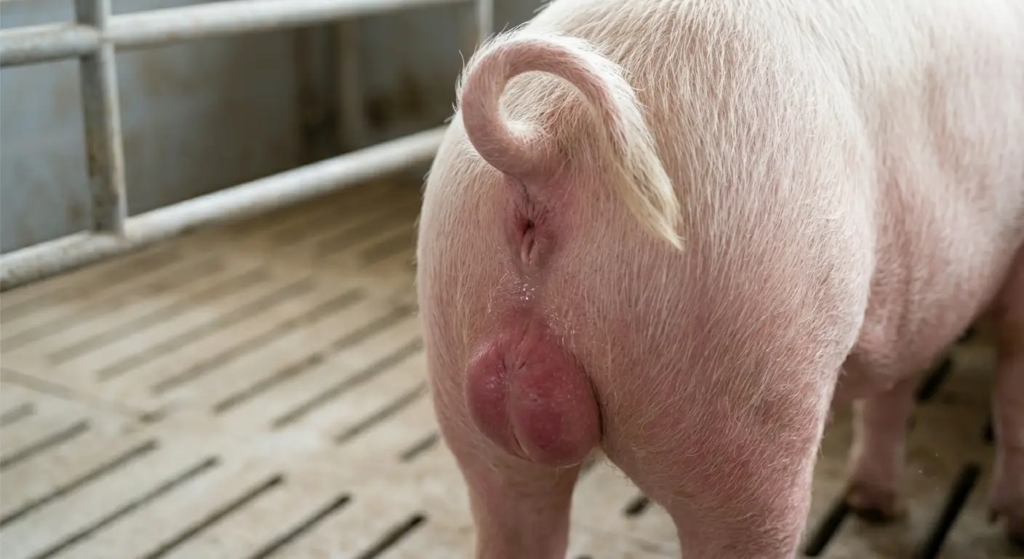
Swelling: As estrogen rises through proestrus, the vulva becomes visibly swollen and enlarged compared to its baseline appearance during diestrus. This swelling typically begins 2–3 days before standing heat onset and peaks around the time standing heat begins.
Reddening: The vulva tissue becomes more deeply colored (reddish to reddish-pink) as blood flow to the area increases under estrogen influence — most visible in lighter-skinned breeds (Large White, Landrace) and less visually distinct in darker-pigmented breeds.
The critical limitation of vulva assessment alone: Vulva swelling and reddening are proestrus signs — they indicate the sow is approaching estrus, not that she is currently in standing heat. Relying on vulva appearance alone to time insemination is one of the most common causes of mistimed breeding, because by the time vulva swelling is at its visually most obvious peak, the sow may already be several hours to a day into standing heat — or, in some individuals, vulva swelling can be subtle even during full standing heat, particularly in multiparous sows where the tissue has less elastic response than in gilts.
Vulva discharge: A thin, clear to slightly cloudy mucus discharge is often visible during proestrus and early estrus. The discharge becomes more profuse and is sometimes described as “stringy” approaching ovulation. Like vulva swelling, discharge character is a supporting indicator, not a definitive standing heat confirmation on its own.
Mounting Behavior
Sows mounting other sows: A sow approaching estrus frequently attempts to mount pen-mates — climbing onto their backs in a behavior that mimics the mounting a boar would perform. This is most pronounced in proestrus and the early hours of estrus.
The critical distinction: The sow doing the mounting is not necessarily the one in standing heat — mounting behavior reflects elevated estrogen and approaching estrus in the mounting sow herself, but a sow being mounted may or may not be in standing heat (she may simply be tolerating the mount without actively standing for it, which is a different behavior from the rigid lordosis stance that defines true standing heat).
Practical use: Increased mounting activity in a group pen is a useful early warning sign that prompts closer individual observation and heat checking, but should not be used as the sole basis for confirming which specific sow is ready for insemination.
Restlessness and Activity Changes
In the 24–48 hours before standing heat onset, many sows show:
- Increased general activity and pacing
- Increased vocalization (grunting, especially in response to other pigs or to a human approach)
- Reduced lying time, more time standing or moving around the pen
- In group housing: increased social interaction, both aggressive and mounting-related
Reduced feed intake: Many sows show a measurable, sometimes substantial, decline in feed intake around the onset of standing heat — sometimes dropping 10–30% below their typical daily consumption for 1–2 days. This is a well-documented physiological response and can serve as a useful indirect indicator, particularly in operations with individual feed intake monitoring, but should be confirmed with direct heat checking rather than relied upon alone (illness can also cause feed intake decline, and the two should not be confused).
Part 3: The Definitive Sign — The Standing Reflex (Lordosis)
Why This Is the Only Truly Reliable Confirmation
All the signs described in Part 2 are supporting indicators — useful for narrowing the observation window and prompting closer attention, but none of them definitively confirms that a sow is in standing heat at the moment of observation. The standing reflex (lordosis) is different: it is a specific, testable physiological response that directly confirms the hormonal state required for successful breeding.
What the Standing Reflex Is
When a sow in true standing heat experiences pressure applied to her back — whether from a mounting boar, from a stockperson’s hand pressure simulating mounting, or in some cases from another sow’s mounting attempt — she responds with a characteristic immobility: she stands rigid, often with her back slightly arched downward (lordosis), ears may become alert or “prick” (visible particularly in breeds with naturally erect or semi-erect ears), and she actively resists being pushed or moved away. This stance can be held for an extended period and represents a specific neuroendocrine reflex triggered by the high estrogen levels of standing heat — it does not occur, or occurs only weakly and briefly, outside the standing heat window.
How to Test for the Standing Reflex
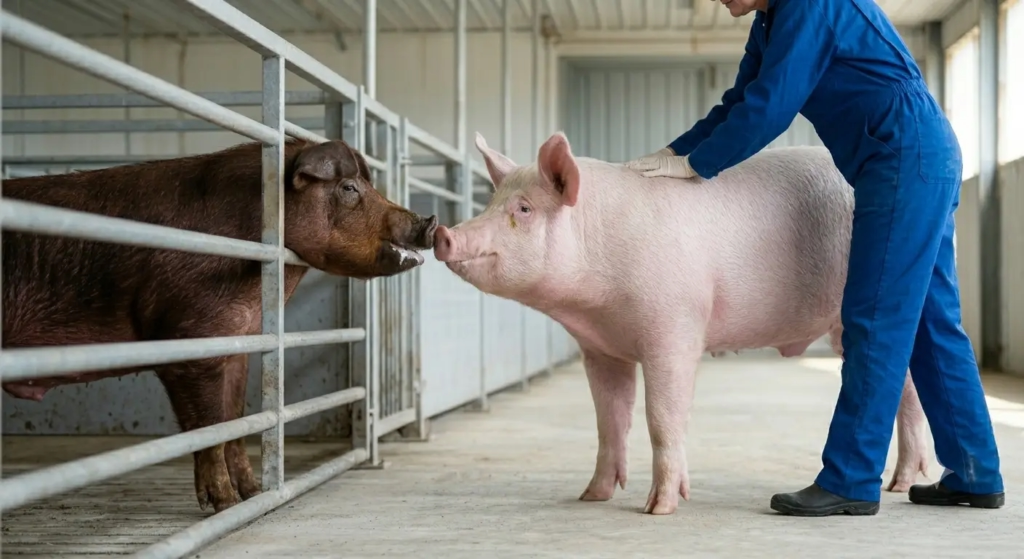
Method 1: Boar-assisted testing (most reliable)
- Bring a mature, active boar into nose-to-nose or close proximity contact with the candidate sow — through a fence, in an adjacent pen, or in a dedicated heat-check area
- Allow the boar to vocalize his characteristic courtship “chant” (a rhythmic, guttural grunting) and display typical courtship behavior (nudging, attempting to make contact)
- While the boar is actively engaged with the sow, apply firm, sustained downward pressure to the sow’s back, simulating the pressure of a mounting boar — using both hands pressed firmly across the loin/back area, or by sitting/leaning your body weight onto her back if she is restrained or in a chute
- Observe her response over 10–15 seconds of sustained pressure
Positive (standing heat confirmed): The sow becomes rigid and immobile, often with ears pricked, and does not move away despite the pressure — she “stands” for the test, mimicking her response to an actual mounting boar.
Negative (not in standing heat): The sow moves away, walks off, or shows no particular behavioral change to the pressure beyond normal reaction to being touched.
Method 2: Back pressure test without boar present (lower reliability, useful when no boar is available)
Apply the same firm back pressure test described above, but without a boar present for stimulation. This method is less reliable — the absence of boar pheromone and vocal stimulation means some sows in true standing heat will not show as strong or as clear a reflex response, increasing the risk of false negatives (missing a sow that is actually in standing heat).
The practical recommendation: Wherever a boar is available on the farm — even if AI is the primary breeding method — using the boar for heat detection assistance is strongly preferred over the back pressure test alone. The improvement in detection accuracy from boar-assisted testing typically justifies maintaining at least one “teaser” boar on the farm specifically for heat detection purposes, even on farms that breed exclusively by AI and do not use any boar for natural service.
Method 3: Boar pheromone spray (partial substitute when no boar is available)
Commercial boar pheromone products (containing synthesized androstenone, the primary pheromone compound in boar saliva) sprayed near the sow’s snout immediately before the back pressure test can partially substitute for live boar presence, improving detection accuracy compared to the back pressure test alone, though generally still somewhat less reliable than a live, actively vocalizing boar.
Part 4: Gilt-Specific Heat Detection Considerations
Why Gilts Require Particular Attention
Gilts (young females that have not yet farrowed) present specific heat detection challenges that differ from multiparous sows:
Puberty onset variability: Gilts reach puberty (first estrus) at variable ages — typically 180–220 days, but influenced significantly by breed, body weight, and environmental stimulation (particularly boar exposure). Some gilts within the same contemporary group will reach puberty considerably earlier or later than their pen-mates, requiring individual rather than group-level attention to detection.
Less pronounced external signs: First and second estrus cycles in gilts frequently show less dramatic vulva swelling and reddening compared to subsequent cycles or compared to mature sows, making visual assessment alone even less reliable for gilts than for sows.
The boar exposure effect on puberty timing: Daily exposure to a mature boar (15–20 minutes of nose-to-nose contact, beginning at approximately 165–170 days of age) reliably accelerates puberty onset by 10–14 days compared to gilts kept in complete isolation from boar contact. This “boar effect” operates through pheromone-mediated stimulation of the gilt’s hypothalamic-pituitary-ovarian axis and is one of the most cost-effective interventions available for ensuring gilts reach puberty within the desired breeding timeline.
The Recommended Gilt Heat Detection Protocol
- Begin daily (not twice-daily, as boar exposure itself partially substitutes for detection frequency at this stage) boar exposure at 165–170 days of age
- Begin formal twice-daily standing heat checks (boar-assisted, as described in Part 3) starting at 170–175 days of age
- Record the date of the first observed standing heat for each gilt individually
- Do not breed at first observed standing heat — research consistently shows that litter size at first breeding is larger when gilts are bred at their second or third observed estrus rather than their first, reflecting the slightly higher ovulation rate that develops over the first few reproductive cycles
- Continue heat checking at subsequent 21-day intervals, breeding at the second or third confirmed standing heat
Recognizing “Silent Heat” in Gilts
A meaningful proportion of gilts — particularly under stress, in suboptimal body condition, or with inadequate boar exposure — experience “silent heat”: ovarian activity and ovulation occur (confirmable via ultrasound or progesterone testing where available) without the typical external behavioral signs of standing heat being expressed strongly enough for visual or even boar-assisted detection to reliably catch.
Practical mitigation:
- Ensure adequate, consistent daily boar exposure from 165–170 days onward (the single most effective intervention for reducing silent heat incidence)
- Maintain target body condition score (avoid both underweight and overweight gilts, both of which are associated with higher silent heat rates)
- Where a gilt fails to show any detected standing heat by 220–230 days despite consistent checking and boar exposure, investigate further (body condition reassessment, veterinary reproductive examination) rather than simply continuing routine checking indefinitely
Part 5: The Practical Detection Schedule and Protocol
Standard Twice-Daily Checking Protocol
For weaned sows: Begin heat checking on day 3 post-weaning (most weaned sows return to estrus 4–7 days after weaning, with the majority showing standing heat onset on days 4–5).
For previously bred sows that returned to service (did not conceive): Begin checking at day 18 after the previous service (anticipating the 21-day average cycle length, checking begins a few days early to ensure the actual onset, which may occur slightly earlier than the average, is not missed).
Checking frequency: twice daily, approximately 12 hours apart (for example, 07:00 and 19:00). This interval is chosen specifically because standing heat duration (40–70 hours) means a 12-hour checking interval will reliably detect the onset within a 12-hour error margin — adequate precision for the insemination timing protocol that follows detection.
Why once-daily checking is inadequate: A sow with a shorter standing heat duration (toward the 40-hour end of the range) checked only once per 24 hours risks the entire standing heat period beginning and ending between two consecutive daily checks, resulting in a completely missed breeding opportunity for that cycle.
Recording Detection Results
Maintain a heat detection log for every sow and gilt under observation:
| Field | Purpose |
|---|---|
| Animal ID | Individual tracking |
| Date and time of each check | Establishes detection precision |
| Standing reflex result (positive/negative) | The core detection data point |
| Vulva condition (swollen/reddened — supporting note) | Context for interpreting borderline standing reflex results |
| Boar used for assistance (if applicable) | Quality control — confirms boar-assisted method was used |
| Confirmed onset time (first positive standing reflex check) | The reference point for calculating insemination timing |
This record-keeping is not bureaucratic overhead — it is the data that allows retrospective troubleshooting when conception rates decline (as discussed in the AI guide’s troubleshooting section), distinguishing heat detection timing problems from semen quality or technique problems as the cause of any specific breeding failure.
Part 6: Common Heat Detection Errors and How to Avoid Them
Error 1: Relying on Vulva Appearance Alone
As discussed, vulva swelling and reddening are proestrus indicators that precede true standing heat by hours to a day, and their visual prominence varies considerably between individual sows, particularly by parity. Vulva assessment should prompt closer attention and trigger a standing reflex test — it should never substitute for the standing reflex test itself.
The correction: Treat vulva signs as a trigger for testing frequency increase, not as confirmation of breeding readiness.
Error 2: Testing Without Boar Stimulation When a Boar Is Available
Some operations, particularly those breeding exclusively by AI, neglect to maintain even a single “teaser” boar for heat detection assistance, relying instead on the less reliable back-pressure-only method. This measurably reduces detection accuracy, particularly for sows whose standing reflex response is weaker without pheromone and vocal stimulation.
The correction: Maintain at least one boar — even an older, lower-genetic-merit animal no longer suitable for breeding contribution — specifically for heat detection assistance. The detection accuracy improvement typically justifies the modest cost of maintaining a teaser boar.
Error 3: Insufficient Checking Frequency
Once-daily checking, or checking that is irregularly timed (sometimes morning, sometimes evening, without a consistent 12-hour interval), introduces a detection timing error that directly translates into insemination timing error.
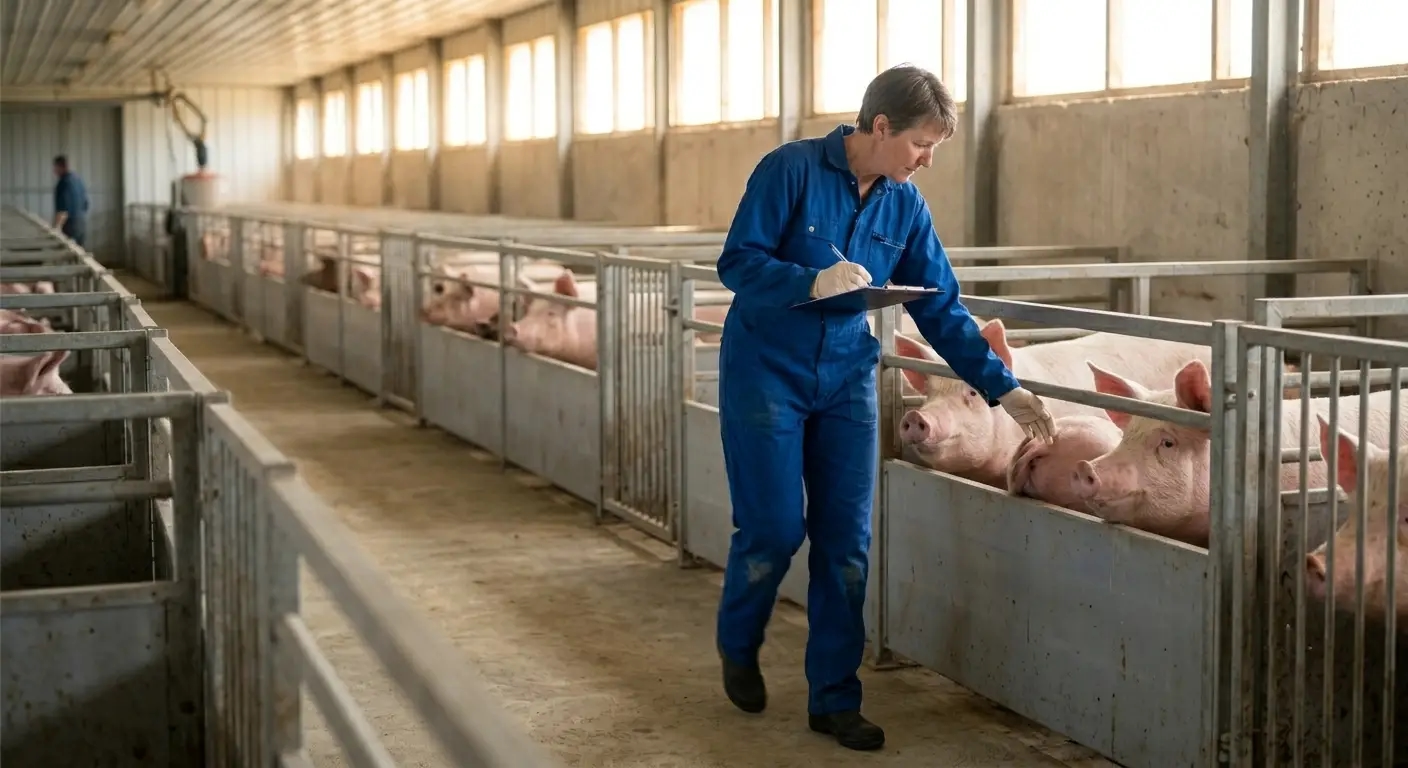
The correction: Commit to a consistent, twice-daily schedule at approximately 12-hour intervals, performed by trained personnel who understand and can correctly perform the standing reflex test.
Error 4: Confusing Mounting Behavior (by the candidate sow) with Standing Heat
A sow actively mounting other sows is approaching her own estrus, but is not, by virtue of her own mounting behavior, confirmed to be in standing heat herself. Standing heat is confirmed by her response to being mounted or to simulated mounting pressure — not by her mounting others.
The correction: Use mounting behavior observed in group housing as a signal to increase individual checking frequency and attention for the specific sows showing this behavior, but always confirm with a direct standing reflex test before scheduling insemination.
Error 5: Inadequate Training and Inconsistent Personnel
Heat detection accuracy depends significantly on the skill and consistency of the person performing the checks. Untrained or infrequent checkers — particularly those unfamiliar with the specific firmness and duration of back pressure required, or who do not recognize the subtler signs of standing heat in gilts or in sows with naturally less pronounced responses — produce lower detection accuracy than trained, consistent personnel.
The correction: Designate specific, trained personnel for heat detection duties rather than rotating the task among whoever happens to be available. Where possible, have an experienced person train and directly supervise new heat-checking staff through their first several weeks of independent checking, comparing their detection calls against the trainer’s assessment of the same animals.
Part 7: Connecting Detection to the Breeding Outcome
The Complete Timeline From Detection to Insemination
Once standing heat onset is confirmed through the standing reflex test, the insemination schedule (detailed fully in the artificial insemination guide in this series) follows directly:
| Time From Confirmed Onset | Action |
|---|---|
| 0 hours | Standing heat onset confirmed via positive standing reflex test |
| 12 hours | First insemination or natural service |
| 36 hours | Second insemination or natural service |
| 60 hours (if standing reflex still positive) | Third insemination, if standing heat persists this long |
Accurate detection of the zero-hour reference point — the actual onset of standing heat — is the foundation on which this entire schedule depends. Every hour of detection error shifts the entire schedule, and because ovulation occurs in a relatively narrow window relative to onset, detection errors of even 6–12 hours can meaningfully reduce conception probability even when every subsequent step (semen quality, insemination technique) is executed correctly.
The Financial Value of Detection Accuracy
A farm achieving accurate heat detection (85%+ of true standing heat events correctly identified within a 12-hour window) compared to a farm with inconsistent detection (60–70% accuracy):
At 20 sows, 2.4 breeding cycles per year per sow attempted:
- Accurate detection farm: 85% successful identification → approximately 41 successfully timed breedings per year out of 48 cycles
- Inconsistent detection farm: 65% successful identification → approximately 31 successfully timed breedings per year out of 48 cycles
The 10 additional successfully timed breeding opportunities per year, at an assumed 88% farrowing rate and 11 pigs weaned per successful farrowing: 10 × 0.88 × 11 = approximately 97 additional pigs per year from improved detection accuracy alone — independent of any change in genetics, nutrition, or semen quality.
At XAF 90,000 (USD 150) gross margin per pig: XAF 8,730,000 (USD 14,550) per year in additional gross margin attributable purely to heat detection accuracy improvement.
Summary
Heat detection is the gateway skill in pig breeding management — every investment in genetics, nutrition, semen quality, and insemination technique depends on first correctly identifying when a sow or gilt has entered standing heat, because insemination timed even hours away from the correct window meaningfully reduces conception probability regardless of how well every other step is executed.
The standing reflex (lordosis) test, ideally performed with boar assistance, is the only truly reliable confirmation of standing heat — vulva swelling, mounting behavior, restlessness, and reduced feed intake are useful supporting signals that should prompt closer attention but should never substitute for the direct standing reflex test before scheduling insemination.
A disciplined twice-daily checking protocol, performed by trained and consistent personnel, with boar assistance wherever possible, and supported by accurate record-keeping that documents the confirmed onset time for every breeding cycle, is the practical framework that converts heat detection from a source of unexplained conception failures into a reliable, accurate foundation for the rest of the breeding program.
The financial stakes are not abstract. At a 20-sow operation, the difference between accurate and inconsistent heat detection is worth approximately XAF 8,730,000 (USD 14,550) per year — a return that justifies the modest investment in teaser boar maintenance, staff training, and the discipline of consistent twice-daily checking that accurate detection requires.