A piggery is a commercial facility for raising pigs — systematically, at scale, for profit. It is not a subsistence activity with a few backyard animals supplementing household food. It is an agribusiness: a production system that converts feed inputs into protein outputs at a documented conversion efficiency, managed by people with specific skills, housed in purpose-built infrastructure, and connected to markets that pay predictable prices for the output.
For an agribusiness investor evaluating opportunities in West and Central Africa, the piggery sector has characteristics that distinguish it favorably from many agricultural alternatives: faster cash flow cycles than most livestock enterprises, strong and growing domestic demand that is consistently undersupplied by local production, relatively modest land requirements, scalable capital structures from XAF 80,000,000 (USD 133,333) for a 20-sow commercial operation to XAF 1,000,000,000+ (USD 1,666,667) for fully integrated industrial production, and a product — pork — that is consumed across all income levels and demographic segments of the population.
It also has characteristics that distinguish investor-level from operator-level risk: management intensity requirements that some passive investment structures cannot accommodate, feed cost volatility that directly compresses margins when grain prices spike, disease events whose probability is manageable through biosecurity investment but whose consequence is severe when biosecurity fails, and a market access challenge in which commodity channel pricing and premium channel pricing create dramatically different return profiles from the same production asset.
This introduction covers what investors need to understand about the piggery sector before engaging with any specific investment opportunity: what piggeries produce, how the economics work across the different production models, what the genuine risks are and how they are managed, and what distinguishes the investments worth making from the ones that look similar on paper but perform very differently in practice.
What a Piggery Produces
A commercial piggery produces pork — but pork takes several commercially distinct forms depending on the production model and market channel:
Live pigs at market weight (100–110 kg): The primary output form for most West African commercial operations. Pigs are sold live to abattoirs, licensed slaughterhouses, or butchers who slaughter and process them. Pricing is typically per kilogram live weight, ranging from XAF 1,200–2,200/kg (USD 2.00–3.67/kg) depending on market, season, and buyer.
Pork carcasses and cuts (to hotels, restaurants, supermarkets): Operations that slaughter and process their own animals — or work with licensed processing facilities — can sell pork by cut to institutional buyers at significantly higher prices. Hotel and restaurant buyers typically pay XAF 3,000–5,000/kg (USD 5.00–8.33/kg) for fresh pork cuts, a premium of 60–150% above live weight commodity pricing.
Weaned piglets (farrow-to-wean operations): Some piggeries specialize in producing weaned piglets (at 21–28 days old, weighing 5–7 kg) for sale to finishing operations that grow them to market weight. This model generates faster cash flow — 21–28 days per production cycle rather than 150–170 days — but depends on consistent demand from reliable piglet buyers.
Breeding stock: Higher-genetic-merit replacement gilts and boars, sold to commercial operations building or upgrading their breeding herds, command significantly higher prices than commercial market pigs — typically XAF 150,000–300,000 (USD 250–500) per breeding gilt compared to XAF 90,000–180,000 (USD 150–300) for a market pig at similar weight.
Organic fertilizer: Pig manure, composted or processed through biogas digesters, generates a secondary revenue stream from the operation’s waste output. A 100-sow farm generates sufficient manure to fertilize 3–5 hectares of crop land annually, or to supply a biogas unit generating meaningful cooking fuel or electricity equivalent.
The Economics of Commercial Pig Production
The Production Cycle Economics
The fundamental financial unit in piggery investment is the farrowing cycle — the sequence from breeding a sow through gestation (114–116 days) to farrowing, nursing (21–28 days), weaning, growing, finishing, and sale (approximately 150–170 days from weaning to market weight). Total cycle from breeding to sale: approximately 270–300 days.
A well-managed commercial sow produces approximately 2.2–2.5 litters per year, weaning 10–13 piglets per litter — 22–33 pigs weaned per sow per year (PSY, the primary productivity metric). At 90% survival from weaning to market, a sow generates approximately 20–30 market pigs per year.
The unit economics at 20-sow scale (mid-range assumptions):
| Item | Per Sow Per Year | 20-Sow Total |
|---|---|---|
| Market pigs produced (PSY 22, 90% survival) | 19.8 pigs | 396 pigs |
| Average market weight | 100 kg live | — |
| Gross revenue (XAF 1,600/kg live weight) | XAF 3,168,000 | XAF 63,360,000 |
| Feed cost (60–65% of gross revenue) | XAF 2,059,200 | XAF 41,184,000 |
| Other operating costs (veterinary, labor, utilities) | XAF 525,000 | XAF 10,500,000 |
| Net operating margin | XAF 583,800 | XAF 11,676,000 |
| Net margin % | ~18% | — |
At premium hotel/restaurant pricing (XAF 4,000/kg for processed cuts, with approximately 74% carcass yield from 100 kg live):
- Revenue per pig: XAF 4,000 × 74 kg = XAF 296,000
- Gross revenue (20 sows, 396 pigs): XAF 117,216,000
- Net operating margin (same cost base): approximately XAF 65,532,000 (56% net margin)
The market channel is the single largest determinant of return — not genetics, not nutrition, not housing design, though all of these influence the cost base. A farm selling into commodity wholesale generates approximately 18% net margin. The same farm with the same pigs selling to premium hotel/restaurant buyers generates 50%+ net margin. This is not a small difference; it is the difference between a viable business and an exceptional one.
The Return on Capital
For a 20-sow farrow-to-finish operation with total capital investment of approximately XAF 81,000,000 (USD 135,000) — as detailed in startup guidance in this series:
| Scenario | Annual Net Profit | Return on Capital |
|---|---|---|
| Commodity wholesale pricing | XAF 11,676,000 (USD 19,460) | 14.4% |
| Mixed commodity + premium | XAF 25,000,000 (USD 41,667) | 30.9% |
| Premium hotel/restaurant pricing | XAF 65,532,000 (USD 109,220) | 80.9% |
These return figures assume well-managed production (PSY 22, FCR 2.6, 90% survival to market). Operations with below-target production performance show significantly lower returns — the 14.4% commodity return falls to break-even or loss if PSY drops to 15–17 (common in poorly managed herds) or if FCR rises to 3.2–3.5 (equally common without appropriate nutritional and health management).
Cash Flow Profile
Unlike crop farming (which concentrates revenue at harvest) or cattle ranching (which requires years before any return), pig farming generates cash flow in a repeating cycle:
- First market pig sales: approximately month 8–10 from startup
- Subsequent sales: approximately every 2–3 months as successive batches reach market weight
- Near-continuous revenue by year 2 as the production pipeline fills across multiple cohorts
This cash flow profile makes piggery investment comparatively liquid among agricultural investments — a characteristic that investors coming from crop or tree crop farming backgrounds often underestimate as an advantage.
The Market Opportunity in West and Central Africa
Why Domestic Demand Consistently Exceeds Local Supply
Pork consumption in West and Central Africa is structurally undersupplied by domestic commercial production for reasons that have not materially changed over the past two decades:
Growing urban middle class: Urbanization rates across the region continue to increase, and urban consumers — with higher disposable incomes and access to formal retail and food service — drive the premium pork demand that generates the highest margins.
Food service sector expansion: The hotel, restaurant, and catering (HORECA) sector in cities like Lagos, Abuja, Douala, Yaoundé, Accra, and Abidjan has expanded significantly over the past decade. Premium pork is a standard component of hotel breakfast and restaurant menu programs — institutional buyers with consistent volume requirements and price premiums that commercial piggeries with reliable supply and quality can access.
Import displacement opportunity: A portion of pork consumed in formal retail and hotel channels is currently imported (frozen pork from Europe and Brazil) due to insufficient domestic fresh pork supply. Domestic fresh pork commands a premium over frozen imports from buyers who prefer locally produced product — an opportunity that well-positioned commercial piggeries can capture.
Regional population growth: Population growth across West and Central Africa — among the highest regional growth rates globally — continues to expand the absolute size of the consumer base for animal protein.
What Limits Market Growth From the Supply Side
The structural undersupply of the regional pork market is not because pig farming is difficult — it is because most existing production is at smallholder or subsistence scale, with neither the production consistency nor the volume to supply formal market channels reliably. The commercial scale, professionally managed piggery that can deliver consistent weekly volume to a hotel purchasing manager — graded, fresh, reliably available — is genuinely scarce in most West and Central African cities, creating a supply gap that commercially operated farms can fill.
The Genuine Risks — What Investors Must Understand
Risk 1: Management Intensity — This Is Not a Passive Investment
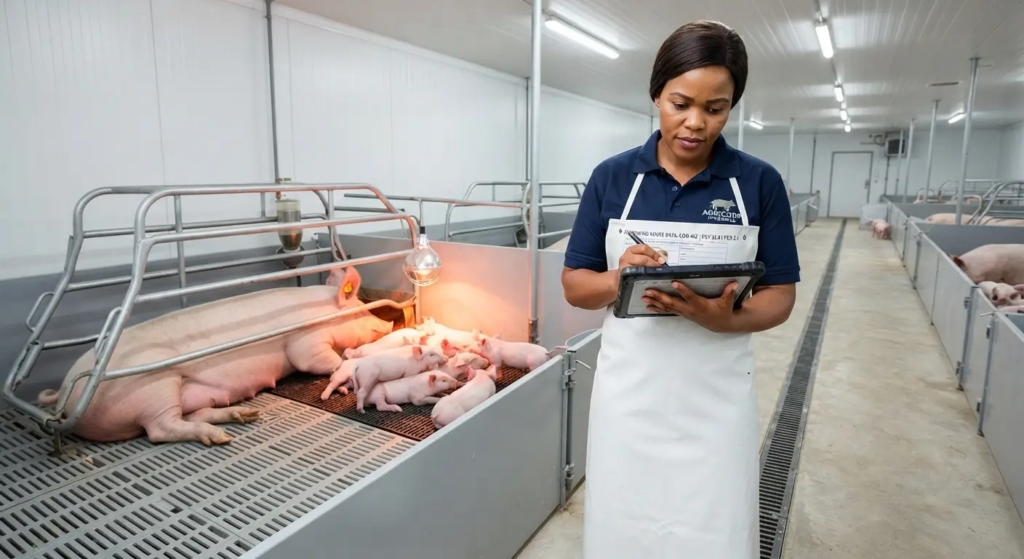
A commercial piggery requires daily professional management attention. Pigs are physiologically demanding animals — their feed intake, water access, thermal environment, health status, and reproductive management all require daily monitoring and daily response. An operation managed remotely, or managed by undertrained staff without competent oversight, will show production performance well below the projections that informed the investment decision.
The investor implication: Piggery investment requires either an equity partner who is an experienced pig production manager, a full-time professional farm manager employed specifically for this role, or an investor who is personally committed to acquiring the operational knowledge required. A pure passive investment in a piggery — capital in, distribution out, no active engagement with operations — is a high-risk structure that is inconsistent with the operational requirements of the business.
Risk 2: Feed Cost Volatility
Feed represents 60–70% of operating costs. Maize and soybean meal — the primary conventional feed ingredients — are internationally traded commodities whose prices reflect global supply and demand dynamics, currency exchange rates, and regional logistics disruptions. A 20% increase in feed ingredient prices compresses the commodity channel operating margin from approximately 18% to approximately 5–6%, making the operation marginally viable until prices normalize.
The risk management levers:
- On-farm feed mixing (capturing the manufacturer’s margin and building flexibility to substitute cheaper regional ingredients — cassava, palm kernel cake, brewers’ grain — when commodity prices spike)
- Local ingredient supply agreements (establishing supply relationships with regional cassava processors or breweries who supply byproduct ingredients at stable prices)
- Feed cost hedging through bulk purchasing and adequate storage when prices are favorable
Risk 3: Disease Events
A serious disease introduction — particularly African Swine Fever (no vaccine, no treatment, mandatory culling of the entire population on confirmation) or PRRS (Porcine Reproductive and Respiratory Syndrome, which dramatically reduces PSY for 6–12 months in naive herds) — can destroy the entire production value of an operation within weeks.
The quantified risk: A confirmed ASF event at a 50-sow farm results in total losses of approximately XAF 120,000,000–200,000,000 (USD 200,000–333,333) including culled animal value, restocking cost, decontamination cost, and revenue loss during the exclusion period.
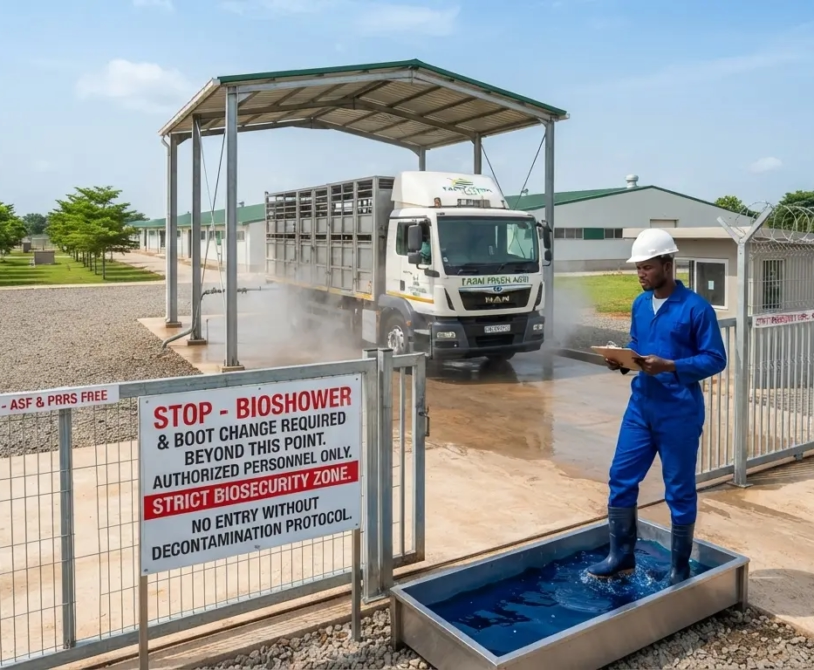
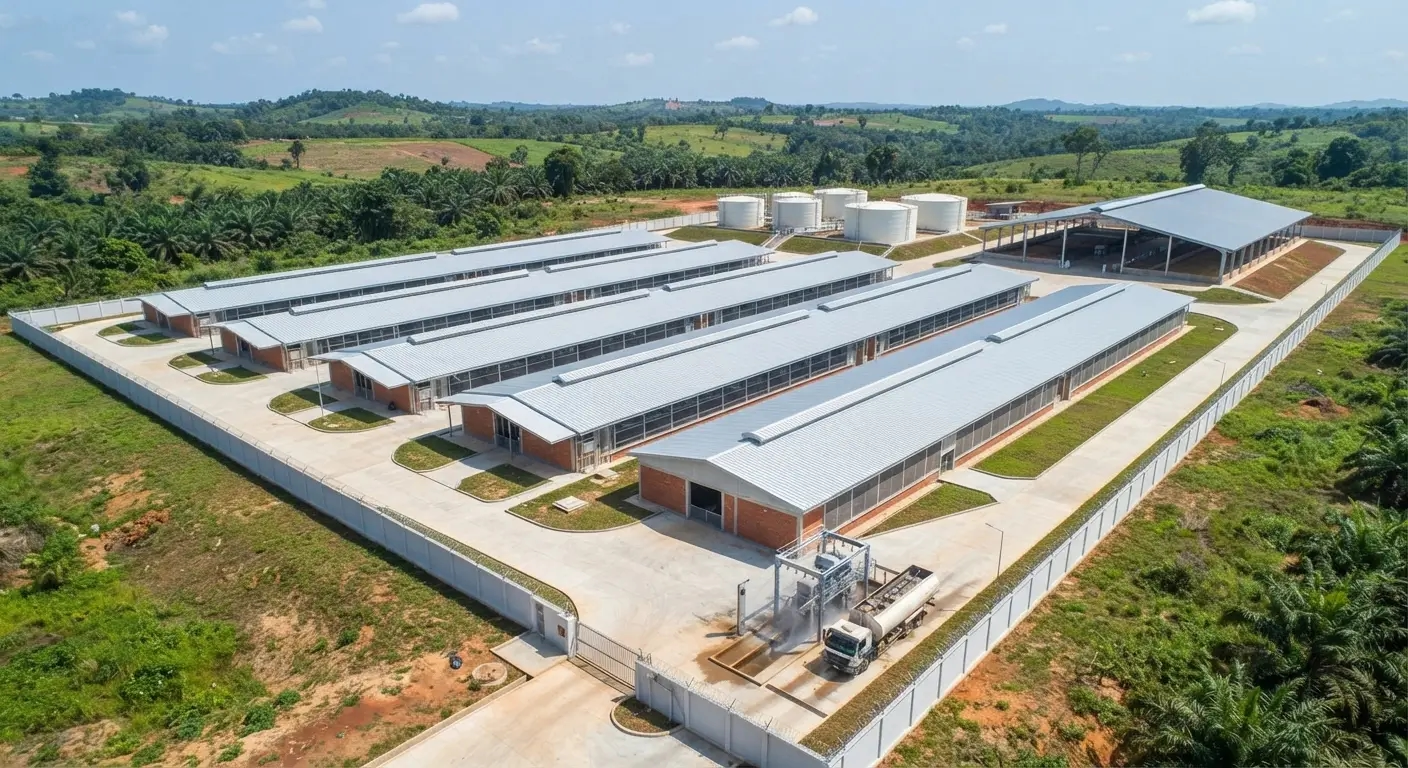
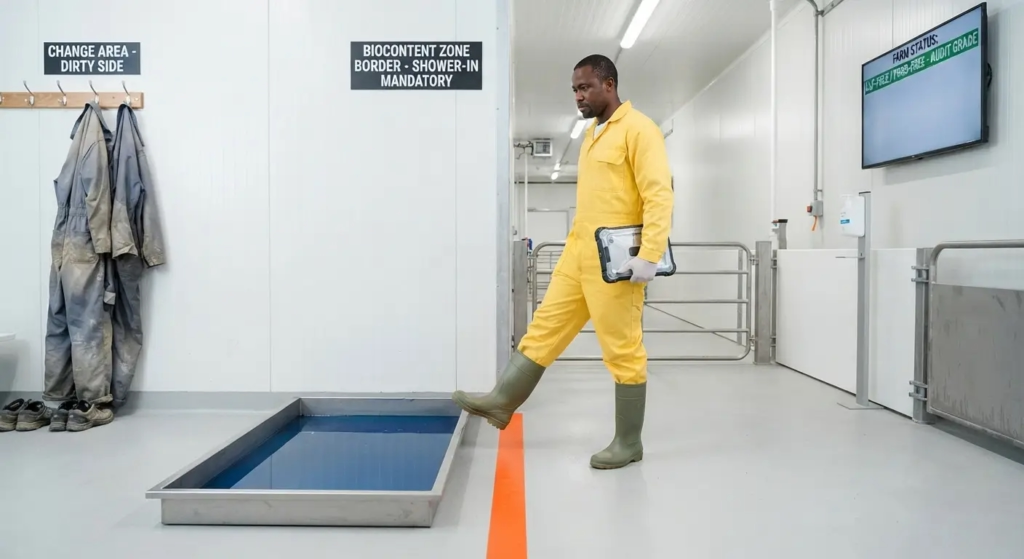
The risk management levers: Biosecurity infrastructure and discipline is the primary tool — as detailed extensively in this series, correctly designed and consistently maintained biosecurity (perimeter fencing, vehicle disinfection, quarantine protocols, personnel transition zones) reduces the probability of disease introduction dramatically. The investment required for correct biosecurity infrastructure (approximately XAF 10,000,000–15,000,000 / USD 16,667–25,000 for a 50-sow operation) is a fraction of the exposure it mitigates.
This is a manageable risk for an investor who takes it seriously and funds the mitigation correctly. It is a catastrophic risk for an investor who treats biosecurity as a cost to minimize.
Risk 4: Market Price Volatility
Live pig prices in West African markets show seasonal variation (typically lower prices around major harvest seasons when alternative proteins are more abundant, higher prices around festive periods) and occasional structural corrections when supply temporarily exceeds demand in specific local markets.
The risk management lever: Market diversification — multiple buyer channels (commodity wholesale, hotel/restaurant, direct retail) rather than dependence on a single buyer — provides the pricing resilience that mono-channel dependence does not. An operation that has established relationships with three buyer categories is insulated from the price pressure any single buyer can exert.
What Distinguishes Viable Investments from Common Failures
The Investment-Ready Piggery: What to Look For
An investor evaluating a piggery opportunity — whether a greenfield startup or an existing operation seeking capital — should specifically assess:
Genetics quality: Are the breeding animals from verified, health-documented sources? Are they commercial F1 hybrid sow genetics (Large White × Landrace) with appropriate terminal sire (Duroc)? Or are they unimproved local genetics whose production ceiling is 40–50% of commercial breed potential?
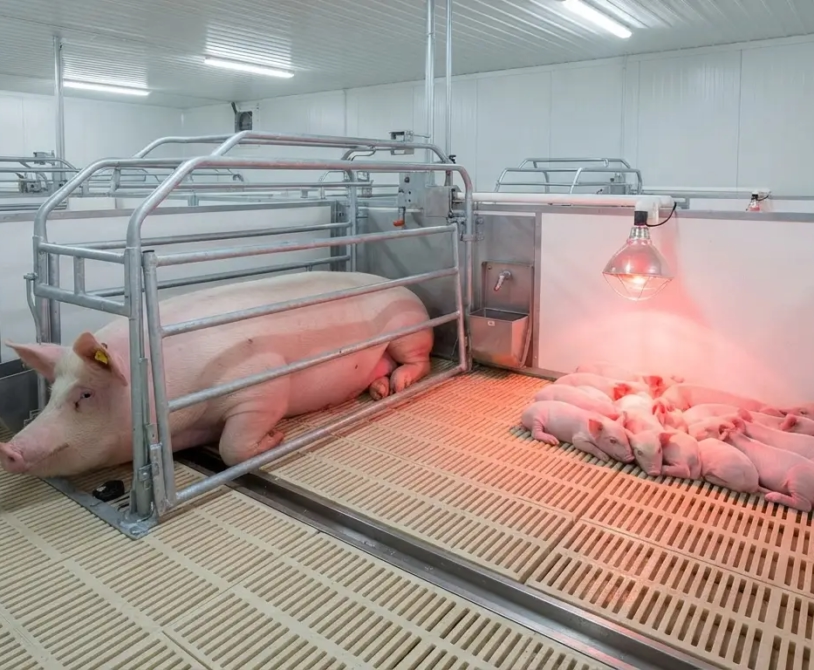
Infrastructure adequacy: Does the housing design meet the functional specifications required for commercial production — correct pen dimensions, adequate ventilation, functional farrowing crate guard rails, reliable water system, quarantine facility? Or is the housing a cost-minimized structure that compromises the production biology it is supposed to support?
Biosecurity investment: Is there a perimeter fence? A personnel changing facility? A vehicle disinfection point? A quarantine pen? Or is the “biosecurity” a footbath filled with unclear liquid at an unprotected gate?
Market relationships: Are there existing, active buyer relationships with named buyers paying documented prices? Or is the market analysis based on observed commodity prices without confirmed purchase commitments?
Records and performance data: Can the operation produce actual production records — PSY by sow, FCR by batch, pre-weaning mortality by litter? Or is performance estimated from memory and impression?
Management depth: Is there an experienced farm manager on-site, or is the operation entirely dependent on one person whose absence would immediately compromise daily management?
The Red Flags That Predict Failure
- Production performance projections using PSY 25–30 without documented basis in actual herd performance (elite PSY requires elite genetics and elite management; typical commercial herd PSY in West Africa without active management discipline is 16–20)
- Feed cost assumptions based on best-case ingredient prices without accounting for seasonal volatility
- No quarantine facility, or quarantine described as “we keep new animals separate for a few days”
- Market analysis that consists entirely of stated commodity prices without named, committed buyers
- Infrastructure costs significantly below the benchmarks in this guide (underbuilt infrastructure that compromises production biology always costs more in production losses than it saved in construction)
- A business model dependent on premium pricing without evidence of existing premium buyer relationships
The Investment Entry Points
Greenfield Development
Starting from scratch with a selected site, purpose-built infrastructure, and sourced breeding stock. Highest control, highest capital requirement, and the longest timeline to first cash flow (8–12 months from site selection to first pig sales). Appropriate for investors with sufficient capital for the full startup requirement (as detailed in startup guidance in this series) and access to experienced management for the startup phase.
Existing Farm Acquisition or Recapitalization
Purchasing an existing operation or providing capital to an existing farm in exchange for equity and operational improvements. Faster path to cash flow than greenfield if the existing operation has infrastructure and animals. Carries the risk of inherited management problems, disease history, genetics quality issues, and market relationships that need verification before value can be attributed to them.
Contract Growing / Outgrower Model
Providing capital for infrastructure to a farmer who provides land and labor, in exchange for a purchase commitment at a specified price. Transfers operational management to the farmer-operator while retaining capital deployment and market access control. Requires careful contracting (what production standards must be met? what happens if they are not?) and active quality oversight. Works well at scale as a portfolio of contract farms rather than a single contract.
Integrated Processing Investment
Investing in a slaughter, processing, and distribution facility that buys live pigs from multiple farms and sells processed product to premium channels — capturing the 60–150% premium between live commodity pricing and cut-and-packed fresh pork without being exposed to the production variability of operating farms. Requires higher capital (slaughter and cold chain infrastructure) and food safety regulatory compliance, but the margin capture potential justifies this for investors at the right scale.
Summary
The piggery sector in West and Central Africa represents a genuine agribusiness investment opportunity: real domestic demand that exceeds current commercial supply, a protein that sells across all income levels, faster cash flow cycles than most agricultural investments, and return profiles that range from acceptable (14–18% at commodity pricing) to exceptional (50%+ at premium pricing with confirmed buyer relationships).
The risks are real and specific — management intensity that passive investment structures cannot accommodate, feed cost volatility that requires supply chain management rather than budget-line acceptance, disease events whose probability is low with correct biosecurity investment but whose consequences are catastrophic without it, and market price risk that channel diversification manages but mono-channel dependence cannot.
The investments worth making in this sector are those where management competence, infrastructure adequacy, genetics quality, biosecurity investment, and market relationships are all genuinely in place — not the investments where these elements are projected to develop after capital is deployed. In agricultural investing generally and pig farming specifically, capital follows demonstrated competence rather than financing its development.
The piggery that is worth investing in looks like what this guide describes: real genetics, real infrastructure, real biosecurity, real buyers, and real records. The one that is not looks similar on a pitch deck but produces very different financial outcomes in practice.