

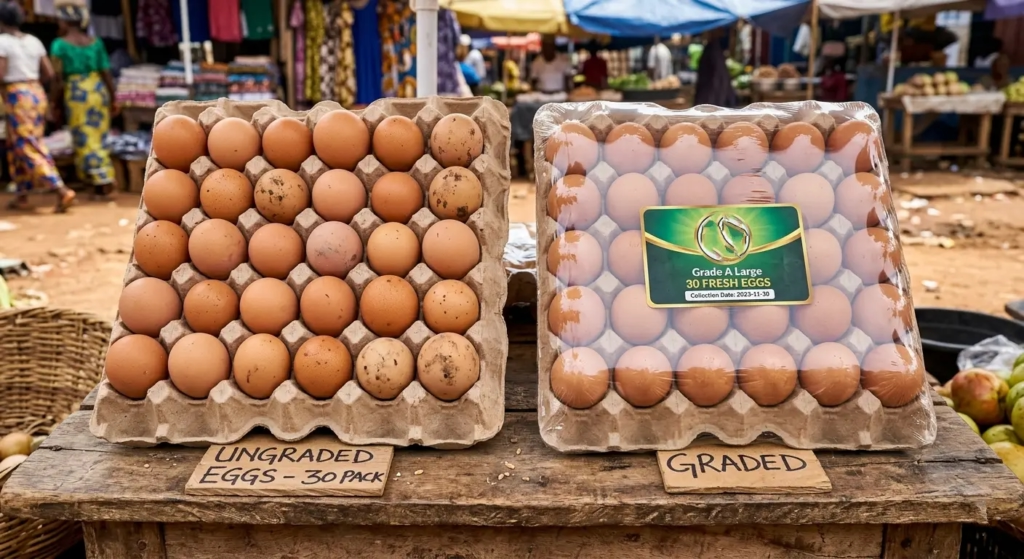
An ungraded egg is a commodity. A graded egg is a product. The difference between the two is not in the bird that produced it, not in the feed that formed it, and not in the shell that protects it. The difference is in the act of measuring, classifying, and presenting it according to a defined standard that a buyer can rely on and a consumer can trust.
In West African egg markets, grading is the competitive advantage that most producers have not yet claimed. The majority of commercial eggs moving through the market chain in Cameroon, Nigeria, and Ghana are ungraded — sold by count in trays at a uniform price regardless of weight, shell quality, or interior condition. Every tray contains a mixture of 48g eggs and 70g eggs, intact shells and hairline cracks, first-week eggs and week-old eggs — sold at the same price per unit.
A graded egg operation — consistently supplying 30 Large-grade (63–68g) eggs per tray, clean-shelled, within 3 days of collection, in a labeled, branded tray — is selling a different product from the ungraded tray at the same market stall. The institutional buyer, the supermarket, the premium hotel purchasing manager sees the difference immediately. They pay for it — XAF 50–150 (USD 0.08–0.25) more per tray — and they return for it consistently because it eliminates the uncertainty that ungraded supply creates for their kitchen operations.
This article builds the complete grading standard framework for West African commercial layer operations: the weight classification system, the shell quality assessment criteria, interior quality standards, the grading equipment appropriate for different production scales, and the documentation that converts grading from a farm practice into a market certification.
Part 1: Weight Classification Standards
Why Weight Grading Matters
Egg weight is the primary determinant of commercial value in institutional and retail channels because it correlates directly with:
- The volume of the egg (and therefore the cooking yield per unit)
- The production cost per gram of food delivered to the consumer
- The visual presentation consistency that hotels and restaurants require for plated food service
- The revenue-per-tray calculation for the producer — a tray of Large eggs at XAF 1,500 (USD 2.50) generates more revenue than a tray of Small eggs at XAF 1,100 (USD 1.83)
The West African Commercial Weight Classification System
The following classification framework reflects market practice in Cameroon and Nigeria and is compatible with international egg grading standards (EU Regulation EC/589/2008, which defines the most widely used global weight classes):
| Grade Name | Weight Range | EU Equivalent | Market Premium |
|---|---|---|---|
| Extra Large (XL) | Above 68g | XL | Premium (+15–25% above standard) |
| Large (L) | 63–68g | L | Standard commercial |
| Medium (M) | 55–62g | M | Slightly below standard (−5–10%) |
| Small (S) | 48–54g | S | Budget/discount (−15–25%) |
| Under-size (US) | Below 48g | — | Not typically for retail; institutional cooking only |
The practical grading implication: A flock of 1,000 commercial layers at week 32 (peak lay, prime egg weight) producing 850 eggs per day will produce approximately:
| Grade | Approximate % of Production | Daily Volume | Revenue at Market Price |
|---|---|---|---|
| XL | 8–12% | 68–102 eggs | XAF 140–165/egg (USD 0.23–0.28) |
| Large | 50–60% | 425–510 eggs | XAF 130–155/egg (USD 0.22–0.26) |
| Medium | 25–35% | 213–298 eggs | XAF 115–135/egg (USD 0.19–0.23) |
| Small | 5–8% | 43–68 eggs | XAF 95–115/egg (USD 0.16–0.19) |
Revenue impact of grading vs. selling ungraded at XAF 130 average:
- Ungraded (all at XAF 130): 850 × XAF 130 = XAF 110,500 (USD 184.17) per day
- Graded and sold by channel: weighted average approximately XAF 136 = 850 × XAF 136 = XAF 115,600 (USD 192.67) per day
- Daily revenue improvement from grading: XAF 5,100 (USD 8.50) per day
- Annual revenue improvement: XAF 5,100 × 365 = XAF 1,861,500 (USD 3,102) per year
This XAF 1.86 million (USD 3,102) annual revenue improvement from grading alone — without producing one additional egg — is the financial case for investing in a grading system.

How Egg Weight Changes Across the Laying Cycle
Understanding the expected weight distribution at each stage of lay is essential for accurate market planning:
| Laying Period | Average Egg Weight | Expected % of Eggs in Large Grade |
|---|---|---|
| Early lay (weeks 1–8 of lay) | 52–58g | 15–30% |
| Developing (weeks 9–20) | 59–63g | 45–60% |
| Peak (weeks 21–40) | 62–65g | 55–65% |
| Mid-lay (weeks 41–55) | 63–67g | 50–60% |
| Late lay (weeks 56–72) | 64–68g | 45–55% |
The early-lay grading challenge: The first 4–8 weeks of lay produce significantly more Small and Medium eggs than the rest of the cycle. Planning market relationships around these early-lay grades — supplying them to institutional cooking channels where size uniformity matters less than in plated service — prevents revenue loss from forcing early-lay eggs through premium channels where they will be rejected or discounted.
Part 2: Shell Quality Standards
Shell quality is the second axis of egg grading. An egg can be correctly weighted but unsaleable due to shell quality failure. Shell quality assessment covers five observable characteristics:
Shell Quality Grade Definitions
Grade AA (Premium/Specification):
- Shell intact, clean, and free of any cracks or deformations
- Shell surface smooth with no rough patches, pitting, or excessive calcium deposits
- Normal shell color consistent with breed (brown-egg breeds: uniform brown, no pale patches or discoloration)
- No foreign matter on the shell surface
Grade A (Standard Commercial):
- Shell intact and undamaged
- Shell may have minor texture irregularities (slight roughness, minor calcium deposit) that do not affect structural integrity
- Shell may have minor staining that does not indicate contamination (slight environmental pigmentation from litter contact, not fecal soiling)
- Structurally sound under the standard 2.5 kg breakage strength test
Grade B (Reduced Value):
- Shell intact but with visible quality defects: significant roughness, multiple calcium deposits, shell porosity, irregular shape
- Suitable for industrial use or institutional kitchens where shell appearance is not a priority
- Not suitable for retail display
Cracked — Hair Crack:
- Visible hairline crack in the shell without membrane rupture
- Contents remain intact
- Must be sold for immediate use only — not stored
- In West Africa, often sold to bakeries, food processors, or institutional kitchens at a discount of 30–50% below the Grade A price
Cracked — Broken:
- Shell breach with membrane visible or broken
- Contents compromised
- Discard immediately — do not sell; bacterial contamination risk
Dirty:
- Fecal, blood, or foreign material contamination on the shell surface
- If minor and fresh: wash with approved egg wash solution, dry immediately, and downgrade to Grade B
- If heavy soiling or if material has been on the shell for more than a few hours, discard
Shell Appearance Defects and Their Causes
| Shell Defect | Appearance | Primary Cause |
|---|---|---|
| Thin shell | Translucent, flexible | Calcium deficiency, vitamin D₃ inadequacy, IBV nephropathogenic strain |
| Wrinkled/corrugated | Irregular surface ridges | IBV oviduct damage, EDS-76 virus, early molt |
| Rough/granular | Sandy or chalky texture | Excess calcium in late lay, IBV variant strain |
| Calcium deposits | White nodules on surface | Disrupted calcification in shell gland; calcium excess + vitamin D₃ insufficiency |
| Porous shell | Pinhole pits across surface | White nodules on the surface |
| Pale shell | Below-standard brown color | Breed characteristic, or early vs. late cycle (first and last eggs of a clutch are paler) |
| Mottled/speckled | Irregular brown patches | Normal in some brown-egg breeds; not a quality defect |
| Blood-stained | Low humidity in housing, excessive salt in the ration | Vent bleeding from prolapse or cannibalism; separate and assess |
Part 3: Interior Quality Standards
Interior quality — the condition of the egg contents — is the third grading axis and the one least visible without candling equipment, but most important for consumer safety and institutional buyer satisfaction.
Interior Quality Assessment Without Candling (Break-Out Test)
For farms without candling equipment, a weekly break-out assessment on a sample of 20–30 eggs provides interior quality monitoring:
Albumen quality:
- Grade AA: Thick, gelatinous white stands high above the yolk and does not spread excessively. Haugh unit (HU) equivalent: above 72.
- Grade A: Reasonably firm white with some spread. HU equivalent: 60–72.
- Grade B: Thin, watery white that spreads flat on the plate. HU equivalent: below 60.
Albumen quality declines with: egg age (normal), high storage temperatures (accelerated decline), heat stress during lay (immediate quality reduction), and nutritional deficiency (protein or methionine shortage reduces albumen gel structure).
Yolk quality:
- Grade AA: Yolk stands tall, rounded, and centered. No visible yolk membrane defects.
- Grade A: Yolk slightly flattened but centered. Minor yolk membrane fragility.
- Grade B: Yolk flat and poorly centered. Membrane weak or ruptured on breaking.
Yolk quality declines with age, heat stress, and fat oxidation (rancid fat in the ration).
Yolk color:
- Reference against DSM Yolk Color Fan (YCF): target DSM 10–13 for commercial brown-egg layer production
- Below DSM 8: pale yolk that fails consumer visual quality expectations
- Above DSM 14: atypically dark; rare but may indicate excessive canthaxanthin or specific diet components
Blood spots:
- Small blood spots (below 3mm diameter) on the yolk: minor vessel rupture during ovulation. Acceptable at Grade A in some markets but rejected at Grade AA/premium channels.
- Large blood spots or blood rings: significant vessel damage or early embryo development (relevant only if fertile eggs — not relevant in commercial hens without males)
- Blood spots increase in frequency under heat stress, vitamin A deficiency, and as hens age
Interior defect checklist (weekly break-out assessment):
| Interior Quality Feature | Target | Action Threshold |
|---|---|---|
| Albumen height (HU equivalent) | Above 65 | Below 55 for 2 consecutive weeks |
| Yolk color (DSM YCF) | 10–13 | Below 8 or above 14 |
| Blood spot incidence | Below 2% | Above 4% |
| Yolk membrane integrity | No rupture at break-out | Rupture rate above 10% |
| Off-odor at break-out | None | Any unusual odor |
Part 4: Grading Equipment — Options by Farm Scale
Option 1: Manual Weight Grading (Scale and Visual Assessment)
Appropriate for: Farms up to 1,500 birds. Equipment: Digital postal or kitchen scale accurate to ±1g; set of reference grade weight cards posted above the grading table
Process:
- Place the egg on the scale
- Read weight; place in the corresponding grade tray
- Visual shell assessment as the egg is transferred to the tray
- Paper record of grade counts per collection round
Speed: 400–600 eggs per hour per grader. Cost: XAF 15,000–30,000 (USD 25–50) for a calibrated digital scale; existing tray infrastructure
Limitation: Requires consistent operator attention; susceptible to grader fatigue after 1–2 hours; no automated record keeping
Option 2: Mechanical Weight Sorter (Spring-Balance Conveyor)
Appropriate for: Farms of 1,500–5,000 birds. Equipment: A manually loaded conveyor with spring-balance weigh cups that drop eggs into grade bins when the cup weight matches the threshold. Available from agricultural equipment suppliers in Nigeria and Cameroon.
Speed: 1,200–2,000 eggs per hour Cost: XAF 1,500,000–4,000,000 (USD 2,500–6,667) for basic manual-loading spring sorters
Limitation: Requires initial calibration; spring balance accuracy drifts over time and requires monthly recalibration; shell quality visual assessment is still manual
Option 3: Semi-Automated Electronic Grader
Appropriate for: Farms of 3,000–10,000 birds. Equipment: Electronic load cells weigh each egg precisely; servo-activated diverters direct eggs to the correct grade belt or bin. Candling light integrated for interior quality inspection.
Speed: 3,000–10,000 eggs per hour, depending on model. Cost: XAF 8,000,000–22,000,000 (USD 13,333–36,667)
Limitation: Significant capital investment; requires trained operator for maintenance and calibration; justified at daily egg volumes above 2,500 eggs (approximately 3,000 birds at 85% lay rate)
Option 4: Full Automatic Grading Line
Appropriate for: Large commercial operations above 10,000 birds Equipment: Fully automated egg collection belt, washing (if applicable), candling, weight grading, and tray packing in a single integrated line.
Speed: 10,000–60,000 eggs per hour Cost: XAF 30,000,000–150,000,000+ (USD 50,000–250,000+)
This investment is justified only at scale, where labor cost savings and premium pricing from consistent graded product support the capital recovery.
Part 5: Building a Grading Program for Premium Market Access
A grading program is only valuable if it connects to a market channel that pays for grading quality. A graded egg sold through a wholesale trader who mixes it with ungraded eggs captures none of the grading premium.
The Three-Step Premium Market Connection
Step 1 — Define your grade specification for each buyer:
Different buyers have different grade requirements. Match your grading output to their specifications:
| Buyer Type | Required Grade | Specification Details |
|---|---|---|
| International hotel | Large (63–68g) | Grade AA shell; DSM 11–13 yolk; within 48 hours of collection; labeled tray |
| Local supermarket | Large and XL | Grade A minimum; branded tray; 5-day freshness guarantee |
| Restaurant/catering | Medium to Large | Grade A minimum; delivered 3× per week |
| Wholesale buyer | Mixed grades (bulk) | Grade A minimum; no cracked or dirty eggs; 30-egg tray standard |
Step 2 — Document your grading standard:
A one-page grading specification document — listing the weight range, shell quality standard, yolk color range, maximum age at delivery, and packaging standard for each buyer category — gives institutional buyers the evidence they need to qualify the farm as a supplier.
This document is the informal certification that many hotel and supermarket purchasing managers require before adding a new supplier. It demonstrates that grading is systematic, documented, and consistent — not an ad hoc visual assessment on the day of delivery.
Step 3 — Grade-separated pricing:
Never quote a single price for your graded output. The pricing structure should reflect the grade distribution:
- Quote the large grade price as the primary price
- Negotiate a medium-grade price at 10–15% below the large price
- Negotiate a small grade price at 20–30% below the Large grade price
- Cracked eggs: institutional cooking channel at 40–50% below Large
This grade-separated pricing ensures that the buyer who specifies Large pays for what they receive — and the producer captures the full grade-specific price rather than averaging it into a blended per-unit price that discounts the Large eggs.
Grading and Food Safety: The Salmonella Documentation Bridge
In markets where food safety certification is emerging as a supply chain requirement — hotel chains, supermarkets with formal supplier qualification programs, export channels — egg grading documentation becomes the foundation of a food safety assurance record.
The documents that support food safety positioning for graded eggs:
- Grading record: Daily log of grade volumes, shell quality rejection rates, and any interior quality findings from weekly break-out assessment
- Flock health record: Vaccination schedule compliance, disease event log, antibiotic withdrawal period documentation
- Water quality test result: Quarterly bacterial test result from the drinker system — demonstrating that production water meets quality standards
- Feed quality record: Mill name, batch number, milling date for each feed delivery — traceability documentation
- Collection date stamp: Tray label or stamp indicating collection date — the freshness guarantee that institutional buyers require
A farm that can produce all five documents on request from a buyer’s food safety auditor is a farm that will keep its institutional supply contracts through audits that eliminate less-organized suppliers.
Summary
Egg grading is the management practice that converts the farm’s production output into a market-differentiated product — one that commands premium pricing, supports reliable buyer relationships, and delivers the quality consistency that converts first-time buyers into long-term supply partners.
The financial case is unambiguous: XAF 1,861,500 (USD 3,102) per year in additional revenue from grading at 1,000 birds, achieved from the same production inputs by sorting and pricing eggs according to their actual quality grade rather than averaging them into an undifferentiated commodity price.
The technical requirements are achievable at every scale: a calibrated scale and two trained hands at 500 birds; a mechanical sorter at 2,000 birds; an electronic grader at 5,000 birds. The premium market connection requires documentation, consistency, and commercial discipline to maintain grade standards and price them accordingly.
Grade every egg. Document every grade. Price every grade. The difference between a commodity producer and a quality supplier is not the birds, the breed, or the feed. It is the grading program and the discipline to maintain it.