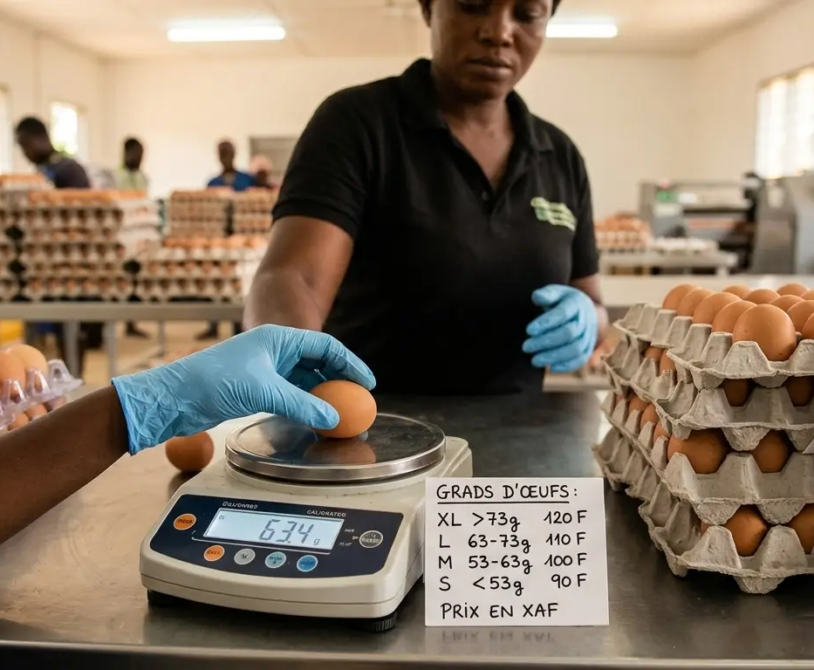

The egg inside the tray is identical. The egg that sells at XAF 200 (USD 0.33) per unit at a Douala supermarket and the egg that sells at XAF 110 (USD 0.18) per unit at the wholesale market, started in the same hen, were formed by the same calcium carbonate crystal deposition, and contain the same nutritional value.
What is different is everything that happens after the egg leaves the nest box: grading, packaging, branding, and the market positioning that tells a buyer — before they open the tray, before they crack the egg — that this product is worth the premium.
In West African egg markets, this premium exists and is growing. Hotel purchasing managers in Yaoundé specify Large-grade eggs with DSM 11–13 yolk color from documented supplier farms and pay XAF 170–210 (USD 0.28–0.35) per egg. Supermarket chains in Lagos list premium farm-branded eggs alongside imported products at NGN 350–480 (USD 0.21–0.29) per egg. Urban consumers with rising incomes are making egg choices based on packaging design and farm provenance that did not exist as purchasing criteria five years ago.
The producers who access these markets are not producing better eggs than commodity producers in most cases. They are communicating value more effectively. The brand, the label, the tray design, and the farm story create the quality signal that commands the premium — and that premium, consistently realized, changes the financial profile of a layer operation permanently.
This article builds the professional packaging and branding program that positions a West African layer operation for premium market access: the brand identity elements, the tray and label specifications, the market channel requirements, and the communication strategy that converts a farm product into a premium food brand.
Why Branding Works: The Psychology of Egg Purchasing
Before building the brand, understand why it works. A consumer choosing between two trays of eggs on a supermarket shelf has no way to directly assess interior egg quality before purchase. She cannot see the yolk color, the albumen height, or the freshness date with certainty from the outside. She makes her purchasing decision based on available signals:
Shell appearance: Color uniformity, surface cleanliness, size consistency
Packaging design: Professional label vs. unlabeled tray, brand name recognition, visual quality cues
Price: As a signal of quality in the absence of other information (a higher-priced, well-packaged egg signals quality to the consumer who has no basis for direct comparison)
Farm provenance: “Ferme des Collines, Bafoussam — élevage responsable depuis 2019” signals a specific, named, traceable origin that an anonymous commodity egg cannot provide
Certification claims: “Nourrie sans OGM,” “Sans antibiotiques depuis 90 jours,” “Poulet élevé en plein air” — claims that may or may not be verifiable but that signal producer confidence and quality consciousness
A professional packaging program creates these signals systematically and consistently. It converts the farm’s production practices and quality standards into visual and verbal communication that reaches the consumer at the point of purchase — where the buying decision is made.
Part 1: Tray Design and Materials
The Egg Tray as a Communication Surface
The 30-egg paper pulp tray is the primary packaging surface for commercial egg production in West Africa. In its unbranded form, it communicates nothing about the eggs inside. In its branded form, it is the farm’s most visible marketing asset — present in every kitchen, every restaurant, every hotel pantry where its eggs are used.
Tray material options and their communication implications:
| Material | Appearance | Consumer Perception | Cost (XAF/tray) | USD Equivalent |
|---|---|---|---|---|
| Unbranded paper pulp (plain) | Generic, commodity | No premium signal | 250–400 | USD 0.42–0.67 |
| Branded paper pulp (printed) | Professional, traceable | Quality and transparency | 450–700 | USD 0.75–1.17 |
| Clear plastic with cardboard sleeve | Visible eggs, professional | Premium, modern | 600–900 | USD 1.00–1.50 |
| Carton (6-pack, consumer retail) | Retail-grade, international | Very premium, food-safe | 800–1,400 | USD 1.33–2.33 |
| Foam tray with film wrap | Visible, cushioned | Supermarket-standard | 700–1,200 | USD 1.17–2.00 |
The branded paper pulp tray is the minimum packaging investment for premium market access in the West African context. At XAF 450–700 (USD 0.75–1.17) per tray — compared to XAF 250–400 (USD 0.42–0.67) for an unbranded tray — the additional cost per tray is XAF 200–300 (USD 0.33–0.50). The premium earned per tray from a hotel or supermarket buyer who specifies branded supply is typically XAF 500–1,500 (USD 0.83–2.50) per tray above what an unbranded commodity tray would sell for in that same channel. The packaging investment pays for itself 2–5 times over in price premium.
Tray printing options:
Stamp pad printing (lowest cost): A custom rubber stamp applied to each tray with food-safe ink — farm name, contact, grade, collection date. Cost: XAF 20,000–50,000 (USD 33–83) for the stamp; XAF 15–25 (USD 0.03–0.04) per tray in ink cost. Acceptable for early-stage branding.
Pre-printed paper sleeve over plain tray: A printed paper band or sleeve wrapped around the standard tray, visible from the front face. Cost: XAF 80–150 (USD 0.13–0.25) per tray in sleeve material and printing. More professional appearance than stamping; still uses standard-cost tray stock.
Custom printed paper pulp tray: Manufactured with the farm brand printed directly into the tray fiber during production. Minimum order quantity typically 5,000–10,000 trays. Cost: XAF 400–600 (USD 0.67–1.00) per tray, including printing. The most professional appearance, appropriate for farms at 2,000+ birds supplying institutional channels.
6-pack retail carton: For supermarket shelf and urban direct retail. Cardboard carton holding 6 or 10 eggs, printed in full color with brand identity, nutritional information, farm story, and QR code. Manufactured by packaging printers with food-grade cardboard supply — available in Lagos, Abuja, Douala, and Yaoundé through commercial printing networks. Cost: XAF 700–1,200 (USD 1.17–2.00) per 6-pack carton.
Part 2: Label Design — What Must Be on the Label
A professional egg label communicates two categories of information: what the buyer needs to know (functional information) and what the buyer wants to feel (brand and values communication).
Functional Information (Required)
Farm name or brand name: The primary identifier. Should be the most visually prominent element on the label.
Contact information: Phone number and/or website. A buyer who wants to reorder — or a consumer who has a quality question — must be able to reach the farm without effort.
Grade designation: “Grade Large (63–68g)” or “Extra Large (+68g)” — the weight grade the buyer is purchasing. This makes the specification visible and creates a quality commitment that is verifiable.
Collection date or packing date: “Conditionné le / Packed on:” followed by the date. Freshness is the most important single quality variable from the consumer’s perspective. A clearly displayed packing date signals transparency and freshness confidence. Its absence signals the opposite.
Use-by or best-before date: Not universal in West African commercial egg markets currently, but increasingly expected by supermarket and hotel buyers. Typically 21 days from packing date for refrigerated storage, 14 days from packing date for ambient storage.
Quantity: “30 oeufs / eggs” — the count per tray. Standard for most commercial packaging but should be explicit.
Storage instructions: “Conservez au frais et à l’abri de la lumière” (Keep refrigerated and away from light) for washed or specification-supply eggs. “Peut être conservé à température ambiante” (Can be stored at ambient temperature) for unwashed eggs with intact cuticle — distinguishing your product from the assumption that all eggs require refrigeration.
Country of origin / région de production: “Produit au Cameroun / Product of Cameroon — Région de l’Ouest” — for buyers and consumers who value local sourcing. Also increasingly relevant for export channel labeling requirements.
Brand Communication (Differentiating)
Tagline or quality claim: A short phrase (maximum 6 words) that encapsulates the farm’s quality positioning. Examples:
- “Nourries aux céréales, sans antibiotiques” (Grain-fed, antibiotic-free)
- “Élevées en liberté, sous le soleil camerounais” (Free-range, under the Cameroonian sun) — only use if accurate
- “Nos poules, votre santé” (Our hens, your health)
- “Ferme certifiée, qualité garantie” (Certified farm, guaranteed quality)
Farm storyline: One sentence that places the farm geographically and communicates its values. La Ferme des Collines élève ses poules dans les hautes terres de Bafoussam depuis 2019, avec une alimentation locale et un suivi vétérinaire régulier.” (Les Collines Farm has raised its hens in the highlands of Bafoussam since 2019, with local feed and regular veterinary oversight.)
QR code: A QR code linking to a farm landing page or social media profile — increasingly scanned by urban consumers and hotel purchasing managers who want to verify supplier claims. Cost of generating a QR code: zero (free generators available online). Cost of creating the landing page it links to: XAF 0 (social media page) to XAF 300,000–1,000,000 (USD 500–1,667) for a professional website.
Logo: A recognizable visual identity that appears consistently across all packaging, social media, invoices, and farm signage. A logo designed by a professional graphic designer in Douala, Yaoundé, or Lagos: XAF 50,000–200,000 (USD 83–333). A logo generated using online design tools (Canva, LogoMaker): XAF 0–15,000 (USD 0–25). Consistency of application matters more than design sophistication at the early stage.
Part 3: Brand Identity — The System Behind the Label
A label is a single touchpoint. A brand is the complete system of visual and verbal communication across every point where the farm meets the market. At a commercial scale, brand consistency across multiple touchpoints creates recognition that builds buyer trust faster than any single packaging design element.
The Brand Identity Elements
Brand name: The most permanent brand decision. It should be:
- Easy to pronounce in both French and English (for multilingual West African markets)
- Memorable in 3 words or fewer
- Not already in use by a competing local farm or food brand
- Scalable — suitable for a 500-bird farm today and a 5,000-bird farm in five years
Examples of effective farm brand name structures in the West African market:
- Geographic + Product: “Collines d’Or Oeufs” (Golden Hills Eggs)
- Family/Personal: “Ferme Djemba” or “Ndongo’s Farm”
- Value claim + Product: “Oeufs Naturels de Bafoussam” (Natural Eggs of Bafoussam)
- Modern/Urban: “FreshEgg NG” (Nigeria) or “OeufFrais CM” (Cameroon)
Brand colors: Two primary colors that appear consistently on packaging, social media, farm signage, and invoices. Color choices for premium food brands in West Africa:
- Deep green + gold: communicates naturalness and premium quality (high trust association in food marketing across the region)
- Terracotta red + cream: warm, local, authentic — resonates with “traditional quality” positioning
- Royal blue + white: clean, modern, food-safety-first — resonates with urban professional and institutional buyer audiences
- Yellow + brown: energy, eggs, naturalness — direct color association with the product
Avoid: generic red and white (associated with commodity fast-food packaging), black-dominant packaging (funeral association in some markets — culturally significant), fluorescent colors (low-quality signal).
Brand font: One primary font for the brand name, one secondary font for body text. Consistency matters more than sophistication. A font that looks identical on the label, on social media graphics, and on an invoice creates professional coherence.
Part 4: Market Channel Requirements by Channel
Channel 1: Supermarket and Formal Retail
Packaging requirement: Labeled tray with batch number, packing date, use-by date, grade designation, and nutritional information (protein, fat, carbohydrate per 100g) — the last increasingly required by formal retail in Nigeria and Cameroon.
Delivery format: Eggs graded by weight class, consistent count per tray, clean shells, consistent yolk color (DSM 10+), no cracked eggs.
Supplier documentation required: Business registration certificate, tax identification, proof of regular veterinary oversight, food safety practice summary (flock health record, water quality test result, feed sourcing documentation).
Price premium vs. wholesale: XAF 30–70 (USD 0.05–0.12) per egg above standard wholesale price; NGN 50–120 (USD 0.03–0.07) per egg premium in Nigeria.
Practical entry point: Start with a supermarket in your city that carries local food brands. Approach the purchasing manager with a branded sample tray, your supplier documentation pack, and a pricing proposal that is realistic relative to what they currently pay — not a price that requires the supermarket to take an unproven product at a price above their current alternatives.
Channel 2: Hotel and Restaurant Supply
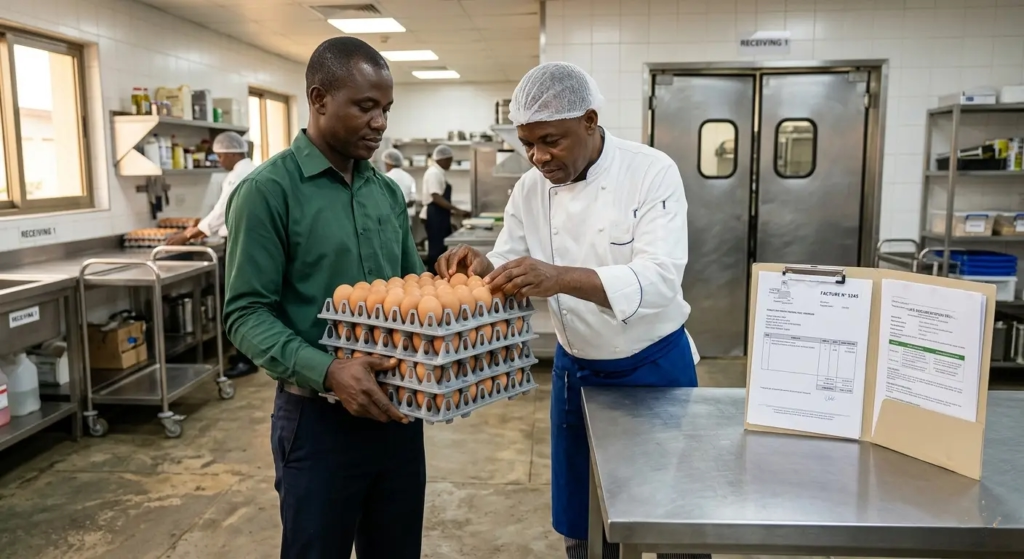
Packaging requirement: Grade specification in writing, packing date on every tray, and a delivery schedule that guarantees a maximum of 3 days from collection to delivery. Most hotels do not require elaborate consumer-facing packaging — they want a professional-looking tray, clearly dated, from a known and reliable supplier.
Delivery format: Large grade (63–68g) minimum; Grade A shell quality minimum; consistent yolk color. Hotels serving international guests often specify DSM 11–13 yolk color. Deliver to the kitchen entrance — not the main hotel entrance.
Supplier documentation required: Company invoice (not handwritten), regular delivery schedule in writing, contact number for the farm manager personally (not just a WhatsApp number for an intermediary), and evidence of regular veterinary oversight.
Price premium vs. wholesale: XAF 40–90 (USD 0.07–0.15) per egg above standard wholesale; significantly higher for hotels with explicit quality specifications.
Practical entry point: Every hotel has a Head Chef or Executive Chef who controls purchasing decisions. Provide a sample tray with a written specification sheet and your contact information — not a verbal pitch. The sample tray should represent the farm’s actual consistent output, not a specially prepared exceptional batch. If the Chef’s team tests the sample against their current supplier and finds the yolk color stronger and the shell quality higher, the conversation about switching suppliers has already succeeded before the price discussion begins.
Channel 3: Urban Direct Retail and Delivery
Packaging requirement: Consumer-facing 6-pack carton or branded 30-egg tray. The farm brand must be prominent enough to be recognized on repeat purchase. Include the farm’s social media handle or QR code so the consumer can follow, share, and refer.
Price premium vs. wholesale: XAF 50–150 (USD 0.08–0.25) per tray above standard wholesale, per tray unit value. The highest per-egg price available, but requires the most logistical effort per unit sold.
Practical entry point: A weekly farmers’ market, a neighborhood WhatsApp group, or a corporate office direct delivery program. Start with 20–30 households or 2–3 offices, build the direct delivery routine over 2–3 months, and expand through referral as quality establishes itself.
Part 5: Digital and Social Media Brand Presence
A farm with a professional Instagram or Facebook page that regularly shows:
- Short-form video of the flock, the feed, the collection process
- Yolk color comparison photos (DSM YCF measurement)
- Packing day content with “fresh from today” collection date
- Farm management insights (without trade-sensitive detail)
…is communicating quality, transparency, and continuous production in a medium that its institutional and consumer buyers are already using daily.
The social media case for layer farms in West Africa:
Urban consumers in Cameroon, Nigeria, and Ghana who are making deliberate food purchasing decisions increasingly use Instagram, Facebook, and WhatsApp to discover and verify local food suppliers. A farm brand that appears credible and transparent on social media removes the verification barrier that prevents first-time buyers from committing to a new premium supplier.
Content strategy for a layer farm account:
- Frequency: 3–5 posts per week at launch; 2–3 posts at stable operation
- Content types: Production transparency (flock health, feeding), product quality evidence (yolk color, shell grade), delivery logistics (fresh delivery day announcements), testimonials (hotel chef using your eggs), farm story (origin, values, team)
- Platform priority: WhatsApp Business first (direct buyer communication, order management); Facebook second (wider reach, older demographic); Instagram third (visual quality signal, urban consumer audience)
WhatsApp Business as the farm’s primary CRM: WhatsApp Business allows the farm to maintain a product catalog, set automated responses, create broadcast lists for weekly order collection, and communicate directly with 50–200 regular buyers at zero cost. A farm managing its entire institutional buyer communication through WhatsApp Business — sending weekly freshness updates, collection date notifications, and order confirmation — is operating a professional buyer relationship management system with no software cost.
The Branding Investment: What It Costs and What It Returns
Minimum Viable Branding Program (Farm at 500–1,000 birds)
| Item | Cost (XAF) | Cost (USD) | Notes |
|---|---|---|---|
| Logo design (freelance designer or Canva Pro) | 50,000–100,000 | USD 83–167 | One-time cost |
| Custom rubber stamp (farm name, grade, date) | 20,000–40,000 | USD 33–67 | One-time cost |
| Pre-printed paper sleeves (first batch 500 units) | 80,000–120,000 | USD 133–200 | Recurring per production run |
| WhatsApp Business setup | 0 | 0 | Free |
| Facebook/Instagram page setup | 0 | 0 | Free |
| Social media graphics (Canva free tier) | 0 | 0 | Free |
| Total Minimum Viable Brand Investment | 150,000–260,000 | USD 250–433 | One-time setup; XAF 80,000–120,000 per production run recurring |
Return on the minimum viable branding program:
At 850 eggs/day, if branding enables access to a hotel channel paying XAF 160 vs. the wholesale channel at XAF 115 — a XAF 45 premium — for 200 eggs/day (the realistic volume for one hotel supply relationship at this scale):
Daily premium: 200 × XAF 45 = XAF 9,000 (USD 15) Annual premium: XAF 9,000 × 365 = XAF 3,285,000 (USD 5,475) per year
The one-time brand setup cost of XAF 150,000–260,000 (USD 250–433) is recovered in the first 2–3 weeks of the hotel supply relationship.
Full Professional Branding Program (Farm at 2,000–5,000 birds)
| Item | Cost (XAF) | Cost (USD) | Notes |
|---|---|---|---|
| Professional brand design (agency) | 300,000–800,000 | USD 500–1,333 | Brand identity system |
| Custom printed paper pulp trays (10,000 units) | 5,000,000–7,000,000 | USD 8,333–11,667 | Approximately 9 months’ supply |
| 6-pack retail cartons (5,000 units) | 4,500,000–6,000,000 | USD 7,500–10,000 | Consumer retail channel |
| Professional website (simple, 5 pages) | 500,000–1,500,000 | USD 833–2,500 | One-time cost |
| Social media management (3 months initial) | 150,000–400,000 | USD 250–667 | If outsourced |
| Supplier documentation pack design | 80,000–200,000 | USD 133–333 | Food safety credentials |
| Total Full Professional Brand Program | 10,530,000–15,900,000 | USD 17,550–26,500 |
Return on full professional brand investment:
At 3,000 birds producing 2,400 eggs/day, if professional branding enables access to two supermarket contracts + three hotel supply contracts paying an average XAF 50 premium vs. wholesale:
For 30% of production through premium channels: 720 eggs/day × XAF 50 = XAF 36,000 (USD 60) per day. Annual premium: XAF 36,000 × 365 = XAF 13,140,000 (USD 21,900) per year
Full professional brand investment recovered in 10–14 months

The Documentation Package: Branding for Institutional Buyers
Institutional buyers — hotels, supermarkets, food service companies — do not make purchasing decisions based on packaging design alone. They require supplier documentation that demonstrates the farm can consistently deliver what the brand promises.
The supplier documentation package for institutional channels:
- Farm overview one-pager: Farm name, location, flock size, breed, production capacity, egg grades available, delivery schedule, contact
- Quality specifications sheet: Grade weight range, shell quality standard, yolk color target (DSM YCF range), freshness guarantee (days from collection to delivery)
- Health management summary: Vaccination schedule compliance, last veterinary visit date, antibiotic withdrawal policy, disease-free flock declaration
- Food safety practices summary: Water quality test result (last quarterly test), feed sourcing documentation, egg collection and storage protocol, cleaning and sanitization protocol
- Business credentials: Business registration certificate, tax identification number, bank account details for invoice payment
This five-document package, presented professionally in a single folder or PDF — not as loose papers — is the commercial credential that elevates a farm from “informal local supplier” to “verified premium supplier.” A purchasing manager at a Yaoundé hotel who receives this package from a new supplier has the documentation they need to justify adding the farm to their approved supplier list without visiting the farm personally.
Summary
Premium egg market access in West Africa is not a function of producing better eggs. It is a function of communicating the quality that is already being produced in a way that buyers recognize, value, and pay for.
The brand communicates quality before the tray is opened. The label communicates freshness before the egg is cracked. The supplier documentation package communicates reliability before the first delivery is made. Together, they convert the farm’s production practices into market signals that institutional buyers and premium consumers respond to with purchase commitment and premium pricing.
The minimum viable branding program costs XAF 150,000–260,000 (USD 250–433) and recovers its cost in 2–3 weeks of one hotel supply relationship. The full professional brand investment recovers in 10–14 months from premium channel margins on 30% of production volume.
The eggs were already premium. The brand makes sure the market knows it.