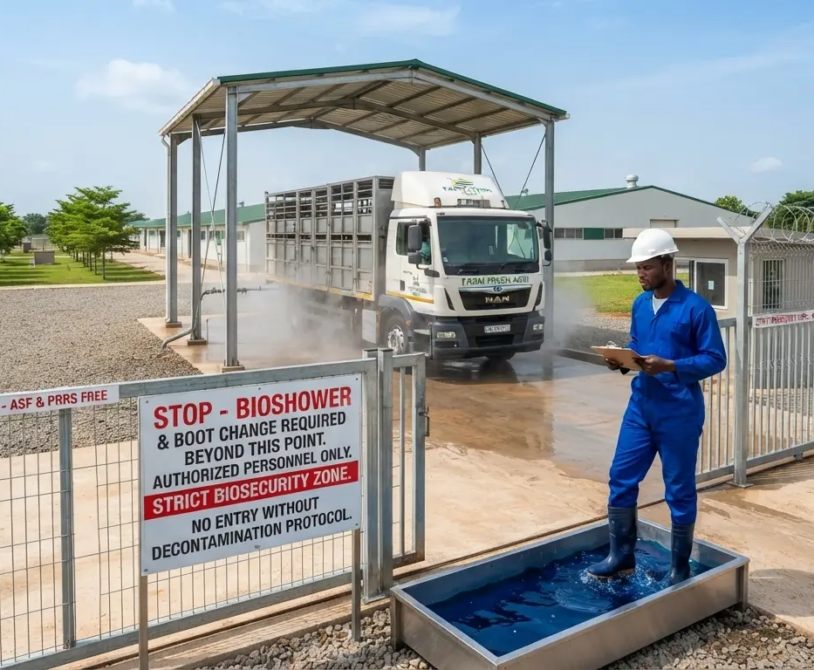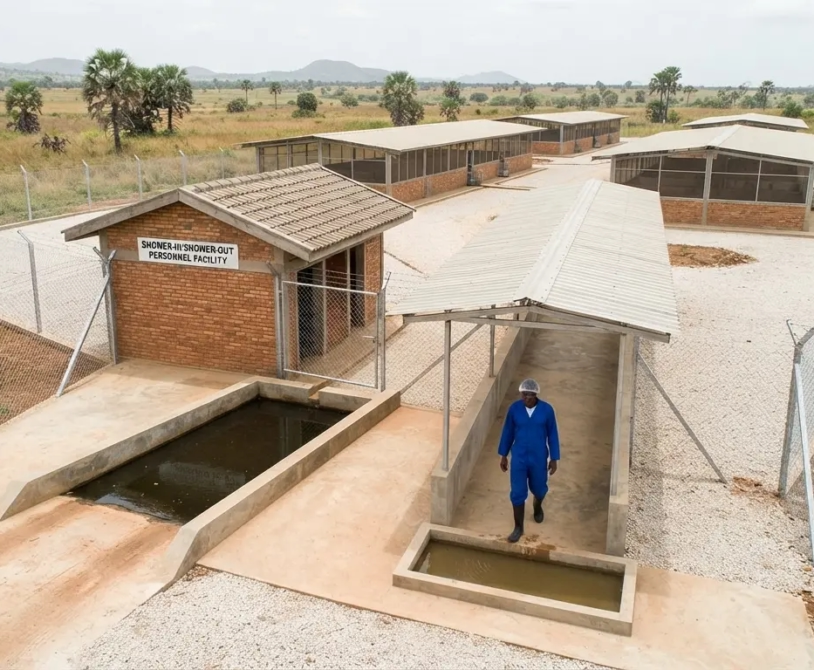
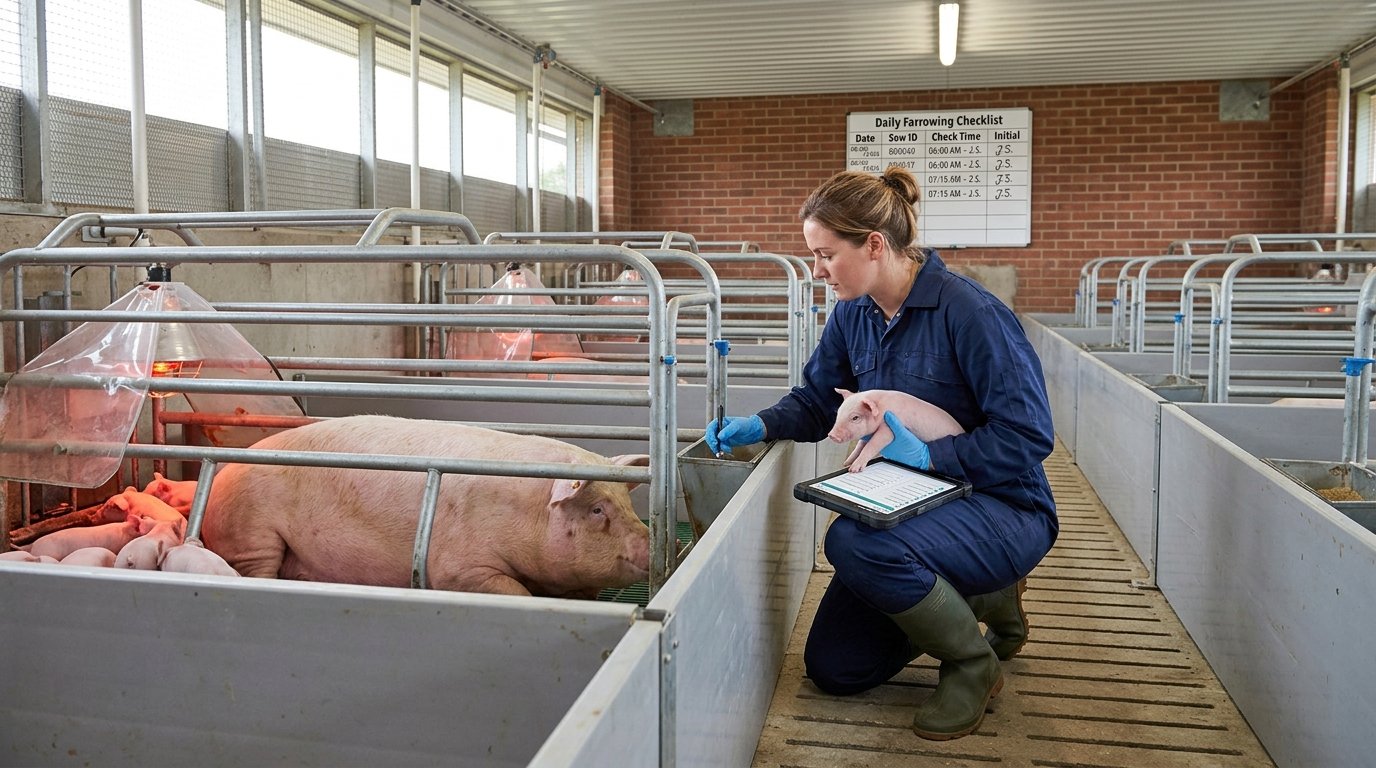
Two piggeries with the same sow herd, the same feed formulation, and the same housing can post PSY figures that differ by four or five pigs per sow per year — a gap worth tens of millions of XAF in annual revenue at commercial scale. The difference is rarely genetics or infrastructure. It is almost always labor management: whether the right task gets done by the right person at the right time, every day, without exception. Farrowing supervision missed by six hours costs piglets to crushing. A gestation feed check skipped for a week produces a body condition drift that shows up as a lower farrowing rate two months later. Labor management on a pig farm is not about headcount — it is about whether a defined task list is actually executed on a defined schedule, and whether anyone is checking.
This guide sets out the task structure for a 50-sow farrow-to-finish operation, consistent with the staffing model of one farm manager, three stockpersons, two casual labor equivalents, and one guard used throughout this series. The checklists below are the operational layer that makes the labor line item in a piggery’s OpEx budget translate into the production performance the financial model depends on.
Staffing Structure and Section Responsibility
Role Definitions
| Role | Headcount | Primary Responsibility | Working Hours |
|---|---|---|---|
| Farm manager | 1 | Overall production oversight, record review, procurement, staff supervision | 48 hrs/week, on-call for farrowing/emergencies |
| Stockperson — Farrowing | 1 | Farrowing house, lactating sows, piglet processing | 54 hrs/week (6-day rotation) |
| Stockperson — Gestation/Breeding | 1 | Gestating sows, boars, breeding and heat detection | 54 hrs/week (6-day rotation) |
| Stockperson — Grower-Finisher | 1 | Weaners, growers, finishers, market loading | 54 hrs/week (6-day rotation) |
| Casual labor | 2 FTE | Cleaning, feed handling, general maintenance, market-day loading support | 48 hrs/week combined coverage |
| Guard | 1 | Perimeter security, after-hours monitoring, visitor log at gate | 12-hr shifts, 7 days |
Section-to-Staff Mapping
Every pen, room, and animal group on the farm must have exactly one staff member accountable for its daily checklist. Shared responsibility without a named owner is the single most common cause of missed tasks on commercial farms.
| Farm Section | Primary Owner | Backup Owner |
|---|---|---|
| Farrowing house (20 crates) | Farrowing stockperson | Farm manager |
| Gestation housing (50 sows) | Gestation stockperson | Farrowing stockperson |
| Boar pen and service area | Gestation stockperson | Farm manager |
| Weaner room | Grower-finisher stockperson | Casual labor |
| Grower-finisher pens | Grower-finisher stockperson | Casual labor |
| Feed storage and mixing | Casual labor | Farm manager |
| Quarantine facility | Farm manager | Gestation stockperson |
| Waste management (biogas, lagoon, compost) | Casual labor | Farm manager |

Daily Task Checklists
Farrowing House — Daily (Farrowing Stockperson)
| Time | Task | Duration |
|---|---|---|
| 06:00 | Visual health check, all crates — appetite, respiration, discharge, lameness | 20 min |
| 06:20 | Piglet count and mortality check per crate, log any losses with cause | 15 min |
| 06:35 | First sow feeding (hand-fed per lactation curve) | 30 min |
| 07:05 | Water line check — all nipple drinkers functioning | 10 min |
| 07:15 | Piglet processing (iron injection day 3, castration day 3–7, tail docking per protocol) for crates due that day | Variable, 30–90 min |
| 08:45 | Crate cleaning — manure removal, creep area bedding | 45 min |
| 12:00 | Midday sow feeding, temperature/ventilation check | 30 min |
| 14:00 | Fostering review — equalize litters where needed, weak piglet management | 20 min |
| 16:30 | Evening sow feeding | 30 min |
| 17:00 | Final crate walk-through, farrowing due-date board update | 15 min |
| Overnight | On-call for active farrowings (farrowing stockperson or manager) | As needed |
Gestation and Breeding — Daily (Gestation Stockperson)
| Time | Task | Duration |
|---|---|---|
| 06:00 | Visual health check all sows and boars | 20 min |
| 06:30 | Feeding — individual ration per body condition score | 45 min |
| 07:15 | Heat detection (boar exposure, standing reflex check) for sows due to be in oestrus | 30 min |
| 08:00 | Breeding/insemination for sows in standing heat | Variable |
| 09:00 | Water and feeder equipment check | 15 min |
| 10:00 | Pregnancy diagnosis (ultrasound, scheduled sows only) | Variable |
| 15:00 | Afternoon feeding | 30 min |
| 16:00 | Body condition scoring — rotating through herd, 8–10 sows/day | 20 min |
| 17:00 | Boar semen collection/management (scheduled days only) | Variable |
Grower-Finisher and Weaner — Daily (Grower-Finisher Stockperson)
| Time | Task | Duration |
|---|---|---|
| 06:00 | Visual health check all pens — lameness, respiratory signs, tail biting | 30 min |
| 06:30 | Feeder checks and refilling, all pens | 45 min |
| 07:15 | Water line and nipple drinker check | 15 min |
| 08:00 | Weight monitoring (rotating sample, 10% of pens/day) | 30 min |
| 09:00 | Pen cleaning and manure scraping | 60 min |
| 14:00 | Afternoon feed and health check | 30 min |
| 16:00 | Ventilation and temperature adjustment | 15 min |
| 17:00 | Market-readiness check for pens approaching target weight | 15 min |
Whole-Farm — Daily (All Staff)
| Task | Owner | Duration |
|---|---|---|
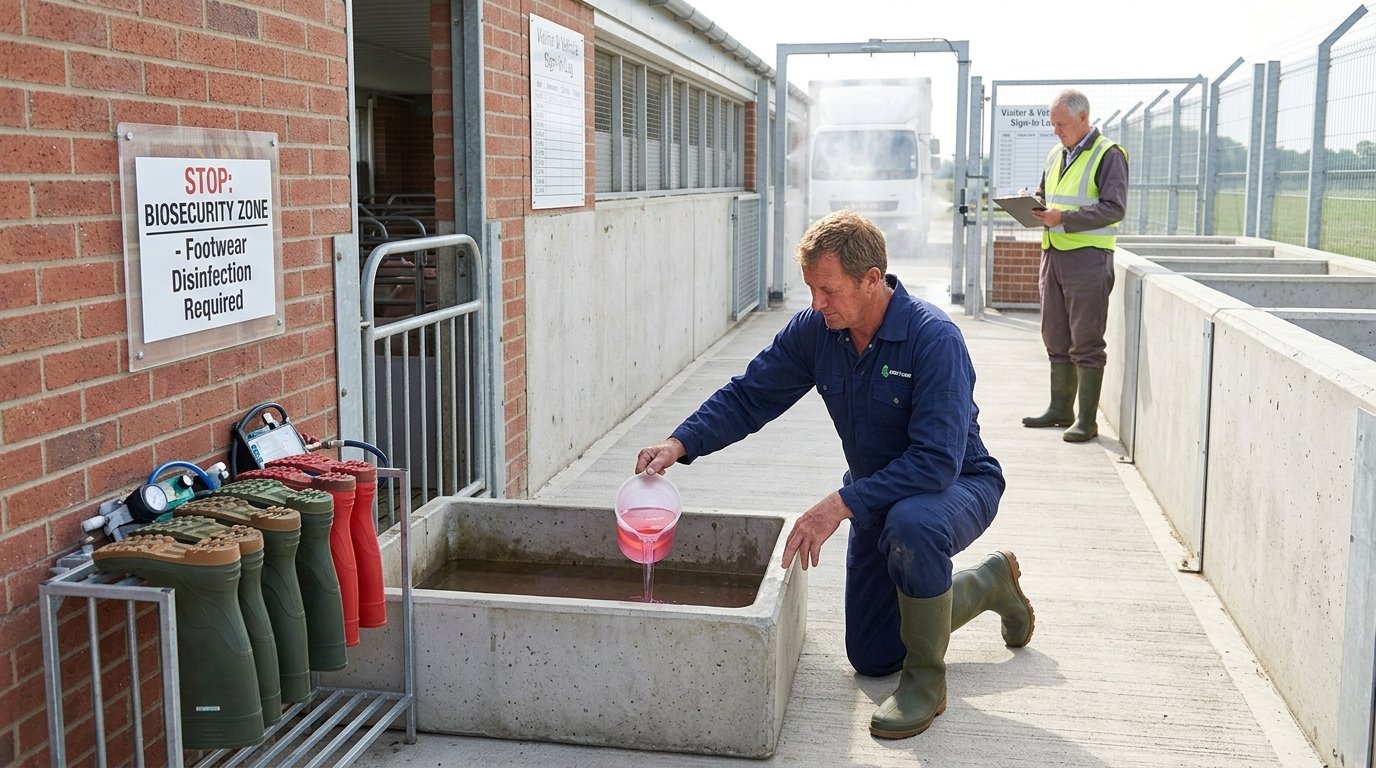
| Footbath disinfectant check and replenishment, all entry points | Casual labor | 15 min |
| Mortality log entry (any deaths, all sections) | Section owner | 10 min |
| Visitor/vehicle log review | Guard | Ongoing |
| Feed delivery reconciliation against storage inventory | Casual labor | 15 min |
Weekly Task Checklist
| Task | Owner | Day | Duration |
|---|---|---|---|
| Full herd body condition scoring review | Gestation stockperson | Monday | 90 min |
| Feed mixer and hammer mill cleaning and inspection | Casual labor | Monday | 60 min |
| Farrowing schedule review for coming 2 weeks | Farm manager + farrowing stockperson | Monday | 30 min |
| Deep clean — farrowing crates between batches (AIAO turnaround) | Farrowing stockperson + casual labor | As scheduled | 3–4 hrs per room |
| Weighbridge/scale calibration check | Grower-finisher stockperson | Tuesday | 20 min |
| Vaccination schedule check against herd calendar | Farm manager | Wednesday | 30 min |
| Waste system inspection (biogas digester, lagoon levels, compost turning) | Casual labor | Wednesday | 90 min |
| Perimeter fence and biosecurity infrastructure walk-through | Farm manager | Thursday | 45 min |
| Feed conversion ratio calculation, current batches | Farm manager | Friday | 45 min |
| Rodent bait station check, all locations | Casual labor | Friday | 30 min |
| Staff meeting — production review, task adjustments for coming week | All staff | Friday | 45 min |
| Vehicle and generator maintenance check | Casual labor | Saturday | 30 min |
| Market pig selection for following week’s sale | Farm manager + grower-finisher stockperson | Saturday | 45 min |
Monthly Task Checklist
| Task | Owner | Duration |
|---|---|---|
| Full financial reconciliation — feed cost, labor cost, revenue against budget | Farm manager | 3–4 hrs |
| Herd inventory reconciliation — sows, boars, growers against records | Farm manager + all stockpersons | 2 hrs |
| Veterinary farm visit — full herd health review, vaccination administration | Veterinarian + farm manager | Half day |
| Breeding performance review — farrowing rate, litter size, PSY tracking against target | Farm manager | 90 min |
| Cull decision review — underperforming sows and boars flagged for replacement | Farm manager + gestation stockperson | 60 min |
| Equipment maintenance — farrowing crates, feeders, water systems, full inspection | Casual labor + relevant stockperson | Half day |
| Biosecurity audit — full protocol compliance review, visitor log audit | Farm manager | 90 min |
| Staff performance review — task completion rates, training needs identified | Farm manager | 1 hr per staff member |
| Feed formulation review against current ingredient prices and pig performance | Farm manager | 90 min |
| Waste management compliance check (environmental regulations, biogas output) | Casual labor + farm manager | 90 min |
| Building and infrastructure condition audit for maintenance budget planning | Farm manager | 2 hrs |
Labor Hours Verification — Does the Staffing Model Cover the Task Load?
A checklist is only useful if the staffing budget can actually deliver it. This is the verification step most farm business plans skip — the task list is written, the labor line item is budgeted, and the two are never checked against each other.
Available Weekly Labor Hours (Production Tasks Only)
| Position | Headcount | Hours/Week Each | Total Hours |
|---|---|---|---|
| Farm manager (hands-on portion, ~50% of time) | 1 | 24 | 24 |
| Farrowing stockperson | 1 | 54 | 54 |
| Gestation stockperson | 1 | 54 | 54 |
| Grower-finisher stockperson | 1 | 54 | 54 |
| Casual labor | 2 | 48 | 96 |
| Total available production hours/week | 282 |
Required Weekly Hours by Task Category (from Parts 2–4, Averaged)
| Category | Estimated Hours/Week |
|---|---|
| Farrowing house daily tasks | 42 |
| Gestation/breeding daily tasks | 40 |
| Grower-finisher/weaner daily tasks | 44 |
| Whole-farm daily tasks | 14 |
| Weekly tasks (averaged across the week) | 24 |
| Monthly tasks (averaged across four weeks) | 10 |
| Total required hours/week | 174 |
Verification
Required hours (174) against available hours (282) leaves a buffer of approximately 108 hours per week, or roughly 38% slack capacity. This buffer is not surplus to be trimmed from the labor budget — it is the margin that absorbs farrowing surges (multiple sows farrowing simultaneously), disease response events, seasonal market-day loading, and the deep-clean turnarounds between AIAO batches that do not occur every week but require concentrated hours when they do.
A staffing model with less than 20–25% slack capacity against its baseline task load is under-resourced. Farms that budget labor at the minimum hours required for routine tasks consistently fail during farrowing peaks and disease events — precisely the periods when labor performance matters most. The 50-sow staffing structure used in this series (1 manager, 3 stockpersons, 2 casual FTE) is sized correctly against this task load; reducing to 2 stockpersons would eliminate the buffer and is not recommended regardless of the apparent labor cost saving.
Record-Keeping and Accountability
Task checklists without a verification system become aspirational documents rather than operational ones. Three records make the checklist enforceable:
Daily task sheet. A physical or digital sheet per section, signed off by the responsible stockperson at the end of each task, reviewed by the farm manager each morning. Missed or incomplete tasks are flagged immediately, not discovered a week later in production data.
Mortality and treatment log. Every death, treatment, and health observation is logged with date, animal ID or pen, and cause where known. This log is what converts vague impressions (“piglets seem to be dying more”) into the specific data needed to identify whether a labor gap, disease, or management error is responsible.
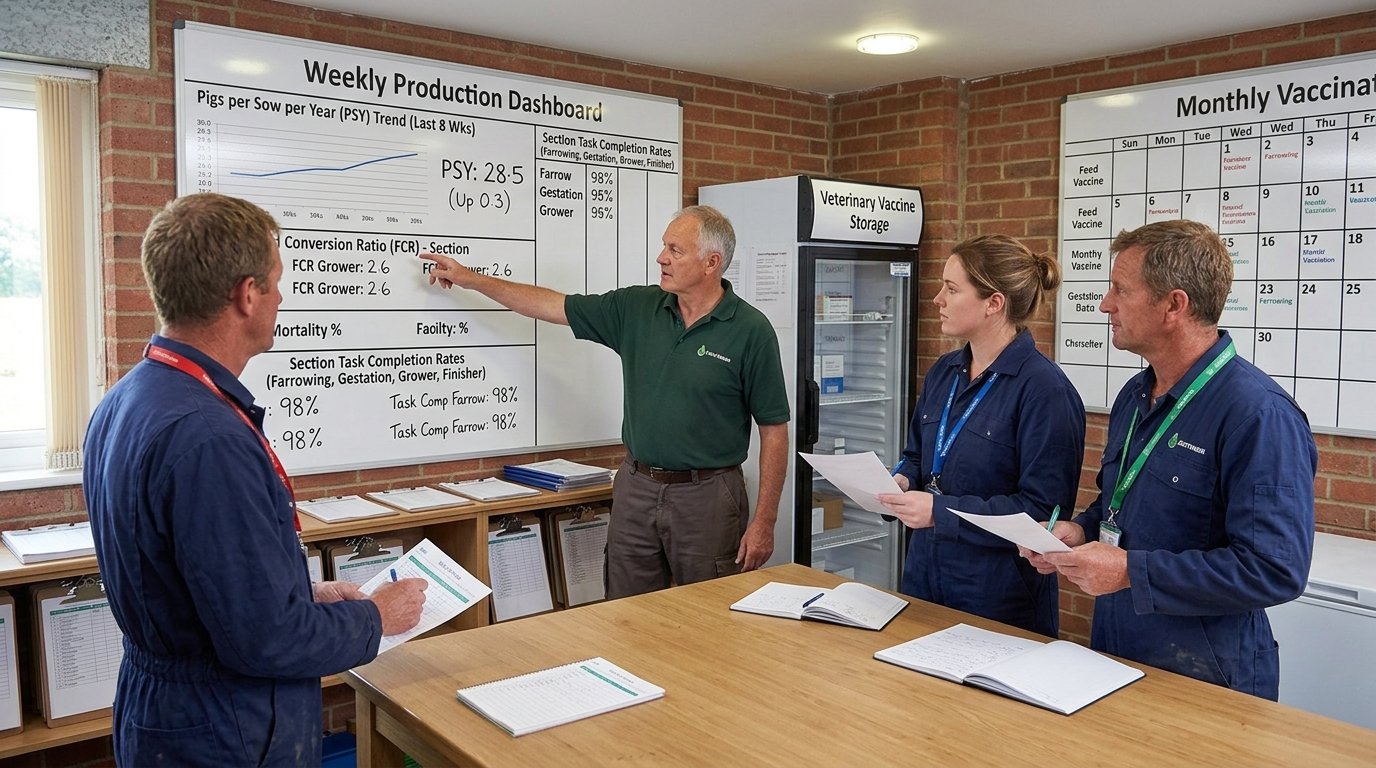
Weekly production dashboard. FCR, mortality rate, breeding performance, and labor task completion rate reviewed together at the Friday staff meeting. Connecting labor performance directly to production metrics — rather than treating them as separate reporting lines — is what allows a farm manager to trace a production dip back to a specific missed task rather than treating it as unexplained variance.
Seasonal and Event-Driven Labor Adjustments
Routine staffing covers baseline operations, but four recurring events require temporary reallocation beyond the standard checklist:
| Event | Labor Adjustment |
|---|---|
| Farrowing peak (multiple sows due within 48–72 hours) | Farm manager shifts to hands-on farrowing support; casual labor reassigned from grower-finisher to farrowing house |
| Vaccination campaign (whole-herd) | All stockpersons reassigned for 1–2 days; veterinary team on-site |
| Disease outbreak response | Full staff reallocation to affected section; guard duties extended to control all farm access points |
| Market day (bulk pig loading and transport) | Casual labor and grower-finisher stockperson reassigned for loading; farm manager on-site for buyer transaction |
Building these adjustments into the monthly planning cycle — rather than treating them as disruptions — is what prevents an event like a farrowing peak from causing tasks in gestation or grower-finisher sections to be skipped entirely.
Summary
Labor management on a commercial pig farm succeeds or fails on three things: whether every section has a named accountable owner, whether the daily/weekly/monthly task structure is realistic against the actual hours available, and whether a record-keeping system exists to catch missed tasks before they become production losses. The checklists in this guide, built against the staffing model of a 50-sow farrow-to-finish operation, provide roughly 38% slack capacity above baseline task requirements — the buffer needed to absorb farrowing surges, disease events, and seasonal demands without routine tasks being dropped. Farms that under-staff against this buffer save on the labor line item in their OpEx budget while losing far more in the production performance that labor is responsible for delivering.